BPC-157: Benefits, Dosage, Side Effects and the Research
What the BPC-157 research actually shows: benefits claims checked against a rodent literature, human dosing, side effects, and legal status.

The short version
BPC-157 is a research peptide with a large, consistently positive body of animal research on tissue healing, but only five small human studies. The one placebo-controlled trial did not show a significant benefit. Many people now use it and report benefits, side effects or no effect. It is not FDA-approved and is sold for research use only.
- Rat studies are consistently positive; controlled human evidence is still missing.
- Not approved for human use, and a research-use label does not make it legal.
- Its human half-life is unknown, so the doses you see online are conventions, not tested.
BPC-157 at a glance
- What it is
- Synthetic pentadecapeptide
- Main use
- Studied in rodents for musculoskeletal soft-tissue healing. Sold to humans for injury recovery, a use whose only human data is one uncontrolled retrospective chart review of 17 people with knee pain.
- Also called
- Body Protection Compound 157, PL 14736, PL-10, Bepecin
- Molecular formula
- C62H98N16O22 (1419.5 g/mol) Structure
- Evidence
- Limited human data
- US status
- Research use only
- Australia
- Not on the ARTG
- Half-life
- Not established in humans
- How it is taken
- Subcutaneous injection
- Common protocol
- 250-500 mcg, once or twice daily, injected subcutaneously near the injury site when possible, for 4-8 weeks (common practice, not trial-established) Dosage chart
BPC-157 is a lab-made peptide that is popular for injury recovery. Rodent studies of it are consistently positive, the way it might work makes sense, and a growing number of people say it helped them. What it still lacks is a proper human trial.
This page covers what has been tested and in whom, what users report, and where it stands legally. Where I couldn’t verify something, I say so.
Dosing: what the studies actually used.
US legal status - Research use only
Sold for laboratory research use only. Not approved by the FDA for human use, and cannot be lawfully marketed as a supplement or a medicine. Products sold this way are not made to pharmaceutical quality standards, and their contents are not verified by anyone.
AU legal status - Not on the ARTG
Schedule 4 of the Poisons Standard since 1 June 2024, and Appendix D, clause 5 - prescription only, and possession without authority is illegal. Nothing containing it is on the ARTG; the TGA scheduled it as an unapproved medicine with no registered products affected. It gave vendors labelling it "for research only" as a reason to restrict it, not as a defence.
Regulators reach their own conclusions on their own timelines. Where these two disagree, the difference is the point - not an error.
What is BPC-157?
BPC stands for body protection compound. The 157 is a serial number for this particular sequence, not a dose or a version. The name comes from the original researchers and is the standard term in the research literature (Gwyer 2019 - Gwyer D, Wragg NM, Wilson SL. Gastric pentadecapeptide body protection compound BPC 157 and its role in accelerating musculoskeletal soft tissue healing. Cell Tissue Res. 2019;377(2):153-159., in the references below). It describes what they hoped the compound would do, not something shown in people.
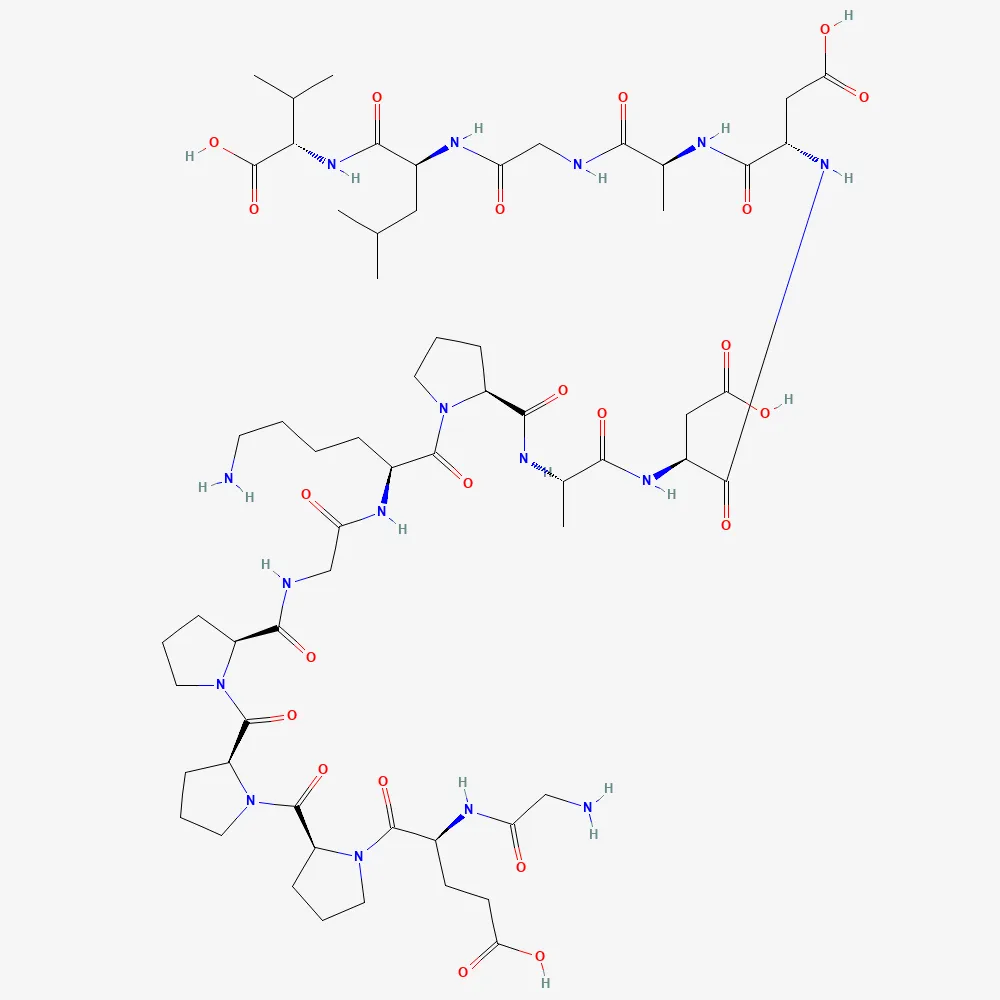
BPC-157 is a synthetic chain of 15 amino acids (Gwyer 2019 - Gwyer D, Wragg NM, Wilson SL. Gastric pentadecapeptide body protection compound BPC 157 and its role in accelerating musculoskeletal soft tissue healing. Cell Tissue Res. 2019;377(2):153-159., in the references below); its structure and sequence follow this section. It is often described as a fragment of a protein found in human stomach juice. I couldn’t confirm that this parent protein has ever been independently isolated and characterised.
BPC-157 structure
- Molecular formula
- C62H98N16O22
- Molecular weight
- 1419.5 g/mol
- Length
- 15 amino acids
- Sequence
- GEPPPGKPADDAGLV
- PubChem CID
- 9941957
Research vials are usually an acetate salt; the diagram is the peptide itself.
Identity checked against Journal of Physiology Paris (2000), via PubMed.
How BPC-157 works
The leading explanation is that BPC-157 helps new blood vessels grow (angiogenesis), working through nitric oxide.
The clearest evidence comes from an independent group in Taiwan (Hsieh 2017 - Hsieh MJ, Liu HT, Wang CN et al. Therapeutic potential of pro-angiogenic BPC157 is associated with VEGFR2 activation and up-regulation. J Mol Med (Berl). 2017;95(3):323-333., in the references below). BPC-157 increased blood-vessel growth in chick-embryo and cell tests, and sped up the return of blood flow in rats with a blocked leg artery. In human blood-vessel cells grown in a dish, it raised levels of the receptor for the growth factor VEGF (VEGFR2) but not the growth factor itself. That switched on a signalling chain (VEGFR2-Akt-eNOS) that ends in nitric oxide, which supports blood flow and new vessels. Stopping the receptor from being taken into the cell blocked the effect.
Reviews describe the same mechanism: nitric oxide, dopamine regulation and VEGF receptor pathways (Józwiak 2025 - Józwiak M, Bauer M, Kamysz W et al. Multifunctionality and Possible Medical Application of the BPC 157 Peptide-Literature and Patent Review. Pharmaceuticals (Basel). 2025;18(2)., in the references below). This is animal and lab work, so it explains why researchers find BPC-157 plausible, not what it does in a person.
BPC-157 benefits: what the research shows
Small or uncontrolled human studies. Too little to settle the question either way. Almost all efficacy data comes from rats. The published human record is five small studies in about 80 people; the only placebo-controlled trial in patients, in ulcerative colitis, did not show a significant benefit and was published only as a meeting abstract. About four in five papers come from one research group, so independent replication is still missing.
What’s promising. A review of the muscle, tendon and ligament studies found consistently positive and fast healing across injury types, and its authors saw real potential for treatment (Gwyer 2019 - Gwyer D, Wragg NM, Wilson SL. Gastric pentadecapeptide body protection compound BPC 157 and its role in accelerating musculoskeletal soft tissue healing. Cell Tissue Res. 2019;377(2):153-159., in the references below). There is a plausible mechanism, covered above. The small human safety record so far is uneventful: in a two-person pilot, intravenous doses caused no measurable change in heart, liver, kidney, thyroid or blood-sugar markers, and no side effects (Lee 2025 - Lee E, Burgess K. Safety of Intravenous Infusion of BPC157 in Humans: A Pilot Study. Altern Ther Health Med. 2025;31(5):20-24., in the references below).
What’s missing. Most of the research is in rats, and the same review notes that benefit in humans has not been confirmed (Gwyer 2019 - Gwyer D, Wragg NM, Wilson SL. Gastric pentadecapeptide body protection compound BPC 157 and its role in accelerating musculoskeletal soft tissue healing. Cell Tissue Res. 2019;377(2):153-159., in the references below). A PubMed search on 15 July 2026 found no BPC-157 study tagged as a clinical trial or a randomised trial. Of the 222 BPC-157 papers on PubMed, 50 involve humans in some way, and every one of those is also tagged as animal research.
The human studies so far
FDA’s briefing for its July 2026 advisory committee lists every published human study: five studies in about 80 people.
- A placebo-controlled safety study in 32 healthy volunteers, 24 of them given BPC-157 as an enema.
- A placebo-controlled trial in 53 people with ulcerative colitis, given BPC-157 or placebo as an enema for two weeks.
- The knee-pain review above: 17 patients, no comparison group.
- A study of 12 people with interstitial cystitis, with no comparison group.
- A report of two people given it intravenously.
Only the ulcerative colitis trial tested whether BPC-157 works against a placebo. Symptom scores fell further on BPC-157 than on placebo, but the difference was not statistically significant, and the trial was only ever published as a short meeting abstract. It leans the right way but proves nothing either way. A larger trial could settle it.
Where the research comes from
Of the 222 BPC-157 papers on PubMed, 175 (79%) list Sikiric or Seiwerth, both of the University of Zagreb, as an author.
That doesn’t make the work wrong. One productive group can build a field, and 47 papers come from other groups, including the Taiwanese work above. But when most of the evidence comes from one lab, a shared method or assumption can run through all of it. Independent replication is the main thing still missing.
Pharmacokinetics
BPC-157’s half-life in humans is not known. No published study has measured how people absorb, distribute or clear it. The half-life figures you will see online come from rat studies or from sources I couldn’t trace to an actual measurement, so I don’t repeat them.
You will also read that BPC-157 survives human stomach juice for more than 24 hours. I couldn’t verify that; the claim comes mainly from the Zagreb group. Even if it’s true, surviving the stomach is not the same as being absorbed into the blood.
Regulatory changes for this compound and others, as they happen: US peptide regulation tracker.
What people who use it report
BPC-157 is now widely used outside any trial. ABC News describes its popularity as having exploded online, and in July 2026 FDA’s compounding advisory committee voted 8-6, with one abstention, to let pharmacies compound it (ABC News). What users report points in more than one direction:
- Less pain, easier training. In a Florida clinic’s phone follow-up of knee-pain patients, 11 of the 12 given BPC-157 injections alone said their pain had improved significantly (Lee 2021 - Lee E, Padgett B. Intra-Articular Injection of BPC 157 for Multiple Types of Knee Pain. Altern Ther Health Med. 2021;27(4):8-13., in the references below). People interviewed for a STAT and Undark investigation described faster healing and less pain; one rehab-clinic owner said it helped him rely less on prescription painkillers.
- No noticeable effect. The twelfth knee patient reported no improvement, and some well-known users say they noticed nothing - see what well-known people have said below.
- Side effects and worries. Users in the same investigation described whole-body itching, intense anxiety and a loss of pleasure (anhedonia). An analysis of more than 12,000 Reddit posts about peptides after injury or surgery found frequent worries about side effects, purity and long-term safety, and some reports of injection-site reactions, diarrhoea and emotional numbness (Rosenberg 2026 - Rosenberg AE, Taylor B, Rasquinha RD et al. Injuries, Injections, and Internet Forums: A Qualitative Study of Reddit User Perspectives on Peptide Therapy After Orthopaedic Surgery. Sports Health. 2026;18(4):901-910., in the references below, as summarised in The Conversation).
Self-reports can’t separate the compound from placebo, natural healing or other changes people made at the same time. A sports-medicine review notes that social media can amplify the placebo effect with peptides (Mendias 2026 - Mendias CL, Awan TM. Safety and Efficacy of Approved and Unapproved Peptide Therapies for Musculoskeletal Injuries and Athletic Performance. Sports Med. 2026;56(8):1921-1935., in the references below). That is why a controlled trial matters.
What Joe Rogan has said about BPC-157 on record, and what it shows: Joe Rogan and peptides. How BPC-157 ranks against other options for one use: gut health, joint pain and inflammation.
BPC-157 dosage
The common BPC-157 dose is 250-500 mcg, once or twice daily, injected subcutaneously near the injury site when possible. From a 5 mg vial mixed with 2 mL of bacteriostatic water, 400 mcg is 16 units (0.16 mL) on a U-100 insulin syringe.
No trial or regulator has set a dose, because there is no approved product. Clinic and vendor guides most often describe 250-500 mcg injected under the skin once or twice a day, near the injury if possible, for 4-8 weeks, then a 2-4 week break. That is common practice, not a tested dose. The BPC-157 dosage page shows what the five human studies actually used, which looks nothing like it.
BPC-157 side effects
There is no long-term human safety data. The five small human studies (listed on the dosage page) were not designed to detect side effects.
Reported in studies
Animal reviews report few side effects and no lethal dose reached (Gwyer 2019 - Gwyer D, Wragg NM, Wilson SL. Gastric pentadecapeptide body protection compound BPC 157 and its role in accelerating musculoskeletal soft tissue healing. Cell Tissue Res. 2019;377(2):153-159., in the references below). That is rat data, not proof of safety in people.
FDA’s concerns come from its list of bulk substances that may pose significant safety risks. Compounded BPC-157 “may pose risk for immunogenicity for certain routes of administration”, raises “complexities with regard to peptide-related impurities and active pharmaceutical ingredient (API) characterization”, and FDA “has identified no, or only limited, safety-related information”. In FDA’s words, “the agency lacks sufficient information to know whether the drug would cause harm when administered to humans.”
A theoretical risk. Because BPC-157 appears to promote blood-vessel growth, some people ask whether it could also feed a tumour. It’s a fair question, but it is untested: I found no research on it either way.
Product quality. BPC-157 itself is a well-defined molecule: the 15-amino-acid sequence shown in the structure section. What no regulator checks is whether a given vial contains it, in the amount on the label, clean enough to inject. A certificate of analysis (COA) from a named lab you can look up confirms that one batch was BPC-157 and how pure it was. It can’t show that your vial came from that batch, and many COAs skip sterility and bacterial-toxin testing, which matter for anything injected. Some vials are the acetate salt rather than the peptide alone. How to read a peptide COA covers what to look for.
For injection-site reactions (redness, swelling, welts), see peptide injection site reactions. For when to seek care, see who should not use it.
Is BPC-157 legal?
Reviews note that FDA and other regulators have not approved it because there are no comprehensive human studies showing a benefit (Józwiak 2025 - Józwiak M, Bauer M, Kamysz W et al. Multifunctionality and Possible Medical Application of the BPC 157 Peptide-Literature and Patent Review. Pharmaceuticals (Basel). 2025;18(2)., in the references below).
Can pharmacies compound it?
Not yet. Under section 503A of the Federal Food, Drug, and Cosmetic Act, a pharmacy may compound with a bulk ingredient only if it has a USP or NF monograph, is part of an FDA-approved drug, or is on FDA’s 503A Bulks List. FDA’s July 2026 briefing says: “There is no applicable United States Pharmacopeia (USP) or National Formulary (NF) drug substance monograph for BPC-157 (free base) or its acetate form, and neither is a component of an FDA-approved drug” (Section I, p. 8). It is not on the Bulks List either, so it meets none of the three conditions.
Three details often get lost:
- FDA’s staff recommended against adding it, and the committee voted the other way. The staff reasons (Section III, pp. 44-47): the substance is poorly characterised, naming is inconsistent, safety and immune-reaction data are missing, there is not enough evidence it works for ulcerative colitis (the only use FDA assessed, not injury healing), and approved drugs already exist for that condition. The committee’s 8-6 vote is advice; FDA makes the decision. The original nominations, from Wells Pharmacy Network and from LDT Health Solutions with the International Peptide Society, were withdrawn, and FDA is reviewing BPC-157 on its own initiative.
- “Category 2” is out of date. FDA put BPC-157 in Category 2 (substances with possible significant safety risks) on 29 September 2023, and archived copies of FDA’s page show it. The current page no longer lists it there; it sits in a table of substances whose nominations were withdrawn. The enforcement wording people quote comes from a separate document, FDA’s Interim Policy on Compounding Using Bulk Drug Substances Under Section 503A. Whether the move changed anything legally is a question for a lawyer; the eligibility rules above apply either way.
- No rule has ever added it to the Bulks List. A Federal Register search for “BPC-157” returns one document, the 16 April 2026 notice of the committee meeting. Adding a substance to the list takes formal rulemaking.
- Proposed US interim policy (not issued). On 14 October 2026, HHS and FDA submitted a notice titled Interim Access Policy for Compounding Using Certain Peptides (RIN 0910-ZD94) for Executive Order 12866 review. OMB’s RegInfo dashboard listed it at Notice stage with status pending review when checked on 19 October 2026. RegInfo shows no legal deadline and, as of that date, no open public comment period on the submission. The policy text is not public until FDA publishes it. Until then, BPC-157 remains ineligible for lawful 503A compounding under current federal law.
Australia: BPC-157 is Schedule 4 (prescription only) under the current Poisons Standard, with Appendix D restrictions on possession without authority. That is TGA and state law, not FDA. A pending or future US interim compounding policy would not amend Australian scheduling or ARTG requirements.
What “research use only” means
It’s a label, not a legal category. FDA judges a product by its intended use, including how it’s marketed on websites and social media. In a 10 December 2024 warning letter to Summit Research Peptides (#695607), FDA wrote: “Despite statements on your product labeling marketing your products as ‘RESEARCH USE ONLY’ and ‘INTENDED AS A RESEARCH CHEMICAL ONLY,’ evidence obtained from your websites establish that your products are intended to be drugs for human use.” That letter was about other peptides, not BPC-157, but the rule is general. A “research use only” label tells you nothing about whether a product is legal or whether the vial matches its label.
Sport
BPC-157 is banned at all times, in and out of competition. The World Anti-Doping Agency’s 2026 Prohibited List names it under S0, non-approved substances.
One published review says BPC-157 “is not currently listed as banned by the WADA” (Józwiak 2025 - Józwiak M, Bauer M, Kamysz W et al. Multifunctionality and Possible Medical Application of the BPC 157 Peptide-Literature and Patent Review. Pharmaceuticals (Basel). 2025;18(2)., in the references below). That is wrong as of the 2026 list. If you are a tested athlete, check the current list yourself.
Beyond US federal law and the Australian status above, I haven’t checked other countries or US states.
What would settle it
A properly sized, placebo-controlled human trial with a real clinical outcome, run by a group with no stake in the result. The animal record, the plausible mechanism and the steady stream of positive user reports all make that trial worth running, and the 2026 regulatory attention makes it more likely. Until one reports, BPC-157 is a promising compound that has not been properly tested in people.
Nothing on this page is a recommendation to take BPC-157, and no vendor can legally sell it to you for human use. The vendors listed below are ones I have checked against my vendor checklist.
How BPC-157 compares
Healing and recovery. Doses for unapproved compounds are common practice, not trial-established. All healing and recovery peptides →
| Compound | Main use | Evidence | Usual dose | US status |
|---|---|---|---|---|
| BPC-157 | Studied in rodents for musculoskeletal soft-tissue healing. Sold to humans for injury recovery, a use whose only human data is one uncontrolled retrospective chart review of 17 people with knee pain. | Limited human data | 250-500 mcg, once or twice daily, injected subcutaneously near the injury site when possible | Research use only |
| TB-500 | Marketed for tissue repair and injury recovery. I could not locate a completed, published human randomized trial for any musculoskeletal or tissue-repair indication. | Animal / lab only | 2-2.5 mg, twice weekly during a 4-6 week loading phase, then once weekly (or every two weeks) for maintenance | Research use only |
| KPV | Sold for gut inflammation, skin conditions and wound healing. Nominated to FDA as a 0.1% topical cream or gel for wound healing and inflammatory conditions. FDA found no study in which KPV was given to a human for anything. | Animal / lab only | 200-500 mcg, once or twice daily, subcutaneous injection, rotating sites | Research use only |
| GHK-Cu | Topical cosmetic anti-aging - fine lines, skin density and firmness, elasticity, photodamage, hyperpigmentation - and wound healing. Also marketed in hair-loss cosmetics. | Limited human data | 1-2 mg, once daily, before bed | Cosmetic |
Where to buy BPC-157 for research
Each vendor is checked against my vendor checklist.
1.Next Level PharmFeatured
10 mg vial
- No FDA warning letter found
- Names its testing lab
- Batch COAs published
- Takes card payment
2.Spartan Peptides
10 mg vial
- No FDA warning letter found
- Names its testing lab
3.BioEdge Research Labs
10 mg vial
- No FDA warning letter found
- Names its testing lab
- Batch COAs published
BPC-157 capsules
Taken by mouth, and a different product from the vial: ask for a COA for the capsule batch.
- BioEdge Research Labs: BPC-157 arginate salt, 500 mcg capsules, 60 count$129.00 as of 3 October 2026 View →
Common questions
What does BPC-157 stand for?
BPC stands for body protection compound. The 157 is a serial number for this 15-amino-acid sequence, not a dose or a version. The name comes from the original researchers and is standard in the research literature. It describes what they hoped the compound would do, not anything shown in people.
Are there any human trials of BPC-157?
A few, and they are small. FDA's July 2026 briefing lists five published human studies in about 80 people. Only one tested whether it works against a placebo: a 53-patient trial in ulcerative colitis, which did not show a significant benefit and was published only as a meeting abstract. The others were a safety study in healthy volunteers and three small studies with no comparison group.
What is the half-life of BPC-157 in humans?
It is not known. No published study has measured how people absorb or clear BPC-157. The half-life figures online come from rat studies or from sources I couldn't trace to a measurement, so any dosing interval built on them is guesswork.
Is BPC-157 legal in the United States?
It is not an FDA-approved drug, a dietary supplement or a cosmetic, and it is sold as a research chemical labelled not for human use. Pharmacies can't currently compound it: it has no USP or NF monograph, isn't part of an approved drug, and isn't on FDA's 503A Bulks List. FDA's advisory committee voted 8-6 in July 2026 to recommend adding it; that vote is advisory only. On 14 October 2026 HHS/FDA submitted a proposed Interim Access Policy for Compounding Using Certain Peptides for White House review; it was not issued as of 19 October 2026.
What does research use only mean legally?
It is a label, not a legal shield. FDA judges a product by its intended use, including how it is marketed online. In a December 2024 warning letter to Summit Research Peptides, FDA said research-use-only labelling did not stop the firm's websites showing the products were meant for human use. That letter was about other peptides, but the rule is general.
Is BPC-157 banned in sport?
Yes. The World Anti-Doping Agency's 2026 Prohibited List names BPC-157 under S0, non-approved substances, banned at all times. One published review says otherwise; it is wrong as of the 2026 list. If you are a tested athlete, check the current list yourself.
Is BPC-157 safe?
That hasn't been established. There is no long-term human safety data. Animal reviews report few side effects, but rat data can't show safety in people. FDA has flagged possible immune reactions, unresolved impurity questions and too little safety information to know whether it causes harm in humans.
What is the usual BPC-157 dose?
No trial or regulator has set one. Clinic and vendor guides most often describe 250-500 mcg injected under the skin once or twice a day for 4-8 weeks, then a 2-4 week break. That is common practice, not a tested dose. See the [BPC-157 dosage page](/bpc-157-dosage/) for what the human studies used.
What are the side effects of BPC-157?
There is no reliable list, because there is no long-term human safety data. Animal reviews report few side effects. Users have described itching, anxiety, a loss of pleasure, injection-site reactions and diarrhoea, which can't be confirmed as caused by BPC-157. FDA has flagged possible immune reactions and impurity problems in products sold this way.
Is BPC-157 hard on your liver?
It hasn't been established either way. In a two-person pilot, intravenous doses caused no measurable change in liver, kidney, heart, thyroid or blood-sugar markers, and FDA found no serious adverse events across the five small human studies. But FDA's review noted liver-related signals, including a raised liver enzyme (ALT), in 28-day rat and dog studies. Two people and short courses can't show liver safety.
Does BPC-157 mess with testosterone?
I found no study showing that it does or that it doesn't. FDA's review of the human studies doesn't mention testosterone, and the small intravenous pilot didn't report sex hormones. That is missing data, not evidence of safety.
Can BPC-157 mess with your heart?
The human data are too thin to say. The two-person intravenous pilot found no change in heart markers. FDA's adverse-event database holds one report of shortness of breath leading to an emergency visit after injected BPC-157, which FDA could not confirm BPC-157 caused.
What are the negatives of taking peptides?
For research peptides like BPC-157, the main negatives are unknowns: no long-term human safety data, no established human dose or half-life, and no regulator checking that vials match their labels (a good COA covers one batch, not sterility or your vial). BPC-157 is also not legally sold for human use in the US and is banned in sport. Approved peptide drugs are different: their labels list the risks.
What well-known people have said about BPC-157
Public statements, shown because people search for them. Each is one person's account, in their words or a faithful summary, with where and when they said it. None of it is evidence that BPC-157 works or is safe; that is what the rest of this page is for.

Joe Roganpodcast host, The Joe Rogan ExperienceSaid they use it
Rogan said on his podcast that he had elbow tendonitis he could not fix and that it was gone within two weeks of starting BPC-157.
“I had a tendonitis in my elbow that I just could not fix”
The Joe Rogan Experience #1683 (with guest Andrew Huberman), 14 July 2021. Source: Podscripts (episode transcript) · Associated Press (Matthew Perrone), via ABC11, 2025-11-14: reports Rogan telling his podcast audience BPC-157 cleared his elbow tendonitis in two weeks; the AP dates the remark it quoted to 2024 ("last year")
Photo: The White House (photo by Daniel Torok), Public domain, via Wikimedia Commons

Ben Greenfieldfitness author and podcasterSaid they use it
Greenfield wrote that he injected BPC-157 himself and credited it with clearing golfer's elbow, calming gut inflammation and healing a torn upper hamstring.
“completely healed golfer's elbow, medial epicondylitis, and inner elbow pain”
Ben Greenfield's own website (article), 16 May 2016. Source: Ben Greenfield Life
Photo: TAterPARsOLI, CC BY-SA 4.0, via Wikimedia Commons

Cameron Hanesbowhunter and ultrarunnerSaid they tried it
Hanes said on Joe Rogan's podcast that a clinic injected BPC-157 once, along with stem cells, into his broken foot in November 2024 to try to avoid surgery, and that he has not taken it since. He had earlier acknowledged BPC-157 use in Instagram comments, which led runner Sage Canaday to file a tip with USADA after Hanes won his age group at the April 2026 Eugene Marathon.
“I'll admit that I took BPC 157 to try to avoid surgery on my foot.”
The Joe Rogan Experience #2514 (guest Cameron Hanes), 12 June 2026. Source: Podscripts (episode transcript) · Marathon Handbook (2026-06-13): reports Hanes saying on the Rogan episode that the November 2024 visit was the only time he used BPC-157 and he has not used it since
Photo: Gage Skidmore, CC BY-SA 3.0, via Wikimedia Commons

Andrew HubermanStanford neuroscientist, host of Huberman LabSaid they tried it
Huberman told guest Dr. Abud Bakri on his own podcast that he had tried BPC-157, obtained through a compounding pharmacy, but was not taking it at the time.
“I don't take it currently, but I've tried it through a compounding pharmacy.”
Huberman Lab, 'Peptides: The Science, Uses & Safety | Dr. Abud Bakri', 1 June 2026. Source: Huberman Lab (episode page and transcript)
Photo: Jamesbrianbounds, CC BY-SA 4.0, via Wikimedia Commons

Bryan Johnsonentrepreneur, founder of BlueprintSaid they tried it
Johnson posted that he has experimented with many peptides over the years, including BPC-157. He added that research on many peptides is limited.
“I’ve experimented with many peptides over the years including BPC 157”
Post on X (@bryan_johnson), 1 April 2025. Source: X (@bryan_johnson)
Photo: M Robertson, CC BY 4.0, via Wikimedia Commons

Peter Attiaphysician, host of The Drive podcastSaid they tried it
Asked by Andrew Huberman whether he had tried BPC-157, Attia said he and another doctor in his practice took it for a couple of months some seven or eight years earlier and he noticed no effect. He also said he had no idea whether BPC-157 works.
“I didn't notice a single thing.”
Huberman Lab, 'Dr. Peter Attia: Exercise, Nutrition, Hormones for Vitality & Longevity', 15 August 2022. Source: Huberman Lab (episode page and transcript)
Photo: Jop van Velthuis, CC BY-SA 4.0, via Wikimedia Commons
Official decisions and statements
Mohammed UsmanUFC fighterOfficial statement
Combat Sports Anti-Doping announced that Usman accepted a two-year, six-month suspension under the UFC Anti-Doping Policy after testing positive for testosterone. He admitted using testosterone and, earlier in 2025, the prohibited peptide BPC-157.
Combat Sports Anti-Doping (CSAD) statement published by the UFC, 15 January 2026. Source: UFC
Cortney CaseyUFC fighterOfficial statement
USADA announced a four-month sanction for Casey under the UFC Anti-Doping Policy after she self-reported using BPC-157. USADA said she provided documentation that a doctor had prescribed it to help treat a medical condition.
USADA sanction announcement, 14 September 2023. Source: U.S. Anti-Doping Agency
References (25 sources)
Bibliographic detail is fetched from PubMed, not written by me - so a citation here cannot drift from the paper it names. Study design comes from PubMed's own tags rather than my judgement.
- 1.Gwyer D, Wragg NM, Wilson SL. Gastric pentadecapeptide body protection compound BPC 157 and its role in accelerating musculoskeletal soft tissue healing. Cell Tissue Res. 2019;377(2):153-159.ReviewPMID 30915550
- 2.Hsieh MJ, Liu HT, Wang CN et al. Therapeutic potential of pro-angiogenic BPC157 is associated with VEGFR2 activation and up-regulation. J Mol Med (Berl). 2017;95(3):323-333.StudyPMID 27847966
- 3.Józwiak M, Bauer M, Kamysz W et al. Multifunctionality and Possible Medical Application of the BPC 157 Peptide-Literature and Patent Review. Pharmaceuticals (Basel). 2025;18(2).ReviewPMID 40005999full text
- 4.Lee E, Padgett B. Intra-Articular Injection of BPC 157 for Multiple Types of Knee Pain. Altern Ther Health Med. 2021;27(4):8-13.StudyPMID 34324435
- 5.Lee E, Burgess K. Safety of Intravenous Infusion of BPC157 in Humans: A Pilot Study. Altern Ther Health Med. 2025;31(5):20-24.StudyPMID 40131143
- 6.Rosenberg AE, Taylor B, Rasquinha RD et al. Injuries, Injections, and Internet Forums: A Qualitative Study of Reddit User Perspectives on Peptide Therapy After Orthopaedic Surgery. Sports Health. 2026;18(4):901-910.StudyPMID 41877514full text
- 7.Mendias CL, Awan TM. Safety and Efficacy of Approved and Unapproved Peptide Therapies for Musculoskeletal Injuries and Athletic Performance. Sports Med. 2026;56(8):1921-1935.ReviewPMID 41966639
- 8.FDA briefing document for the Pharmacy Compounding Advisory Committee meeting, 23-24 July 2026 - evaluation of BPC-157-related bulk drug substances- US Food and Drug Administrationregulatory
- 9.FDA - July 23-24, 2026 Meeting of the Pharmacy Compounding Advisory Committee (meeting page)- US Food and Drug Administrationregulatory
- 10.OMB RegInfo - Pending EO 12866 review of FDA notice "Interim Access Policy for Compounding Using Certain Peptides" (RIN 0910-ZD94), received 14 October 2026, Notice stage, pending review (checked 19 October 2026).- Office of Management and Budget, US Executive Office of the Presidentregulatory
- 11.Federal Register, 16 April 2026 - Pharmacy Compounding Advisory Committee notice listing BPC-157-related bulk drug substances for 503A Bulks List review (document 2026-07361).- Federal Register (US National Archives)regulatory
- 12.FDA - Certain Bulk Drug Substances for Use in Compounding That May Present Significant Safety Risks (contains the "bulk drug substances nominated but withdrawn" table)- US Food and Drug Administrationregulatory
- 13.Internet Archive snapshot (21 April 2026) of the FDA bulk drug substances safety-risks page, preserving the Category 2 row for BPC-157- Internet Archive, snapshot of the US Food and Drug Administrationregulatory
- 14.FDA - Interim Policy on Compounding Using Bulk Drug Substances Under Section 503A of the Federal Food, Drug, and Cosmetic Act (guidance for industry)- US Food and Drug Administrationregulatory
- 15.FDA warning letter to Summit Research Peptides (#695607, 10 December 2024)- US Food and Drug Administrationregulatory
- 16.WADA 2026 Prohibited List - BPC-157 named under S0, non-approved substances (national-agency mirror)- World Anti-Doping Agency, mirrored by the Jamaica Anti-Doping Commissionregulatory
- 17.NCBI E-utilities esearch - ("BPC 157" OR "BPC-157") AND clinical trial[pt], queried 15 July 2026, zero records- US National Library of Medicinedatabase
- 18.NCBI E-utilities esearch - BPC-157 records co-authored by Sikiric P or Seiwerth S, author-concentration tally, queried 15 July 2026- US National Library of Medicinedatabase
- 19.Therapeutic Goods (Poisons Standard - June 2026) Instrument 2026, the current Poisons Standard (SUSMP). BPC-157 is a Schedule 4 (prescription only) entry, and Appendix D, clause 5 - possession without authority is illegal.- Federal Register of Legislation, Australian Governmentstatute
- 20.TGA - Unapproved therapeutic goods. Goods not on the ARTG have not been assessed by the TGA for safety, quality or effectiveness, and reach patients only through defined pathways such as the Special Access Scheme.- Therapeutic Goods Administration, Australian Governmentregulatory
- 21.TGA - Notice of final decision to amend the current Poisons Standard, ACMS #43. Created the Schedule 4 and Appendix D, clause 5 entries for BPC-157, implemented 1 June 2024.- Therapeutic Goods Administration, Australian Governmentregulatory
- 22.TGA - Notice of interim decisions, ACMS #43 (PDF). The delegate's reasons: BPC-157 is "an unapproved medicine with no registered products affected", and vendors marketing it "for research only" is given as a reason to schedule it.- Therapeutic Goods Administration, Australian Governmentregulatory
- 23.ABC News, 23 July 2026 - FDA advisory committee votes to add popular peptide BPC-157 to drug compounding list (8-6, one abstention; describes BPC-157 as having exploded in popularity online).- ABC Newsnews
- 24.STAT (reporting by Sara Talpos for Undark), 3 February 2026 - BPC-157: The peptide with big claims and scant evidence. Interviews with users describing benefits and side effects.- STAT Newsnews
- 25.The Conversation, 7 May 2026 - Can peptide injections help people recover from injuries? Summarises an analysis of more than 12,000 Reddit posts on peptide use after injury or surgery.- The Conversationnews