
GHK-Cu (Copper Peptides): Benefits, Dosage, Side Effects
GHK-Cu (copper peptides): what the research shows, typical cosmetic concentrations, side effects users report, and how legal status works for a cosmetic ingredient.

The short version
Copper peptides, usually GHK-Cu, are cosmetic ingredients with a genuine research history in wound healing and skin. The evidence is strongest in lab work and small cosmetic studies, and thinner for the dramatic anti-aging claims made in marketing.
- Usually a topical cosmetic ingredient, not a medicine.
- An interesting research history, but no guarantee of big clinical results.
- Formula stability and concentration matter more than buzzwords.
GHK-Cu at a glance
- What it is
- Copper tripeptide (carrier peptide)
- Main use
- Topical cosmetic anti-aging - fine lines, skin density and firmness, elasticity, photodamage, hyperpigmentation - and wound healing. Also marketed in hair-loss cosmetics.
- Also called
- Copper Tripeptide-1, Copper peptide, Cu-GHK, Glycyl-L-histidyl-L-lysine copper(II)
- Molecular formula
- C14H23CuN6O4+ (402.92 g/mol) Structure
- Evidence
- Limited human data
- US status
- Cosmetic
- Australia
- Cosmetic
- Half-life
- Not established in humans
- How it is taken
- Subcutaneous injection
- Common protocol
- 1-2 mg, once daily, before bed, for 4 weeks (common practice, not trial-established) Dosing page
Copper peptides, almost always GHK-Cu, are at the centre of cosmetic peptide marketing. The appeal is real: a naturally occurring three-amino-acid peptide with decades of cosmetic use, and lab work on collagen and wound healing. The human evidence is smaller than the marketing suggests. This page sets out both, from the peer-reviewed record.
Dosing: what the safety review and published studies actually used.
What is GHK-Cu?
GHK-Cu is copper bound to GHK (glycyl-L-histidyl-L-lysine), a peptide of three amino acids. Its link to copper binding and tissue biology came from work led by Loren Pickart. Cosmetic products list it as Copper Tripeptide-1.
Reviews propose several roles: helping make collagen and glycosaminoglycans, remodelling the tissue around cells, and carrying copper without the toxicity of free copper. These are proposals from review authors, promising in the lab but not confirmed as effects of a face cream. Pickart 2008 - Pickart L. The human tri-peptide GHK and tissue remodeling. J Biomater Sci Polym Ed. 2008;19(8):969-88., in the references belowPickart 2015 - Pickart L, Vasquez-Soltero JM, Margolina A. GHK Peptide as a Natural Modulator of Multiple Cellular Pathways in Skin Regeneration. Biomed Res Int. 2015;2015:648108., in the references below
GHK-Cu structure
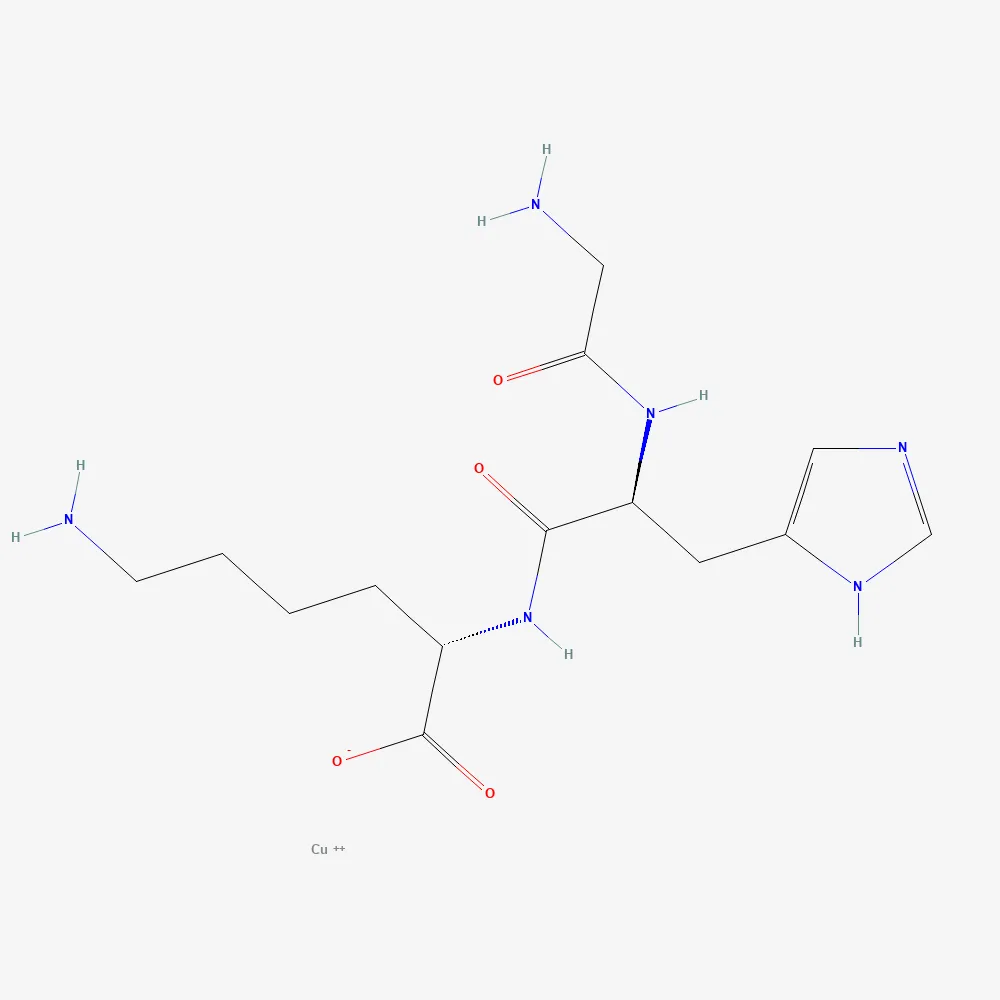
- Molecular formula
- C14H23CuN6O4+
- Molecular weight
- 402.92 g/mol
- Length
- 3 amino acids
- Sequence
- GHK
- Modifications
- Gly-His-Lys bound 1:1 to a copper(II) ion.
- PubChem CID
- 71587328
PubChem draws the copper ion separately rather than showing how it is held by the peptide, and its formula differs from FDA's by one hydrogen because of how the charges are written. Not the plain GHK peptide (CID 73587).
Identity checked against FDA Global Substance Registration System (UNII 6BJQ43T1I9).
GHK-Cu benefits: what the research shows
Small or uncontrolled human studies. Too little to settle the question either way. Small topical human studies, animal and mechanistic data, and reviews. Several widely cited human sources are not peer-reviewed journal articles. A PubMed-indexed randomized trial of topical GHK-Cu was negative on objective endpoints.
Reviews treat copper peptides as one of many topical peptides under study, not as drug-level evidence. A 2020 review of cosmetic peptides places them among the signal and carrier peptides Errante 2020 - Errante F, Ledwoń P, Latajka R et al. Cosmeceutical Peptides in the Framework of Sustainable Wellness Economy. Front Chem. 2020;8:572923., in the references below. More recent overviews still describe the field as active research rather than settled care.
Badilli 2025 - Badilli U, Inal O. Current Approaches in Cosmeceuticals: Peptides, Biotics and Marine Biopolymers. Polymers (Basel). 2025;17(6)., in the references below Nukaly 2026 - Nukaly HY, Halawani IR, Irtaza HM et al. Oral and topical peptides for skin aging: systematic review and meta-analysis of randomized controlled trials. Front Med (Lausanne). 2026;13:1618306., in the references belowWhat people usually cite - and what it actually is
Much of the consumer story rests on conference presentations, book chapters and reviews by researchers with a commercial stake in GHK-Cu skincare. That doesn’t make the claims false, but those documents are not independent randomised trials.
A randomised human study of topical copper tripeptide after CO₂ laser resurfacing is indexed in PubMed. On its objective measures, GHK-Cu did no better than the comparison skincare. The study was small and used laser-treated skin, not ordinary sun-damaged faces, so it isn’t a final verdict. Patients using GHK-Cu did rate their skin quality higher. Miller 2006 - Miller TR, Wagner JD, Baack BR et al. Effects of topical copper tripeptide complex on CO2 laser-resurfaced skin. Arch Facial Plast Surg. 2006;8(4):252-9., in the references below
Much of the interest comes from animal and wound-healing studies, such as a tripeptide-copper complex applied to experimental wounds Cangul 2006 - Cangul IT, Gul NY, Topal A et al. Evaluation of the effects of topical tripeptide-copper complex and zinc oxide on open-wound healing in rabbits. Vet Dermatol. 2006;17(6):417-23., in the references below. Healing a wound is a different question from reversing skin aging in people.
Many people now use GHK-Cu, some by injection, and describe better skin, no effect or side effects; see what people who use it report.
Does GHK-Cu penetrate the skin?
The “500 Dalton rule” is a common rule of thumb: many compounds heavier than about 500 Da struggle to pass the skin’s outer layer Bos 2000 - Bos JD, Meinardi MM. The 500 Dalton rule for the skin penetration of chemical compounds and drugs. Exp Dermatol. 2000;9(3):165-9., in the references below. GHK is well below that, so the rule does not forbid penetration.
Being very water-loving works against it. Lab work has measured how a copper tripeptide passes through human skin samples Hostynek 2011 - Hostynek JJ, Dreher F, Maibach HI. Human skin penetration of a copper tripeptide in vitro as a function of skin layer. Inflamm Res. 2011;60(1):79-86., in the references below. Whether cosmetic strengths deliver a useful amount to the living layer of the skin in real use is not settled.
Is there a conflict of interest in the GHK-Cu research?
Yes, and it should be in the open. Pickart’s reviews shape how the field is described, and the same research lineage is commercially linked to GHK-Cu skincare. When the main papers share a commercial interest with the ingredient, independent replication matters more. Pickart 2015 - Pickart L, Vasquez-Soltero JM, Margolina A. GHK Peptide as a Natural Modulator of Multiple Cellular Pathways in Skin Regeneration. Biomed Res Int. 2015;2015:648108., in the references belowDou 2020 - Dou Y, Lee A, Zhu L et al. The potential of GHK as an anti-aging peptide. Aging Pathobiol Ther. 2020;2(1):58-61., in the references below
Décolletage and combination products
Not every copper cosmetic is GHK-Cu alone. A clinical paper on a copper-zinc malonate complex for sun damage of the décolletage is sometimes folded into “copper peptide” marketing. Check what was actually tested before generalising. Leyden 2010 - Leyden JJ, Parr L. Treating photodamage of the décolletage area with a novel copper zinc malonate complex plus hydroquinone and tretinoin. J Drugs Dermatol. 2010;9(3):220-6., in the references below
GHK-Cu dosage
GHK-Cu has no FDA-approved dose, because it is sold as a cosmetic ingredient rather than a drug. The Cosmetic Ingredient Review’s 2014 industry safety assessment found typical concentrations under 10 parts per million in finished cosmetics, with one industry submission describing a 1-30 ppm range.
The published topical studies, a post-laser skin cream and a rabbit wound test, mostly didn’t state the concentration used. Full breakdown, including the one lab penetration study run at 0.68%: GHK-Cu dosage.
GHK-Cu side effects
There is no dedicated human safety trial for GHK-Cu. What follows is user-reported experience with topical use, as described consistently by two independent research-peptide sites.
Reported by users
Neurogan Health and Klow Peptide both list the most common effects:
- redness
- itching, or a stinging or tingling feeling
- dryness or mild flaking
These are usually mild and settle on their own or with less frequent use. Both sites note that many of these reactions probably come from other ingredients in a finished serum, such as preservatives, fragrances or exfoliating acids, rather than GHK-Cu itself.
Rare but serious
Klow Peptide describes allergic contact dermatitis as “uncommon but not impossible,” especially in people with a known copper or nickel sensitivity. Signs include a spreading rash, persistent swelling or blistering.
Stop using it and see a doctor for any of those, or any sign of a severe allergic reaction. This page covers topical use only. Injectable GHK-Cu sold online has no published human safety data, and no regulator checks its purity or strength.
Is GHK-Cu legal?
In the US, GHK-Cu is a cosmetic ingredient (Copper Tripeptide-1). Cosmetics are regulated but not FDA-approved before sale. That is normal for every cosmetic, from lipstick to moisturiser, and it means the brand carries the burden of proof for its claims. FDA also doesn’t recognise a legal category called “cosmeceuticals.” The topical cosmetic form has no controlled-substance or prescription status.
What I can say cleanly
- GHK-Cu is a real molecule with a long cosmetic history and a large lab and review literature.
- Human anti-aging evidence at the level most ads imply is limited, partly because some of the most-cited human material is not modern peer-reviewed trials.
- At least one PubMed-indexed randomised topical trial was negative on objective measures.
- Penetration is plausible by size and studied in the lab, not proven as “it goes deep and rebuilds collagen” for every serum.
- Its US status is ordinary cosmetic law, not FDA drug approval.
How this fits the three-bucket model
Copper peptides are Clean: sold off the shelf as cosmetics. They are not research chemicals or prescription GLP-1s, which is why they can sit next to collagen powders without BPC-157’s legal caveats.
For the wider skin-peptide picture (Matrixyl-class signal peptides, argireline, and the retinoid comparison), start with Peptides for skin. For buyer criteria when evidence is thin, see Best peptide serums; the copper serums that state their GHK-Cu percentage are under best copper peptide serums. For hair, see peptides for hair growth.
Regulatory changes for this compound and others, as they happen: US peptide regulation tracker.
How GHK-Cu compares
Healing and recovery. Doses for unapproved compounds are common practice, not trial-established. All healing and recovery peptides →
| Compound | Main use | Evidence | Usual dose | US status |
|---|---|---|---|---|
| BPC-157 | Studied in rodents for musculoskeletal soft-tissue healing. Sold to humans for injury recovery, a use whose only human data is one uncontrolled retrospective chart review of 17 people with knee pain. | Limited human data | 250-500 mcg, once or twice daily, injected subcutaneously near the injury site when possible | Research use only |
| TB-500 | Marketed for tissue repair and injury recovery. I could not locate a completed, published human randomized trial for any musculoskeletal or tissue-repair indication. | Animal / lab only | 2-2.5 mg, twice weekly during a 4-6 week loading phase, then once weekly (or every two weeks) for maintenance | Research use only |
| KPV | Sold for gut inflammation, skin conditions and wound healing. Nominated to FDA as a 0.1% topical cream or gel for wound healing and inflammatory conditions. FDA found no study in which KPV was given to a human for anything. | Animal / lab only | 200-500 mcg, once or twice daily, subcutaneous injection, rotating sites | Research use only |
| GHK-Cu | Topical cosmetic anti-aging - fine lines, skin density and firmness, elasticity, photodamage, hyperpigmentation - and wound healing. Also marketed in hair-loss cosmetics. | Limited human data | 1-2 mg, once daily, before bed | Cosmetic |
Where to buy GHK-Cu
GHK-Cu is sold legally as a cosmetic ingredient in copper peptide serums and creams, but no GHK-Cu drug is FDA-approved. The Ordinary's 1% copper peptide serum costs $32 for 30 mL (as of 3 October 2026).
Every route for GHK-Cu, with dated prices and its legal status →
Research vials of GHK-Cu (labelled not for human use)
A research vial is not the cosmetic, supplement or clinic product above. It is labelled not for human use, and the seller chooses how each batch is tested.
1.Next Level Pharm
50 mg vial
- No FDA warning letter found
- Names its testing lab
- Batch COAs published
- Takes card payment
2.Spartan Peptides
50 mg vial
- No FDA warning letter found
- Names its testing lab
3.BioEdge Research Labs
50 mg vial
- No FDA warning letter found
- Names its testing lab
- Batch COAs published
Research GHK-Cu capsules
Taken by mouth, and a different product from the vial: ask for a COA for the capsule batch.
- BioEdge Research Labs: 2 mg capsules, 60 count$109.00 as of 3 October 2026 View →
How research-labelled GHK-Cu differs, and what FDA has said →
Common questions
What are copper peptides?
In skincare, copper peptides almost always means GHK-Cu: copper bound to the three-amino-acid peptide glycyl-L-histidyl-L-lysine. Ingredient lists call it Copper Tripeptide-1. It is a cosmetic ingredient, not an FDA-approved drug.
Do copper peptides work for wrinkles?
The human evidence is thinner than marketing implies. Much of what is widely cited is not peer-reviewed journal research, and a randomized human trial of topical GHK-Cu indexed in PubMed was negative on its objective measures. Small studies exist; large, modern, independent trials are hard to find.
Are copper peptides safe?
Used on the skin, GHK-Cu has a long history as a cosmetic ingredient and is not a controlled substance. The safety of a finished product still depends on the full formula, the concentration and your skin. Cosmetics are not FDA-approved before sale. This is not medical advice.
Do copper peptides penetrate the skin?
GHK is small enough that the 500 Dalton rule doesn't rule it out, but it is very water-loving, which works against absorption. Lab work has measured copper tripeptide penetration in skin samples. Whether cosmetic strengths reach the living dermis in useful amounts is still open.
Can I use copper peptides with vitamin C or retinoids?
Formulators often keep copper peptides apart from strong acids or high-dose vitamin C, because copper can react with ascorbate. For advice on a specific product, ask a clinician or the manufacturer. I don't give regimen recommendations.
What is the usual GHK-Cu dose?
There is no FDA-approved dose, because GHK-Cu is a cosmetic ingredient, not a drug. The industry Cosmetic Ingredient Review safety assessment found typical concentrations under 10 parts per million in finished cosmetics. Published topical studies mostly didn't report the strength used. The dosing page has the full breakdown.
What are the side effects of GHK-Cu?
For use on the skin, independent research-peptide sites describe mild, passing redness, itching or stinging, and dryness, mostly at first or alongside strong actives. Allergic contact dermatitis is described as uncommon but possible, especially with a known copper sensitivity. No human safety trial gives a rate.
What is GHK-Cu peptide used for?
Mostly as a skincare ingredient, listed as Copper Tripeptide-1 and marketed for anti-aging and skin repair. It has also been studied in wound healing, and an injectable form is sold online as a research chemical. It is not an FDA-approved drug for any use, and the human evidence for cosmetic claims is limited.
Is it safe to inject GHK-Cu every day?
That hasn't been established. I found no published human safety data for injected GHK-Cu, and no regulator checks the purity or strength of vials sold online. Clinic sources describe 1 mg under the skin daily for 15 days, then 2 mg daily for 15 days, then a 30-day break. That is common practice, not a tested dose. See the [dosing page](/ghk-cu-dosage/).
How long does GHK-Cu take to work?
I found no controlled human trial measuring that, so a seller's timeline is not a trial finding. The randomised topical trial I cite, in 13 patients after laser resurfacing around the mouth, found no objective difference in wrinkles or skin quality at 12 weeks, though patients using GHK-Cu rated their skin higher. Wound-healing results are not a cosmetic effect.
References (15 sources)
Bibliographic detail is fetched from PubMed, not written by me - so a citation here cannot drift from the paper it names. Study design comes from PubMed's own tags rather than my judgement.
- 1.Pickart L. The human tri-peptide GHK and tissue remodeling. J Biomater Sci Polym Ed. 2008;19(8):969-88.ReviewPMID 18644225
- 2.Pickart L, Vasquez-Soltero JM, Margolina A. GHK Peptide as a Natural Modulator of Multiple Cellular Pathways in Skin Regeneration. Biomed Res Int. 2015;2015:648108.ReviewPMID 26236730full text
- 3.Errante F, Ledwoń P, Latajka R et al. Cosmeceutical Peptides in the Framework of Sustainable Wellness Economy. Front Chem. 2020;8:572923.ReviewPMID 33195061full text
- 4.Miller TR, Wagner JD, Baack BR et al. Effects of topical copper tripeptide complex on CO2 laser-resurfaced skin. Arch Facial Plast Surg. 2006;8(4):252-9.Randomised trialPMID 16847171
- 5.Cangul IT, Gul NY, Topal A et al. Evaluation of the effects of topical tripeptide-copper complex and zinc oxide on open-wound healing in rabbits. Vet Dermatol. 2006;17(6):417-23.Randomised trialPMID 17083573
- 6.Nukaly HY, Halawani IR, Irtaza HM et al. Oral and topical peptides for skin aging: systematic review and meta-analysis of randomized controlled trials. Front Med (Lausanne). 2026;13:1618306.Systematic reviewPMID 41924746full text
- 7.Bos JD, Meinardi MM. The 500 Dalton rule for the skin penetration of chemical compounds and drugs. Exp Dermatol. 2000;9(3):165-9.ReviewPMID 10839713
- 8.Hostynek JJ, Dreher F, Maibach HI. Human skin penetration of a copper tripeptide in vitro as a function of skin layer. Inflamm Res. 2011;60(1):79-86.StudyPMID 20721598full text
- 9.Dou Y, Lee A, Zhu L et al. The potential of GHK as an anti-aging peptide. Aging Pathobiol Ther. 2020;2(1):58-61.StudyPMID 35083444full text
- 10.Leyden JJ, Parr L. Treating photodamage of the décolletage area with a novel copper zinc malonate complex plus hydroquinone and tretinoin. J Drugs Dermatol. 2010;9(3):220-6.Randomised trialPMID 20232582
- 11.Badilli U, Inal O. Current Approaches in Cosmeceuticals: Peptides, Biotics and Marine Biopolymers. Polymers (Basel). 2025;17(6).ReviewPMID 40292641full text
- 12.PubChem CID 73587 - glycyl-L-histidyl-L-lysine (GHK), computed physicochemical properties including molecular weight, XLogP and topological polar surface area.- PubChem, National Library of Medicinedatabase
- 13.FDA - Is It a Cosmetic, a Drug, or Both? (Or Is It Soap?) Source for the intended-use test and for FDA stating the law recognises no category called cosmeceuticals.- US Food and Drug Administrationregulatory
- 14.Neurogan Health- neuroganhealth.comother
- 15.Klow Peptide- klow-peptide.comother