Ipamorelin: Benefits, Dosage, Side Effects and Research
Ipamorelin: the 1998 pharmacology, why Phase 2 stopped, the common research dose, trial-reported side effects, and legal and sport status.

The short version
Ipamorelin is a research growth hormone secretagogue with published pharmacology going back to 1998. Its clinical programme reached Phase 2 but never produced an approved drug. It is not a legal over-the-counter fat-loss peptide.
- Not FDA-approved for any use, and not approved anywhere else.
- Early clinical work is not the same as a proven consumer therapy.
- Sold as a research chemical; banned in sport under WADA S2.2.4.
Ipamorelin at a glance
- What it is
- Pentapeptide growth hormone secretagogue
- Main use
- Investigated for postoperative ileus, reaching Phase 2 before being discontinued for insufficient efficacy. Marketed to consumers for growth hormone release, an application never approved anywhere.
- Also called
- NNC 26-0161, Aib-His-D-2-Nal-D-Phe-Lys-NH2
- Molecular formula
- C38H49N9O5 (711.9 g/mol) Structure
- Evidence
- Limited human data
- US status
- Research use only
- Australia
- Not on the ARTG
- Half-life
- About 2 hours (terminal), from a dose-escalation pharmacokinetic study in healthy men given 15-minute intravenous infusions (eight men at each of five dose levels). Not measured after subcutaneous injection in a source I verified.
- How it is taken
- Subcutaneous injection
- Common protocol
- 100-300 mcg, once nightly on 5 days a week in physician-supervised protocols, up to three times daily on an empty stomach in less structured use, for 8-12 weeks (common practice, not trial-established) Dosage chart
Ipamorelin was designed to release growth hormone without the cortisol rise seen with older peptides in its family, and in animal studies it did exactly that. It is a research-only growth hormone secretagogue. Its one controlled human trial, in a different use, did not show a benefit, and it has no approval anywhere.
Dosing: what the published human studies used.
What is ipamorelin?
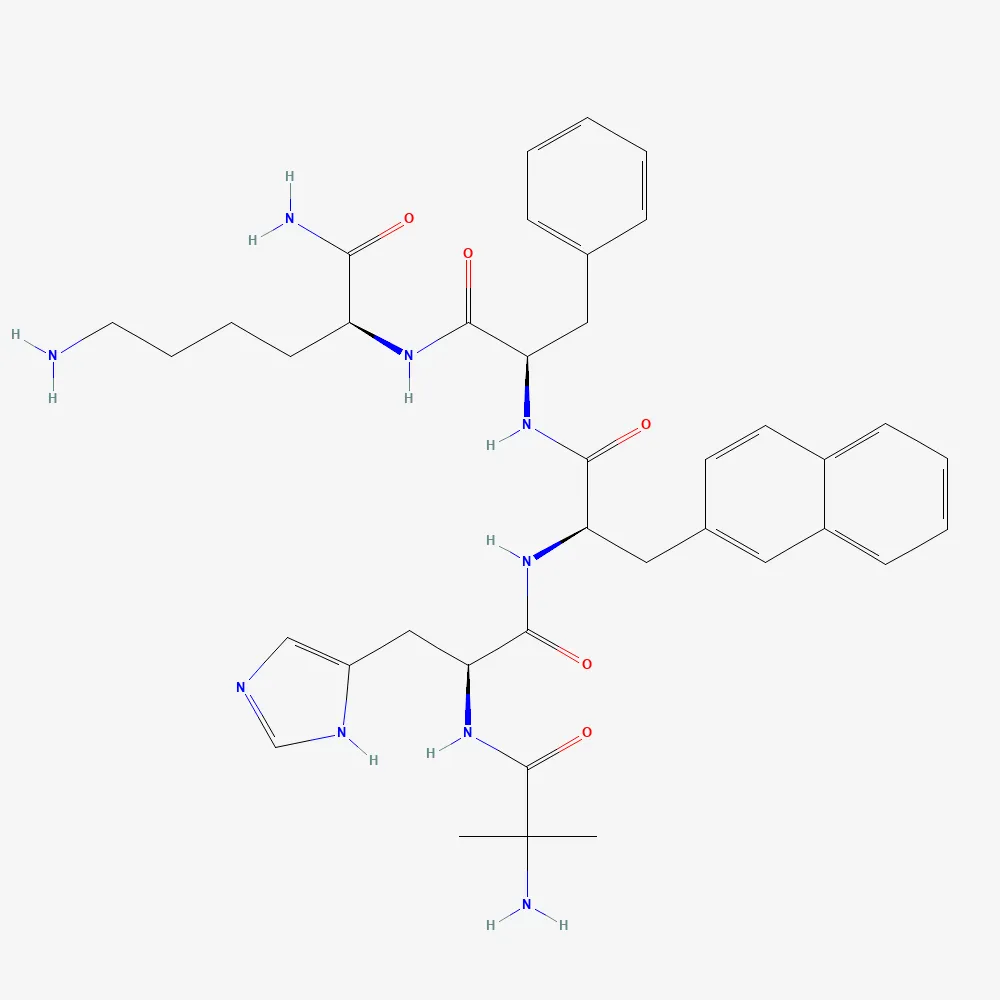
Ipamorelin is a chain of five amino acids: Aib-His-D-2-Nal-D-Phe-Lys-NH2. Novo Nordisk developed it as NNC 26-0161, and Helsinn later investigated it. Because there is no approved label, some of that history comes from secondary sources.
Ipamorelin structure
- Molecular formula
- C38H49N9O5
- Molecular weight
- 711.9 g/mol
- Length
- 5 amino acids
- Sequence
- XHXFK
- Modifications
- X1 = Aib (2-aminoisobutyric acid); L-His2; X3 = D-2-naphthylalanine (D-2-Nal); D-Phe4; L-Lys5; C-terminal amide.
- PubChem CID
- 9831659
Identity checked against ChEMBL (EMBL-EBI).
Ipamorelin benefits: what the research shows
The 1998 finding everyone quotes. Raun and colleagues described ipamorelin as a selective growth hormone secretagogue acting through the GHRP receptor pathway, later placed in the ghrelin receptor family. In rat pituitary cells, rats and conscious pigs, it released growth hormone about as potently as GHRP-6. It did so without the ACTH and cortisol rise the authors saw with some other GHRPs Raun 1998 - Raun K, Hansen BS, Johansen NL et al. Ipamorelin, the first selective growth hormone secretagogue. Eur J Endocrinol. 1998;139(5):552-61., in the references below. That is a clean, interesting result, but it comes from animals and lab tests, not people.
The one controlled human trial did not show a benefit. Ipamorelin reached Phase 2 for postoperative ileus (restarting the gut after surgery), and development was stopped for insufficient efficacy. That trial tested a hospital use, not the sleep, recovery or body-composition uses it is sold for. It neither supports nor rules those out.
Secondary sources report a human half-life of about a couple of hours from Phase 1 work. I haven’t seen the primary paper, so I treat that figure as likely, not verified.
Small or uncontrolled human studies. Too little to settle the question either way. Strong animal/in vitro GH-release pharmacology; human development discontinued for insufficient efficacy in postoperative ileus; no approved indication.
What people who use it report
Ipamorelin is one of the most widely used peptides outside any trial. In March 2026 NPR named it among “some of the most popular” peptides compounding pharmacies are barred from making. A CNN report found a prominent wellness influencer selling it, and Health Canada lists it among the injectable peptides it has seized. User reports point in more than one direction:
- Muscle, fat loss and sleep. The fitness author Ben Greenfield wrote that he saw his best muscle-gain and fat-loss results taking it at bedtime on an empty stomach - see what well-known people have said below. It is most often taken at night with CJC-1295, which proponents say can promote fat loss and better sleep, TIME reported.
- Side effects. A 2026 endocrinology review for doctors seeing people who inject growth-hormone peptides, ipamorelin among them, lists problems reported across the group: fluid retention, muscle and joint aches, appetite changes, blood-sugar changes, raised prolactin and cortisol, and injection-site reactions Dominikowski 2026 - Dominikowski A, Rękoś Z, Olejarz M et al. The emerging landscape of performance-enhancing peptides modulating GH-IGF1 axis: bridging the gap between clinical evidence and patient self-administration. Front Endocrinol (Lausanne). 2026;17:1822475., in the references below.
- No published count. I found no survey or case series of ipamorelin users, so there is no measure of how many notice a benefit, a side effect or nothing.
Self-reports can’t separate the compound from placebo, better sleep habits or other changes. A sports-medicine review notes that social media can amplify the placebo effect with peptides Mendias 2026 - Mendias CL, Awan TM. Safety and Efficacy of Approved and Unapproved Peptide Therapies for Musculoskeletal Injuries and Athletic Performance. Sports Med. 2026;56(8):1921-1935., in the references below. A placebo-controlled trial of the uses people actually buy it for would settle that.
Ipamorelin dosage
The common Ipamorelin dose is 100-300 mcg, once nightly on 5 days a week in physician-supervised protocols, up to three times daily on an empty stomach in less structured use. From a 5 mg vial mixed with 2 mL of bacteriostatic water, 200 mcg is 8 units (0.08 mL) on a U-100 insulin syringe.
No trial has set a dose for self-injected use. The one controlled human trial used intravenous infusion in hospital, not the injections under the skin sold to consumers. Research-community sources describe 100-300 mcg injected under the skin on an empty stomach, in 8-12 week cycles with a 4-week break, often paired with CJC-1295. That is common practice, not a tested dose.
Sources disagree on frequency. One clinic protocol uses once nightly, 5 nights a week; a vendor guide describes up to three times a day. Full sourcing, including both published studies: ipamorelin dosage.
Ipamorelin side effects
There is no approved label and no outpatient safety study. What exists is the Phase 2 hospital trial and FDA’s compounding-safety flag.
Reported in studies
In the Phase 2 trial, adverse events were common in both groups: 87.5% on ipamorelin and 94.8% on placebo Beck 2014 - Beck DE, Sweeney WB, McCarter MD. Prospective, randomized, controlled, proof-of-concept study of the Ghrelin mimetic ipamorelin for the management of postoperative ileus in bowel resection patients. Int J Colorectal Dis. 2014;29(12):1527-34., in the references below. The paper didn’t single out a severe reaction specific to ipamorelin at the dose tested. That was one small, week-long hospital trial of intravenous infusion. It says nothing about longer use or injections at home.
Rare but serious
FDA’s compounding-safety flag. Ipamorelin acetate is in FDA’s Category 2 table under its interim compounding policy, for substances with potential significant safety risks. FDA’s listing cites a published study reporting serious adverse events, including death, when ipamorelin was given intravenously to improve stomach emptying. That was a different route and use from the self-injected product sold today. The listing is a flag raised during FDA’s review, not a completed safety determination.
No long-term data. There is no outpatient safety data at any dose or frequency for self-injected use.
Product quality. Ipamorelin is sold as a research chemical labelled not for human use, and no regulator checks that a vial’s identity, purity or concentration matches its label.
For redness, itching or swelling at the injection site, see injection-site reactions.
Is ipamorelin legal?
US legal status - Research use only
Sold for laboratory research use only. Not approved by the FDA for human use, and cannot be lawfully marketed as a supplement or a medicine. Products sold this way are not made to pharmaceutical quality standards, and their contents are not verified by anyone.
AU legal status - Not on the ARTG
Schedule 4 of the Poisons Standard, named directly, and Appendix D, clause 5 - prescription only, and possession without authority is illegal. Appendix D covers growth hormone secretagogues as a class as well, so a renamed one is caught whether or not it is listed by name. Nothing containing it is on the ARTG.
Regulators reach their own conclusions on their own timelines. Where these two disagree, the difference is the point - not an error.
- Not FDA-approved for any use.
- Sold by research-chemical vendors as not for human use.
- FDA lists ipamorelin acetate in its Category 2 bulk-substance table for potential significant safety risks.
- WADA 2026 lists growth hormone secretagogues such as ipamorelin under S2.2.4, banned at all times in sport.
Common claims, checked
| Claim you will see | What the record shows |
|---|---|
| “Selective GH release without cortisol” | Shown in animal and lab work from 1998; not shown as a clinical benefit in humans. |
| “Safe peptide for recovery” | Never approved; Phase 2 stopped for efficacy, and long-term consumer safety was never proven. |
| “Research pure = fine to take” | Research-only labelling is a sales category, not a safety certificate. |
Related reading
Regulatory changes for this compound and others, as they happen: US peptide regulation tracker.
How Ipamorelin compares
Secretagogues (act on the ghrelin receptor). Doses for unapproved compounds are common practice, not trial-established. All growth hormone and muscle peptides →
| Compound | Main use | Evidence | Usual dose | US status |
|---|---|---|---|---|
| Ipamorelin | Investigated for postoperative ileus, reaching Phase 2 before being discontinued for insufficient efficacy. Marketed to consumers for growth hormone release, an application never approved anywhere. | Limited human data | 100-300 mcg, once nightly on 5 days a week in physician-supervised protocols, up to three times daily on an empty stomach in less structured use | Research use only |
| MK-677 (Ibutamoren) | Developed as an oral, non-injectable alternative to peptide growth hormone secretagogues. Published trials in healthy older adults and obese men found it raised growth hormone and IGF-1 and increased fat-free mass; FDA references a hip-fracture trial that was stopped early. Marketed to consumers as a research chemical for muscle and recovery, a use never approved by any regulator. | Limited human data | 12.5-25 mg, once daily by mouth; the published 2008 trial dosed each morning, while compounding-pharmacy protocols commonly move dosing to before bed | Research use only |
| GHRP-2 | Sold to consumers as a growth-hormone-release research chemical for muscle and recovery use, an application never approved anywhere. Historically investigated as a pituitary growth-hormone stimulus and diagnostic agent. | Limited human data | 100-300 mcg, 2 to 3 times daily, on an empty stomach, 5 days a week (5 on, 2 off) | Research use only |
| GHRP-6 | One of the original growth hormone-releasing peptides, studied since the 1980s as a pituitary GH secretagogue. Marketed to consumers for muscle and recovery goals, an application never approved anywhere. | Limited human data | 100-300 mcg, 2 to 3 times daily, on an empty stomach, spaced at least 3-4 hours apart | Research use only |
| Hexarelin | Investigated since the 1990s as a growth hormone-releasing peptide (GHRP), including for growth-hormone stimulation testing. Sold to consumers as a research chemical for muscle and recovery use, an application with no controlled human trial behind it. | Limited human data | 80-160 mcg, once or twice daily (morning and/or before bed), on an empty stomach | Research use only |
Where to buy Ipamorelin for research
Each vendor is checked against my vendor checklist.
1.Next Level PharmFeatured
5 mg vial
- No FDA warning letter found
- Names its testing lab
- Batch COAs published
- Takes card payment
2.BioEdge Research Labs
10 mg vial
- No FDA warning letter found
- Names its testing lab
- Batch COAs published
Common questions
Does ipamorelin work?
In animals and lab tests it releases growth hormone selectively, which interested researchers in the 1990s. Its Phase 2 programme in postoperative ileus was stopped for insufficient efficacy. It has no approved clinical use.
Is ipamorelin safer than other GHRPs because it does not raise cortisol?
Not proven. The finding that it releases growth hormone without the ACTH and cortisol rise of some GHRPs comes from 1998 rat and pig studies. That is not a proven safety advantage in humans.
What are the side effects of ipamorelin?
In the one controlled human trial, an intravenous Phase 2 study in surgical patients, adverse events were common in both groups (87.5% on ipamorelin, 94.8% on placebo), with no severe reaction singled out for ipamorelin. FDA lists ipamorelin acetate in Category 2 of its compounding policy for potential significant safety risks. There is no long-term safety data for the self-injected use it is sold for, and no regulator checks that a vial matches its label.
What is the usual ipamorelin dose?
No trial has set one for self-injected use. Research-community sources describe 100-300 mcg injected under the skin on an empty stomach, in 8-12 week cycles with a 4-week break, often paired with CJC-1295. They disagree on frequency: one clinic protocol uses once nightly, 5 nights a week, while a vendor guide describes up to three times a day. The dosing page has the sourcing.
What are the downsides of ipamorelin?
It has never been approved anywhere, and development stopped at Phase 2 for insufficient efficacy. FDA lists ipamorelin acetate in Category 2 for potential significant safety risks, and no trial has reported safety for repeated injections under the skin. No regulator checks research-chemical vials against their labels, and it is banned in sport at all times under WADA S2.2.4.
Does ipamorelin reduce belly fat?
I found no human study showing that it does. The one fat-related finding points the other way: in mice, twice-daily ipamorelin increased fat pad weight relative to body weight, even in growth hormone-deficient mice, and the authors concluded growth hormone wasn't the cause. That is animal data, not a result in people.
Can I take ipamorelin every day?
No trial has shown that daily use is safe, and I found no study of a self-injected daily schedule. Research-community protocols disagree: one clinic uses one bedtime injection 5 nights a week, while a vendor guide describes up to three times a day, in 8-12 week cycles with about a 4-week break. Neither has long-term safety data.
Can you gain muscle on ipamorelin?
I found no study showing muscle gain in people. The human data are a pharmacokinetic study in healthy men and a Phase 2 bowel-surgery trial that missed its goal. In rats, repeated injections increased bone growth and weight gain, but no animal study I found measured muscle, and one in mice found fat pad weight increased.
How quickly do you see results from ipamorelin?
No trial I found measured how long a body-composition or recovery effect takes, because none tested those uses. In healthy men given intravenous infusions, each dose produced one burst of growth hormone that peaked at about 40 minutes and then fell to negligible levels. That is a blood-level change, not a visible result.
What well-known people have said about Ipamorelin
Public statements, shown because people search for them. Each is one person's account, in their words or a faithful summary, with where and when they said it. None of it is evidence that Ipamorelin works or is safe; that is what the rest of this page is for.

Ben Greenfieldfitness author and podcasterSaid they use it
Greenfield wrote that, for muscle gain and fat loss, he had personally seen the best results taking ipamorelin at bedtime on an empty stomach.
“I’ve personally seen the best results using ipamorelin before bedtime on an empty stomach.”
Ben Greenfield's own website (article), 17 September 2024. Source: Ben Greenfield Life
Photo: TAterPARsOLI, CC BY-SA 4.0, via Wikimedia Commons
Official decisions and statements
David BranchUFC fighterOfficial statement
USADA announced a two-year sanction for Branch after an out-of-competition urine sample from 24 May 2019 was positive for ipamorelin.
USADA sanction announcement, 18 September 2019. Source: U.S. Anti-Doping Agency
References (13 sources)
Bibliographic detail is fetched from PubMed, not written by me - so a citation here cannot drift from the paper it names. Study design comes from PubMed's own tags rather than my judgement.
- 1.Raun K, Hansen BS, Johansen NL et al. Ipamorelin, the first selective growth hormone secretagogue. Eur J Endocrinol. 1998;139(5):552-61.StudyPMID 9849822
- 2.Beck DE, Sweeney WB, McCarter MD. Prospective, randomized, controlled, proof-of-concept study of the Ghrelin mimetic ipamorelin for the management of postoperative ileus in bowel resection patients. Int J Colorectal Dis. 2014;29(12):1527-34.Randomised trialPMID 25331030
- 3.Dominikowski A, Rękoś Z, Olejarz M et al. The emerging landscape of performance-enhancing peptides modulating GH-IGF1 axis: bridging the gap between clinical evidence and patient self-administration. Front Endocrinol (Lausanne). 2026;17:1822475.ReviewPMID 42395176full text
- 4.Mendias CL, Awan TM. Safety and Efficacy of Approved and Unapproved Peptide Therapies for Musculoskeletal Injuries and Athletic Performance. Sports Med. 2026;56(8):1921-1935.ReviewPMID 41966639
- 5.Ipamorelin - secondary reference for development history (Novo Nordisk NNC 26-0161, Helsinn), Phase 2 postoperative ileus discontinuation, and half-life figures reported secondarily.- Wikipediaother
- 6.FDA - Certain Bulk Drug Substances for Use in Compounding that May Present Significant Safety Risks (category 2 table lists ipamorelin acetate, 503B context).- US Food and Drug Administrationregulatory
- 7.WADA 2026 Prohibited List - growth hormone secretagogues under S2.2.4 (national anti-doping agency mirror, PDF).- World Anti-Doping Agency (mirrored by the Jamaica Anti-Doping Commission)regulatory
- 8.Therapeutic Goods (Poisons Standard - June 2026) Instrument 2026, the current Poisons Standard (SUSMP). Ipamorelin is a Schedule 4 (prescription only) entry, and Appendix D, clause 5 - which also covers growth hormone secretagogues as a class.- Federal Register of Legislation, Australian Governmentstatute
- 9.TGA - Unapproved therapeutic goods. Goods not on the ARTG have not been assessed by the TGA for safety, quality or effectiveness, and reach patients only through defined pathways such as the Special Access Scheme.- Therapeutic Goods Administration, Australian Governmentregulatory
- 10.NPR, 26 March 2026 (Will Stone) - The government may soon lift restrictions on some peptide treatments. Names ipamorelin, with BPC-157 and MOTS-c, among "some of the most popular" peptides FDA bars compounding pharmacies from producing.- NPRnews
- 11.CNN, 15 November 2025 - The trend of unproven peptides is spreading through influencers and RFK Jr. allies. Reports that a prominent wellness influencer sells ipamorelin and CJC-1295, with vials labelled "research use only".- CNNnews
- 12.Health Canada, 9 April 2026 - Think twice before injecting peptides bought online: unauthorized products can seriously harm you. Names ipamorelin and CJC-1295 among the unauthorized injectable peptides it has seized.- Health Canada, Government of Canadaregulatory
- 13.TIME, 24 February 2026 (Dominique Mosbergen) - Why "anti-aging" peptide shots are trending on social media. Describes CJC-1295, the peptide ipamorelin is most often paired with, as one "which proponents say can promote fat loss and better sleep".- TIMEnews