
TB-500: Benefits, Dosage, Side Effects and Legal Status
TB-500 is a 7-amino-acid fragment, not full thymosin beta-4. What that changes about the evidence, the common dose, oral TB-500 and capsules, and the WADA ban.

The short version
TB-500 is usually sold as a short fragment of thymosin beta-4, not the full natural protein, and that changes which research applies to it. The parent protein has an active tissue-repair research record, and one rat tendon study using TB-500 was positive, but no human trial of TB-500 has been published. Many people use it and report benefits, side effects or no effect. It is not an approved treatment.
- TB-500 is a 7-amino-acid fragment, not the full 43-amino-acid thymosin beta-4.
- Much of the research shared online is on the full protein, not the fragment.
- Research-chemical legal and purity issues still apply.
- I found no study of TB-500 taken by mouth, so capsules are untested.
TB-500 at a glance
- What it is
- Synthetic heptapeptide fragment
- Main use
- Marketed for tissue repair and injury recovery. I could not locate a completed, published human randomized trial for any musculoskeletal or tissue-repair indication.
- Also called
- Ac-LKKTETQ, Thymosin beta-4 fragment (17-23), TB4 fragment
- Molecular formula
- C38H68N10O14 (889.0 g/mol) Structure
- Evidence
- Animal / lab only
- US status
- Research use only
- Australia
- Not on the ARTG
- Half-life
- Not established in humans
- How it is taken
- Subcutaneous injection
- Common protocol
- 2-2.5 mg, twice weekly during a 4-6 week loading phase, then once weekly (or every two weeks) for maintenance, for 4-6 weeks (common practice, not trial-established) Dosage chart
TB-500 is one of the most talked-about recovery peptides, and the interest has real roots. The protein it comes from, thymosin beta-4, has an active research record in tissue repair, and a recent rat tendon study of TB-500 came out well. But TB-500 is only a 7-amino-acid piece of that protein, so much of the evidence you will be shown is about a different molecule.
Dosing: what the studies actually used.
What is TB-500?
TB-500 is Ac-LKKTETQ, a synthetic 7-amino-acid fragment matching residues 17–23 of thymosin beta-4 (Tβ4), with an acetyl group on the front end. Tβ4 itself is a 43-amino-acid protein.
That difference matters. Lab and clinical work on full-length Tβ4 does not automatically describe what TB-500 in a vial does.
TB-500 structure
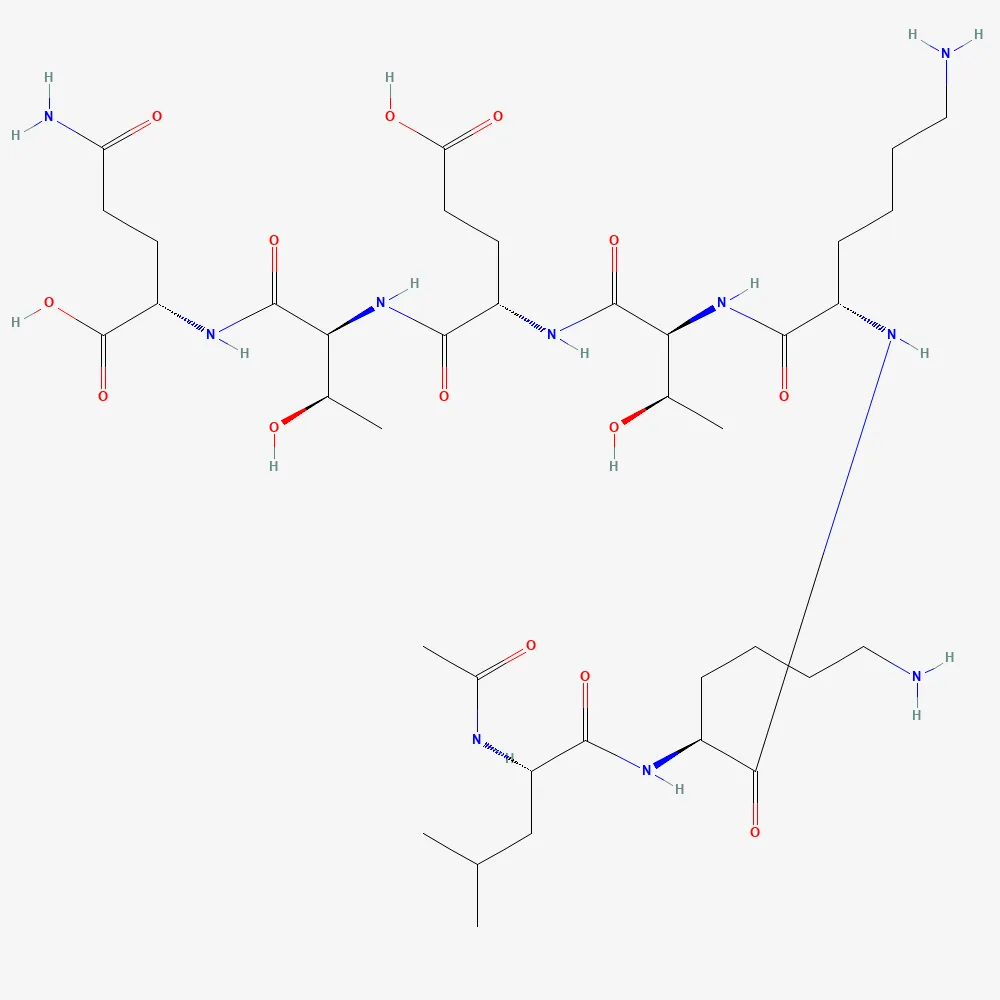
- Molecular formula
- C38H68N10O14
- Molecular weight
- 889.0 g/mol
- Length
- 7 amino acids
- Sequence
- LKKTETQ
- Modifications
- N-terminal acetyl (Ac-LKKTETQ); C-terminal free acid; all L-amino acids.
- PubChem CID
- 62707662
TB-500 is this 7-residue acetylated fragment of thymosin beta-4, not the full 43-residue protein and not the separate Ac-SDKP fragment. PubChem lists it under the FDA code UNII-QHK6Z47GTG with the synonyms TB-500 and Ac-Leu-Lys-Lys-Thr-Glu-Thr-Gln-OH.
Identity checked against UniProt.
How TB-500 works
Lab studies describe this stretch of the protein binding single actin molecules (G-actin) and holding them back from building the cell’s internal skeleton. That can change how cells hold their shape and move in laboratory systems. It is a plausible route to tissue repair, and one a human trial would need to confirm.
TB-500 benefits: what the research shows
Studied in cells or animals. No controlled trials in humans. Lab and animal work on related sequences; I found no published human randomised controlled trial of the fragment for tissue repair. Research on full-length Tβ4 is often mis-cited as TB-500 evidence.
TB-500 is sold and widely used for tissue repair and recovery. The most direct animal test under the TB-500 name is encouraging. In a rat Achilles tendon study, TB-500 alone significantly improved tendon strength (load to failure) and tissue scores compared with untreated rats Biçer 2026 - Biçer O, Adanir O, Güleryüz Y et al. Effects of BPC-157 and TB-500 on Achilles tendon healing in rats: A histopathological and biomechanical study. Jt Dis Relat Surg. 2026;37(3):822-837., in the references below. The abstract calls it synthetic thymosin beta-4 without giving a sequence, so even here it isn’t certain whether the fragment or the full protein was used.
That is one small study in one species. I found no published human randomised controlled trial of the fragment for an injury or tissue-repair outcome, so “it heals tendons” is still untested in people. There is no human safety data, it is not an approved medicine, and no regulator checks that research-labelled vials match their labels.
What people who use it report
TB-500 is widely used outside any trial, often with BPC-157 in the pairing users call the Wolverine stack, which Scientific American describes many people taking. In July 2026, ABC News reported that FDA’s compounding advisory committee narrowly voted to recommend TB-500 and five other peptides for the list pharmacies compound from. User reports point in more than one direction:
- Feeling it helped. USC’s chief of sports medicine, Alexander Weber, told NPR that patients he sees feel these injectable peptides help them, while adding that they still need to be studied. Some well-known users describe taking TB-500 in a recovery stack - see what well-known people have said below.
- Mixed results. In a Florida clinic’s phone follow-up of knee-pain patients, 3 of the 4 given BPC-157 with an agent the paper calls TB4 reported significant improvement, and the fourth had no relief (Lee 2021 - Lee E, Padgett B. Intra-Articular Injection of BPC 157 for Multiple Types of Knee Pain. Altern Ther Health Med. 2021;27(4):8-13., in the references below). That is 4 people, and the paper doesn’t say whether TB4 meant the fragment or the full protein.
- Side effects and worries. An analysis of more than 12,000 Reddit posts about BPC-157 and other peptides after injury or surgery found frequent worries about side effects, purity and long-term safety. Some posts described injection-site reactions, diarrhoea and emotional numbness (Rosenberg 2026 - Rosenberg AE, Taylor B, Rasquinha RD et al. Injuries, Injections, and Internet Forums: A Qualitative Study of Reddit User Perspectives on Peptide Therapy After Orthopaedic Surgery. Sports Health. 2026;18(4):901-910., in the references below, as summarised in The Conversation).
None of this can separate TB-500 from placebo, natural healing or other changes made at the same time. A sports-medicine review notes that social media can amplify the placebo effect with peptides (Mendias 2026 - Mendias CL, Awan TM. Safety and Efficacy of Approved and Unapproved Peptide Therapies for Musculoskeletal Injuries and Athletic Performance. Sports Med. 2026;56(8):1921-1935., in the references below). That is why a controlled trial of the fragment matters.
TB-500 dosage
The common TB-500 dose is 2-2.5 mg, twice weekly during a 4-6 week loading phase, then once weekly (or every two weeks) for maintenance. From a 10 mg vial mixed with 2 mL of bacteriostatic water, 2.5 mg is 50 units (0.5 mL) on a U-100 insulin syringe.
No clinical trial has set a dose, because there is no published human trial of TB-500. Research-community sources describe a loading phase of 2-2.5 mg injected under the skin twice a week for 4-6 weeks, then once a week (or every two weeks), then a 4-6 week break. That is common practice, not a tested dose. Full sourcing: TB-500 dosage.
Oral TB-500 and capsules
I found no study that gave TB-500 by mouth, in people or in animals, and no measurement of whether it survives digestion or reaches the blood from a capsule.
None of the three vendors I check sells TB-500 on its own as a capsule. As of 3 October 2026, BioEdge Research Labs sold it only paired with BPC-157, in capsules holding 500 mcg of each, labelled for laboratory research and not for human use. Spartan Peptides and Next Level Pharm sell no capsules at all.
That capsule also shows the naming problem above. BioEdge’s TB-500 vial page describes its TB-500 as the full 43-amino-acid thymosin beta-4. The capsule page calls TB-500 a thymosin beta fragment, but gives the formula and CAS number PubChem lists for thymosin beta-4, not those of the 7-amino-acid fragment.
The only oral test I found used the full protein. In mice with chemically induced colitis, recombinant human thymosin beta-4 given by mouth improved survival and reduced gut damage Zhao 2026 - Zhao TR, Hu EB, Wang MW et al. Recombinant human Thymosin β4 ameliorates experimental colitis and intestinal fibrosis through suppression of mineralocorticoid receptor signaling. Mol Biomed. 2026;7(1)., in the references below. It tested the full protein on the gut it was swallowed into, so it says nothing about the fragment or about tendons.
FDA’s July 2026 review found TB-500 proposed only for injection under the skin or into muscle. The only blood-level data it cited came from horses injected under the skin, whose levels peaked within 2 hours and were unmeasurable by 6-10 hours (FDA briefing document). The common protocol above is for injection, and I give no oral dose. Other compounds sold as capsules are compared in oral peptides.
TB-500 side effects
No human safety data
There is no clinical side-effect data, because no human study of TB-500 has been published. The lab and animal work tests how it acts on actin, not toxicity or tolerability, so it says nothing about what a person injecting it experiences.
Reported by users
Clinic pages most often describe fatigue, headache and injection-site reactions (redness, itching, soreness). These haven’t been measured against controls, so I note them without treating them as evidence. Independent reports are under What people who use it report.
Separately from the molecule, no regulator checks that a research-chemical vial matches its label for purity or contents.
For the injection itself, see injection-site reactions for what is ordinary and what needs attention. The same user-report sources advise seeing a doctor if a reaction is severe or doesn’t clear within a couple of days. With no label or trial, there is no firmer threshold. See dosing for what little published data exists.
Is TB-500 legal?
US legal status - Research use only
Sold for laboratory research use only. Not approved by the FDA for human use, and cannot be lawfully marketed as a supplement or a medicine. Products sold this way are not made to pharmaceutical quality standards, and their contents are not verified by anyone.
AU legal status - Not on the ARTG
Schedule 4 of the Poisons Standard, and Appendix D, clause 5 - prescription only, and possession without authority is illegal. The Poisons Standard lists "TB-500" and "Thymosin beta 4" as separate entries, so the TGA draws the same fragment-versus-protein distinction this page does, and covers both. Nothing containing either is on the ARTG.
Regulators reach their own conclusions on their own timelines. Where these two disagree, the difference is the point - not an error.
- Not FDA-approved in the US for any use.
- Sold as a research chemical, not for human use. That label says nothing about purity or legal status. See research peptides and the law.
- WADA 2026 lists Thymosin-β4 and its derivatives e.g. TB-500 under S2.3, prohibited at all times. The ban groups the protein and the fragment together for regulatory purposes; it doesn’t mean they are chemically identical.
Practical next reads
- BPC-157 - the recovery peptide TB-500 is most often paired with
- Ipamorelin
- CJC-1295
- Are peptides safe?
- All compounds
Regulatory changes for this compound and others, as they happen: US peptide regulation tracker.
How TB-500 compares
Healing and recovery. Doses for unapproved compounds are common practice, not trial-established. All healing and recovery peptides →
| Compound | Main use | Evidence | Usual dose | US status |
|---|---|---|---|---|
| BPC-157 | Studied in rodents for musculoskeletal soft-tissue healing. Sold to humans for injury recovery, a use whose only human data is one uncontrolled retrospective chart review of 17 people with knee pain. | Limited human data | 250-500 mcg, once or twice daily, injected subcutaneously near the injury site when possible | Research use only |
| TB-500 | Marketed for tissue repair and injury recovery. I could not locate a completed, published human randomized trial for any musculoskeletal or tissue-repair indication. | Animal / lab only | 2-2.5 mg, twice weekly during a 4-6 week loading phase, then once weekly (or every two weeks) for maintenance | Research use only |
| KPV | Sold for gut inflammation, skin conditions and wound healing. Nominated to FDA as a 0.1% topical cream or gel for wound healing and inflammatory conditions. FDA found no study in which KPV was given to a human for anything. | Animal / lab only | 200-500 mcg, once or twice daily, subcutaneous injection, rotating sites | Research use only |
| GHK-Cu | Topical cosmetic anti-aging - fine lines, skin density and firmness, elasticity, photodamage, hyperpigmentation - and wound healing. Also marketed in hair-loss cosmetics. | Limited human data | 1-2 mg, once daily, before bed | Cosmetic |
Where to buy TB-500 for research
Each vendor is checked against my vendor checklist.
1.Next Level PharmFeatured
10 mg vial
- No FDA warning letter found
- Names its testing lab
- Batch COAs published
- Takes card payment
2.Spartan Peptides
10 mg vial
- No FDA warning letter found
- Names its testing lab
3.BioEdge Research Labs
Full-length thymosin beta-4 10 mg vial, sold as "TB4 (TB500)"
- No FDA warning letter found
- Names its testing lab
- Batch COAs published
Common questions
Is TB-500 the same as thymosin beta-4?
No. Thymosin beta-4 is a 43-amino-acid protein, and TB-500 is a short acetylated piece of it. Research on the full protein doesn't automatically apply to the fragment.
Does TB-500 heal injuries?
It hasn't been tested in people yet: I found no published human randomised controlled trial of it for injuries or tissue repair. The most direct evidence is a rat Achilles-tendon study in which TB-500 significantly improved tendon strength. Much of what is shared online is about full-length thymosin beta-4, a different molecule.
What are the side effects of TB-500?
There is no human safety data, because no human trial has been published. Users commonly describe fatigue, headache and injection-site reactions, but those are anecdotes, not trial findings. No regulator checks that a research-labelled vial matches its label.
What is the usual TB-500 dose?
No clinical trial has set one. Research-community sources describe 2-2.5 mg injected under the skin twice a week for 4-6 weeks, then once a week (or every two weeks), then a 4-6 week break. That is common practice, not a tested dose; see the dosing page for sources.
What are the differences between TB-500 and BPC-157?
They are different molecules. TB-500 is a 7-amino-acid acetylated fragment of thymosin beta-4; BPC-157 is a 15-amino-acid peptide often described as a fragment of a protein in gastric juice. Both are unapproved research chemicals with thin evidence. In one rat Achilles-tendon study, TB-500 improved tendon strength significantly, BPC-157 only numerically, and combining them added nothing. See [BPC-157 vs TB-500](/compare/bpc-157-vs-tb-500/).
Can I take TB-500 every day?
The common protocol isn't daily: 2-2.5 mg twice a week for 4-6 weeks, then once a week or every two weeks. One clinic source doses a BPC-157/TB-500 blend 5 days on, 2 off. No human trial has tested any TB-500 schedule, so there is no safety data for daily use.
Is TB-500 effective when taken orally?
Nobody has tested it. I found no study that gave TB-500 by mouth, in people or animals, and no measurement of how much a capsule delivers to the blood. The only oral study I found used the full thymosin beta-4 protein, in mice with gut inflammation. None of the three vendors I check sells TB-500 alone as a capsule.
Does TB-500 affect testosterone or raise blood pressure?
I found no data either way. No human study of TB-500 has been published, and FDA's 2026 review found no human exposure data and no animal toxicity studies. Claims either way are unverified.
What well-known people have said about TB-500
Public statements, shown because people search for them. Each is one person's account, in their words or a faithful summary, with where and when they said it. None of it is evidence that TB-500 works or is safe; that is what the rest of this page is for.
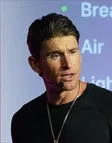
Ben Greenfieldfitness author and podcasterSaid they use it
In a 2024 article on his own site Greenfield gave the TB-500 dosing he said he had used, as part of a recovery stack. In 2016 he had written that he had not used it because he was competing in WADA-governed sports.
Ben Greenfield's own website (article), 17 September 2024. Source: Ben Greenfield Life · Ben Greenfield Life (2016-06-27 article in which he said he had not used TB-500)
Photo: TAterPARsOLI, CC BY-SA 4.0, via Wikimedia Commons
References (18 sources)
Bibliographic detail is fetched from PubMed, not written by me - so a citation here cannot drift from the paper it names. Study design comes from PubMed's own tags rather than my judgement.
- 1.Biçer O, Adanir O, Güleryüz Y et al. Effects of BPC-157 and TB-500 on Achilles tendon healing in rats: A histopathological and biomechanical study. Jt Dis Relat Surg. 2026;37(3):822-837.StudyPMID 42542926
- 2.Rosenberg AE, Taylor B, Rasquinha RD et al. Injuries, Injections, and Internet Forums: A Qualitative Study of Reddit User Perspectives on Peptide Therapy After Orthopaedic Surgery. Sports Health. 2026;18(4):901-910.StudyPMID 41877514full text
- 3.Mendias CL, Awan TM. Safety and Efficacy of Approved and Unapproved Peptide Therapies for Musculoskeletal Injuries and Athletic Performance. Sports Med. 2026;56(8):1921-1935.ReviewPMID 41966639
- 4.Lee E, Padgett B. Intra-Articular Injection of BPC 157 for Multiple Types of Knee Pain. Altern Ther Health Med. 2021;27(4):8-13.StudyPMID 34324435
- 5.Zhao TR, Hu EB, Wang MW et al. Recombinant human Thymosin β4 ameliorates experimental colitis and intestinal fibrosis through suppression of mineralocorticoid receptor signaling. Mol Biomed. 2026;7(1).StudyPMID 42606759full text
- 6.WADA 2026 Prohibited List, section S2.3 - Growth Factors and Growth Factor Modulators, listing Thymosin-ß4 and its derivatives e.g. TB-500 as prohibited at all times (national anti-doping agency mirror, PDF).- World Anti-Doping Agency (mirrored by the Jamaica Anti-Doping Commission)regulatory
- 7.Wikipedia - TB-500. Secondary source used only for the Ac-LKKTETQ structure, the fragment-versus-parent distinction, and non-US prescription notes reported there.- Wikipediaother
- 8.Therapeutic Goods (Poisons Standard - June 2026) Instrument 2026, the current Poisons Standard (SUSMP). "TB-500" and "Thymosin beta 4 (Thymosin B4)" are separate Schedule 4 (prescription only) entries, both also in Appendix D, clause 5 - possession without authority is illegal.- Federal Register of Legislation, Australian Governmentstatute
- 9.TGA - Unapproved therapeutic goods. Goods not on the ARTG have not been assessed by the TGA for safety, quality or effectiveness, and reach patients only through defined pathways such as the Special Access Scheme.- Therapeutic Goods Administration, Australian Governmentregulatory
- 10.FDA Briefing Document, Pharmacy Compounding Advisory Committee meeting of 23-24 July 2026: evaluation of TB-500 (free base) and TB-500 acetate, reporting no human exposure data and no animal toxicity studies. Routes proposed were subcutaneous and intramuscular injection only; the only blood-level data cited came from horses given 10 mg under the skin, with plasma levels peaking at 60-120 minutes and unquantifiable by 6-10 hours.- US Food and Drug Administrationregulatory
- 11.BioEdge Research Labs - BPC 157 + TB-500 (60 Count) product page: capsules of 500 mcg BPC-157 + 500 mcg TB-500, $149, describes TB-500 as a thymosin beta fragment but lists formula C212H350N56O78S, 4963.4 g/mol, CAS 77591-33-4; for in vitro laboratory research only, not for human or veterinary use, as of 3 October 2026.- BioEdge Research Labsother
- 12.BioEdge Research Labs - TB4 (TB500) 10 mg product page: gives the full 43-residue thymosin beta-4 sequence, formula C212H350N56O78S and CAS 77591-33-4, and says TB 500 is a synthetic 43 amino acid peptide, as of 3 October 2026.- BioEdge Research Labsother
- 13.PubChem - Timbetasin, thymosin beta-4 (CID 16132341): formula C212H350N56O78S, molecular weight 4963; synonyms include CAS 77591-33-4.- US National Library of Medicinedatabase
- 14.PubChem - TB-500 (CID 62707662): formula C38H68N10O14, molecular weight 889.0.- US National Library of Medicinedatabase
- 15.ABC News, 24 July 2026 - FDA advisers narrowly vote to add 6 peptides to a drug compounding list (BPC-157, KPV, TB-500, MOTS-c, Epitalon and Semax; describes such peptides as having exploded in popularity online).- ABC Newsnews
- 16.Scientific American, 18 April 2026 - Peptides promise longevity and healing. Does the science back them up? Describes many people combining BPC-157 with TB-500 in the "Wolverine" stack.- Scientific Americannews
- 17.NPR, 8 July 2026 - What's behind the push to make peptide therapies more readily available. USC sports-medicine chief Alexander Weber on patients who feel injectable peptides help them.- NPRnews
- 18.The Conversation, 7 May 2026 - Can peptide injections help people recover from injuries? Summarises an analysis of more than 12,000 Reddit posts on peptide use after injury or surgery.- The Conversationnews