PT-141 (Bremelanotide): Dosage, Nasal Spray, Side Effects
PT-141 (bremelanotide): the FDA-approved injection for low desire in women, its label dose and side effects, and why the nasal spray was dropped.

The short version
PT-141, or bremelanotide, is an FDA-approved prescription medicine for premenopausal women with low sexual desire. Two Phase 3 trials back it, which makes it better evidenced than almost anything else on this site. It is also sold widely as a research chemical, mostly to men, for a use it was never approved for.
- It is approved, and the approval is specific: premenopausal women with HSDD.
- The approved dose is on the record: 1.75 mg injected under the skin, as needed.
- A research-chemical vial is an unverified copy of a medicine that exists in a verified form.
- A nasal spray was tested first, then dropped over blood pressure rises and uneven absorption. No spray is approved.
PT-141 at a glance
- What it is
- Melanocortin receptor agonist
- Main use
- Approved for premenopausal women with acquired, generalised hypoactive sexual desire disorder. Sold in grey channels predominantly to men.
- Generic name
- bremelanotide
- Brand names
- Vyleesi (Cosette Pharmaceuticals) Label
- Molecular formula
- C50H68N14O10 (1025.2 g/mol) Structure
- Evidence
- Strong human evidence
- US status
- FDA-approved · prescription only
- Dose
- Set by the FDA label Dosing page
Dosing: what the trials and the label use.
Most compounds on this site have thin evidence and are sold with confidence. PT-141 has the opposite problem. The evidence is good and the approval is real, but almost everyone buying it wants it for something the trials did not test, from a source that is not the approved product. The approved product, Vyleesi, is an injection. The nasal sprays sold online are not approved.
What is PT-141?
PT-141 is bremelanotide, a melanocortin receptor agonist. It was developed for desire disorders rather than as another sildenafil.
PT-141 structure
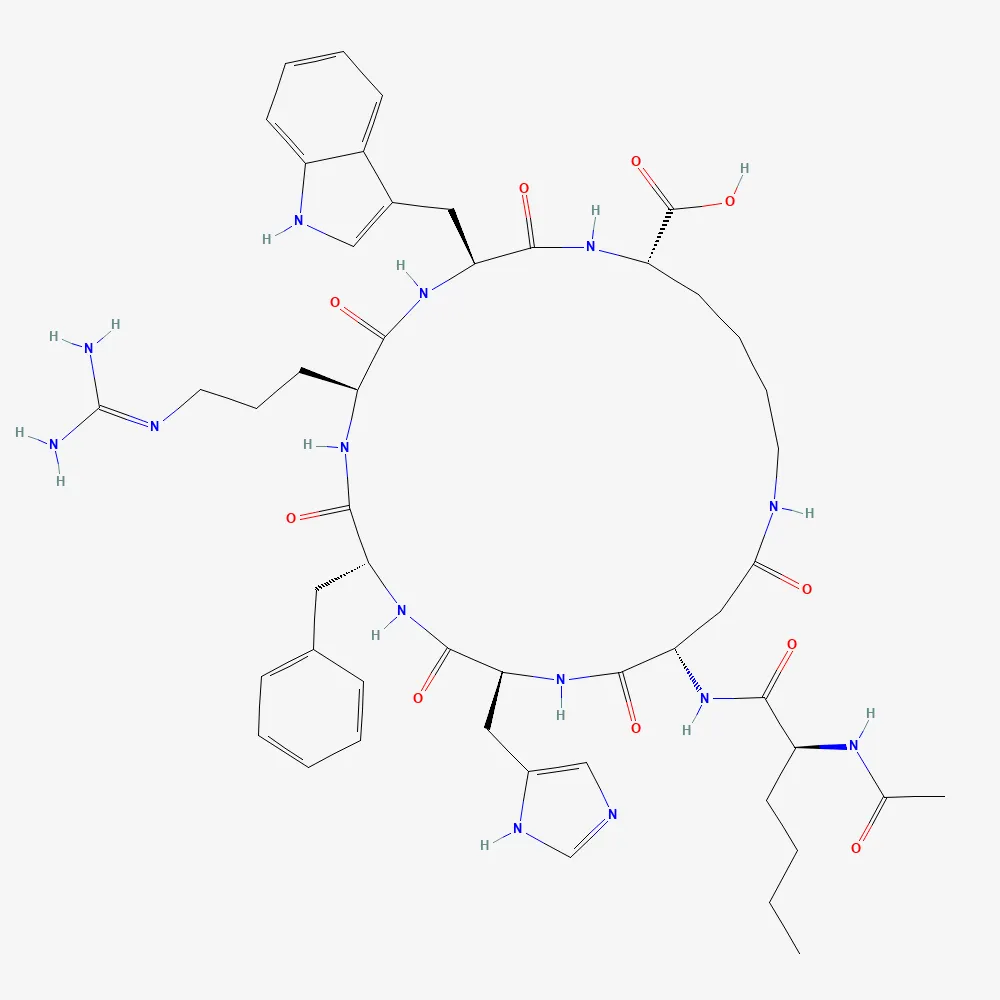
- Molecular formula
- C50H68N14O10
- Molecular weight
- 1025.2 g/mol
- Length
- 7 amino acids
- Sequence
- XDHFRWK
- Modifications
- N-terminal acetyl on X1 = norleucine (Nle); D-Phe4; cyclic: lactam bond between the Asp2 and Lys7 side chains; C-terminal free acid.
- PubChem CID
- 9941379
Vyleesi is bremelanotide acetate; the diagram is the peptide itself. It is the free-acid form of the melanotan II ring (melanotan II ends in an amide).
Identity checked against FDA prescribing information (Vyleesi), DailyMed.
How PT-141 works
PT-141 does not work on blood flow the way erectile dysfunction drugs do. It acts on pathways in the brain associated with sexual desire.
PT-141 benefits: what the research shows
The RECONNECT programme ran 2 identical Phase 3 trials: randomised, double-blind, placebo-controlled and multicentre. They tested bremelanotide 1.75 mg under the skin, as needed, in premenopausal women with hypoactive sexual desire disorder. Both “demonstrated that bremelanotide significantly improved sexual desire and related distress” in that population Kingsberg 2019 - Kingsberg SA, Clayton AH, Portman D et al. Bremelanotide for the Treatment of Hypoactive Sexual Desire Disorder: Two Randomized Phase 3 Trials. Obstet Gynecol. 2019;134(5):899-908., in the references below.
Further work backs this up:
- prespecified and integrated subgroup analyses Simon 2022 - Simon JA, Kingsberg SA, Portman D et al. Prespecified and Integrated Subgroup Analyses from the RECONNECT Phase 3 Studies of Bremelanotide. J Womens Health (Larchmt). 2022;31(3):391-400., in the references below
- responder analyses from the earlier Phase 2b dose-ranging study Althof 2019 - Althof S, Derogatis LR, Greenberg S et al. Responder Analyses from a Phase 2b Dose-Ranging Study of Bremelanotide. J Sex Med. 2019;16(8):1226-1235., in the references below
- a safety review across the whole clinical development programme Clayton 2022 - Clayton AH, Kingsberg SA, Portman D et al. Safety Profile of Bremelanotide Across the Clinical Development Program. J Womens Health (Larchmt). 2022;31(2):171-182., in the references below
Who were the trials actually run on?
The trials enrolled premenopausal women with acquired, generalised hypoactive sexual desire disorder. That is also the approved indication Clayton 2022 - Clayton AH, Kingsberg SA, Portman D et al. Safety Profile of Bremelanotide Across the Clinical Development Program. J Womens Health (Larchmt). 2022;31(2):171-182., in the references below. The grey market sells PT-141 mostly to men, for erections and libido.
The main trial in men is an older one, in men who had not responded to sildenafil Safarinejad 2008 - Safarinejad MR, Hosseini SY. Salvage of sildenafil failures with bremelanotide: a randomized, double-blind, placebo controlled study. J Urol. 2008;179(3):1066-71., in the references below. In 2023 The Journal of Urology, which published it, issued a formal Expression of Concern about it Safarinejad 2023 - Safarinejad MR, Hosseini SY. Expression of Concern: Salvage of Sildenafil Failures With Bremelanotide: A Randomized, Double-Blind, Placebo Controlled Study. J Urol. 2023., in the references below. It has not been retracted, but the notice is part of its record. That work never produced an approval, and the modern trials, the safety database and the licensed product all concern women.
PT-141 dosage
Here a study does set a dose: 1.75 mg, injected under the skin, as needed Kingsberg 2019 - Kingsberg SA, Clayton AH, Portman D et al. Bremelanotide for the Treatment of Hypoactive Sexual Desire Disorder: Two Randomized Phase 3 Trials. Obstet Gynecol. 2019;134(5):899-908., in the references below, matching the approved Vyleesi label. Full detail: PT-141 dosage.
“As needed” means it is taken before expected sexual activity, not daily and not in cycles. That pattern differs from nearly everything else on this site, and from how vendor protocols for “PT-141” tend to describe it.
PT-141 nasal spray vs the approved injection
The only approved form is Vyleesi: 1.75 mg in a single-dose autoinjector, used under the skin of the abdomen or thigh. No nasal spray has been approved.
A nasal spray was the first form tested:
- In a study by Palatin, the developer, in healthy men and men with erectile dysfunction, blood levels peaked about 30 minutes after a nasal dose, and the half-life was about 2 hours. At the higher doses, the first erection came about 30 minutes after dosing Diamond 2004 - Diamond LE, Earle DC, Rosen RC et al. Double-blind, placebo-controlled evaluation of the safety, pharmacokinetic properties and pharmacodynamic effects of intranasal PT-141, a melanocortin receptor agonist, in healthy males and patients with mild-to-moderate erectile dysfunction. Int J Impot Res. 2004;16(1):51-9., in the references below.
- In a Palatin study of 18 premenopausal women with arousal disorder, more reported moderate or high desire after a single nasal dose than after placebo Diamond 2006 - Diamond LE, Earle DC, Heiman JR et al. An effect on the subjective sexual response in premenopausal women with sexual arousal disorder by bremelanotide (PT-141), a melanocortin receptor agonist. J Sex Med. 2006;3(4):628-638., in the references below.
- The separate 2008 trial in men who had not responded to sildenafil also used a nasal spray Safarinejad 2008 - Safarinejad MR, Hosseini SY. Salvage of sildenafil failures with bremelanotide: a randomized, double-blind, placebo controlled study. J Urol. 2008;179(3):1066-71., in the references below. That paper now carries the Expression of Concern described above.
Palatin then dropped the spray. In August 2010 it said blood pressure rises in some patients, “coupled with significant variation in plasma levels”, led it to stop nasal bremelanotide as a first-line therapy. Injection under the skin gave steadier blood levels, and that is the form FDA approved in 2019.
What isn’t known is how much PT-141 a spray sold online delivers. No regulator checks how much it holds, and I found no study of how much reaches the blood. The nasal trials also used doses several times the 1.75 mg injection, and blood levels varied widely.
PT-141 side effects
These figures come from the adverse-reaction table in the Vyleesi label, built from the Phase 3 trials.
When starting
- Nausea is by far the most common: 40% on bremelanotide versus 1% on placebo. It usually starts within an hour of a dose, lasts about two hours and is worst after the first dose. The label suggests taking it with food or using an anti-nausea drug, and 8% of patients stopped treatment because of it.
- Flushing: 20% versus under 1% on placebo.
- Headache: 11% versus 2%.
Ongoing
Blood pressure rises briefly after each dose, by about 6 mmHg systolic and 3 mmHg diastolic on average, peaking 2-4 hours after the dose. Heart rate falls by up to 5 beats per minute. Both return to baseline within about 12 hours.
Vyleesi also significantly reduces the effect of naltrexone taken by mouth, so the label says not to combine them.
Rare but serious
- Heart and blood pressure. Because of the blood-pressure rise after each dose, the label contraindicates Vyleesi in anyone with uncontrolled hypertension or known cardiovascular disease.
- Skin darkening. Patches of darker skin (focal hyperpigmentation), including on the face and gums, were reported by 1% of patients after up to 8 monthly doses. It can persist, and the label says to consider stopping if it develops.
For the injection itself, see injection-site reactions for what is ordinary and what needs attention.
Get medical care for chest pain, a pounding or irregular heartbeat, or severe or persistent nausea; the label’s warnings are built around these. A research-chemical vial comes with no clinician managing the dose or your blood pressure. See dosing for what the trials and label use.
Is PT-141 legal?
US legal status - FDA-approved · prescription only
Bremelanotide is an FDA-approved prescription medicine for premenopausal women with acquired, generalised hypoactive sexual desire disorder. Research-chemical vendors sell the same molecule name without the approval, the quality control, or the indication.
On most pages here, “not approved” is the whole story. PT-141 is the reverse.
An approved version exists. It is made to pharmaceutical standards, its contents are verified, and it comes with a clinician who knows your blood pressure. The research-chemical version carries the same name, but no regulator checks that the vial matches its label.
Regulatory changes for this compound and others, as they happen: US peptide regulation tracker.
Related
How PT-141 compares
Melanocortin peptides. Doses for unapproved compounds are common practice, not trial-established. All hormones and sexual health peptides →
| Compound | Main use | Evidence | Usual dose | US status |
|---|---|---|---|---|
| PT-141 | Approved for premenopausal women with acquired, generalised hypoactive sexual desire disorder. Sold in grey channels predominantly to men. | Strong human evidence | FDA label | FDA-approved · prescription only |
| Melanotan II | Marketed to consumers as a tanning aid, sold unapproved and outside any FDA-cleared indication. | Limited human data | 100-1000 mcg, daily loading dose of 100-1000 mcg for several weeks, then 250-1000 mcg 1-3 times a week for maintenance | Research use only |
Where to get PT-141 legally
PT-141 is an FDA-approved prescription medicine, so the legal route is a licensed prescriber, in person or by telehealth, and a licensed pharmacy.
With a prescription, Vyleesi costs $99 for a 4-dose box without insurance, says its maker, Cosette Pharmaceuticals (as of 3 October 2026).
Every legal route for PT-141, with dated prices →
How telehealth prescribing works, what it costs and what to check: telehealth peptide prescribing.
Research-labelled PT-141 (not the approved medicine)
These checked vendors sell a research-labelled version. It has not been reviewed by FDA, is labelled not for human use, and is tested only as the seller chooses.
1.Next Level Pharm
10 mg vial
- No FDA warning letter found
- Names its testing lab
- Batch COAs published
- Takes card payment
2.Spartan Peptides
10 mg vial
- No FDA warning letter found
- Names its testing lab
3.BioEdge Research Labs
10 mg vial
- No FDA warning letter found
- Names its testing lab
- Batch COAs published
How research-labelled PT-141 differs, and what FDA has said →
Common questions
Is PT-141 FDA-approved?
Yes, but more narrowly than most pages selling it suggest. It is approved for premenopausal women with acquired, generalised hypoactive sexual desire disorder. That is the population it was trialled in.
What is the approved dose of PT-141?
The Phase 3 trials used 1.75 mg injected under the skin as needed, not daily and not on a cycle. That figure comes from published trials rather than a vendor protocol, which is unusual in this space.
Does PT-141 work for men?
The evidence in men is old. Early studies of a nasal spray measured erections in the clinic. The main trial, in men who had not responded to sildenafil, received a formal Expression of Concern from its journal in 2023. None of it led to an approval for men. The modern evidence and the approval are in premenopausal women, so the trials vendor pages lean on were not run on men.
Is buying PT-141 as a research chemical the same thing?
No. It is the same molecule name on an unverified product. Unusually for this site, a quality-controlled, approved version exists, which makes the research-chemical route harder to justify here than almost anywhere else I cover.
What are the side effects of PT-141?
Per the Vyleesi label, nausea is by far the most common: 40% of patients versus 1% on placebo, usually within an hour of a dose. Flushing (20%) and headache (11%) are also common. Blood pressure rises and heart rate falls briefly after each dose, so it is contraindicated with uncontrolled hypertension or known cardiovascular disease. Less common: patches of darker skin after repeated doses, and an interaction with oral naltrexone.
What does PT-141 feel like?
I found no validated description; the trials measured desire and distress scores, not sensations. The Vyleesi label documents how a dose commonly affects people: nausea in 40% (usually within an hour, worst after the first dose), flushing in 20%, headache in 11%, and a brief rise in blood pressure.
Is PT-141 nasal spray safe?
Its safety has not been established. The only approved form is Vyleesi, an injection under the skin, and the label's safety data come from that route. The developer tested a nasal spray first, then dropped it because blood pressure rose in some patients and blood levels varied widely. A research-sold spray has no verified contents or dose.
Does PT-141 work as a nasal spray?
Early trials of a nasal version reported effects on erections in men and on desire in women. The developer dropped it over blood pressure rises and uneven absorption, and FDA approved the injection instead. No nasal spray has been approved, and research-sold sprays have no verified contents.
How long does it take for nasal PT-141 to work?
In the developer's 2004 study of a nasal version in men, the first erection came about 30 minutes after a dose. That spray was never approved. The Vyleesi label says to inject at least 45 minutes before sexual activity, and that the best timing has not been fully worked out. A research-sold spray has no verified dose, so no timing applies to it.
Can I buy PT-141 nasal spray online?
Sprays are sold online, but no nasal form of PT-141 is FDA-approved. A spray sold as a research chemical has no verified contents or dose. The approved product is Vyleesi, an injection prescribed by a clinician and dispensed by a pharmacy.
Is PT-141 better than Viagra?
They are not directly comparable, and no trial on this page compares them. Viagra (sildenafil) treats erectile dysfunction through blood flow. PT-141 acts on brain pathways tied to desire and is approved only for premenopausal women with low desire. The main trial in men cited here enrolled sildenafil non-responders and now carries an Expression of Concern.
What is the brand name of bremelanotide?
Bremelanotide is sold under the brand name Vyleesi, made by Cosette Pharmaceuticals. Vyleesi is approved for acquired, generalized hypoactive sexual desire disorder (low sexual desire causing marked distress) in premenopausal women; not for postmenopausal women or men, and not to enhance sexual performance.
What is the generic name for Vyleesi?
The generic name for Vyleesi is bremelanotide. Vyleesi is Cosette Pharmaceuticals's brand, approved for acquired, generalized hypoactive sexual desire disorder (low sexual desire causing marked distress) in premenopausal women; not for postmenopausal women or men, and not to enhance sexual performance.
Is Vyleesi the same as bremelanotide?
Yes. Vyleesi is a brand of bremelanotide, made by Cosette Pharmaceuticals: the active ingredient is bremelanotide. It comes as a as-needed subcutaneous injection (single-dose autoinjector), dosed at 1.75 mg at least 45 minutes before sexual activity; no more than 1 dose in 24 hours or 8 doses a month. Compounded or research-vial bremelanotide is not Vyleesi and has not been through its FDA review.
References (10 sources)
Bibliographic detail is fetched from PubMed, not written by me - so a citation here cannot drift from the paper it names. Study design comes from PubMed's own tags rather than my judgement.
- 1.Kingsberg SA, Clayton AH, Portman D et al. Bremelanotide for the Treatment of Hypoactive Sexual Desire Disorder: Two Randomized Phase 3 Trials. Obstet Gynecol. 2019;134(5):899-908.Randomised trialPMID 31599840full text
- 2.Simon JA, Kingsberg SA, Portman D et al. Prespecified and Integrated Subgroup Analyses from the RECONNECT Phase 3 Studies of Bremelanotide. J Womens Health (Larchmt). 2022;31(3):391-400.Randomised trialPMID 35230162
- 3.Clayton AH, Kingsberg SA, Portman D et al. Safety Profile of Bremelanotide Across the Clinical Development Program. J Womens Health (Larchmt). 2022;31(2):171-182.Randomised trialPMID 35147466
- 4.Althof S, Derogatis LR, Greenberg S et al. Responder Analyses from a Phase 2b Dose-Ranging Study of Bremelanotide. J Sex Med. 2019;16(8):1226-1235.Randomised trialPMID 31277966
- 5.Safarinejad MR, Hosseini SY. Salvage of sildenafil failures with bremelanotide: a randomized, double-blind, placebo controlled study. J Urol. 2008;179(3):1066-71.Randomised trialPMID 18206919
- 6.Safarinejad MR, Hosseini SY. Expression of Concern: Salvage of Sildenafil Failures With Bremelanotide: A Randomized, Double-Blind, Placebo Controlled Study. J Urol. 2023.StudyPMID 36626345
- 7.Diamond LE, Earle DC, Rosen RC et al. Double-blind, placebo-controlled evaluation of the safety, pharmacokinetic properties and pharmacodynamic effects of intranasal PT-141, a melanocortin receptor agonist, in healthy males and patients with mild-to-moderate erectile dysfunction. Int J Impot Res. 2004;16(1):51-9.Randomised trialPMID 14963471
- 8.Diamond LE, Earle DC, Heiman JR et al. An effect on the subjective sexual response in premenopausal women with sexual arousal disorder by bremelanotide (PT-141), a melanocortin receptor agonist. J Sex Med. 2006;3(4):628-638.Randomised trialPMID 16839319
- 9.VYLEESI (bremelanotide injection) prescribing information on DailyMed, label revised 03/2024: 1.75 mg single-dose autoinjector, at least 45 minutes before sexual activity- US National Library of Medicine (DailyMed), label by Cosette Pharmaceuticalslabel
- 10.Palatin Technologies press release, 17 August 2010: blood pressure rises and variable plasma levels led it to stop nasal bremelanotide; subcutaneous dosing gave consistent levels- Palatin Technologiesnews