Sermorelin: Cost, Benefits, Dosage and Side Effects
Sermorelin cost ($99-$199 a month at telehealth clinics), nasal spray and tablet forms, the trial doses, side effects and legal status.

The short version
Sermorelin is a fragment of growth hormone-releasing hormone that tells the pituitary to release its own growth hormone. It was studied and approved for children with growth hormone deficiency. It is now sold to adults for sleep, body composition and aging, a use with very little controlled evidence behind it. Telehealth clinics charged $99 to $199 a month for it as of 3 October 2026.
- The controlled trials are in children with growth hormone deficiency, not in healthy adults.
- It is supplied by compounding pharmacies and needs a prescriber.
- The studied doses are weight-based and for children. The fixed adult protocols online are a different regimen.
- Only the injection has trial data. Little of a nasal dose is absorbed, and I found no study of tablets.
Sermorelin at a glance
- What it is
- GHRH analogue (first 29 amino acids)
- Main use
- Marketed to adults for sleep, body composition and aging. Its former FDA approvals, as Geref, were for growth hormone deficiency in children and a 0.05 mg diagnostic test; both are discontinued.
- Generic name
- sermorelin
- Brand names
- Geref (discontinued in the US) Label
- Also called
- GHRH(1-29)NH2, Sermorelin acetate
- Molecular formula
- C149H246N44O42S (3357.9 g/mol) Structure
- Evidence
- Limited human data
- US status
- Unapproved drug
- Half-life
- Not established for the marketed adult use in humans
- How it is taken
- Subcutaneous injection
- Common protocol
- 200-600 mcg, once nightly; most protocols run 5-7 nights a week, some as 5 days on/2 off (common practice, not trial-established) Dosing page
Dosing: what the studies used.
Sermorelin prompts the pituitary to release its own growth hormone. It was approved for children with growth hormone deficiency and is now prescribed to adults for sleep, body composition and aging. Telehealth clinics listed it at $99 to $199 a month on 3 October 2026.
Most of what is written about it comes from people selling it, and two facts tend to go missing: the trials were in children, and FDA found the approved products were not withdrawn for safety or effectiveness reasons.
What is sermorelin?
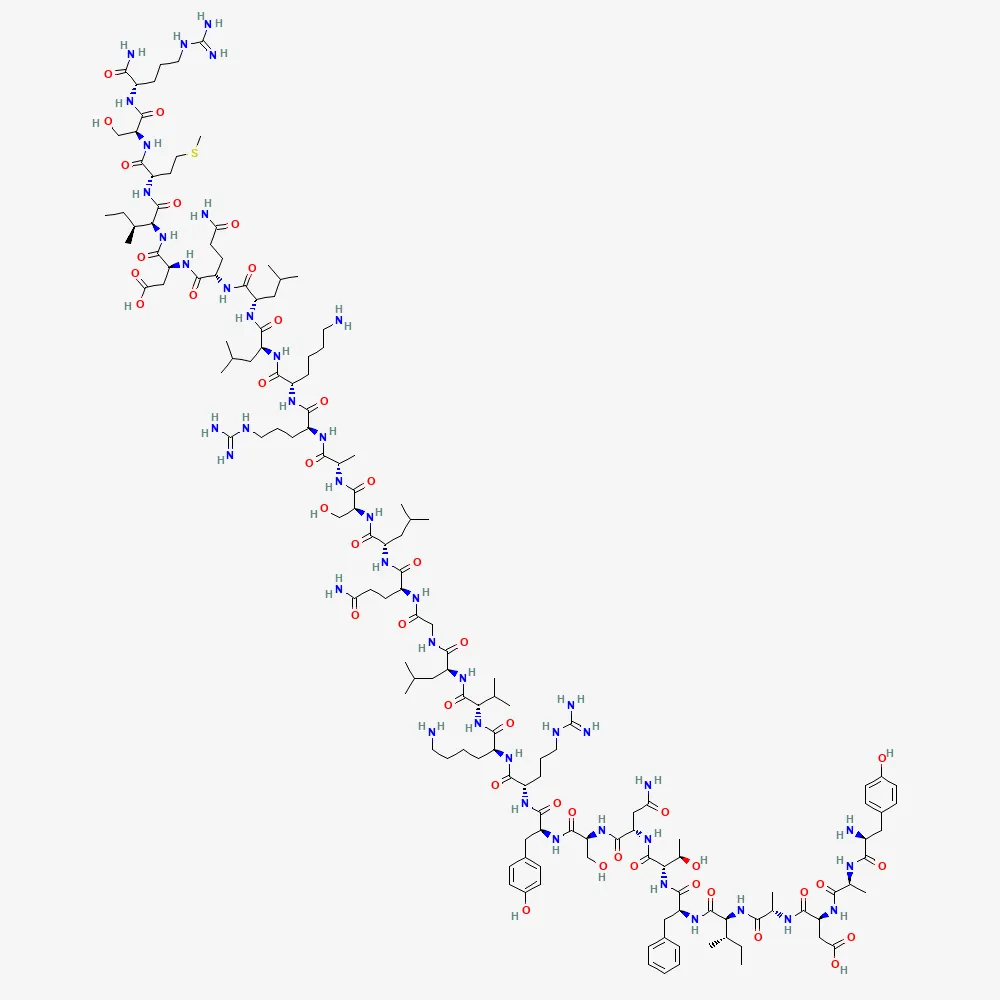
Sermorelin is GHRH(1-29)NH2: the first 29 amino acids of growth hormone-releasing hormone. The natural hormone is 44 amino acids long, and this fragment is the shortest synthetic peptide with the full biological activity of GHRH Prakash 1999 - Prakash A, Goa KL. Sermorelin: a review of its use in the diagnosis and treatment of children with idiopathic growth hormone deficiency. BioDrugs. 1999;12(2):139-57., in the references below.
It works indirectly, and that is the main argument for it. Rather than supplying growth hormone, sermorelin prompts the pituitary to release its own. The body’s somatostatin feedback stays in place, so release stays pulsatile in a way that injected growth hormone does not Ehlers 2001 - Ehlers MR. Recombinant human GHRH(1-44)NH2: clinical utility and therapeutic development program. Endocrine. 2001;14(1):137-41., in the references below.
Sermorelin structure
Sermorelin benefits: what the research shows
The controlled evidence is in children with growth hormone deficiency, the use it was developed and approved for.
- A review by Prakash and Goa covers its use in diagnosing and treating children with idiopathic growth hormone deficiency Prakash 1999 - Prakash A, Goa KL. Sermorelin: a review of its use in the diagnosis and treatment of children with idiopathic growth hormone deficiency. BioDrugs. 1999;12(2):139-57., in the references below.
- A multicentre comparative trial measured growth response to GHRH(1-29)-NH2 against growth hormone itself Neyzi 1993 - Neyzi O, Yordam N, Ocal G et al. Growth response to growth hormone-releasing hormone(1-29)-NH2 compared with growth hormone. Acta Paediatr Suppl. 1993;388:16-21; discussion 22., in the references below.
- A study in adults, not a treatment trial, compared 20 tall and 20 short healthy men aged 18 to 27, using GHRH as a stimulation test. It found no difference in growth hormone secretion between them Trainer 1999 - Trainer PJ, Palermo M, Kirk JM et al. Quantitative growth hormone secretion and final adult height. Clin Endocrinol (Oxf). 1999;51(5):597-602., in the references below.
That is a real evidence base, but it is about children who were growing.
Does sermorelin work for sleep, fat loss or anti-aging?
Adults buying sermorelin today are after something else: better sleep, fat loss, muscle tone, recovery and “anti-aging”.
A PubMed search for randomised controlled trials of sermorelin in adults returns a small set. Most of it covers growth in children or sermorelin’s other established role, as a diagnostic test of pituitary function. That is a different job from long-term treatment.
The nearest adult evidence I found reports that growth hormone secretagogue treatment raised blood IGF-1 in hypogonadal men Sigalos 2017 - Sigalos JT, Pastuszak AW, Allison A et al. Growth Hormone Secretagogue Treatment in Hypogonadal Men Raises Serum Insulin-Like Growth Factor-1 Levels. Am J Mens Health. 2017;11(6):1752-1757., in the references below. Raising IGF-1 is what the drug is supposed to do. But it is a biomarker moving in men with a diagnosed hormonal condition, not a healthy adult sleeping better or losing fat.
How sermorelin compares with other peptides sold for sleep: peptides for sleep.
Sermorelin dosage
These are the doses the studies used. The sermorelin dosage page gives the same figures with more context.
- Diagnosis: a single intravenous dose of 1 microgram per kilogram of bodyweight, to test whether the pituitary can release growth hormone at all Prakash 1999 - Prakash A, Goa KL. Sermorelin: a review of its use in the diagnosis and treatment of children with idiopathic growth hormone deficiency. BioDrugs. 1999;12(2):139-57., in the references below.
- Treatment in children: 30 micrograms per kilogram of bodyweight, once daily, under the skin, at bedtime, in prepubertal children with idiopathic growth hormone deficiency Prakash 1999 - Prakash A, Goa KL. Sermorelin: a review of its use in the diagnosis and treatment of children with idiopathic growth hormone deficiency. BioDrugs. 1999;12(2):139-57., in the references below.
- A comparative trial used a low-dose arm of 30 micrograms/kg/day split into three daily doses and a high-dose arm of 60 micrograms/kg/day Neyzi 1993 - Neyzi O, Yordam N, Ocal G et al. Growth response to growth hormone-releasing hormone(1-29)-NH2 compared with growth hormone. Acta Paediatr Suppl. 1993;388:16-21; discussion 22., in the references below.
The review that reports the 30 mcg/kg regimen hedges it in the same sentence (“limited data indicate”). It also says the effect of long-term treatment on final adult height is yet to be determined.
Sermorelin also did less than growth hormone itself. At the same 30 mcg/kg/day, children’s growth rate rose less on sermorelin than on growth hormone Prakash 1999 - Prakash A, Goa KL. Sermorelin: a review of its use in the diagnosis and treatment of children with idiopathic growth hormone deficiency. BioDrugs. 1999;12(2):139-57., in the references below.
Sermorelin nasal spray, tablets and injections
The telehealth clinics I checked sell sermorelin in three forms: a nightly injection under the skin, a nasal spray, and a tablet dissolved under the tongue. A pharmacy compounds each one on prescription. Only the injection has trial data behind it.
- Injection. The children’s treatment regimen was a nightly injection under the skin Prakash 1999 - Prakash A, Goa KL. Sermorelin: a review of its use in the diagnosis and treatment of children with idiopathic growth hormone deficiency. BioDrugs. 1999;12(2):139-57., in the references below. A 6-week study of 11 healthy older men also used nightly self-injections Vittone 1997 - Vittone J, Blackman MR, Busby-Whitehead J et al. Effects of single nightly injections of growth hormone-releasing hormone (GHRH 1-29) in healthy elderly men. Metabolism. 1997;46(1):89-96., in the references below.
- Nasal spray. In 30 healthy men, only 3-5% of a nasal dose was absorbed. A nasal dose about 50 times the intravenous dose gave a similar growth hormone rise Wilton 1993 - Wilton P, Chardet Y, Danielson K et al. Pharmacokinetics of growth hormone-releasing hormone(1-29)-NH2 and stimulation of growth hormone secretion in healthy subjects after intravenous or intranasal administration. Acta Paediatr Suppl. 1993;388:10-5., in the references below. In a 6-month pilot in 8 children with growth hormone deficiency, the response to the spray faded and 3 children developed antibodies to it. Growth did not speed up over 6 months, most children had sneezing or a burning nose, and the researchers judged the spray unsuitable in that form Hümmelink 1993 - Hümmelink R, Sippell WG, Benoit KG et al. Intranasal administration of growth hormone-releasing hormone(1-29)-NH2 in children with growth hormone deficiency: effects on growth hormone secretion and growth. Acta Paediatr Suppl. 1993;388:23-6; discussion 27., in the references below.
- Tablets. I found no published study of sermorelin taken by mouth or under the tongue.
I found no trial of a compounded spray or tablet in adults, so there is no evidence on whether either one changes IGF-1, sleep or body composition.
Sermorelin side effects
The GEREF products were discontinued in 2008 and their label is no longer listed on DailyMed. What follows comes from the children’s trials, not a current FDA-reviewed label.
Reported in studies
In the diagnostic and treatment trials, brief facial flushing and injection-site pain were the most common side effects. Both the single diagnostic dose and repeated daily doses were well tolerated Prakash 1999 - Prakash A, Goa KL. Sermorelin: a review of its use in the diagnosis and treatment of children with idiopathic growth hormone deficiency. BioDrugs. 1999;12(2):139-57., in the references below. Those trials were in children with growth hormone deficiency, not the healthy adults it is marketed to today.
Rare but serious
Excess growth hormone from any GH-releasing therapy carries known risks:
- fluid retention and swelling in the arms, legs and face
- joint and nerve pain
- insulin resistance
- with chronic excess, high blood pressure, an enlarged heart (cardiac hypertrophy) and possibly cardiomyopathy.
USADA names these harms for GH-releasing factors specifically (see the sport section). Today’s sermorelin comes from compounding pharmacies, so its quality depends on each pharmacy’s own checks rather than a single FDA-reviewed manufacturing standard.
For the injection itself, see injection-site reactions for what is ordinary and what needs attention.
Is sermorelin legal?
US legal status - FDA-approved · prescription only
Sermorelin was an FDA-approved prescription medicine that is no longer marketed as one. Both GEREF products were moved to the Orange Book's Discontinued Drug Product List after the sponsor discontinued them in 2008. It reaches patients today through compounding pharmacies, and still requires a prescriber.
Sermorelin was approved, then discontinued, and FDA’s own record explains how. Two products were approved:
- GEREF injection, 0.05 mg base/amp: NDA 19-863, approved on 28 December 1990.
- GEREF injection, 0.5 and 1.0 mg base/vial: NDA 20-443, held by EMD Serono, approved on 26 September 1997.
In letters dated July and December 2008, EMD Serono told FDA it was discontinuing both products and asked FDA to withdraw both NDAs. FDA moved them to the Orange Book’s Discontinued Drug Product List and withdrew both approvals effective 18 June 2009.
In 2013 FDA formally determined that these products were not withdrawn from sale for reasons of safety or effectiveness. The determination was published in the Federal Register under docket FDA-2012-P-1071.
Can sermorelin be compounded?
Sermorelin is not a biologic, so the rule FDA applies to compounded hCG and tesamorelin does not reach it. FDA’s 2020 transition of protein drugs to biologics licences did not affect peptides of 40 or fewer amino acids, and sermorelin has 29.
Outsourcing facilities compound under section 503B. FDA’s list of substances nominated for 503B compounding puts sermorelin acetate in Category 1 (under evaluation) and marks it as a component of an FDA-approved drug. FDA says it does not intend to take action against an outsourcing facility compounding with a Category 1 substance, provided the conditions in its guidance are met.
Sermorelin is in none of the three categories on FDA’s list of substances nominated for 503A compounding, updated 14 May 2026. Where no USP or NF monograph applies, a 503A pharmacy may use a bulk substance that is a component of an FDA-approved drug. FDA points to the Orange Book for that test, and the Orange Book still lists GEREF in its discontinued section. I found no FDA statement on whether sermorelin itself meets the 503A rules.
Where to get sermorelin legally
In the US, sermorelin needs a prescription. A licensed prescriber, in person or by telehealth, decides whether to prescribe it, and a state-licensed compounding pharmacy makes it. No FDA-approved sermorelin is on the market, so every prescription is filled by a compounding pharmacy.
It is not sold over the counter. Research-chemical sites sell sermorelin vials labelled for research use only, not for human use. No regulator checks what is in those vials.
The prescription is worth using rather than routing around: it gives you a clinician, bloodwork and someone accountable for the decision. Before paying a clinic, check that a licensed prescriber reviews your history, that the compounding pharmacy is named and state-licensed, and what the monthly price includes.
How much does sermorelin cost?
Sermorelin costs $99 to $199 a month at the US telehealth clinics I checked on 3 October 2026. Each lists a monthly price, and each prescribes only after an evaluation by a licensed prescriber.
| Clinic | Form | Monthly price, as of 3 October 2026 |
|---|---|---|
| AgelessRx | Injection | From $99 |
| AgelessRx | Nasal spray | $149 the first month, then $199 |
| Sermorelin.com | Injection or under-the-tongue tablet | $199 month to month; $169 on a 3-month plan; $149 on a 6-month plan |
| GOAL.MD | Injection | $199 month to month; $179 on a 3-month bundle |
These are list prices from each clinic’s own page, and they change. AgelessRx’s page notes that FDA has not reviewed or approved compounded products for safety, effectiveness or quality. I don’t rank clinics.
If you compete, this one is simple
Sermorelin is banned in sport at all times, not only in competition. USADA says: “Yes, Sermorelin is prohibited due to its ability to enhance muscle growth, endurance, and recovery by boosting endogenous hGH production.” It sits in the growth hormone releasing factors section of the WADA Prohibited List, alongside CJC-1295.
An exemption is unlikely. Per the US Anti-Doping Agency, “it is highly unlikely a TUE would be approved for Sermorelin, as it is not a first-line treatment for growth hormone deficiency and there are alternative treatments available.” If you are tested, a prescription from a wellness clinic won’t make it allowed after the fact.
Regulatory changes for this compound and others, as they happen: US peptide regulation tracker.
How Sermorelin compares
GHRH analogues (act on the GHRH receptor). Doses for unapproved compounds are common practice, not trial-established. All growth hormone and muscle peptides →
| Compound | Main use | Evidence | Usual dose | US status |
|---|---|---|---|---|
| CJC-1295 | Investigated as a long-acting growth hormone-releasing hormone analogue to raise GH and IGF-I. Reached Phase 2 and was discontinued; never approved for any indication. | Limited human data | 100-300 mcg, once daily, 5 days a week (5 days on, 2 off), usually the no-DAC form | Research use only |
| Tesamorelin | Approved for reducing excess visceral abdominal fat in people with HIV-associated lipodystrophy. | Strong human evidence | FDA label | FDA-approved · prescription only |
| Sermorelin | Marketed to adults for sleep, body composition and aging. Its former FDA approvals, as Geref, were for growth hormone deficiency in children and a 0.05 mg diagnostic test; both are discontinued. | Limited human data | 200-600 mcg, once nightly; most protocols run 5-7 nights a week, some as 5 days on/2 off | Unapproved drug |
Where to get Sermorelin legally
No FDA-approved sermorelin is on the market: both GEREF products were discontinued in 2008, and patients now get it as a compounded drug on prescription.
With a prescription, compounded sermorelin injections start at $99 a month at AgelessRx (as of 3 October 2026).
Every legal route for sermorelin, with dated prices →
How telehealth prescribing works, what it costs and what to check: telehealth peptide prescribing.
Research-labelled sermorelin (not a prescription product)
These checked vendors sell a research-labelled version. No prescriber or pharmacist is involved, it is labelled not for human use, and it is tested only as the seller chooses.
1.Next Level Pharm
5 mg vial
- No FDA warning letter found
- Names its testing lab
- Batch COAs published
- Takes card payment
2.BioEdge Research Labs
5 mg vial
- No FDA warning letter found
- Names its testing lab
- Batch COAs published
How research-labelled sermorelin differs, and what FDA has said →
Common questions
What was sermorelin actually approved for?
Growth hormone deficiency in children, which is where its controlled trial evidence is. It is no longer marketed as an approved product in the US, so it reaches patients through compounding pharmacies rather than as a branded prescription medicine.
How is sermorelin different from taking growth hormone?
Sermorelin acts one step earlier. It prompts the pituitary to release its own growth hormone, so the body's feedback control stays in place and release stays pulsatile; injected growth hormone bypasses that. It is a real pharmacological difference, but a mechanism argument, not evidence of a better outcome.
What dose of sermorelin should I take?
The studies used 1 microgram/kg intravenously as a diagnostic test, and 30 micrograms/kg daily at bedtime for prepubertal children with growth hormone deficiency. Those are weight-based doses for children. The fixed adult doses online are a different regimen, and no adult trial of the marketed outcomes established them. Sermorelin needs a prescriber, and the dose is their call with your bloodwork in front of them.
What are the side effects of sermorelin?
In the children's trials, brief facial flushing and injection-site pain were the most common side effects, and both diagnostic and repeated treatment doses were well tolerated. Those children are not the healthy adults it is sold to now, and FDA withdrew the GEREF approvals in 2009 at the maker's request. Excess growth hormone from any GH-releasing therapy carries known risks: fluid retention, joint pain, insulin resistance and, with chronic excess, heart strain.
What will sermorelin do to your body?
It prompts your pituitary to release its own growth hormone, in pulses, with the body's feedback control still in place. In some children with growth hormone deficiency that raised growth rates. In adults, the small studies I found show hormone changes and, in one 6-week study of older men, gains on 2 of 6 strength measures, not the sleep, fat-loss or anti-aging results it is marketed for. Flushing and injection-site pain were the most common side effects in the children's trials.
How much weight will you lose on sermorelin?
No trial I found shows that sermorelin causes weight loss, so there is no figure to give. In a 6-week study with no placebo group, 11 healthy men aged 64 to 76 injected it nightly, and their weight and body composition did not change. Fat-loss claims come from the compounding market, not from controlled trials in adults.
Is 3 months of sermorelin enough?
I found no trial establishing how long adults should take sermorelin, so there is no evidence that 3 months, or any other length, is enough. The prescriber protocols I found describe continuous nightly use, reassessed against IGF-1 bloodwork, rather than a fixed cycle. That is common practice, not trial-established, and the decision belongs with the prescriber.
What is the average monthly cost of sermorelin therapy?
The listed prices I checked on 3 October 2026 ran from $99 to $199 a month at telehealth clinics. AgelessRx listed injections from $99. Sermorelin.com and GOAL.MD listed $199 month to month, with lower monthly prices on 3- or 6-month plans. Each prescribes only after an evaluation by a licensed prescriber.
Where is the best place to get sermorelin online?
I don't rank clinics. The legal route in the US is a licensed prescriber, in person or by telehealth, and a state-licensed compounding pharmacy. Before paying, check that a prescriber reviews your history, that the pharmacy is named and licensed, and what the monthly price includes.
Can you buy sermorelin over the counter?
No. In the US it needs a prescription and is made by a compounding pharmacy, because no FDA-approved sermorelin product is on the market. Research-chemical sites sell sermorelin vials labelled not for human use, and no regulator checks what is in them.
Are sermorelin nasal sprays effective?
I found no trial of a compounded sermorelin spray in adults. In 30 healthy men, only 3 to 5% of a nasal dose was absorbed. In a 6-month pilot in 8 children, the response to the spray faded, 3 children developed antibodies to it, and growth did not speed up. Those researchers judged the spray unsuitable in that form.
Does oral sermorelin work?
I found no published study of sermorelin taken by mouth or as a tablet under the tongue. So there is no evidence that a tablet raises growth hormone or IGF-1. The trial evidence on this page comes from injections.
What are the cons of taking sermorelin?
The adult evidence is thin: the controlled trials were in children, and I found no trial in healthy adults for sleep, fat loss or aging. It needs a prescription and costs $99 to $199 a month at the clinics I checked. Most protocols use a nightly injection. Excess growth hormone can cause fluid retention, joint pain and insulin resistance, and sermorelin is banned in sport at all times.
How long does it take for sermorelin to kick in?
After an intravenous test dose in healthy men, growth hormone stayed raised for about 3 hours. In a 6-week study of 11 older men, nightly injections increased night-time growth hormone release, but IGF-1 had not changed by the end. I found no trial in healthy adults measuring how long any sleep, body-composition or energy effect takes.
Does sermorelin reduce belly fat?
No trial I found shows that it does. In a 6-week study of 11 healthy older men, nightly injections did not change weight, waist-to-hip ratio or body fat measured by DEXA scan. Belly-fat claims come from sellers, not from controlled trials in adults.
What is the brand name of sermorelin?
Sermorelin has no brand on the US market. Geref (EMD Serono) was sold in the US but has been discontinued.
What is the generic name for Geref?
The generic name for Geref is sermorelin. Geref is EMD Serono's brand, approved for treating idiopathic growth hormone deficiency in children with growth failure (0.5 mg and 1 mg vials), and, as a diagnostic test, checking the pituitary gland's ability to release growth hormone (0.05 mg ampule). It has been discontinued in the US.
What well-known people have said about Sermorelin
Public statements, shown because people search for them. Each is one person's account, in their words or a faithful summary, with where and when they said it. None of it is evidence that Sermorelin works or is safe; that is what the rest of this page is for.

Andrew HubermanStanford neuroscientist, host of Huberman LabSaid they use it
Huberman said on his own podcast that he had taken sermorelin on and off for a couple of years, one to two nights a week. He said he then almost completely stopped because it seemed to reduce his REM sleep.
“I've taken Sermorelin on and off for the last couple of years.”
Huberman Lab, 'Benefits & Risks of Peptide Therapeutics for Physical & Mental Health' (solo episode), 1 April 2024. Source: Huberman Lab (episode page and transcript) · Huberman Lab (2024-10-07 episode with Dr. Craig Koniver)
Photo: Jamesbrianbounds, CC BY-SA 4.0, via Wikimedia Commons
References (22 sources)
Bibliographic detail is fetched from PubMed, not written by me - so a citation here cannot drift from the paper it names. Study design comes from PubMed's own tags rather than my judgement.
- 1.Ehlers MR. Recombinant human GHRH(1-44)NH2: clinical utility and therapeutic development program. Endocrine. 2001;14(1):137-41.StudyPMID 11322496
- 2.Prakash A, Goa KL. Sermorelin: a review of its use in the diagnosis and treatment of children with idiopathic growth hormone deficiency. BioDrugs. 1999;12(2):139-57.StudyPMID 18031173
- 3.Neyzi O, Yordam N, Ocal G et al. Growth response to growth hormone-releasing hormone(1-29)-NH2 compared with growth hormone. Acta Paediatr Suppl. 1993;388:16-21; discussion 22.Randomised trialPMID 8329826
- 4.Trainer PJ, Palermo M, Kirk JM et al. Quantitative growth hormone secretion and final adult height. Clin Endocrinol (Oxf). 1999;51(5):597-602.Randomised trialPMID 10594520
- 5.Sigalos JT, Pastuszak AW, Allison A et al. Growth Hormone Secretagogue Treatment in Hypogonadal Men Raises Serum Insulin-Like Growth Factor-1 Levels. Am J Mens Health. 2017;11(6):1752-1757.StudyPMID 28830317full text
- 6.Vittone J, Blackman MR, Busby-Whitehead J et al. Effects of single nightly injections of growth hormone-releasing hormone (GHRH 1-29) in healthy elderly men. Metabolism. 1997;46(1):89-96.Clinical trialPMID 9005976
- 7.Wilton P, Chardet Y, Danielson K et al. Pharmacokinetics of growth hormone-releasing hormone(1-29)-NH2 and stimulation of growth hormone secretion in healthy subjects after intravenous or intranasal administration. Acta Paediatr Suppl. 1993;388:10-5.Randomised trialPMID 8329825
- 8.Hümmelink R, Sippell WG, Benoit KG et al. Intranasal administration of growth hormone-releasing hormone(1-29)-NH2 in children with growth hormone deficiency: effects on growth hormone secretion and growth. Acta Paediatr Suppl. 1993;388:23-6; discussion 27.Clinical trialPMID 8329828
- 9.AgelessRx, Sermorelin Nasal Spray page (checked 3 October 2026): nasal spray $149 the first month, then $199/mo; sermorelin injection from $99/mo; compounded by a licensed pharmacy after an online evaluation- AgelessRxother
- 10.Sermorelin.com, Injectable Sermorelin page (checked 3 October 2026): $199/mo monthly, $169/mo on a 3-month plan, $149/mo on a 6-month plan; injection or under-the-tongue tablet at the same price; state-licensed 503A pharmacy- Sermorelin.comother
- 11.GOAL.MD, Sermorelin Injections page (checked 3 October 2026): $199 per month month to month, $179 per month on a 3-month bundle; prescribed only after a physician evaluation- GOAL.MDother
- 12.Peptides Optimized, Sermorelin product page (checked 3 October 2026): 5 mg lyophilised vial sold for research use only, not for human or veterinary use- Peptides Optimizedother
- 13.FDA, Determination That GEREF (Sermorelin Acetate) Injection Was Not Withdrawn From Sale for Reasons of Safety or Effectiveness (Federal Register, 4 March 2013)- Federal Register / US Food and Drug Administrationregulatory
- 14.FDA, Bulk Drug Substances Nominated for Use in Compounding Under Section 503B (updated 21 March 2025): sermorelin acetate in Category 1, marked as a component of an FDA-approved drug- US Food and Drug Administrationregulatory
- 15.FDA, Bulk Drug Substances Used in Compounding Under Section 503B: what Category 1 means for outsourcing facilities- US Food and Drug Administrationregulatory
- 16.FDA, Bulk Drug Substances Nominated for Use in Compounding Under Section 503A (updated 14 May 2026): sermorelin is in none of the three categories- US Food and Drug Administrationregulatory
- 17.FDA, Bulk Drug Substances Used in Compounding Under Section 503A: the three routes by which a 503A pharmacy may use a bulk substance (USP or NF monograph, component of an FDA-approved drug, or the 503A bulks list)- US Food and Drug Administrationregulatory
- 18.FDA, Interim Policy on Compounding Using Bulk Drug Substances Under Section 503A (January 2025): use the Orange Book to check whether a substance is a component of an approved drug- US Food and Drug Administrationregulatory
- 19.FDA, Orange Book data files (products.txt, downloaded 3 October 2026): all three GEREF entries listed as discontinued, with a Federal Register determination that they were not withdrawn for safety or effectiveness- US Food and Drug Administrationdatabase
- 20.FDA, 'Deemed to be a License' Provision of the BPCI Act: the 2020 biologics transition does not affect peptides of 40 or fewer amino acids- US Food and Drug Administrationregulatory
- 21.Determination that GEREF (sermorelin acetate) injection was not withdrawn from sale for reasons of safety or effectiveness (4 March 2013)- Federal Register (US Food and Drug Administration notice)label
- 22.The US Anti-Doping Agency- US Anti-Doping Agencyregulatory