Oxytocin: Uses, Dosage, Side Effects and Legal Status
What the approved oxytocin label says, the IU range used in research, and why neither backs the nasal spray sold for libido.

The short version
Oxytocin is a natural hormone and a long-approved injectable medicine used in childbirth. The peptide market sells a nasal spray for libido and connection. Intranasal oxytocin has been studied in 71 randomised trials, in autism, obesity and social cognition, and in none for sexual function.
- The approved medicine and the nasal spray sold online are different products.
- 71 randomised trials of intranasal oxytocin. Zero for the sexual-function use.
- An approval for one route and purpose does not transfer to another.
Oxytocin at a glance
- What it is
- Nine-amino-acid peptide hormone
- Main use
- An approved injectable medicine in obstetrics. Sold online as a nasal spray for libido, connection and anxiety.
- Generic name
- oxytocin
- Brand names
- Pitocin (Par Health USA) Label
- Brand guides
- Pitocin
- Also called
- Syntocinon
- Molecular formula
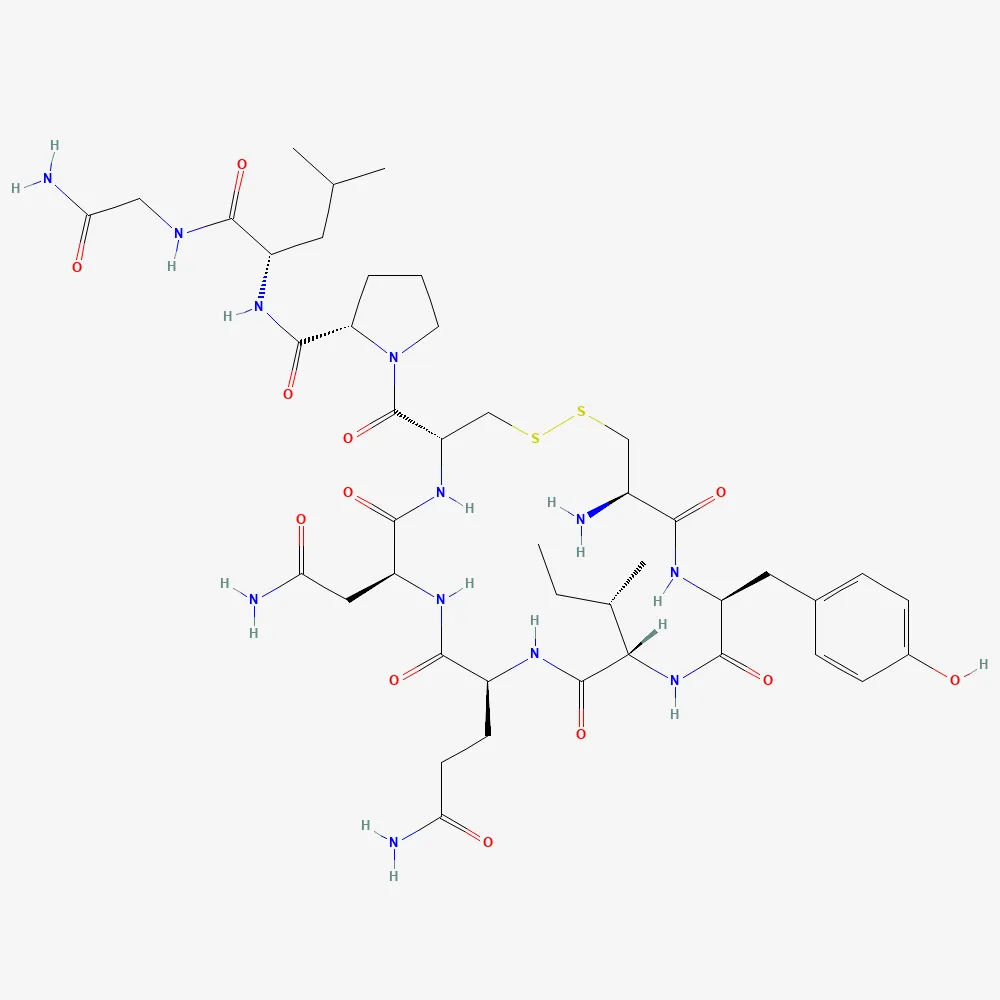
- C43H66N12O12S2 (1007.2 g/mol) Structure
- Evidence
- Moderate human evidence
- US status
- FDA-approved · prescription only
- Half-life
- About 1 to 6 minutes in plasma, shorter in late pregnancy and during breastfeeding, per the Pitocin label.
- Dose
- Set by the FDA label Dosing page
Dosing: what the label and the research actually use.
Oxytocin appears on peptide comparison tables, and it is the entry most likely to mislead. Almost everything said about it is true of a different product from the one being sold.
What is oxytocin?
There are two products under one name:
- The medicine. Injectable oxytocin is a long-approved prescription drug used in obstetrics and given in hospital with monitoring. It carries serious risks in that setting, which is why it is used the way it is.
- The peptide-market product. A nasal spray, self-administered and bought online, taken for libido, connection or anxiety.
Oxytocin structure
Oxytocin benefits: what the research shows
Oxytocin is well researched. There is a substantial randomised literature on the nasal route, including:
- work in autism spectrum conditions Anagnostou 2014 - Anagnostou E, Soorya L, Brian J et al. Intranasal oxytocin in the treatment of autism spectrum disorders: a review of literature and early safety and efficacy data in youth. Brain Res. 2014;1580:188-98., in the references below
- work in obesity Balestrino 2023 - Balestrino R, Losa M, Albano L et al. Intranasal oxytocin as a treatment for obesity: safety and efficacy. Expert Rev Endocrinol Metab. 2023;18(4):295-306., in the references below
- a review of safety, side effects and how people say it feels MacDonald 2011 - MacDonald E, Dadds MR, Brennan JL et al. A review of safety, side-effects and subjective reactions to intranasal oxytocin in human research. Psychoneuroendocrinology. 2011;36(8):1114-26., in the references below
None of it is about libido.
Oxytocin dosage
There is no single dose, because the approved and marketed products are different things. The approved injectable is given only by continuous IV infusion, adjusted for each patient by clinical staff under continuous fetal and uterine monitoring. It is never a self-administered number.
Research on the nasal route has used single or repeated doses of 18-40 IU, in autism, obesity and social-cognition studies, not for libido. The full dosage page covers both, with sourcing.
Oxytocin side effects
This section uses the FDA label for the approved injectable and the published research for the nasal route. They are two products with two different safety records.
The injectable’s label lists risks tied to the hospital setting: excessive uterine contraction, fetal distress, and, especially with prolonged high-dose infusion, water intoxication and low blood sodium. That is why it is used only under continuous monitoring.
Reported in studies
For nasal oxytocin, a review of the research reports side effects similar to placebo at the doses studied, in supervised, time-limited use MacDonald 2011 - MacDonald E, Dadds MR, Brennan JL et al. A review of safety, side-effects and subjective reactions to intranasal oxytocin in human research. Psychoneuroendocrinology. 2011;36(8):1114-26., in the references below. There are only isolated case reports of adverse reactions, all linked to use outside a research protocol rather than to the studied doses.
That evidence comes from fixed-length studies. It doesn’t show that taking it indefinitely, at any dose, from a vial bought online is safe. No study has looked at the doses, frequency or duration used for libido.
Is oxytocin legal?
US legal status - FDA-approved · prescription only
Injectable oxytocin is an approved prescription medicine used in obstetrics under clinical supervision. Intranasal oxytocin sold for libido, connection or anxiety is not an approved product for that purpose, and compounded or grey-market preparations are not quality-verified.
Regulatory changes for this compound and others, as they happen: US peptide regulation tracker.
Related
How Oxytocin compares
Reproductive hormones. Doses for unapproved compounds are common practice, not trial-established. All hormones and sexual health peptides →
| Compound | Main use | Evidence | Usual dose | US status |
|---|---|---|---|---|
| Kisspeptin | Studied in hospital-based human research as a reproductive-hormone signal - it stimulates LH and FSH release upstream of GnRH - and, in a small number of academic trials, for its effect on sexual and romantic brain processing. Sold to consumers for sexual desire and fertility use, a use no regulator has evaluated as safe or effective. | Limited human data | 50-200 mcg, once or twice daily, 50-200 mcg per injection | Research use only |
| Gonadorelin | FDA approved decades ago as a diagnostic test of pituitary function (Factrel) and as a pulsatile treatment for hypothalamic amenorrhea (Lutrepulse). Both approved products are discontinued. Today it is mainly sold through compounding pharmacies and research-peptide sellers to men on testosterone therapy, paired with TRT to keep the pituitary-testicular signal running - a use no trial has tested. | Moderate human evidence | 50-100 mcg, 2-3 times weekly, subcutaneous, spaced through the week (e.g. Monday/Thursday or Monday/Wednesday/Friday), alongside testosterone therapy | Unapproved drug |
| Human Chorionic Gonadotropin | FDA-approved prescription injection for prepubertal cryptorchidism, selected cases of male hypogonadotropic hypogonadism, and induction of ovulation in anovulatory, infertile women pretreated with menotropins. | Strong human evidence | FDA label | FDA-approved · prescription only |
| Human Menopausal Gonadotropin | FDA-approved prescription injection (Menopur) for development of multiple follicles and pregnancy in ovulatory women as part of an Assisted Reproductive Technology (ART) cycle. Not approved for any indication in men. | Strong human evidence | FDA label | FDA-approved · prescription only |
| Oxytocin | An approved injectable medicine in obstetrics. Sold online as a nasal spray for libido, connection and anxiety. | Moderate human evidence | FDA label | FDA-approved · prescription only |
Where to get Oxytocin legally
Oxytocin is an FDA-approved prescription medicine, so the legal route is a licensed prescriber, in person or by telehealth, and a licensed pharmacy.
With a prescription, a compounded oxytocin nasal spray or troche starts at $118 for 10 mL at Bayview Pharmacy (as of 3 October 2026).
Every legal route for oxytocin, with dated prices →
How telehealth prescribing works, what it costs and what to check: telehealth peptide prescribing.
Research-labelled oxytocin (not the approved medicine)
These checked vendors sell a research-labelled version. It has not been reviewed by FDA, is labelled not for human use, and is tested only as the seller chooses.
1.Next Level Pharm
5 mg vial
- No FDA warning letter found
- Names its testing lab
- Batch COAs published
- Takes card payment
2.BioEdge Research Labs
10 mg vial
- No FDA warning letter found
- Names its testing lab
- Batch COAs published
How research-labelled oxytocin differs, and what FDA has said →
Common questions
What is the usual oxytocin dose?
There is no single dose, because the approved and marketed products are different. The approved injectable is a continuous IV infusion, adjusted by clinical staff, never self-given. Research on the nasal route has used single or repeated doses of 18-40 IU (see the [full dosage page](/oxytocin-dosage/)), but no trial has tested a dose for libido.
What are the side effects of oxytocin?
The injectable's label lists risks tied to childbirth: excessive uterine contraction, fetal distress, and water intoxication with prolonged high-dose infusion. For the nasal route, trials report side effects similar to placebo at the 18-40 IU doses tested. See the [side effects section](#oxytocin-side-effects).
Is oxytocin a peptide?
Yes. It is a nine-amino-acid peptide hormone your body makes, involved in labour, breastfeeding and social bonding. It is also a long-established prescription medicine in obstetrics, given by injection under close monitoring.
Is the oxytocin sold online the same as the approved medicine?
No. The approved product is an injection used in hospital for a specific obstetric purpose. The peptide market usually sells a nasal spray for libido, connection or anxiety: a different route, a different context, and no approval for that use.
Does intranasal oxytocin improve libido or sexual function?
I couldn't find a single randomised trial testing that. My search found 71 randomised trials of nasal oxytocin, but in autism, obesity and social cognition. The use it is marketed for is the one nobody has tested.
Is intranasal oxytocin safe?
The published safety data cover the doses and durations used in research, not open-ended use of a product bought online. Being generally tolerated in a trial is not the same as being safe as consumers use it.
What is an oxytocin injection used for?
The approved injection, Pitocin, is a hospital obstetric medicine. Its label covers starting or strengthening contractions for vaginal delivery when there is a medical reason, and producing contractions after birth to control bleeding. It is not indicated for elective induction, and no approval covers the libido or connection uses of the nasal spray sold online.
What would happen if a man took oxytocin?
Most of what is known comes from research on the nasal route. A review of 38 randomised trials of short-term nasal oxytocin at 18-40 IU, with 79% of participants male, found people couldn't tell it from placebo and side effects matched placebo. I found no trial of it for male sexual function, and the research covers short-term supervised use, not long-term use of products bought online.
How long does a shot of oxytocin last?
Not long. The Pitocin label gives a plasma half-life of about 1 to 6 minutes. Given intravenously, the uterus responds almost at once and the effect fades within 1 hour; after an intramuscular injection it starts within 3 to 5 minutes and lasts 2 to 3 hours. For labour the label allows only an IV infusion adjusted by clinical staff; the single intramuscular shot is for after the placenta is delivered, to control bleeding.
Who should avoid taking oxytocin?
The Pitocin label lists situations where it must not be used before birth, including significant cephalopelvic disproportion, fetal distress where delivery is not imminent, an already overactive uterus, conditions where vaginal delivery is unsafe such as total placenta previa, and hypersensitivity to the drug. Those are decisions for the obstetric team. No label covers the nasal spray sold online, so nobody has defined who should avoid it.
What is the brand name of oxytocin?
Oxytocin is sold under the brand name Pitocin, made by Par Health USA. Pitocin is approved for starting or strengthening labor contractions when there is a medical reason (not elective induction), adjunctive treatment of incomplete or inevitable abortion, and producing uterine contractions and controlling bleeding after delivery.
What is the generic name for Pitocin?
The generic name for Pitocin is oxytocin. Pitocin is Par Health USA's brand, approved for starting or strengthening labor contractions when there is a medical reason (not elective induction), adjunctive treatment of incomplete or inevitable abortion, and producing uterine contractions and controlling bleeding after delivery.
Is Pitocin the same as oxytocin?
Yes. Pitocin is a brand of oxytocin, made by Par Health USA: the active ingredient is oxytocin. It comes as a intravenous infusion or intramuscular injection (10 units/mL vials), dosed at labor: IV infusion starting at 0.5 to 1 milliunit/min; after delivery: 10 units IM, or 10 to 40 units added to IV fluid. Compounded or research-vial oxytocin is not Pitocin and has not been through its FDA review.
References (4 sources)
Bibliographic detail is fetched from PubMed, not written by me - so a citation here cannot drift from the paper it names. Study design comes from PubMed's own tags rather than my judgement.
- 1.Anagnostou E, Soorya L, Brian J et al. Intranasal oxytocin in the treatment of autism spectrum disorders: a review of literature and early safety and efficacy data in youth. Brain Res. 2014;1580:188-98.ReviewPMID 24508578
- 2.Balestrino R, Losa M, Albano L et al. Intranasal oxytocin as a treatment for obesity: safety and efficacy. Expert Rev Endocrinol Metab. 2023;18(4):295-306.ReviewPMID 37232186
- 3.MacDonald E, Dadds MR, Brennan JL et al. A review of safety, side-effects and subjective reactions to intranasal oxytocin in human research. Psychoneuroendocrinology. 2011;36(8):1114-26.Systematic reviewPMID 21429671
- 4.PITOCIN (oxytocin injection, USP) synthetic - prescribing information: indications, contraindications, boxed warning on elective induction, and a plasma half-life of about 1 to 6 minutes.- DailyMed, National Library of Medicinelabel