SS-31 (Elamipretide): Dosage, Side Effects, Legal Status
SS-31 (elamipretide) is FDA-approved only for Barth syndrome. The label dose, side effects, and why its largest trial missed its endpoints.

The short version
SS-31, or elamipretide, is a mitochondria-targeted peptide with a substantial trial programme, which is unusual on this site. In 2025 FDA gave it accelerated approval, as Forzinity, for one ultra-rare genetic disorder: Barth syndrome. Its largest controlled trial, in a different mitochondrial disease, did not meet its primary endpoints. It is sold online as a longevity peptide to people who have neither condition.
- FDA-approved, on an accelerated basis, only to improve muscle strength in Barth syndrome.
- Genuinely in clinical development, with 16 randomised trials on PubMed.
- The lead Phase 3 in mitochondrial myopathy did not improve its primary outcomes.
- No trial has tested it in healthy adults for aging or energy.
SS-31 at a glance
- What it is
- Mitochondria-targeted tetrapeptide
- Main use
- FDA-approved (accelerated approval, 2025) as Forzinity to improve muscle strength in Barth syndrome, a rare genetic mitochondrial disease. Sold online as a longevity and cellular-energy peptide.
- Generic name
- elamipretide
- Brand names
- Forzinity (Stealth BioTherapeutics) Label
- Also called
- MTP-131, Bendavia
- Molecular formula
- C32H49N9O5 (639.8 g/mol) Structure
- Evidence
- Moderate human evidence
- US status
- FDA-approved · prescription only
- Dose
- Set by the FDA label Dosing page
Dosing: what the clinical trials used.
SS-31 stands out among the compounds I cover because it has been properly tested. Drug companies have run randomised, controlled, multicentre trials of it in patients, and in 2025 it became an FDA-approved medicine for one rare disease.
That record includes a clear negative result as well as an encouraging one. Both matter if you are reading about it as an energy or longevity peptide.
What is SS-31?
SS-31 is elamipretide. It gathers in the inner mitochondrial membrane and interacts with cardiolipin, a lipid that the cell’s energy machinery depends on. The idea is that a peptide which stabilises that machinery could help in diseases where it is failing. It is a serious idea, and it has been seriously tested.
SS-31 structure
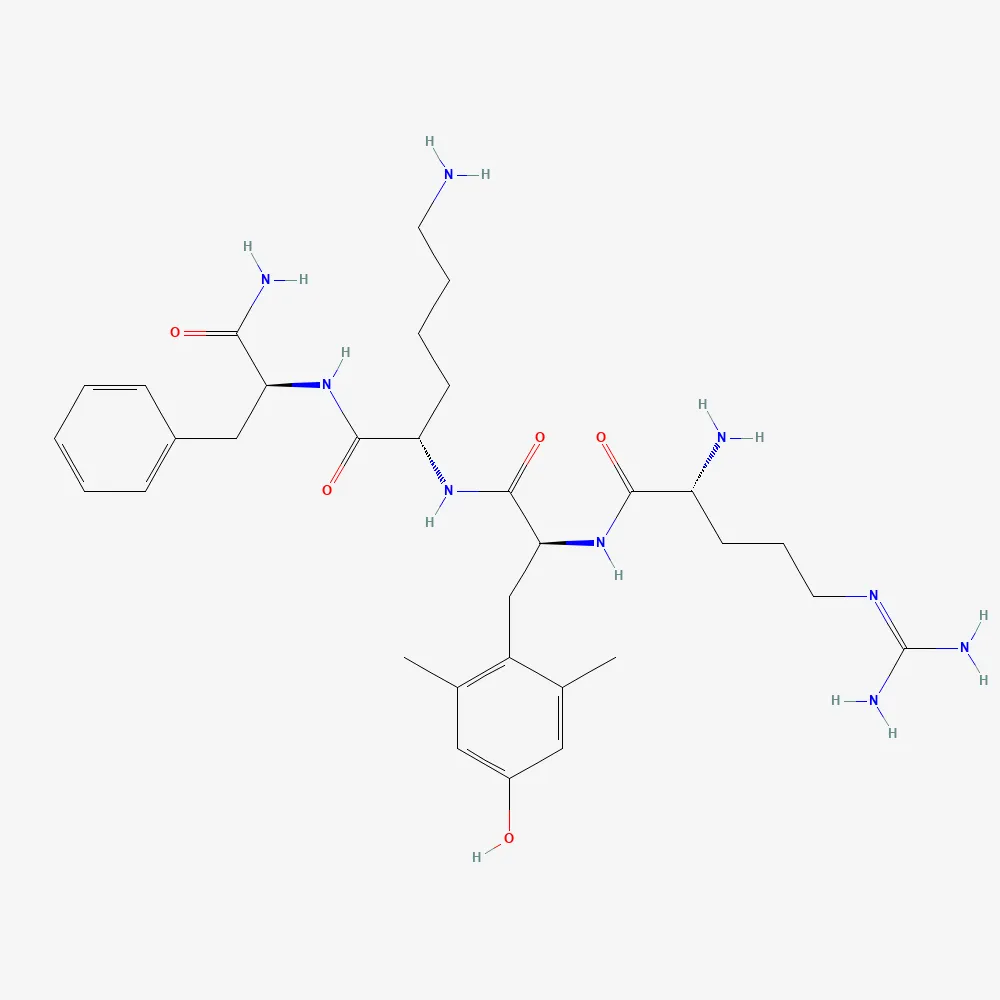
- Molecular formula
- C32H49N9O5
- Molecular weight
- 639.8 g/mol
- Length
- 4 amino acids
- Sequence
- RXKF
- Modifications
- D-Arg1; X2 = 2',6'-dimethyl-L-tyrosine (Dmt); L-Lys3; L-Phe4; C-terminal amide.
- PubChem CID
- 11764719
Forzinity contains elamipretide as the hydrochloride salt; the diagram is the peptide itself.
Identity checked against FDA prescribing information (Forzinity), DailyMed.
SS-31 benefits: what the research shows
The programme has produced an approved medicine for one rare disorder and a well-run negative trial in another:
- Primary mitochondrial myopathy: a dose-escalation study Karaa 2018 - Karaa A, Haas R, Goldstein A et al. Randomized dose-escalation trial of elamipretide in adults with primary mitochondrial myopathy. Neurology. 2018;90(14):e1212-e1221., in the references below, a randomised crossover trial Karaa 2020 - Karaa A, Haas R, Goldstein A et al. A randomized crossover trial of elamipretide in adults with primary mitochondrial myopathy. J Cachexia Sarcopenia Muscle. 2020;11(4):909-918., in the references below, then the large controlled study Karaa 2023 - Karaa A, Bertini E, Carelli V et al. Efficacy and Safety of Elamipretide in Individuals With Primary Mitochondrial Myopathy: The MMPOWER-3 Randomized Clinical Trial. Neurology. 2023;101(3):e238-e252., in the references below.
- Barth syndrome: separate work, covered below Thompson 2024 - Thompson WR, Manuel R, Abbruscato A et al. Long-term efficacy and safety of elamipretide in patients with Barth syndrome: 168-week open-label extension results of TAZPOWER. Genet Med. 2024;26(7):101138., in the references below.
- An eye condition: a topical eye-drop formulation Karanjia 2024 - Karanjia R, Sadun AA. Elamipretide Topical Ophthalmic Solution for the Treatment of Subjects with Leber Hereditary Optic Neuropathy: A Randomized Trial. Ophthalmology. 2024;131(4):422-433., in the references below.
The result
The large trial in primary mitochondrial myopathy did not meet its primary endpoints, the six-minute walk test and total fatigue score. In the authors’ words, subcutaneous elamipretide “did not improve outcomes” on those measures in those patients Karaa 2023 - Karaa A, Bertini E, Carelli V et al. Efficacy and Safety of Elamipretide in Individuals With Primary Mitochondrial Myopathy: The MMPOWER-3 Randomized Clinical Trial. Neurology. 2023;101(3):e238-e252., in the references below.
The more encouraging result, and its design
In Barth syndrome, an ultra-rare X-linked disorder, elamipretide was linked to lasting tolerability and to improvements in functional assessments and heart function Thompson 2024 - Thompson WR, Manuel R, Abbruscato A et al. Long-term efficacy and safety of elamipretide in patients with Barth syndrome: 168-week open-label extension results of TAZPOWER. Genet Med. 2024;26(7):101138., in the references below.
Those improvements come from an open-label extension: everyone knew who was on the drug, and there was no placebo group running alongside. That is a weaker design than the trial that failed, in a condition that affects very few people worldwide.
In September 2025 FDA granted Forzinity (elamipretide) accelerated approval to improve muscle strength in adults and children with Barth syndrome who weigh at least 30 kg. Accelerated approval rests on an intermediate endpoint, here knee extensor muscle strength, rather than confirmed clinical benefit. Continued approval may depend on a confirmatory trial.
It is a real signal, and now an approved medicine for that one disorder. It is not evidence that a healthy adult will feel more energetic.
SS-31 dosage
The trials gave patients with diagnosed mitochondrial disease 40 mg of elamipretide under the skin once daily, continuously, under clinical supervision. The FDA-approved Barth syndrome label (Forzinity) later used the same dose. The label also sets 20 mg once daily for adults with severely reduced kidney function who are not on dialysis.
That is a dose for a narrow, diagnosed population, and the largest trial at that dose did not show benefit on its primary outcomes. I don’t translate it to a healthy adult. Full detail: SS-31 dosage.
SS-31 side effects
The only FDA-reviewed safety record comes from Forzinity’s Barth syndrome approval, plus what the negative mitochondrial-myopathy trial reports about tolerability. Neither group is healthy adults buying it online.
When starting
Injection-site reactions were near-universal in the Barth syndrome label trial (12 on drug, 12 on placebo):
- redness (erythema): all 12 on drug, against 3 on placebo
- pain: 9 against 5
- hardening (induration) and itching (pruritus): 8 against 2 each
- bruising or hives: a quarter of patients on drug, none on placebo.
Ongoing
Eosinophil counts rose in most patients in the label trial, peaking around three months and settling within 6-12 months, with no symptoms linked to it. The larger, negative myopathy trial calls elamipretide generally well tolerated, with mostly mild to moderate side effects, but doesn’t give the same reaction-by-reaction breakdown Karaa 2023 - Karaa A, Bertini E, Carelli V et al. Efficacy and Safety of Elamipretide in Individuals With Primary Mitochondrial Myopathy: The MMPOWER-3 Randomized Clinical Trial. Neurology. 2023;101(3):e238-e252., in the references below.
Rare but serious
The label calls out hypersensitivity reactions (rash, eczema-like skin reactions and cough) that can appear anywhere from minutes to months after starting. It says a serious reaction means stopping the drug and emergency treatment with epinephrine, antihistamines or corticosteroids.
For the injection itself, see injection-site reactions for what is ordinary and what needs attention.
Stop and get medical care for any breathing trouble, widespread rash or swelling after a dose. The label treats those as a hypersensitivity reaction needing emergency treatment.
The label applies only to Barth syndrome patients weighing at least 30 kg on the approved regimen. There is no published safety record in healthy adults using it for aging or energy, which is what it is sold for online. See dosing for what the trials used.
Is SS-31 legal?
US legal status - FDA-approved · prescription only
Elamipretide is an FDA-approved prescription medicine, Forzinity, granted accelerated approval to improve muscle strength in patients with Barth syndrome weighing at least 30 kg. The approval covers Barth syndrome only - not energy, longevity or any use in healthy adults. Research-chemical vials sold as SS-31 carry the name without the approval, the quality control, or the indication.
Online, SS-31 is sold as a research chemical to people who don’t have Barth syndrome. No regulator checks that those vials match their labels, which is odd for a molecule that also exists as a carefully made, approved medicine. The approved product needs a prescriber and a diagnosis; a vial bought online carries the name without either.
Regulatory changes for this compound and others, as they happen: US peptide regulation tracker.
Related
How SS-31 compares
Mitochondrial and metabolic. Doses for unapproved compounds are common practice, not trial-established. All longevity and mitochondria peptides →
| Compound | Main use | Evidence | Usual dose | US status |
|---|---|---|---|---|
| MOTS-c | Sold for metabolic health, fat loss and longevity. Studied in humans as a biomarker of exercise response. | Animal / lab only | 2.5-10 mg, 2 to 3 times a week is most common, with some protocols ramping toward daily dosing at higher amounts | Research use only |
| SS-31 | FDA-approved (accelerated approval, 2025) as Forzinity to improve muscle strength in Barth syndrome, a rare genetic mitochondrial disease. Sold online as a longevity and cellular-energy peptide. | Moderate human evidence | FDA label | FDA-approved · prescription only |
| Humanin | Sold online for anti-aging and neuroprotection claims. Studied almost entirely in cell cultures and rodents; no completed human efficacy trial was located for this page. | Animal / lab only | 0.5-5 mg, commonly once daily; some protocols use 2 to 3 times a week instead | Research use only |
| NAD+ (injection) | Sold by IV-therapy clinics and compounding pharmacies, by subcutaneous injection or IV infusion, for marketed energy, anti-aging, cognition and addiction-recovery claims. | Limited human data | 50-500 mg, 1-3 times a week by subcutaneous injection; many protocols start low, once weekly, and increase only if tolerated | Unapproved drug |
| SLU-PP-332 | A laboratory research chemical studied in mice as an "exercise mimetic" - it triggers some of the same muscle and metabolic gene programs endurance exercise does. Sold to consumers as a research chemical for that same effect, with no human study behind that use. | Animal / lab only | No consistent protocol | Unapproved drug |
| AICAR | Studied as an AMPK-activating "exercise mimetic" that boosted running endurance in sedentary mice; separately studied in humans, under the name acadesine, as an intravenous cardioprotective drug during heart bypass surgery - a use large trials found did not work. Now sold to consumers as an unapproved research-chemical endurance and metabolic product. | Limited human data | No consistent protocol | Unapproved drug |
| L-Carnitine (injection) | FDA-approved, as CARNITOR, for treating carnitine deficiency (a defined metabolic/biochemical condition): the injection also for the prevention and treatment of carnitine deficiency in dialysis patients, and the tablets and oral solution (including sugar-free CARNITOR SF) for primary and inherited-metabolic-disorder carnitine deficiency. This page covers the injection. Sold off-label, and through compounding and aesthetic-medicine clinics, as a "fat-burning" or metabolism-support injection for people without diagnosed deficiency. | Strong human evidence | FDA label | FDA-approved · prescription only |
Where to get SS-31 legally
SS-31 is an FDA-approved prescription medicine, so the legal route is a licensed prescriber, in person or by telehealth, and a licensed pharmacy.
It is sold only as Forzinity, for Barth syndrome, through AnovoRx Specialty Pharmacy, and neither AnovoRx nor the maker publishes a price.
How telehealth prescribing works, what it costs and what to check: telehealth peptide prescribing.
Research-labelled SS-31 (not the approved medicine)
These checked vendors sell a research-labelled version. It has not been reviewed by FDA, is labelled not for human use, and is tested only as the seller chooses.
1.Next Level Pharm
10 mg vial
- No FDA warning letter found
- Names its testing lab
- Batch COAs published
- Takes card payment
How research-labelled SS-31 differs, and what FDA has said →
Common questions
Does SS-31 work?
In its lead use, the controlled answer so far is no: the trial in primary mitochondrial myopathy did not meet its primary endpoints. In Barth syndrome, FDA granted accelerated approval based on improved muscle strength, an intermediate endpoint, so confirmed clinical benefit is still to be shown. The longer-term Barth data come from an open-label extension, a weaker design.
Has SS-31 been tested for anti-aging or energy in healthy people?
No. Every randomised trial I found was in patients with a diagnosed condition: primary mitochondrial myopathy, Barth syndrome or an eye disease. No one has run a controlled trial of SS-31 in healthy adults for the outcomes it is marketed for online.
What is the SS-31 dosage?
The trials gave elamipretide under the skin, under clinical supervision, to patients with diagnosed mitochondrial disease. I won't apply a dose from a trial in a rare genetic disorder to a healthy adult buying a research chemical. The largest trial at that dose also did not show benefit on its primary outcomes.
Is SS-31 approved?
Only for one rare disease. In September 2025 FDA granted accelerated approval to Forzinity (elamipretide) to improve muscle strength in adults and children with Barth syndrome who weigh at least 30 kg; continued approval may depend on a confirmatory trial. It does not cover energy, longevity or any use in healthy adults. Research-chemical vials sold as SS-31 are not the approved product, and no regulator checks that they match their labels.
What are the side effects of SS-31?
The only FDA label (Barth syndrome, at the approved dose) reports injection-site reactions in nearly everyone on the drug: redness, pain, hardening and itching. It also lists hypersensitivity reactions such as rash and cough that can need urgent treatment, and a temporary rise in eosinophil counts. That label covers a narrow patient group, not healthy adults; the negative myopathy trial calls elamipretide generally well tolerated without a reaction-by-reaction breakdown.
Can SS-31 help with weight loss?
I found no evidence that it does. Every randomised SS-31 trial I found was in patients with a diagnosed condition, testing walking distance, fatigue, muscle strength or an eye condition, and none tested weight loss. The FDA approval covers muscle strength in Barth syndrome only.
What peptides to stack with SS-31 or MOTS-c?
The MOTS-c protocols I track list SS-31 as a common pairing, alongside CJC-1295 and ipamorelin. That is common practice, not trial-established. I found no trial testing SS-31 with any other peptide, and no source I track sets an order or lead-in period. See [MOTS-c](/mots-c/).
What is the brand name of elamipretide?
Elamipretide is sold under the brand name Forzinity, made by Stealth BioTherapeutics. Forzinity is approved for improving muscle strength in adults and children with Barth syndrome who weigh at least 30 kg (accelerated approval, pending a confirmatory trial).
What is the generic name for Forzinity?
The generic name for Forzinity is elamipretide. Forzinity is Stealth BioTherapeutics's brand, approved for improving muscle strength in adults and children with Barth syndrome who weigh at least 30 kg (accelerated approval, pending a confirmatory trial).
Is Forzinity the same as elamipretide?
Yes. Forzinity is a brand of elamipretide, made by Stealth BioTherapeutics: the active ingredient is elamipretide. It comes as a once-daily subcutaneous injection (single-patient-use vial), dosed at 40 mg once daily (20 mg in adults with eGFR below 30 mL/min not on dialysis). Compounded or research-vial elamipretide is not Forzinity and has not been through its FDA review.
References (8 sources)
Bibliographic detail is fetched from PubMed, not written by me - so a citation here cannot drift from the paper it names. Study design comes from PubMed's own tags rather than my judgement.
- 1.Karaa A, Bertini E, Carelli V et al. Efficacy and Safety of Elamipretide in Individuals With Primary Mitochondrial Myopathy: The MMPOWER-3 Randomized Clinical Trial. Neurology. 2023;101(3):e238-e252.Randomised trialPMID 37268435full text
- 2.Thompson WR, Manuel R, Abbruscato A et al. Long-term efficacy and safety of elamipretide in patients with Barth syndrome: 168-week open-label extension results of TAZPOWER. Genet Med. 2024;26(7):101138.Randomised trialPMID 38602181
- 3.Karaa A, Haas R, Goldstein A et al. Randomized dose-escalation trial of elamipretide in adults with primary mitochondrial myopathy. Neurology. 2018;90(14):e1212-e1221.Randomised trialPMID 29500292full text
- 4.Karaa A, Haas R, Goldstein A et al. A randomized crossover trial of elamipretide in adults with primary mitochondrial myopathy. J Cachexia Sarcopenia Muscle. 2020;11(4):909-918.Randomised trialPMID 32096613full text
- 5.Karanjia R, Sadun AA. Elamipretide Topical Ophthalmic Solution for the Treatment of Subjects with Leber Hereditary Optic Neuropathy: A Randomized Trial. Ophthalmology. 2024;131(4):422-433.Randomised trialPMID 37923251
- 6.FORZINITY (elamipretide) injection - prescribing information as approved: Barth syndrome indication, accelerated-approval statement, 40 mg daily dosing and the renal-impairment dose reduction.- US Food and Drug Administrationlabel
- 7.FDA accelerated approval letter for NDA 215244 (Forzinity), including the confirmatory-trial requirement attached to the approval.- US Food and Drug Administrationregulatory
- 8.FORZINITY (elamipretide) injection - prescribing information- DailyMed, National Library of Medicinelabel