DSIP Peptide: Benefits, Dosage, Nasal Spray and Side Effects
DSIP peptide: what the research shows, what was tested by nasal spray, the common-practice dose, side effects and legal status.

The short version
DSIP stands for delta sleep-inducing peptide, named after an early proposed role rather than a proven one. It was researched heavily in the 1980s, and research has been winding down ever since. The trial closest to how it is sold today was published in 1992.
- 519 papers in total, 11 of them published since 2015.
- The name describes a hypothesis from the 1970s, not a demonstrated effect.
- Not approved for human use; sold as a research chemical.
- DSIP is also sold as a nasal spray, but I found no study that measured sleep after a nasal dose.
DSIP at a glance
- What it is
- Nonapeptide
- Main use
- Sold for sleep. Named in the 1970s after a proposed role in promoting delta-wave sleep.
- Also called
- Delta sleep-inducing peptide, Emideltide
- Molecular formula
- C35H48N10O15 (848.8 g/mol) Structure
- Evidence
- Limited human data
- US status
- Research use only
- Half-life
- Not established in humans
- How it is taken
- Subcutaneous injection
- Common protocol
- 100-500 mcg, once nightly, 30-60 minutes before intended sleep onset; anywhere from 5-14 nights a month to nightly use depending on the protocol, for 4-12 weeks (common practice, not trial-established) Dosage chart
Dosing: what the 1992 insomnia trial used.
DSIP is a research chemical sold for sleep, as vials for injection and as nasal sprays. Its human trials are small, decades old and intravenous, and I found none that tested a nasal spray for sleep.
What is DSIP?
DSIP, delta sleep-inducing peptide, is a short peptide first isolated in the 1970s. It was named for a proposed role in deep, slow-wave sleep and researched heavily in the 1980s.
The early human work was encouraging: a 1983 summary of five double-blind studies reported that four consecutive injections normalised disturbed sleep in insomniacs Schneider-Helmert 1983 - Schneider-Helmert D, Schoenenberger GA. Effects of DSIP in man. Multifunctional psychophysiological properties besides induction of natural sleep. Neuropsychobiology. 1983;9(4):197-206., in the references below. But the name records the original hypothesis, not a shown effect, and the human trials that followed were small and short.
DSIP structure
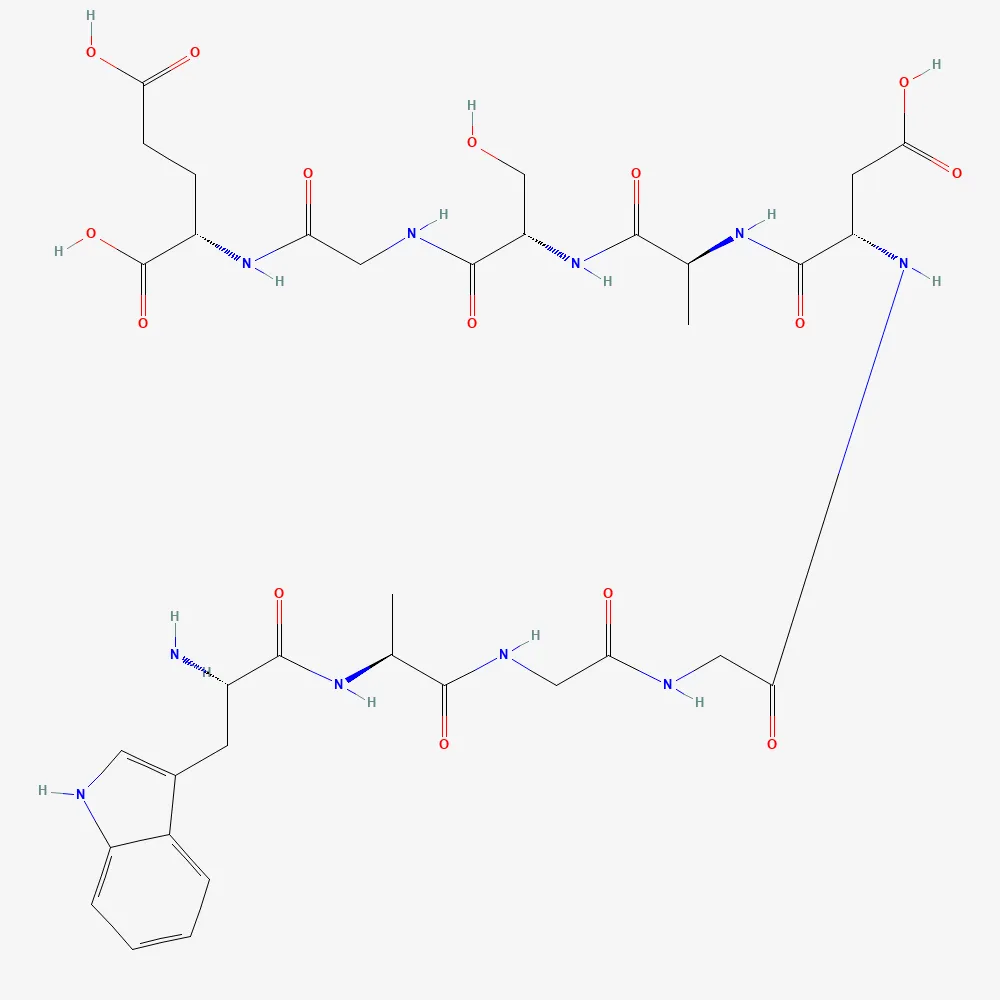
- Molecular formula
- C35H48N10O15
- Molecular weight
- 848.8 g/mol
- Length
- 9 amino acids
- Sequence
- WAGGDASGE
- Modifications
- Free N- and C-termini; all L-amino acids.
- PubChem CID
- 68816
Identity checked against ChEMBL (EMBL-EBI).
DSIP benefits: what the research shows
That curve is unusual on this site. Most research peptides I cover are recent and under-studied. DSIP was studied extensively a long time ago, by a field that has largely moved on.
Do the trials match how DSIP is sold?
Six records are tagged as randomised trials. Only one is really about what DSIP is sold for:
- Chronic insomnia Bes 1992 - Bes F, Hofman W, Schuur J et al. Effects of delta sleep-inducing peptide on sleep of chronic insomniac patients. A double-blind study. Neuropsychobiology. 1992;26(4):193-7., in the references below, published in 1992, the closest to the marketed use. In 16 patients given DSIP or placebo by vein in the afternoon before lab nights 3, 4 and 5, DSIP was linked to higher sleep efficiency and falling asleep faster. The authors judged those effects weak and possibly partly due to a chance change in the placebo group. They saw no change in how well people felt they slept, and concluded short-term DSIP was unlikely to help chronic insomnia much. How DSIP compares with other peptides sold for sleep: peptides for sleep.
- Effects on arginine-related hormone measures Chiodera 1994 - Chiodera P, Volpi R, Capretti L et al. Different effects of delta-sleep-inducing peptide on arginine-vasopressin and ACTH secretion in normal men. Horm Res. 1994;42(6):267-72., in the references below: hormone outcomes, not sleep.
- Glucocorticoid replacement and REM sleep García-Borreguero 2000 - García-Borreguero D, Wehr TA, Larrosa O et al. Glucocorticoid replacement is permissive for rapid eye movement sleep and sleep consolidation in patients with adrenal insufficiency. J Clin Endocrinol Metab. 2000;85(11):4201-6., in the references below: DSIP is part of the design, not the treatment being tested.
- DSIP altering the bispectral index Pomfrett 2009 - Pomfrett CJ, Dolling S, Anders NR et al. Delta sleep-inducing peptide alters bispectral index, the electroencephalogram and heart rate variability when used as an adjunct to isoflurane anaesthesia. Eur J Anaesthesiol. 2009;26(2):128-34., in the references below: anaesthesia monitoring, a long way from taking something before bed.
Outside those, the 1983 report summarised five double-blind intravenous studies in insomniacs; its abstract gives no participant numbers Schneider-Helmert 1983 - Schneider-Helmert D, Schoenenberger GA. Effects of DSIP in man. Multifunctional psychophysiological properties besides induction of natural sleep. Neuropsychobiology. 1983;9(4):197-206., in the references below. Hormone studies in healthy volunteers also gave single intravenous doses Bjartell 1989 - Bjartell A, Ekman R, Bergquist S et al. Reduction of immunoreactive ACTH in plasma following intravenous injection of delta sleep-inducing peptide in man. Psychoneuroendocrinology. 1989;14(5):347-55., in the references below Giusti 1993 - Giusti M, Carraro A, Porcella E et al. Delta sleep-inducing peptide administration does not influence growth hormone and prolactin secretion in normal women. Psychoneuroendocrinology. 1993;18(1):79-84., in the references below Späth-Schwalbe 1995 - Späth-Schwalbe E, Schäfer A, Uthgenannt D et al. Delta-sleep-inducing peptide does not affect CRH and meal-induced ACTH and cortisol secretion. Psychoneuroendocrinology. 1995;20(3):231-7., in the references below.
So there is an encouraging early report, one small randomised trial in the right group three decades ago with modest results, and scattered work in other settings. DSIP hasn’t been tested in a modern controlled trial.
DSIP dosage
The common DSIP dose is 100-500 mcg, once nightly, 30-60 minutes before intended sleep onset; anywhere from 5-14 nights a month to nightly use depending on the protocol. From a 5 mg vial mixed with 2 mL of bacteriostatic water, 300 mcg is 12 units (0.12 mL) on a U-100 insulin syringe.
Clinic and vendor guides commonly describe 100-500 mcg injected under the skin once a night, 30-60 minutes before bed. Protocols range from about 5 nights a month to every night, for roughly 4-12 weeks at a time. That is common practice, not a tested dose. Full protocol and sourcing: DSIP dosage.
The only study dose for this use comes from the 1992 insomnia trial, run in a research setting with intravenous doses. With almost no clinical work since, that dose doesn’t translate into a modern bedtime protocol.
DSIP nasal spray: what was tested
DSIP is also sold as a ready-made nasal spray. One seller’s spray holds 5 mg in 100 sprays of 50 mcg each, labelled for research use only and not for human consumption.
All the human sleep studies above gave DSIP by intravenous injection. The only human nasal data I found is a 2001 research letter whose title reports that a nasal dose increased P300, a brain-wave response linked to attention Hruz 2001 - Hruz P, Zechner S, Heimberg D et al. Intranasal administration of delta sleep-inducing peptide increases P300. J Clin Psychopharmacol. 2001;21(6):626-8., in the references below. It is not a sleep outcome. I found no study that measured sleep after a nasal dose.
What isn’t known is how much DSIP a spray delivers. I found no study measuring nasal absorption in people. Injected DSIP also breaks down quickly in blood Graf 1987 - Graf MV, Saegesser B, Schoenenberger GA. Degradation and aggregation of delta sleep-inducing peptide (DSIP) and two analogs in plasma and serum. Peptides. 1987;8(4):599-603., in the references below, so the amount that would reach the brain from a spray is unknown.
DSIP side effects
The human studies I found gave DSIP intravenously under monitoring, as a single dose or over a few days, apart from the one nasal report above. None followed people beyond that.
- The 1992 insomnia trial and the 1994 hormone study reported their findings but not side effects Bes 1992 - Bes F, Hofman W, Schuur J et al. Effects of delta sleep-inducing peptide on sleep of chronic insomniac patients. A double-blind study. Neuropsychobiology. 1992;26(4):193-7., in the references below Chiodera 1994 - Chiodera P, Volpi R, Capretti L et al. Different effects of delta-sleep-inducing peptide on arginine-vasopressin and ACTH secretion in normal men. Horm Res. 1994;42(6):267-72., in the references below.
- The 1983 report on five intravenous studies called tolerability good and said slow injection proved essential, but gave no side-effect counts Schneider-Helmert 1983 - Schneider-Helmert D, Schoenenberger GA. Effects of DSIP in man. Multifunctional psychophysiological properties besides induction of natural sleep. Neuropsychobiology. 1983;9(4):197-206., in the references below.
- In a 2009 randomised study of 24 women having general anaesthesia, intravenous DSIP significantly raised heart rate and reduced heart rate variability Pomfrett 2009 - Pomfrett CJ, Dolling S, Anders NR et al. Delta sleep-inducing peptide alters bispectral index, the electroencephalogram and heart rate variability when used as an adjunct to isoflurane anaesthesia. Eur J Anaesthesiol. 2009;26(2):128-34., in the references below.
The lack of reported problems is a lack of data, not evidence of safety. There is no published human safety data at all for the injected, cycled schedule DSIP is sold for. FDA has not evaluated DSIP for any use, so there is no boxed warning, reviewed risk list or label to check.
For injection technique and site problems, see injection site reactions. Get emergency care for a severe allergic reaction, chest pain, fainting or any symptom that feels dangerous, and call Poison Control (1-800-222-1222) for a suspected overdose of anything sold as DSIP.
Is DSIP legal?
US legal status - Research use only
Sold for laboratory research use only. Not approved by the FDA for human use, and cannot be lawfully marketed as a supplement or a medicine. Products sold this way are not made to pharmaceutical quality standards, and their contents are not verified by anyone.
DSIP is not approved for human use and is sold as a research chemical, which means no regulator checks that a vial matches its label.
Regulatory changes for this compound and others, as they happen: US peptide regulation tracker.
How DSIP compares
Brain, mood and sleep. Doses for unapproved compounds are common practice, not trial-established. All brain, mood and sleep peptides →
| Compound | Main use | Evidence | Usual dose | US status |
|---|---|---|---|---|
| Semax | Sold as a nootropic for focus, memory and mood. Used clinically within Russian medicine. | Limited human data | 100-600 mcg, once daily for a fixed telehealth-prescribed protocol, up to twice daily in a wider clinic-published range | Research use only |
| Selank | Sold as a nootropic for focus, memory and mood. Used clinically within Russian medicine. | Limited human data | 250-900 mcg, 1-3 times daily, spaced through waking hours; the published Russian GAD clinical-trial protocol used a fixed 3 times daily schedule (900 mcg per dose, 2.7 mg/day total) for a 14-day course | Research use only |
| Adamax | Sold as a nootropic, marketed as a longer-acting, more potent successor to Semax, aimed at the same cognitive-enhancement buyers. | No meaningful evidence | No consistent protocol | Unapproved drug |
| Cerebrolysin | A prescription drug in Russia, China, several Eastern European and other markets for acute ischaemic stroke, traumatic brain injury and vascular dementia. Also sold outside those markets, including to US buyers, as an unregulated "research" or grey-market vial for self-injection, which is not how it is used where it is actually approved. | Limited human data | No consistent protocol | Unapproved drug |
| PE-22-28 | Studied only in mice as a candidate fast-acting antidepressant. Never tested in a single published human trial, and sold to consumers as an unregulated research-chemical mood/depression product. | Animal / lab only | No consistent protocol | Unapproved drug |
| Dihexa | Sold online as a research chemical for cognition and memory. FDA has not identified any human exposure data on drug products containing dihexa acetate by any route. | Animal / lab only | 10-100 mg, 1 to 3 times a week, not daily; sources describe starting around 10-20 mg and titrating up to 50-100 mg as tolerated | Research use only |
| DSIP | Sold for sleep. Named in the 1970s after a proposed role in promoting delta-wave sleep. | Limited human data | 100-500 mcg, once nightly, 30-60 minutes before intended sleep onset; anywhere from 5-14 nights a month to nightly use depending on the protocol | Research use only |
Where to buy DSIP for research
Each vendor is checked against my vendor checklist.
1.Next Level PharmFeatured
5 mg vial
- No FDA warning letter found
- Names its testing lab
- Batch COAs published
- Takes card payment
2.BioEdge Research Labs
10 mg vial
- No FDA warning letter found
- Names its testing lab
- Batch COAs published
Common questions
Does DSIP work for sleep?
The evidence is old and thin. The randomised trial closest to the marketed use tested DSIP in chronic insomniacs and was published in 1992; its authors judged the effects weak. There has been little clinical work since, and nothing recent settles the question.
Why is there so little recent research on DSIP?
I can report the pattern, not the reason. Publications peaked in the late 1980s at over 200 papers in a decade and have fallen to 11 since 2015. Fields wind down for many reasons, but a compound whose research has largely stopped is different from one whose evidence is still growing.
What is the DSIP dosage?
The clinical studies are decades old and were run in research settings, not as consumer sleep protocols. The most relevant is a 1992 insomnia trial, which is not a basis for a modern protocol. Clinic and vendor guides describe a common practice of injection under the skin; the dosage page covers both.
What are the side effects of DSIP?
A few small human studies from 1983 to 2009 gave DSIP intravenously for a day or a few days. Most didn't report side effects; a 1983 report called tolerability good without giving counts, and a 2009 anaesthesia study found DSIP raised heart rate and reduced heart rate variability. None followed people beyond a few days or tested the injected, cycled schedule DSIP is sold for, so there is no safety data for that use.
Does DSIP nasal spray work?
It has not been tested for sleep. The human sleep studies gave DSIP by intravenous injection, and the one human report of a nasal dose I found measured a brain-wave response, not sleep. I found no study measuring how much of a spray reaches the blood, so there is no evidence that a DSIP nasal spray works.
Can DSIP be taken intranasally?
It can be sprayed into the nose, and a 2001 research letter reported that a nasal dose changed P300, a brain-wave response linked to attention. That is the only human nasal data I found. I found no study of absorption by this route, and injected DSIP breaks down quickly in blood, so the dose that reaches the brain from a spray is unknown.
References (11 sources)
Bibliographic detail is fetched from PubMed, not written by me - so a citation here cannot drift from the paper it names. Study design comes from PubMed's own tags rather than my judgement.
- 1.Bes F, Hofman W, Schuur J et al. Effects of delta sleep-inducing peptide on sleep of chronic insomniac patients. A double-blind study. Neuropsychobiology. 1992;26(4):193-7.Randomised trialPMID 1299794
- 2.Chiodera P, Volpi R, Capretti L et al. Different effects of delta-sleep-inducing peptide on arginine-vasopressin and ACTH secretion in normal men. Horm Res. 1994;42(6):267-72.Randomised trialPMID 7698722
- 3.García-Borreguero D, Wehr TA, Larrosa O et al. Glucocorticoid replacement is permissive for rapid eye movement sleep and sleep consolidation in patients with adrenal insufficiency. J Clin Endocrinol Metab. 2000;85(11):4201-6.Randomised trialPMID 11095454
- 4.Pomfrett CJ, Dolling S, Anders NR et al. Delta sleep-inducing peptide alters bispectral index, the electroencephalogram and heart rate variability when used as an adjunct to isoflurane anaesthesia. Eur J Anaesthesiol. 2009;26(2):128-34.Randomised trialPMID 19142086
- 5.Schneider-Helmert D, Schoenenberger GA. Effects of DSIP in man. Multifunctional psychophysiological properties besides induction of natural sleep. Neuropsychobiology. 1983;9(4):197-206.Clinical trialPMID 6689058
- 6.Bjartell A, Ekman R, Bergquist S et al. Reduction of immunoreactive ACTH in plasma following intravenous injection of delta sleep-inducing peptide in man. Psychoneuroendocrinology. 1989;14(5):347-55.Randomised trialPMID 2554357
- 7.Giusti M, Carraro A, Porcella E et al. Delta sleep-inducing peptide administration does not influence growth hormone and prolactin secretion in normal women. Psychoneuroendocrinology. 1993;18(1):79-84.Clinical trialPMID 8475226
- 8.Späth-Schwalbe E, Schäfer A, Uthgenannt D et al. Delta-sleep-inducing peptide does not affect CRH and meal-induced ACTH and cortisol secretion. Psychoneuroendocrinology. 1995;20(3):231-7.Clinical trialPMID 7777652
- 9.Graf MV, Saegesser B, Schoenenberger GA. Degradation and aggregation of delta sleep-inducing peptide (DSIP) and two analogs in plasma and serum. Peptides. 1987;8(4):599-603.StudyPMID 3628078
- 10.Hruz P, Zechner S, Heimberg D et al. Intranasal administration of delta sleep-inducing peptide increases P300. J Clin Psychopharmacol. 2001;21(6):626-8.StudyPMID 11763019
- 11.PSPeptides, DSIP Nasal Spray product page (checked 3 October 2026): 5 mg total in 100 sprays of 50 mcg, labelled for laboratory and research use only, not for human consumption- PSPeptidesother