
What Is Saxenda? Liraglutide for Weight Loss: Dose, Side Effects
Saxenda is liraglutide, a once-daily Novo Nordisk injection for weight management. The label dose, side-effect rates, boxed warning and how it differs from Victoza.

The short version
Saxenda is the brand name for liraglutide, a GLP-1 receptor agonist made by Novo Nordisk and injected once a day for long-term weight management. The dose climbs weekly from 0.6 mg to 3 mg. Nausea is the most common side effect, and the label carries a boxed warning about thyroid C-cell tumours seen in rodents. Victoza is the same molecule at lower doses for type 2 diabetes.
- Saxenda = liraglutide, from Novo Nordisk, approved for weight management alongside diet and physical activity.
- One injection a day, stepping up weekly from 0.6 mg to a 3 mg maintenance dose in week 5.
- In the main 56-week trial, average weight loss was 7.4% on Saxenda against 3.0% on placebo.
- The label says to stop if an adult has not lost at least 4% of body weight after 16 weeks.
- Compounded or "research" liraglutide is not Saxenda; FDA does not review compounded drugs before they are sold.
Saxenda is the brand name for liraglutide, a once-daily injection made by Novo Nordisk. It is approved in the US for chronic weight management, alongside a reduced-calorie diet and more physical activity. The approved groups are adults and children 12 and older who have obesity and weigh more than 60 kg, and adults with overweight plus at least one weight-related condition.
Full detail on the molecule: liraglutide. Full dosing schedule: liraglutide dosage.
What is Saxenda?
Saxenda is a prescription GLP-1 receptor agonist supplied as a prefilled pen (18 mg in 3 mL). The pen delivers doses of 0.6 mg, 1.2 mg, 1.8 mg, 2.4 mg or 3 mg. FDA first approved it in December 2014. The label describes its purpose as reducing excess body weight and keeping it off long term, always with diet and activity changes. It is not approved as a stand-alone treatment. It sits alongside the other approved GLP-1 medicines on my FDA-approved peptides list.
Saxenda structure
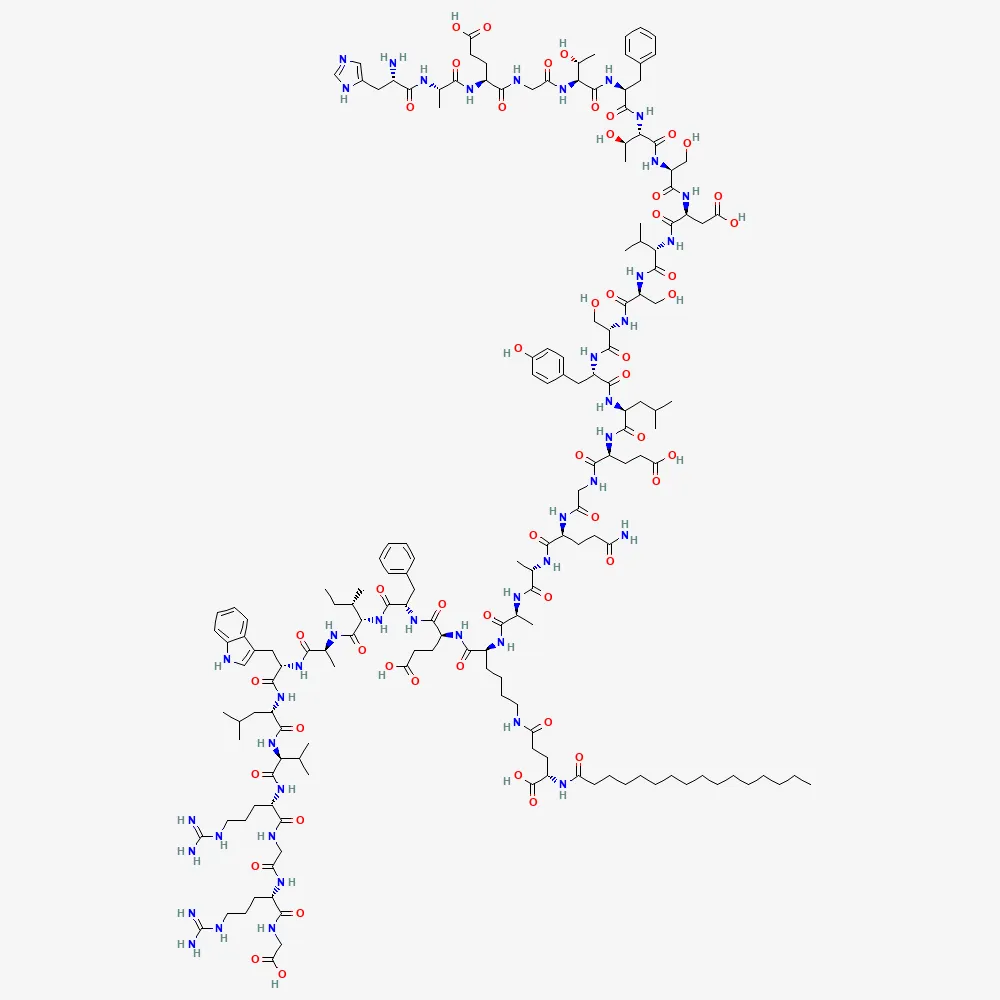
- Molecular formula
- C172H265N43O51
- Molecular weight
- 3751 g/mol
- Length
- 31 amino acids
- Sequence
- HAEGTFTSDVSSYLEGQAAKEFIAWLVRGRG
- Modifications
- Human GLP-1(7-37) with Lys34 replaced by Arg; the remaining Lys26 (position 20 here) carries a palmitoyl (C16) fatty acid attached through a gamma-glutamic acid spacer.
- PubChem CID
- 16134956
Identity checked against FDA prescribing information (Victoza), DailyMed.
Saxenda vs Victoza
Saxenda and Victoza are the same molecule from the same company, approved for different things at different doses.
| Saxenda | Victoza | |
|---|---|---|
| Approved for | Chronic weight management | Type 2 diabetes blood-sugar control; lowering major cardiovascular event risk in adults with type 2 diabetes and established cardiovascular disease |
| Ages | Adults; children 12+ with obesity over 60 kg | Adults; children 10+ with type 2 diabetes |
| Top daily dose | 3 mg | 1.8 mg |
| Frequency | Once daily | Once daily |
Because both contain liraglutide, the Saxenda label says not to use it with Victoza, with any other liraglutide product, or with any other GLP-1 receptor agonist. More on the diabetes brand: Victoza.
How Saxenda works
Liraglutide is a modified version of the gut hormone GLP-1 and activates the same receptor. The label notes that GLP-1 helps regulate appetite and calorie intake. It states that liraglutide lowers body weight through decreased calorie intake, not by raising energy expenditure. Its half-life of about 13 hours is why it is injected every day rather than weekly. See how liraglutide works and how GLP-1 medicines work.
Saxenda dosage
The label starts every patient low and steps the dose up each week to limit stomach side effects:
| Week | Daily dose |
|---|---|
| 1 | 0.6 mg |
| 2 | 1.2 mg |
| 3 | 1.8 mg |
| 4 | 2.4 mg |
| 5 onward | 3 mg (maintenance) |
It is injected under the skin of the abdomen, thigh or upper arm once a day, at any time, with or without meals. The label’s other dosing rules:
- For adults, the lower doses are for titration only.
- Stop if 3 mg cannot be tolerated.
- Stop if weight has not fallen by at least 4% after 16 weeks.
- Children may take up to eight weeks to titrate and may stay on 2.4 mg if 3 mg is not tolerated.
- A missed dose is skipped, not doubled.
- After more than three days off, restart at 0.6 mg.
A prescriber sets every step. Full schedule: liraglutide dosage.
Side effects and who should not take it
Most common adverse reactions in adults in the Saxenda trials, drug versus placebo:
| Reaction | Saxenda | Placebo |
|---|---|---|
| Nausea | 39.3% | 13.8% |
| Diarrhoea | 20.9% | 9.9% |
| Constipation | 19.4% | 8.5% |
| Vomiting | 15.7% | 3.9% |
| Injection-site reaction | 13.9% | 10.5% |
| Headache | 13.6% | 12.6% |
| Low blood sugar (in type 2 diabetes) | 12.6% | 6.6% |
| Dyspepsia | 9.6% | 2.7% |
| Fatigue | 7.5% | 4.6% |
In the adult trials, 9.8% of people on Saxenda stopped because of side effects, against 4.3% on placebo. The label also warns about:
- Pancreatitis.
- Gallbladder disease (gallstones in 2.2% versus 0.8%).
- Low blood sugar when combined with insulin or a sulfonylurea.
- A resting heart-rate rise of 2 to 3 beats per minute.
- Kidney injury from dehydration.
- Severe stomach side effects.
- Serious allergic reactions.
It is not recommended with severe gastroparesis. Anyone having surgery or sedation should tell the team they take it. Beyond MTC and MEN 2, it is contraindicated in anyone with a serious hypersensitivity to liraglutide or its ingredients. Full rates: liraglutide side effects.
Saxenda vs compounded liraglutide
Compounded or “research use only” liraglutide is not Saxenda. FDA states that compounded drugs are not FDA-approved and are not reviewed for safety, effectiveness or quality before they are sold. It has also published concerns about unapproved GLP-1 products sold for weight loss. Generic liraglutide injection is different: it is sold in the US as a generic of the branded product. The same comparison for the weekly drugs is in compounded vs branded semaglutide and tirzepatide.
Is Saxenda the same as liraglutide?
Yes, in the sense that matters chemically: the active ingredient in Saxenda is liraglutide. Saxenda is one approved product of that molecule, at a specific dose, for a specific use, with its own label. Victoza is another, and generic liraglutide versions matching each are also sold in the US. Anything else sold under the liraglutide name sits outside those approvals.
Common questions
What is the generic name for Saxenda?
Liraglutide. Saxenda is Novo Nordisk's brand of liraglutide for chronic weight management. The same molecule is sold at lower doses as Victoza for type 2 diabetes. Generic liraglutide injection, from makers including Teva, Hikma and Meitheal, is also sold in the US. Those are generics, not separate brands.
Is Ozempic and Saxenda the same thing?
No. Ozempic is semaglutide, a different GLP-1 receptor agonist injected once a week and approved for type 2 diabetes. Saxenda is liraglutide, injected once a day and approved for weight management. They work on the same receptor and share a boxed warning about thyroid C-cell tumours. They are different molecules with different labels and trial data. See [semaglutide](/semaglutide/).
Is Saxenda a GLP-1?
Yes. The label describes Saxenda as a glucagon-like peptide-1 (GLP-1) receptor agonist. Liraglutide has 97% amino acid sequence homology to human GLP-1(7-37). It resists the enzymes that break natural GLP-1 down in minutes, which gives it a half-life of about 13 hours.
Why is Saxenda being discontinued?
Novo Nordisk says it is discontinuing Saxenda, with last shipments to wholesalers in late January 2027. Its NovoCare notice, checked 3 October 2026, gives two reasons: alternative medicines have become available, and fewer patients use Saxenda. The notice says the decision is not the result of any safety or quality concern. It asks patients to discuss alternatives with their prescriber.
How long does it take to lose 20 pounds on Saxenda?
The label gives no timeline to a set number of pounds. In the 56-week trial behind the approval, adults on Saxenda lost an average of 7.4% of body weight against 3.0% on placebo. In all, 62.3% lost at least 5%, against 34.4% on placebo. The label builds in a checkpoint. If an adult has not lost at least 4% of starting weight after 16 weeks, it says to stop, because meaningful weight loss is then unlikely.
Can Saxenda be used with Victoza or another GLP-1 drug?
No. Saxenda contains liraglutide, and the label does not recommend using it with any other liraglutide product, such as Victoza, or any other GLP-1 receptor agonist.
References (4 sources)
Bibliographic detail is fetched from PubMed, not written by me - so a citation here cannot drift from the paper it names. Study design comes from PubMed's own tags rather than my judgement.
- 1.NovoCare Saxenda page, discontinuation notice (checked 3 October 2026): last shipments to wholesalers in late January 2027; not the result of any safety or quality concern.- Novo Nordisk (NovoCare)label
- 2.SAXENDA (liraglutide) injection - full prescribing information: indication, weekly titration to 3 mg, week-16 stopping rule, boxed warning and adverse reaction rates.- DailyMed, National Library of Medicinelabel
- 3.Drugs@FDA record for Saxenda (NDA 206321) - original approval in December 2014 and current marketing status.- US Food and Drug Administrationdatabase
- 4.FDA's Concerns with Unapproved GLP-1 Drugs Used for Weight Loss - compounded drugs are not FDA-approved and are not reviewed for safety, effectiveness or quality before sale.- US Food and Drug Administrationregulatory