
Liraglutide (Saxenda, Victoza): Uses, Dosage and Side Effects
Liraglutide (Saxenda, Victoza): the FDA label's dosing schedule, adverse-reaction rates and boxed warning.

The short version
Liraglutide is an FDA-approved GLP-1 receptor agonist sold as Saxenda (chronic weight management) and Victoza (type 2 diabetes and cardiovascular risk reduction). Unlike semaglutide and tirzepatide, it is injected once a day, because the body clears it much faster. Its label sets out a boxed warning, a dosing schedule and adverse-reaction rates. None of that applies to a compounded or "research use only" vial sold under the same name.
- Two brands, one molecule: Saxenda for weight management, Victoza for type 2 diabetes.
- Liraglutide is injected once a day, the older GLP-1 pattern from before once-weekly drugs existed.
- Its half-life is about 13 hours, against roughly a week for semaglutide and about five days for tirzepatide. That gap is why the dosing differs.
- Grey-market liraglutide is a different supply chain with FDA-documented quality problems, not a cheaper version of the same product.
Liraglutide at a glance
- What it is
- GLP-1 receptor agonist
- Main use
- FDA-approved as a once-daily injection under two brands: Saxenda, for chronic weight management alongside diet and exercise in adults and in children 12 years and older with obesity who weigh more than 60 kg, and Victoza, for glycemic control in type 2 diabetes in adults and children 10 years and older, and for reducing major adverse cardiovascular events in adults with type 2 diabetes and established cardiovascular disease.
- Generic name
- liraglutide
- Brand names
- Victoza and Saxenda (Novo Nordisk) Label
- Molecular formula
- C172H265N43O51 (3751 g/mol) Structure
- Evidence
- Strong human evidence
- US status
- FDA-approved · prescription only
- Australia
- TGA-registered · prescription only
- Half-life
- Approximately 13 hours after subcutaneous administration, per the Saxenda label - the reason it is dosed daily rather than weekly like semaglutide or tirzepatide.
- Dose
- Set by the FDA label Dosing page
Liraglutide is the molecule behind two FDA-approved products, Saxenda and Victoza. It is the older of the approved GLP-1 receptor agonists, several years ahead of once-weekly semaglutide and tirzepatide, and it is still dosed the original way: once a day.
The same name is also printed on unapproved vials sold directly to consumers. This page covers only what the approved label says.
Dosing: the exact titration and maintenance schedules from the label.
What is liraglutide approved for?
| Brand | Form | Approved for |
|---|---|---|
| Victoza | Daily injection | Glycemic control in type 2 diabetes, as an adjunct to diet and exercise, and reducing major adverse cardiovascular events in adults with type 2 diabetes and established cardiovascular disease |
| Saxenda | Daily injection | Chronic weight management alongside a reduced-calorie diet and increased physical activity, in adults and in adolescents aged 12 and older with obesity |
Liraglutide structure
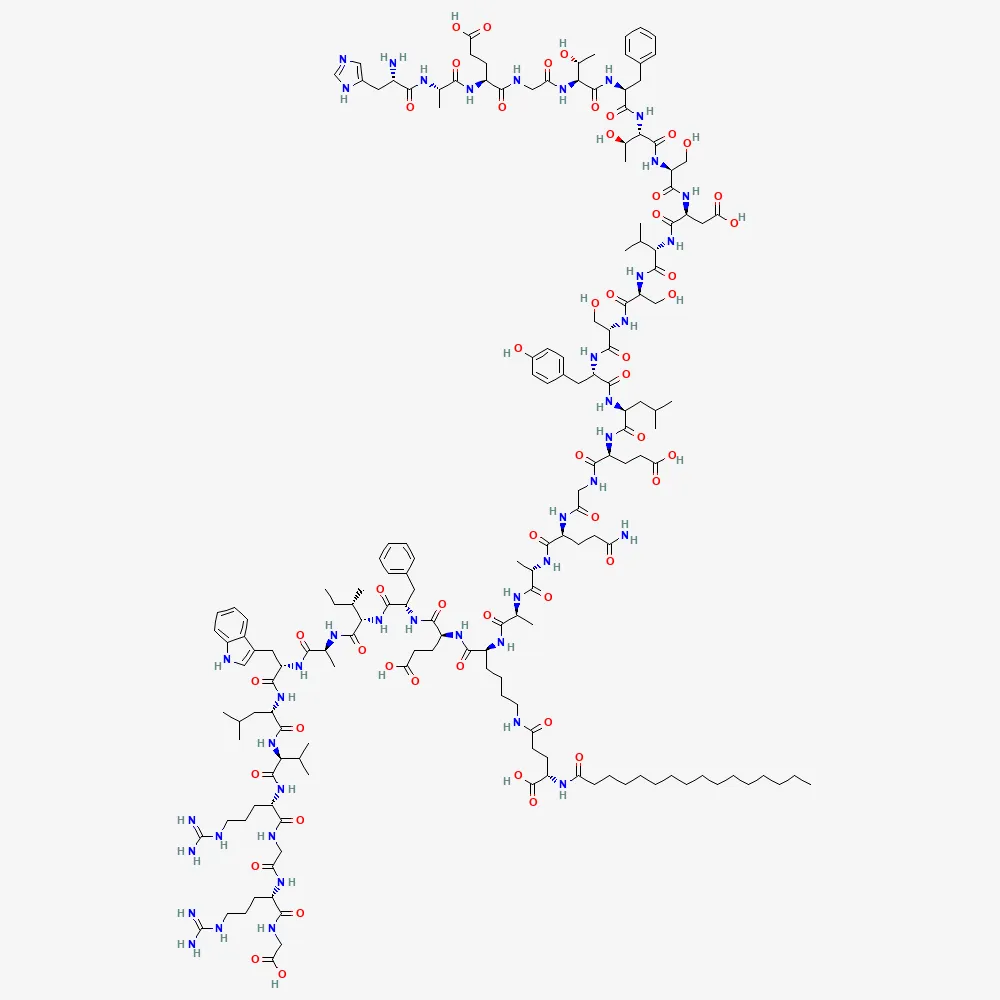
- Molecular formula
- C172H265N43O51
- Molecular weight
- 3751 g/mol
- Length
- 31 amino acids
- Sequence
- HAEGTFTSDVSSYLEGQAAKEFIAWLVRGRG
- Modifications
- Human GLP-1(7-37) with Lys34 replaced by Arg; the remaining Lys26 (position 20 here) carries a palmitoyl (C16) fatty acid attached through a gamma-glutamic acid spacer.
- PubChem CID
- 16134956
Identity checked against FDA prescribing information (Victoza), DailyMed.
How liraglutide works
Liraglutide is a synthetic peptide with 97% amino acid sequence homology to the body’s own GLP-1(7-37). It binds to and activates the GLP-1 receptor, a cell-surface receptor coupled to adenylyl cyclase through the stimulatory G-protein Gs.
That has three effects. It raises insulin release and lowers glucagon release, both only when blood sugar is high (glucose-dependent). It also slows stomach emptying, which the label flags separately because it can change how other oral medicines taken around the same time are absorbed.
Liraglutide benefits: what the research shows
The Saxenda label reports the weight-management trial at the 3 mg dose. Over 56 weeks, 2,487 patients on liraglutide lost an average of 7.4% of body weight, against 3.0% on placebo. And 62.3% lost at least 5% of their body weight, against 34.4% on placebo.
Victoza’s approval rests on separate trials. They showed better blood-sugar control and, in people with type 2 diabetes and established cardiovascular disease, fewer major cardiovascular events. Both sets of results are from the labels, within the approved uses.
Once-daily, not once-weekly: the real contrast with semaglutide and tirzepatide
This is the practical difference from the newer drugs in the class. Liraglutide’s plasma half-life is about 13 hours, per the Saxenda label. That is short enough that it has to be taken every day to keep working, so a missed dose has no week-long buffer.
Semaglutide’s half-life is roughly a week and tirzepatide’s roughly five days. That is why both are dosed once a week.
Liraglutide dosage
Both brands start at the same low dose and step up on a fixed schedule, which helps people tolerate the gut side effects. The two schedules end at different maintenance doses. The schedules below are exactly as the labels state them; the liraglutide dosage page adds step-by-step tables, missed-dose rules and the week-16 stopping rule.
Saxenda (weight management), weekly titration:
| Week | Dose |
|---|---|
| 1 | 0.6 mg once daily |
| 2 | 1.2 mg once daily |
| 3 | 1.8 mg once daily |
| 4 | 2.4 mg once daily |
| 5 onward | 3 mg once daily (maintenance) |
Children and adolescents may take up to eight weeks to complete the titration. Those who don’t tolerate 3 mg may stay at 2.4 mg.
Victoza (type 2 diabetes), dose-as-needed titration:
| Step | Dose |
|---|---|
| Start | 0.6 mg once daily for 1 week |
| Week 2 | Increase to 1.2 mg once daily |
| If needed | Increase to 1.8 mg once daily, at least 1 week after reaching 1.2 mg |
The 0.6 mg starting dose on both brands is a run-in dose for tolerability, not a treatment dose. A prescriber manages every step against response and side effects; none of it is a number to self-direct from an unlabelled vial.
Liraglutide side effects
This section uses the FDA-approved labels for Saxenda and Victoza: trial adverse-reaction rates, the boxed warning and the label’s precautions.
When starting
Gut effects are the most common adverse reaction for both uses, and the titration schedule above exists to manage them. Selected rates from the trials behind the Saxenda label, drug versus placebo:
| Reaction | Liraglutide (Saxenda) | Placebo |
|---|---|---|
| Nausea | 39.3% | 13.8% |
| Diarrhoea | 20.9% | 9.9% |
| Constipation | 19.4% | 8.5% |
| Vomiting | 15.7% | 3.9% |
| Injection-site reaction | 13.9% | 10.5% |
| Headache | 13.6% | 12.6% |
| Dyspepsia | 9.6% | 2.7% |
The Victoza label reports lower rates at its lower diabetes doses, drug versus placebo:
| Reaction | Placebo | Liraglutide 1.2 mg | Liraglutide 1.8 mg |
|---|---|---|---|
| Nausea | 5% | 18% | 20% |
| Diarrhoea | 4% | 10% | 12% |
| Headache | 7% | 11% | 10% |
| Vomiting | 2% | 6% | 9% |
| Decreased appetite | 1% | 10% | 9% |
| Dyspepsia | 1% | 4% | 7% |
| Constipation | 1% | 5% | 5% |
The gap tracks the dose: Victoza’s diabetes doses are lower than Saxenda’s 3 mg weight-management dose. Semaglutide shows the same pattern between Ozempic and Wegovy doses. For what to watch for where you inject, see peptide injection-site reactions.
Rare but serious
The label also documents serious allergic (hypersensitivity) reactions, including anaphylaxis and angioedema, and sets out these precautions:
| Precaution | What the label says |
|---|---|
| Pancreatitis | Observe for persistent abdominal pain; discontinue if acute pancreatitis is suspected, and do not restart if confirmed. |
| Gallbladder disease | Cholelithiasis was reported in 2.2% of Saxenda-treated patients, against 0.8% on placebo. |
| Hypoglycaemia | Risk rises when liraglutide is combined with insulin or a sulfonylurea; those doses may need adjusting. |
| Heart rate | Mean resting heart rate rose 2 to 3 beats per minute on liraglutide in trials, monitored at routine visits. |
| Kidney function | Dehydration from gastrointestinal side effects can lead to acute kidney injury; renal function is monitored in patients with persistent nausea, vomiting or diarrhoea. |
Is liraglutide legal?
US legal status - FDA-approved · prescription only
Liraglutide is FDA-approved as Saxenda and Victoza, each with its own label, and needs a prescriber. A compounded, counterfeit or "research use only" vial is not the approved product and is not made to the same quality standard.
AU legal status - TGA-registered · prescription only
Liraglutide is Schedule 4 of the Poisons Standard (prescription only), and approved products are on the ARTG. Prescription medicines cannot lawfully be advertised to the Australian public.
Regulators reach their own conclusions on their own timelines. Where these two disagree, the difference is the point - not an error.
Who should not use liraglutide
The boxed warning and the allergy data above rule out two groups entirely:
- Anyone with a personal or family history of medullary thyroid carcinoma or Multiple Endocrine Neoplasia syndrome type 2.
- Anyone with a known hypersensitivity to liraglutide or its excipients.
A prescriber still needs to review your full medical history before a first dose.
Why the grey market is a different problem than price
FDA has documented problems across the unapproved GLP-1 market: dosing errors, counterfeit product, unapproved salt-form substitution, and labels naming compounding pharmacies that don’t exist or didn’t make the product. The warnings that apply to grey-market semaglutide and tirzepatide apply equally to liraglutide sold outside its approved brands.
None of that is a reason to avoid liraglutide. It is a reason to get it through the channel the approval covers.
Related
- Semaglutide (Ozempic, Wegovy)
- Tirzepatide (Mounjaro, Zepbound)
- Best GLP-1 for weight loss: the approved options compared
- How GLP-1 medicines work
- FDA-approved peptides: the complete list
Regulatory changes for this compound and others, as they happen: US peptide regulation tracker.
How Liraglutide compares
GLP-1 and related medicines. Doses for unapproved compounds are common practice, not trial-established. All weight loss and metabolism peptides →
| Compound | Main use | Evidence | Usual dose | US status |
|---|---|---|---|---|
| Liraglutide | FDA-approved as a once-daily injection under two brands: Saxenda, for chronic weight management alongside diet and exercise in adults and in children 12 years and older with obesity who weigh more than 60 kg, and Victoza, for glycemic control in type 2 diabetes in adults and children 10 years and older, and for reducing major adverse cardiovascular events in adults with type 2 diabetes and established cardiovascular disease. | Strong human evidence | FDA label | FDA-approved · prescription only |
| Semaglutide | FDA-approved for type 2 diabetes in adults (Ozempic injection and tablets, Rybelsus), including cardiovascular risk reduction and, for the Ozempic injection, kidney-disease progression; and as Wegovy injection and tablets for chronic weight management and cardiovascular risk reduction in adults with obesity or overweight. The Wegovy injection is also approved for weight management from age 12 and for MASH with moderate to advanced liver fibrosis in adults. | Strong human evidence | FDA label | FDA-approved · prescription only |
| Tirzepatide | FDA-approved to improve glycemic control in type 2 diabetes in adults and children 10 years and older, and to reduce cardiovascular risk in adults with type 2 diabetes (Mounjaro), and for chronic weight management and moderate-to-severe obstructive sleep apnoea in adults with obesity (Zepbound). | Strong human evidence | FDA label | FDA-approved · prescription only |
| Orforglipron | FDA-approved as Foundayo, in combination with a reduced-calorie diet and increased physical activity, to reduce excess body weight and maintain weight reduction long term in adults with obesity, or adults with overweight who have at least one weight-related condition. | Strong human evidence | FDA label | FDA-approved · prescription only |
| Retatrutide | Investigational in Phase 3 trials for obesity, type 2 diabetes and related conditions. Not approved for any indication in the US. Sold outside the trial system as an unapproved research chemical, often alongside semaglutide and tirzepatide. | Moderate human evidence | 2-12 mg, once weekly, starting at 2 mg and titrating up every 4 weeks to a 4-12 mg maintenance dose | Research use only |
| Survodutide | An investigational injectable peptide, not approved for any use. Its sponsor, Boehringer Ingelheim, is studying it in Phase 3 trials for chronic weight management and, in a separate programme, for MASH (metabolic dysfunction-associated steatohepatitis). It is also sold directly to consumers as a research chemical outside those trials. | Moderate human evidence | 0.6-6 mg, once weekly, starting around 0.6 mg; the phase 2 trial titrated over about 20 weeks to a 2.4-4.8 mg maintenance dose, while the published phase 3 SYNCHRONIZE-1 trial randomizes to a higher 3.6 or 6.0 mg maintenance target using a slower, flexible up-titration | Research use only |
| Mazdutide | Approved in China for chronic weight management and for glycemic control in type 2 diabetes. Not FDA-approved in the United States, where it is sold to consumers as a research-chemical vial. | Moderate human evidence | 3-9 mg, once weekly, titrated upward from a lower starting dose | Research use only |
| Cagrilintide | Investigational amylin analogue studied alone and, more prominently, combined with semaglutide as the fixed-dose combination CagriSema, for chronic weight management. Not approved for any indication in the US; the combination is under FDA review following the sponsor's New Drug Application. | Moderate human evidence | 0.25-4.5 mg, once weekly, titrating from a 0.25-0.6 mg starting dose up to a 2.4-4.5 mg maintenance dose | Research use only |
Where to get Liraglutide legally
Liraglutide is an FDA-approved prescription medicine, so the legal route is a licensed prescriber, in person or by telehealth, and a licensed pharmacy.
With a prescription, a 2-pen box of generic liraglutide costs $133.58 with a TrumpRx.gov coupon (as of 3 October 2026).
Every legal route for liraglutide, with dated prices →
How telehealth prescribing works, what it costs and what to check: telehealth peptide prescribing.
Research-labelled liraglutide (not the approved medicine)
These checked vendors sell a research-labelled version. It has not been reviewed by FDA, is labelled not for human use, and is tested only as the seller chooses.
1.Next Level Pharm
5 mg vial
- No FDA warning letter found
- Names its testing lab
- Batch COAs published
- Takes card payment
How research-labelled liraglutide differs, and what FDA has said →
Common questions
What is liraglutide?
An FDA-approved GLP-1 receptor agonist: a synthetic peptide with 97% sequence homology to human GLP-1. Novo Nordisk sells it as two once-daily injections: Victoza for type 2 diabetes and cardiovascular risk reduction, and Saxenda for chronic weight management.
What are the side effects of liraglutide?
The most common are nausea, diarrhoea, constipation and vomiting, reported most often while the dose is being stepped up. The label also carries a boxed warning for thyroid C-cell tumours seen in rodents, and precautions for pancreatitis, gallbladder disease, low blood sugar and kidney injury from dehydration. See the [side effects section](#liraglutide-side-effects) for the full rates.
Can you lose weight on liraglutide?
Yes, at the approved dose. In the 56-week trial behind the Saxenda label, 2,487 patients on liraglutide lost an average of 7.4% of body weight, against 3.0% on placebo, and 62.3% lost at least 5% (34.4% on placebo). Those results are for Saxenda at up to 3 mg a day; Victoza, dosed lower for diabetes, has no weight-loss indication.
What is the boxed warning on liraglutide?
Liraglutide causes thyroid C-cell tumours in male and female rats and mice at clinically relevant exposures, and the risk rises with dose and duration. Whether this happens in humans is unknown. It must not be used by anyone with a personal or family history of medullary thyroid carcinoma or Multiple Endocrine Neoplasia syndrome type 2.
Why is liraglutide injected daily when semaglutide and tirzepatide are weekly?
Its half-life is about 13 hours, per the Saxenda label. Semaglutide's is roughly a week and tirzepatide's roughly five days, which is what allows weekly dosing. Liraglutide came first, as the first once-daily GLP-1 receptor agonist approved; the shorter half-life is a property of the drug, not a dosing preference.
How is liraglutide dosed?
Both brands start at 0.6 mg once a day for one week. Saxenda then rises weekly (1.2, 1.8, 2.4 mg) to 3 mg a day from week five; children may take up to eight weeks, and some stay at 2.4 mg. Victoza rises to 1.2 mg after week one, and to 1.8 mg after at least a week at 1.2 mg if needed. A prescriber manages this; it is not a number to copy from a forum.
Is compounded or "research" liraglutide the same product?
No. As with semaglutide and tirzepatide, FDA has documented dosing errors, counterfeit product and fraudulent labelling in the compounded and grey-market GLP-1 supply. A vial labelled "research use only" and sold with dosing instructions is being sold for human use outside any approval.
Can I switch between liraglutide and semaglutide or tirzepatide?
That is a decision for a prescriber who knows your history. The three drugs act on overlapping but not identical receptors, follow different dosing schedules and rest on different trial data. Switching is a medical decision, not a like-for-like swap.
Is liraglutide being discontinued?
Saxenda is. Novo Nordisk's NovoCare notice, checked 3 October 2026, says it is discontinuing Saxenda, with last shipments to wholesalers in late January 2027, because alternatives exist and fewer patients use it, not for safety or quality reasons. The notice covers Saxenda only. FDA's Drugs@FDA database lists Victoza with active 'Prescription' marketing status, and its latest label update was approved in October 2025.
Why does liraglutide stop working?
Usually it hasn't: people respond differently from early in treatment, rather than failing later. The Saxenda label builds this into a stopping rule. If a patient hasn't lost at least 4% of starting body weight after 16 weeks, the label says to stop, because it hasn't worked for that person. That is different from a drug that worked and later stopped.
How much does liraglutide cost at Walmart?
I couldn't verify a current Walmart price. Brand liraglutide is Saxenda or Victoza from Novo Nordisk, and DailyMed also lists generic liraglutide injection from Teva, Lupin, Hikma and Cipla, among others. Brand versus generic, dose strength and insurance decide the price, so ask a pharmacist for a current quote and your insurer about coverage.
What is the brand name of liraglutide?
Liraglutide is sold under the brand names Victoza and Saxenda, made by Novo Nordisk. Victoza is approved for type 2 diabetes: improving blood-sugar control alongside diet and exercise in adults and children 10 years and older, and lowering the risk of major cardiovascular events in adults with established cardiovascular disease. Saxenda is approved for chronic weight management in adults with obesity or overweight with at least one weight-related condition, and in children 12 years and older with obesity who weigh more than 60 kg.
What is the generic name for Victoza?
The generic name for Victoza is liraglutide. Victoza is Novo Nordisk's brand, approved for type 2 diabetes: improving blood-sugar control alongside diet and exercise in adults and children 10 years and older, and lowering the risk of major cardiovascular events in adults with established cardiovascular disease.
What is the generic name for Saxenda?
The generic name for Saxenda is liraglutide. Saxenda is Novo Nordisk's brand, approved for chronic weight management in adults with obesity or overweight with at least one weight-related condition, and in children 12 years and older with obesity who weigh more than 60 kg.
Is Victoza the same as liraglutide?
Yes. Victoza is a brand of liraglutide, made by Novo Nordisk: the active ingredient is liraglutide. It comes as a once-daily injection (multi-dose prefilled pen, 18 mg/3 mL), dosed at 0.6 mg once daily for one week to start, then 1.2 mg, up to 1.8 mg once daily. Compounded or research-vial liraglutide is not Victoza and has not been through its FDA review.
Is Saxenda the same as liraglutide?
Yes. Saxenda is a brand of liraglutide, made by Novo Nordisk: the active ingredient is liraglutide. It comes as a once-daily injection (multi-dose prefilled pen, 18 mg/3 mL), dosed at 0.6 mg once daily to start, increased weekly to 3 mg once daily. Compounded or research-vial liraglutide is not Saxenda and has not been through its FDA review.
Is Victoza the same as Saxenda?
Victoza and Saxenda contain the same active ingredient, liraglutide, and both are made by Novo Nordisk. They are approved for different uses and doses: Victoza for type 2 diabetes: improving blood-sugar control alongside diet and exercise in adults and children 10 years and older, and lowering the risk of major cardiovascular events in adults with established cardiovascular disease (0.6 mg once daily for one week to start, then 1.2 mg, up to 1.8 mg once daily); Saxenda for chronic weight management in adults with obesity or overweight with at least one weight-related condition, and in children 12 years and older with obesity who weigh more than 60 kg (0.6 mg once daily to start, increased weekly to 3 mg once daily).
References (7 sources)
Bibliographic detail is fetched from PubMed, not written by me - so a citation here cannot drift from the paper it names. Study design comes from PubMed's own tags rather than my judgement.
- 1.NovoCare Saxenda page, discontinuation notice (checked 3 October 2026): last shipments to wholesalers in late January 2027; not the result of any safety or quality concern.- Novo Nordisk (NovoCare)label
- 2.SAXENDA (liraglutide) injection, solution - full prescribing information, including boxed warning, weekly titration schedule and adverse reaction rates for the weight-management indication.- DailyMed, National Library of Medicinelabel
- 3.VICTOZA (liraglutide) injection - full prescribing information for the type 2 diabetes and cardiovascular-risk-reduction indications, including dosing and adverse reaction rates.- DailyMed, National Library of Medicinelabel
- 4.FDA's Concerns with Unapproved GLP-1 Drugs Used for Weight Loss - dosing errors, counterfeit product, fraudulent labelling and salt-form substitution in the compounded and grey-market supply.- US Food and Drug Administrationregulatory
- 5.Drugs@FDA record for Saxenda (NDA 206321) - approval history and current marketing status.- US Food and Drug Administrationdatabase
- 6.Drugs@FDA record for Victoza (NDA 022341) - approval history and current marketing status.- US Food and Drug Administrationdatabase
- 7.VICTOZA (liraglutide) injection - prescribing information- DailyMed, National Library of Medicinelabel