SNAP-8 (Acetyl Octapeptide-3): Benefits, Dosage and Side Effects
SNAP-8 (acetyl octapeptide-3): the topical cosmetic peptide explained - mechanism, the manufacturer-testing evidence, formulation use and legal status.

The short version
SNAP-8 is a topical cosmetic peptide, not an injectable, sold in serums and gels as a longer, supposedly stronger version of Argireline. It is proposed to soften expression lines by partly blocking the signal that makes muscles contract. The 63% wrinkle-depth figure quoted in marketing comes from manufacturer-sponsored testing, and I found no independent, peer-reviewed human trial to check it against.
- SNAP-8 is a topical cosmetic ingredient (INCI: Acetyl Octapeptide-3), not an injectable or a drug.
- Its proposed mechanism is the same as Argireline's: partly blocking nerve-to-muscle signalling at the skin surface.
- I found no independent, peer-reviewed human trial of SNAP-8; the headline efficacy figure is manufacturer-sponsored.
- Used at 3-10% of a commercial solution in formulations, per two vendor sources - not 3-10% pure peptide by weight.
SNAP-8 at a glance
- What it is
- Synthetic octapeptide (topical cosmetic ingredient, INCI name Acetyl Octapeptide-3)
- Main use
- Topical cosmetic anti-wrinkle ingredient in serums, gels and emulsions, marketed as a longer version of the neurotransmitter-release-inhibiting peptide family that includes Argireline (acetyl hexapeptide-8).
- Also called
- Acetyl Octapeptide-3, Acetyl Octapeptide-1, SNAP-8™
- Molecular formula
- C41H70N16O16S (1075.2 g/mol) Structure
- Evidence
- Animal / lab only
- US status
- Cosmetic
- Australia
- Cosmetic
- Half-life
- Not established in humans
- Dose
- No consistent protocol in circulation Dosing page
Dosing: how it’s used in formulations.
SNAP-8 is a topical cosmetic ingredient, not an injectable. It is sold under the INCI name Acetyl Octapeptide-3, usually as a pre-diluted solution added to serums, gels and emulsions, never as a vial for injection. It belongs to the same marketed family as Argireline, with two extra amino acids.
Studied in cells or animals. No controlled trials in humans. No independently published, peer-reviewed human clinical trial specific to SNAP-8 was located in a PubMed search. The main efficacy figure in circulation (63% wrinkle-depth reduction over 28 days) traces to manufacturer-sponsored testing in vendor and ingredient-marketing material, not to a verified independent paper.
What is SNAP-8?
SNAP-8 (acetyl octapeptide-3) is a synthetic peptide of eight amino acids. It was developed as an extension of the six-amino-acid peptide behind Argireline (acetyl hexapeptide-8, called acetyl hexapeptide-3 in some older marketing). It is not a drug and is not injected. It goes into leave-on skincare at a low percentage, alongside other ingredients.
SNAP-8 structure
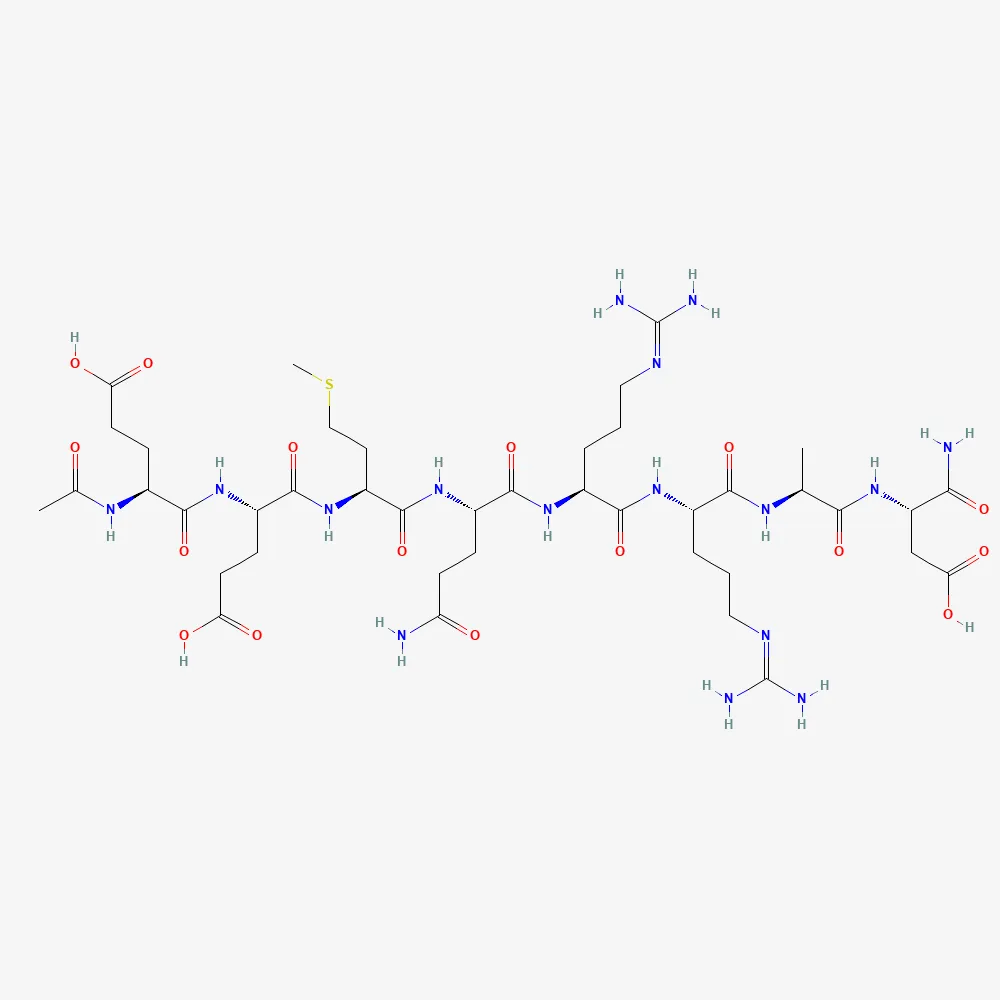
- Molecular formula
- C41H70N16O16S
- Molecular weight
- 1075.2 g/mol
- Length
- 8 amino acids
- Sequence
- EEMQRRAD
- Modifications
- N-terminal acetyl; C-terminal amide (Ac-EEMQRRAD-NH2).
- PubChem CID
- 76283482
Identity checked against FDA Global Substance Registration System (UNII 8K14HJF88S).
How SNAP-8 works
The manufacturer says SNAP-8 mimics one end (the N-terminal end) of SNAP-25. Nerve cells use SNAP-25, as part of the SNARE complex, to release acetylcholine, the chemical that makes muscles contract.
SNAP-8 is proposed to compete with SNAP-25 for its place in that complex and partly destabilise it. Less acetylcholine is released, so the small, repeated muscle contractions behind expression lines weaken. It is the same general strategy as botulinum toxin, blocking nerve-to-muscle signals, but applied to the skin on a much smaller scale.
This mechanism comes from the ingredient’s manufacturer. A described mechanism is not a shown clinical effect.
SNAP-8 benefits: what the research shows
Marketing repeats two figures: a 63% reduction in wrinkle depth after 28 days of twice-daily use, and roughly 30% more activity than Argireline in comparative testing. Both come from the manufacturer’s own lab and skin testing, reported through vendor and ingredient marketing.
I searched PubMed for SNAP-8 and acetyl octapeptide-3 and found no independently published, peer-reviewed human trial to check those figures against. That is a much thinner evidence base than its parent peptide’s: Argireline has small independent clinical and instrument-based studies (see the Argireline page).
SNAP-8 dosage
For a cosmetic, “dosage” means how much goes into the formula. Two vendor formulation guides, on different sites, describe using SNAP-8 at 3-10% of a commercial solution in a finished serum, gel or emulsion. There is an important caveat about what that percentage measures. Full sourcing: SNAP-8 dosage.
SNAP-8 side effects
There is no FDA safety review of SNAP-8, because FDA doesn’t review cosmetic ingredients before sale. Vendor formulation material describes it as generally well tolerated on the skin at the usual concentrations. I found no independent published human safety or irritation data on SNAP-8.
As with any cosmetic, patch-test a new product and stop using it if irritation, redness or a rash develops. Get emergency care for signs of a severe allergic reaction (swelling of the face, lips or throat, or difficulty breathing) after using any cosmetic product.
Is SNAP-8 legal?
US legal status - Cosmetic
Regulated as a cosmetic in the US. Cosmetics are not FDA-approved before sale, and may only make appearance claims - a product claiming to change the structure or function of skin is making a drug claim.
AU legal status - Cosmetic
Regulated as a cosmetic, which in Australia means its ingredients are industrial chemicals overseen by AICIS rather than therapeutic goods overseen by the TGA. Which regulator applies turns on three things together: what the product is mainly for, what is in it, and what is claimed for it - start claiming a therapeutic effect and the same formula becomes a therapeutic good.
Regulators reach their own conclusions on their own timelines. Where these two disagree, the difference is the point - not an error.
- Lawful as a cosmetic ingredient under the INCI name Acetyl Octapeptide-3, in both the US and Australia.
- Not FDA-approved, like almost every cosmetic ingredient: US cosmetics don’t need approval before sale the way drugs do.
- Limited to appearance claims. A SNAP-8 product may say it reduces the look of expression lines. Claiming it changes the structure or function of skin would be a drug claim, a different legal category.
Related reading
- Argireline (Acetyl Hexapeptide-8): the study evidence
- GHK-Cu vs Matrixyl
- Skin peptides: an overview
- Research peptides and the law
How SNAP-8 compares
Skin and cosmetic. Doses for unapproved compounds are common practice, not trial-established. All skin and cosmetic peptides →
| Compound | Main use | Evidence | Usual dose | US status |
|---|---|---|---|---|
| GHK-Cu | Topical cosmetic anti-aging - fine lines, skin density and firmness, elasticity, photodamage, hyperpigmentation - and wound healing. Also marketed in hair-loss cosmetics. | Limited human data | 1-2 mg, once daily, before bed | Cosmetic |
| SNAP-8 | Topical cosmetic anti-wrinkle ingredient in serums, gels and emulsions, marketed as a longer version of the neurotransmitter-release-inhibiting peptide family that includes Argireline (acetyl hexapeptide-8). | Animal / lab only | No consistent protocol | Cosmetic |
| Glutathione | Naturally synthesized in nearly all human cells as the body's principal intracellular antioxidant. Sold as an oral dietary supplement, and marketed by IV/wellness clinics and online sellers as an injectable "glutathione push" or "skin whitening" infusion - a use with no FDA-approved product behind it. | Limited human data | 200-1200 mg, 1-3 times weekly, intramuscular (glute or deltoid) | Dietary supplement |
Common questions
What is the usual SNAP-8 dose?
It has no dose in the medical sense; it is a cosmetic ingredient that gets formulated, not dosed. Two vendor formulation guides describe using it at 3-10% of a commercial SNAP-8 solution in a finished serum, gel or emulsion. The dosing page has the sourcing and an important caveat about what that percentage means.
What are the side effects of SNAP-8?
There is no FDA safety review of SNAP-8, because FDA doesn't review cosmetics before sale. Vendor material describes it as well tolerated for daily use on the skin at typical concentrations. I found no independent published human safety data on SNAP-8.
References (1 sources)
Bibliographic detail is fetched from PubMed, not written by me - so a citation here cannot drift from the paper it names. Study design comes from PubMed's own tags rather than my judgement.
- 1.FDA - Is It a Cosmetic, a Drug, or Both? Intended-use framework distinguishing cosmetic appearance claims from drug structure/function claims.- US Food and Drug Administrationregulatory