What Is Pitocin? Oxytocin for Labour: Uses and Side Effects
Pitocin is synthetic oxytocin, given in hospital to start or strengthen labour and control bleeding after birth. How it is used, its risks and when it is not used.

The short version
Pitocin is the brand name for synthetic oxytocin, made for Par Health USA. It is a hospital medicine. It is given by IV drip to start or strengthen labour when there is a medical reason. After birth it is given by injection or drip to help the uterus contract and control bleeding. Its label carries a boxed notice that it is not indicated for elective induction. It is given only with continuous monitoring by trained staff.
- Pitocin = synthetic oxytocin, the same hormone the body makes, in 10 units/mL vials.
- It is given in hospital by clinical staff, never self-administered, with continuous fetal and uterine monitoring.
- The label says it is not indicated for elective induction - labour started with no medical reason.
- The main risks come from contractions that are too strong, and from water retention with long, high-dose infusions.
- Oxytocin nasal sprays and vials sold online are not Pitocin and are not approved for the uses they are sold for.
Pitocin is the brand name for synthetic oxytocin, made for Par Health USA. It is a hospital medicine, given by IV drip or injection. It is approved to start or strengthen labour when there is a medical reason and as an add-on treatment for incomplete or inevitable miscarriage. It is also used to make the uterus contract and control bleeding after birth.
This page describes the approved hospital product. For the hormone itself, and the unapproved nasal sprays sold under its name, see oxytocin.
What is Pitocin?
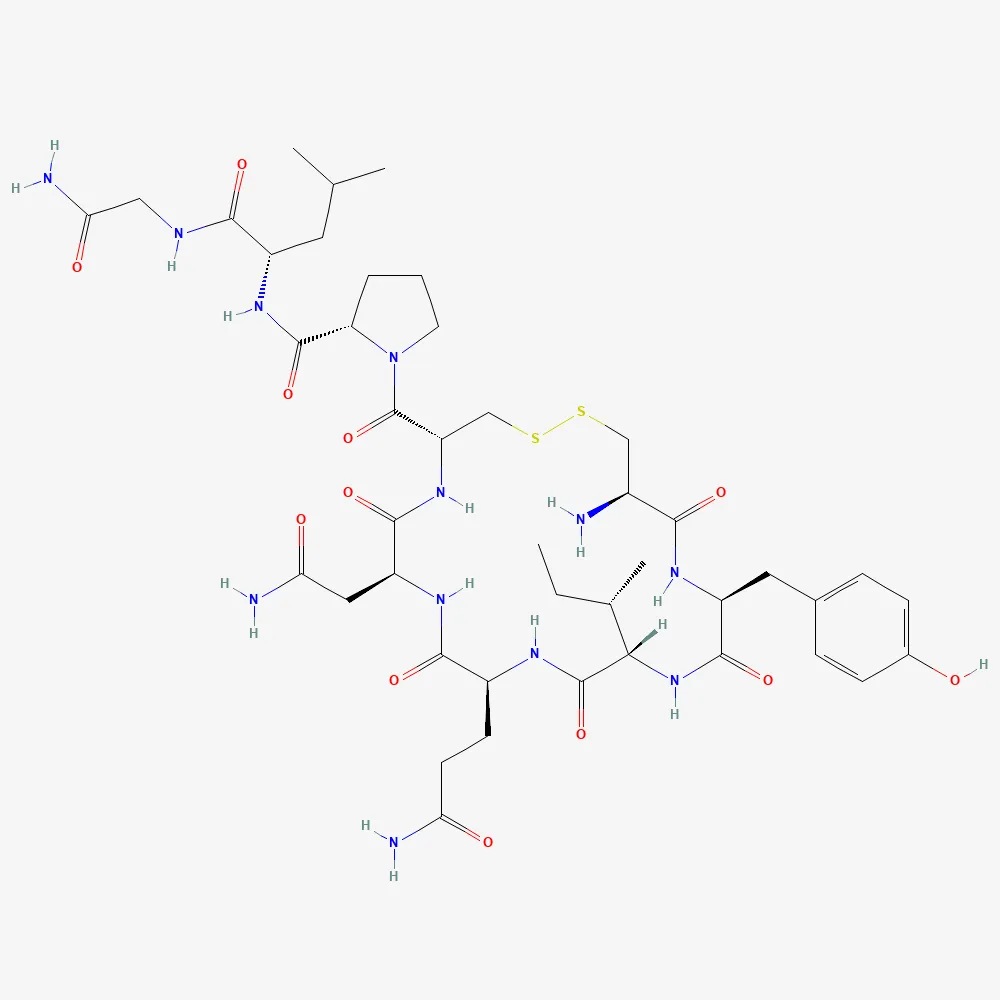
Pitocin is a clear solution of synthetic oxytocin at a standard 10 units per mL, supplied in vials for intravenous infusion or intramuscular injection. Oxytocin is a nine-amino-acid hormone the pituitary gland makes. The medicine is made synthetically so that it is free of vasopressin and other pituitary peptides.
Pitocin is the only US brand currently marketed. Syntocinon was once FDA-approved but is listed as discontinued, and no oxytocin nasal spray is currently approved in the US.
The label covers three situations:
- Before birth: starting labour when delivery is in the interest of mother and baby for a medical reason, and strengthening labour that has stalled. The label’s examples of medical reasons include Rh problems, maternal diabetes, preeclampsia at or near term, and waters that have broken early.
- Miscarriage: as an add-on treatment for incomplete or inevitable miscarriage.
- After birth: producing contractions in the third stage of labour and controlling bleeding.
For the after-birth use there is trial evidence beyond the label. A Cochrane review of 24 trials looked at oxytocin given in the third stage of labour after vaginal birth, compared with placebo or no uterotonic drug. It may roughly halve the risk of losing 500 mL of blood or more. The evidence was of low to moderate quality Salati 2019 - Salati JA, Leathersich SJ, Williams MJ et al. Prophylactic oxytocin for the third stage of labour to prevent postpartum haemorrhage. Cochrane Database Syst Rev. 2019;4(4):CD001808., in the references below. Pitocin is on my FDA-approved peptides list.
Pitocin structure
How Pitocin works
Oxytocin binds receptors in the muscle of the uterus and raises calcium inside the muscle cells, which drives contractions. The number of receptors rises sharply in pregnancy and peaks in early labour at term. The same dose can therefore have very different effects from one person to the next.
It acts fast and clears fast. Its half-life in the blood is about 1 to 6 minutes. The uterus responds almost at once to an IV drip, and the effect fades within about an hour of stopping. After an injection into muscle, the response starts in 3 to 5 minutes and lasts 2 to 3 hours.
Oxytocin differs from vasopressin at only two amino-acid positions, so large doses can raise blood pressure and make the body hold on to water. More in the oxytocin guide.
Pitocin dosage
For labour, the label allows only an IV drip, run through an infusion pump so the rate can be controlled exactly. The baby’s heart rate and the contractions are monitored electronically throughout. The drip starts at a very low rate, 0.5 to 1 milliunit per minute. Staff raise it gradually, at 30 to 60 minute intervals, until the contractions follow the pattern they are aiming for. It is stopped at once if the uterus becomes overactive or the baby shows signs of distress.
After birth, the label allows 10 units by injection into muscle once the placenta is delivered. It also allows 10 to 40 units added to an IV drip that is already running. What the label says, and why this is not a number to copy, is on the oxytocin dosage page.
Side effects and who should not have it
The label lists adverse reactions without percentages. In the mother, it reports:
- anaphylaxis, irregular heart rhythms and high-blood-pressure episodes;
- bleeding after birth, pelvic haematoma, bleeding around the brain (subarachnoid haemorrhage) and fatal loss of clotting fibrinogen;
- nausea and vomiting;
- rupture of the uterus.
Too much oxytocin, or a uterus that is very sensitive to it, can cause contractions that are too strong or sustained. Its water-retaining effect can cause water intoxication, a particular risk when large doses are infused for long periods. Seizures and coma have occurred with a slow infusion over 24 hours, and maternal deaths have been reported.
In the baby, reported effects include a slow heart rate and other rhythm changes, low Apgar scores at five minutes and jaundice. They also include bleeding in the retina, seizures, permanent brain damage and death.
The label rules out Pitocin before birth when there is:
- significant mismatch between the baby’s head and the mother’s pelvis (cephalopelvic disproportion);
- a baby lying in a position that cannot be delivered without turning, such as a transverse lie;
- an emergency where surgery is the better option for mother or baby;
- fetal distress where delivery is not imminent;
- adequate contractions that are still not producing progress;
- a uterus that is already overactive or has too much tone;
- a reason vaginal birth is unsafe, such as invasive cervical cancer, active genital herpes, total placenta previa, vasa previa, or the cord presenting or prolapsing first;
- hypersensitivity to the drug.
It is also avoided, except in unusual circumstances, where the uterus is more prone to rupture, such as after a caesarean section or other major surgery on the uterus. These are decisions for the obstetric team.
Pitocin vs oxytocin sold online
Oxytocin is sold online as nasal sprays and “research use only” vials, marketed for libido, bonding or mood. Those products are not Pitocin, are not quality-verified, and are not approved for the uses they are sold for. No oxytocin nasal spray is currently approved in the US at all. What the research on intranasal oxytocin covers, and what it does not, is in my oxytocin guide.
Is Pitocin the same as oxytocin?
Pitocin is synthetic oxytocin, at a set strength, approved as a prescription medicine for specific obstetric uses and given only in hospital. The name “oxytocin” on anything else, such as a nasal spray or a vial bought online, describes the molecule, not the approved product.
Common questions
What is the generic name for Pitocin?
Oxytocin. The label calls it oxytocin injection, USP (synthetic). It is the same nine-amino-acid hormone the pituitary gland releases, made synthetically so it is free of vasopressin and other pituitary peptides. Pitocin is the only US brand currently marketed. Syntocinon was once FDA-approved but is listed as discontinued.
What does Pitocin do in pregnancy?
It makes the uterus contract. Before birth, the label approves it to start labour when there is a medical reason to deliver and to strengthen labour that has stalled. It is also approved as an add-on treatment for incomplete or inevitable miscarriage. The label's examples of medical reasons include Rh problems, maternal diabetes, preeclampsia at or near term, and waters that have broken early. After birth, it is used to produce contractions in the third stage of labour and to control bleeding.
How quickly does Pitocin work in labour?
Given by IV drip, the uterus responds almost immediately, and the effect fades within about an hour once the drip stops. Oxytocin's half-life in the blood is only 1 to 6 minutes. The label does not say how long it then takes to reach delivery. That varies widely, because the response depends on how sensitive the uterus is, which rises through pregnancy and peaks in early labour at term.
How painful is labour with Pitocin?
The label does not measure pain. It says that, properly given, oxytocin should produce contractions comparable to those of normal labour. Too much, or a uterus that is very sensitive to it, can cause contractions that are too strong or too long. That is why the drip is started low, adjusted by staff under continuous monitoring, and stopped at once if contractions become too powerful. Pain relief options are a conversation for the birth team.
Is Pitocin used for elective induction?
Not according to its label. The boxed notice says Pitocin is not indicated for elective induction (starting labour in someone with no medical reason for it). The available data are not enough to weigh the benefits against the risks.
Is Pitocin the same as the oxytocin nasal spray sold online?
No. Pitocin is an injectable given in hospital for labour and bleeding after birth. No oxytocin nasal spray is currently FDA-approved in the US, and the sprays sold for libido or connection have no approval for that use. See my [oxytocin guide](/oxytocin/) for what the nasal-spray research does and does not show.
References (3 sources)
Bibliographic detail is fetched from PubMed, not written by me - so a citation here cannot drift from the paper it names. Study design comes from PubMed's own tags rather than my judgement.
- 1.Salati JA, Leathersich SJ, Williams MJ et al. Prophylactic oxytocin for the third stage of labour to prevent postpartum haemorrhage. Cochrane Database Syst Rev. 2019;4(4):CD001808.Meta-analysisPMID 31032882full text
- 2.PITOCIN (oxytocin injection, USP) synthetic - prescribing information: indications, boxed notice on elective induction, contraindications, adverse reactions and administration.- DailyMed, National Library of Medicinelabel
- 3.Drugs@FDA record for Pitocin (NDA 018261) - approval history and current prescription marketing status.- US Food and Drug Administrationdatabase