Gonadorelin: Uses, Dosage, Side Effects and Legal Status
What the Gonadorelin research shows: how it works, historical dosing, side effects, and why the FDA-approved product is now discontinued.

The short version
Gonadorelin is a synthetic copy of GnRH, the brain hormone that tells the pituitary to release LH and FSH. FDA approved it twice, as Factrel (a diagnostic test dose) and Lutrepulse (a pulsed pump treatment for hypothalamic amenorrhea). Both were discontinued years ago, so no approved human product exists today. What circulates now is compounded or unapproved vials, mostly sold to men on testosterone therapy to keep their own hormone signal running, a use no published trial has tested.
- FDA approved gonadorelin twice: Factrel (1982, diagnostic test) and Lutrepulse (1989, hypothalamic amenorrhea). Both are discontinued.
- The Lutrepulse trial reported ovulation in 91-96% of 109 women with hypothalamic amenorrhea, using pulsed IV dosing, not the self-injected use it's sold for today.
- Every current DailyMed listing for "gonadorelin" is a veterinary livestock product.
- Its popular use today, low-dose injection under the skin alongside TRT, has no published human trial behind it.
Gonadorelin at a glance
- What it is
- Decapeptide - synthetic gonadotropin-releasing hormone (GnRH/LHRH)
- Main use
- FDA approved decades ago as a diagnostic test of pituitary function (Factrel) and as a pulsatile treatment for hypothalamic amenorrhea (Lutrepulse). Both approved products are discontinued. Today it is mainly sold through compounding pharmacies and research-peptide sellers to men on testosterone therapy, paired with TRT to keep the pituitary-testicular signal running - a use no trial has tested.
- Generic name
- gonadorelin
- Brand names
- Factrel and Lutrepulse (discontinued in the US) Label
- Also called
- GnRH, LHRH, Gonadorelin acetate, Gonadorelin hydrochloride
- Molecular formula
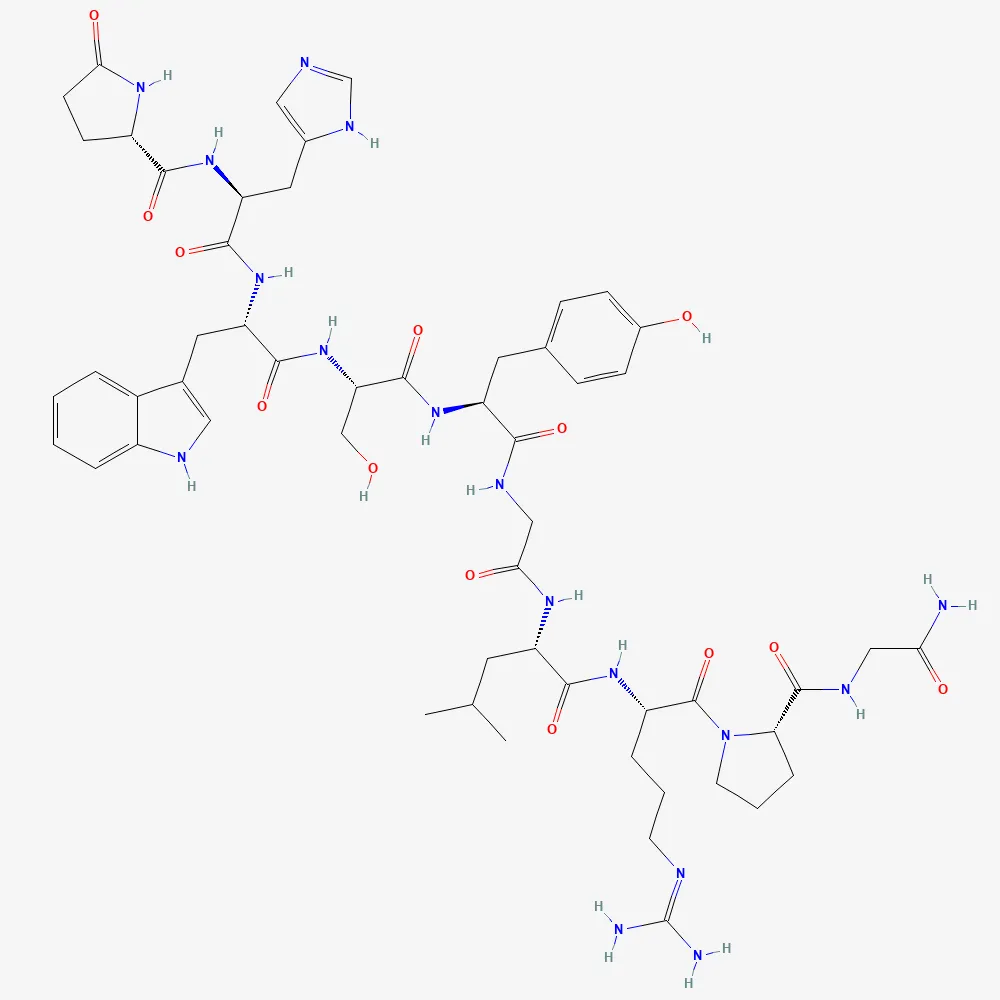
- C55H75N17O13 (1182.3 g/mol) Structure
- Evidence
- Moderate human evidence
- US status
- Unapproved drug
- Half-life
- About 2 to 10 minutes in humans; short enough that its effect depends on dosing pattern (single bolus vs. repeated pulses vs. continuous exposure), not just total dose.
- How it is taken
- Subcutaneous injection
- Common protocol
- 50-100 mcg, 2-3 times weekly, subcutaneous, spaced through the week (e.g. Monday/Thursday or Monday/Wednesday/Friday), alongside testosterone therapy (common practice, not trial-established) Dosing page
Gonadorelin is a synthetic copy of gonadotropin-releasing hormone (GnRH), the 10-amino-acid peptide (decapeptide) the hypothalamus uses to tell the pituitary to release LH and FSH. FDA approved it twice, decades ago, as two different salts under two brand names. Both are now discontinued. Dosing detail, diagnostic and historical, is on the dosing page.
US legal status - FDA-approved · prescription only
Twice FDA-approved (Factrel 1982, Lutrepulse 1989), both discontinued by their sponsors. Drugs@FDA lists every strength of both as 'Discontinued' - the status FDA uses for a sponsor-stopped product, not necessarily a safety withdrawal, though I could not confirm a specific FDA finding either way. No approved human product is on the market today.
Two approvals, two brand names, one molecule
| Brand | Salt | NDA | Approved | Indication | Status |
|---|---|---|---|---|---|
| Factrel | Gonadorelin hydrochloride | 018123 | 30 Sept 1982 | Diagnostic test of pituitary gonadotrope function | Discontinued |
| Lutrepulse | Gonadorelin acetate | 019687 | 10 Oct 1989 (orphan drug) | Pulsatile treatment of primary hypothalamic amenorrhea | Discontinued |
Both records come from FDA’s Drugs@FDA database. Neither product has an active DailyMed listing. The only gonadorelin products DailyMed lists today (Cystorelin, Factrel, Fertagyl, Gonabreed, Ovacyst) are veterinary drugs for cattle, from different companies than the human NDA holders.
Regulatory changes for this compound and others, as they happen: US peptide regulation tracker.
Gonadorelin structure
How gonadorelin works
Gonadorelin binds GnRH receptors on the front of the pituitary and triggers the release of luteinizing hormone (LH) and follicle-stimulating hormone (FSH). These drive testosterone production in men, and ovarian hormones and ovulation in women.
What matters clinically is the dosing pattern, not just the dose:
- A single dose produces one LH/FSH pulse. This is the basis of the diagnostic stimulation test.
- Repeated pulses at the body’s natural interval, historically from a portable infusion pump, can restore a missing LH/FSH rhythm. This is the basis of the Lutrepulse treatment.
- Continuous exposure desensitises the GnRH receptor and suppresses the system instead. Other GnRH-analogue drugs use this effect deliberately to suppress hormones.
Gonadorelin’s half-life in humans is very short, around 2 to 10 minutes, which is part of why pattern matters more than total dose.
Gonadorelin benefits: what the research shows
Fertility. The multicentre trial behind Lutrepulse’s 1989 approval gave pulsed IV gonadorelin acetate to 109 women with primary or secondary hypothalamic amenorrhea Santoro 1990 - Santoro N. Efficacy and safety of intravenous pulsatile gonadotropin-releasing hormone: Lutrepulse for injection. Am J Obstet Gynecol. 1990;163(5 Pt 2):1759-64., in the references below. Ovulation occurred in 91% of the primary group and 96% of the secondary group. That is real, controlled human evidence, for pulsed IV dosing in women with a specific diagnosis.
Diagnosis. The stimulation test also has an evidence base and still sees some clinical use. A study published in 2021 used a single 100-microgram IV dose of gonadorelin acetate in 67 men being assessed for secondary hypogonadism Sansone 2021 - Sansone A, Schubert M, Tüttelmann F et al. Pituitary response to GnRH stimulation tests in different FSHB-211 G/T genotypes. Hum Reprod. 2021;36(5):1376-1382., in the references below.
Neither is the use gonadorelin is mostly sold for today. The dosing page shows what that current use looks like and why it rests on different evidence.
Gonadorelin, TRT and hCG
Gonadorelin is often sold alongside testosterone replacement therapy. The concern is the one covered in Peptides and TRT: what has (and has not) been studied: outside testosterone suppresses the body’s own LH/FSH signal, which can shrink the testes and reduce fertility over time.
Gonadorelin and hCG are both discussed as ways to keep that signal alive, but they act at different points:
- Gonadorelin (GnRH) acts on the pituitary, prompting it to release the body’s own LH and FSH.
- hCG acts on the testes directly, mimicking LH without going through the pituitary.
hCG has current FDA-approved uses; gonadorelin does not. Neither gonadorelin nor hCG has been tested with TRT in a published trial for safety or effect, a gap the peptides-and-TRT guide covers in more detail.
Gonadorelin dosage
There is no current approved dose, because there is no current approved product. The approval-era studies used two very different patterns:
- a single 100-microgram IV dose for the diagnostic stimulation test
- repeated pulses from a pump for the discontinued Lutrepulse fertility treatment
The low-dose, self-injected pattern sold today alongside TRT does not appear in any published human study. See the gonadorelin dosage page for the study-by-study breakdown.
Gonadorelin side effects
With both approved products discontinued, there is no current label to list side effects. What follows comes from the Lutrepulse trial and a published case report.
Reported in studies
- Multiple pregnancy and ovarian hyperstimulation. In the Lutrepulse trial, 12% of pregnancies were multiple. One case of ovarian hyperstimulation syndrome occurred, in a patient also taking clomiphene citrate Santoro 1990 - Santoro N. Efficacy and safety of intravenous pulsatile gonadotropin-releasing hormone: Lutrepulse for injection. Am J Obstet Gynecol. 1990;163(5 Pt 2):1759-64., in the references below. That was pulsed IV dosing under close monitoring, not self-injection.
- Allergic reaction (case report). One patient on long-term pump gonadorelin (Factrel) developed an IgE-mediated allergic reaction: raised, red welts (wheal and flare) at injection sites. Skin-prick testing and radioimmunoassay confirmed it, and it cleared once treatment stopped Foster 1989 - Foster WG, Jarrell JF, Dolovich J et al. Immunoglobulin-mediated hypersensitivity in response to long-term treatment with gonadorelin hydrochloride (Factrel) in a female patient. Am J Obstet Gynecol. 1989;160(4):979-83., in the references below. One case shows it can happen, not how often.
- Suppression from the wrong dosing pattern. Continuous or too-frequent dosing desensitises the pituitary and can suppress LH and FSH, the opposite of the intended effect. This follows from the mechanism, so it applies to any gonadorelin use, past or current.
For redness, itching or swelling at the injection site, see injection-site reactions.
More detail, including the pediatric stimulation-test data: gonadorelin dosage. For the related hormone, see hCG, which has an active FDA label of its own.
Related
- Gonadorelin dosage: what the historical trials and tests used
- TRT and peptides: what has (and has not) been studied
- hCG: the approved prescription label
- Dosage calculator
How Gonadorelin compares
Reproductive hormones. Doses for unapproved compounds are common practice, not trial-established. All hormones and sexual health peptides →
| Compound | Main use | Evidence | Usual dose | US status |
|---|---|---|---|---|
| Kisspeptin | Studied in hospital-based human research as a reproductive-hormone signal - it stimulates LH and FSH release upstream of GnRH - and, in a small number of academic trials, for its effect on sexual and romantic brain processing. Sold to consumers for sexual desire and fertility use, a use no regulator has evaluated as safe or effective. | Limited human data | 50-200 mcg, once or twice daily, 50-200 mcg per injection | Research use only |
| Gonadorelin | FDA approved decades ago as a diagnostic test of pituitary function (Factrel) and as a pulsatile treatment for hypothalamic amenorrhea (Lutrepulse). Both approved products are discontinued. Today it is mainly sold through compounding pharmacies and research-peptide sellers to men on testosterone therapy, paired with TRT to keep the pituitary-testicular signal running - a use no trial has tested. | Moderate human evidence | 50-100 mcg, 2-3 times weekly, subcutaneous, spaced through the week (e.g. Monday/Thursday or Monday/Wednesday/Friday), alongside testosterone therapy | Unapproved drug |
| Human Chorionic Gonadotropin | FDA-approved prescription injection for prepubertal cryptorchidism, selected cases of male hypogonadotropic hypogonadism, and induction of ovulation in anovulatory, infertile women pretreated with menotropins. | Strong human evidence | FDA label | FDA-approved · prescription only |
| Human Menopausal Gonadotropin | FDA-approved prescription injection (Menopur) for development of multiple follicles and pregnancy in ovulatory women as part of an Assisted Reproductive Technology (ART) cycle. Not approved for any indication in men. | Strong human evidence | FDA label | FDA-approved · prescription only |
| Oxytocin | An approved injectable medicine in obstetrics. Sold online as a nasal spray for libido, connection and anxiety. | Moderate human evidence | FDA label | FDA-approved · prescription only |
Where to get Gonadorelin legally
No FDA-approved human gonadorelin is on the market: Factrel and Lutrepulse are both discontinued, and the current gonadorelin labels are veterinary drugs for cattle.
With a prescription, compounded gonadorelin costs $209 every 2 months at Regen Doctors (as of 3 October 2026).
Every legal route for gonadorelin, with dated prices →
How telehealth prescribing works, what it costs and what to check: telehealth peptide prescribing.
Common questions
Is gonadorelin FDA-approved?
It was approved twice, decades ago: as Factrel (gonadorelin hydrochloride, 1982) for diagnostic pituitary testing, and as Lutrepulse (gonadorelin acetate, 1989) for pulsed treatment of hypothalamic amenorrhea in women. FDA's Drugs@FDA database lists both as discontinued. No approved human gonadorelin product is available today.
Why was gonadorelin discontinued?
Drugs@FDA lists every strength of Factrel and Lutrepulse as 'Discontinued', the status FDA uses when a sponsor stops marketing a product. I could not confirm whether FDA has made a formal finding on the reason, as it has for some other discontinued drugs, so I don't give one.
What is gonadorelin?
A synthetic copy of gonadotropin-releasing hormone (GnRH), the 10-amino-acid peptide the hypothalamus uses to tell the pituitary to release LH and FSH. FDA approved it twice, decades ago: Factrel for diagnostic testing and Lutrepulse for a pulsed fertility treatment. Both are now discontinued.
What is the usual gonadorelin dose?
There is no current approved dose, because there is no current approved product. The approval-era studies used a single 100-microgram IV dose for diagnostic testing, and repeated pulses from a pump for Lutrepulse. The low-dose, self-injected use alongside TRT has no published human trial behind it. See the [gonadorelin dosage page](/gonadorelin-dosage/).
What is gonadorelin actually used for now?
With no approved product on the market, it is compounded or sold as an unapproved research peptide. Its most common use is alongside testosterone replacement therapy (TRT). Because it acts on the pituitary, the idea is that it keeps the pituitary-testes signal running while outside testosterone would otherwise shut it down. I found no published human trial of that use, dose or schedule.
Is gonadorelin the same as hCG?
No. They act at different points on the same hormone chain. Gonadorelin (GnRH) signals the pituitary to release LH and FSH; hCG mimics LH directly at the testes, bypassing the pituitary. Both are discussed for men on TRT who want to preserve testicular function; see the hCG and TRT-and-peptides pages.
Is a gonadorelin GnRH stimulation test still used?
In some settings, yes. A study published in 2021 describes the test, a single 100-microgram IV dose of gonadorelin acetate, in 67 men being tested for secondary hypogonadism. That is a diagnostic dose given and monitored by clinical staff, not a self-injection protocol.
Does gonadorelin work for fertility?
For its approved use, yes. The multicentre trial behind Lutrepulse gave pulsed IV gonadorelin acetate to 109 women with primary or secondary hypothalamic amenorrhea, and reported ovulation in 91% and 96% of each group. That was monitored IV dosing for a specific diagnosis, not evidence for the at-home injections sold today for a different purpose.
Who should not use gonadorelin?
No FDA-reviewed contraindication list exists for any current unapproved product, because no such review has happened. See the dosing page for what the historical trials excluded, and for risk detail including a documented allergic reaction.
What are the side effects of gonadorelin?
There is no current FDA label to list them, because both approved products are discontinued. The Lutrepulse trial reported a 12% multiple-pregnancy rate and one case of ovarian hyperstimulation syndrome. A case report describes an IgE-mediated allergic reaction (raised, red welts at injection sites) in one patient on long-term pump gonadorelin. Continuous or too-frequent dosing can also suppress LH and FSH, the opposite of the intended effect.
What does gonadorelin do for a man?
It prompts the pituitary to release LH and FSH, which drive testosterone and sperm production. In men it is used as a diagnostic test: one 100-microgram IV dose produced a marked rise in both hormones in 67 men tested for secondary hypogonadism. In a small non-randomised study, a gonadorelin pump led to sperm production in men with congenital hypogonadotropic hypogonadism. I found no published trial of its use alongside TRT.
Will gonadorelin increase testosterone?
In principle, indirectly: it makes the pituitary release LH, and LH drives testosterone production in the testes. I found no published trial measuring whether the low-dose, self-injected use alongside TRT raises testosterone. Continuous or too-frequent dosing can desensitise the pituitary and suppress LH and FSH instead. See [how gonadorelin works](#how-gonadorelin-works).
Which is more effective for men, gonadorelin or kisspeptin?
I found no study comparing them, so neither can be called more effective. They act at neighbouring steps of the same hormone chain: kisspeptin prompts the hypothalamus to release GnRH, and gonadorelin is GnRH itself, acting directly on the pituitary. Neither has an FDA-approved human product on the market today; see the [kisspeptin page](/kisspeptin/) for its evidence.
What is the brand name of gonadorelin?
Gonadorelin has no brand on the US market. Factrel (Hikma (current holder of the discontinued application)) and Lutrepulse (Ferring) were sold in the US but have been discontinued.
What is the generic name for Factrel?
The generic name for Factrel is gonadorelin. Factrel is Hikma (current holder of the discontinued application)'s brand, approved for diagnostic testing of the pituitary's LH and FSH (gonadotropin) response. It has been discontinued in the US.
What is the generic name for Lutrepulse?
The generic name for Lutrepulse is gonadorelin. Lutrepulse is Ferring's brand, approved for induction of ovulation in women with hypothalamic amenorrhea caused by absent or deficient GnRH pulses. It has been discontinued in the US.
References (7 sources)
Bibliographic detail is fetched from PubMed, not written by me - so a citation here cannot drift from the paper it names. Study design comes from PubMed's own tags rather than my judgement.
- 1.Santoro N. Efficacy and safety of intravenous pulsatile gonadotropin-releasing hormone: Lutrepulse for injection. Am J Obstet Gynecol. 1990;163(5 Pt 2):1759-64.Clinical trialPMID 2122733
- 2.Sansone A, Schubert M, Tüttelmann F et al. Pituitary response to GnRH stimulation tests in different FSHB-211 G/T genotypes. Hum Reprod. 2021;36(5):1376-1382.StudyPMID 33704441
- 3.Foster WG, Jarrell JF, Dolovich J et al. Immunoglobulin-mediated hypersensitivity in response to long-term treatment with gonadorelin hydrochloride (Factrel) in a female patient. Am J Obstet Gynecol. 1989;160(4):979-83.Case reportPMID 2653043
- 4.Zhang L, Cai K, Wang Y et al. The Pulsatile Gonadorelin Pump Induces Earlier Spermatogenesis Than Cyclical Gonadotropin Therapy in Congenital Hypogonadotropic Hypogonadism Men. Am J Mens Health. 2019;13(1):1557988318818280.StudyPMID 30569789full text
- 5.Drugs@FDA record for FACTREL (gonadorelin hydrochloride), NDA 018123 - original approval 30 September 1982, marketing status Discontinued for all three listed strengths.- US Food and Drug Administrationdatabase
- 6.Drugs@FDA record for LUTREPULSE KIT (gonadorelin acetate), NDA 019687 - orphan-drug approval 10 October 1989, marketing status Discontinued for both listed strengths.- US Food and Drug Administrationdatabase
- 7.DailyMed search results for "gonadorelin" - the five active listings (Cystorelin, Factrel, Fertagyl, Gonabreed, Ovacyst) are all veterinary drug labels, none for human use.- DailyMed, National Library of Medicinedatabase