Kisspeptin: Benefits, Dosage, Side Effects and Legal Status
What the Kisspeptin research shows: how it works, dosing, side effects, and why FDA declined to approve it for compounding.

The short version
Kisspeptin is a hormone your hypothalamus makes to switch on the reproductive system. It triggers the release of LH and FSH, which drive ovulation, sperm production and sex-steroid levels. The human research is real, decades old and comes largely from one Imperial College London group. That doesn't make a vial sold online safe or effective: FDA reviewed kisspeptin-10 in 2024 and found the safety and effectiveness evidence too thin to let pharmacies compound it.
- Kisspeptin is the trigger hormone upstream of GnRH, LH and FSH: real human physiology, not a marketing story.
- The human research is real but small: single-dose and short-infusion studies in healthy volunteers, not treatment trials.
- FDA's October 2024 review proposed NOT adding kisspeptin-10 to the list of substances pharmacies may lawfully compound.
- No kisspeptin product is FDA-approved, and WADA bans it at all times for male athletes.
Kisspeptin at a glance
- What it is
- Neuropeptide - KISS1 gene product, upstream regulator of GnRH secretion
- Main use
- Studied in hospital-based human research as a reproductive-hormone signal - it stimulates LH and FSH release upstream of GnRH - and, in a small number of academic trials, for its effect on sexual and romantic brain processing. Sold to consumers for sexual desire and fertility use, a use no regulator has evaluated as safe or effective.
- Also called
- Kisspeptin-10, Kisspeptin-54, KP-10, KP-54, Metastin
- Molecular formula
- C63H83N17O14 (1302.4 g/mol) Structure
- Evidence
- Limited human data
- US status
- Research use only
- Half-life
- About 3.8 (±0.3) minutes for kisspeptin-10 by IV bolus in healthy men - the only human figure FDA identifies in its review of the published pharmacokinetic studies. For kisspeptin-54, a 2005 study measured a plasma half-life of about 27.6 minutes in six healthy men during a 90-minute IV infusion.
- How it is taken
- Subcutaneous injection
- Common protocol
- 50-200 mcg, once or twice daily, 50-200 mcg per injection, for 1-6 weeks (common practice, not trial-established) Dosage chart
Kisspeptin is a hormone your own hypothalamus makes to switch on the reproductive system. Unlike most research peptides, the biology behind it is textbook: it triggers the release of GnRH, LH and FSH. What is sold online, though, is not the dose or setting the research studied.
Dosing: what the studies used.
Small or uncontrolled human studies. Too little to settle the question either way. Real human data: single-dose and short-infusion studies in healthy volunteers, run mostly by one reproductive-endocrinology group. FDA's 2024 review of kisspeptin-10 found the evidence too small and too short to show it works for the one use it evaluated. Genuine research, but it supports no treatment claim yet.
What is kisspeptin? The two forms sold under the name
Kisspeptin is made from the KISS1 gene, first linked to reproduction in the early 2000s. It comes in two forms that act on the same receptor, KISS1R:
- Kisspeptin-54, the full-length form that circulates in the blood.
- Kisspeptin-10, a 10-amino-acid fragment. Most academic infusion studies and most grey-market vials use this one.
The two differ in dose and in how long they act, so a number established for one doesn’t carry over to the other.
FDA’s review gives the timeline. The KISS1 gene was identified in 1996, kisspeptin was first described in 2001, and kisspeptin-10 was characterised as a distinct regulator in 2004. Two decades of study is why the hormone-raising effect is well established. It also makes the lack of long-term human safety data notable, not an oversight.
Kisspeptin structure
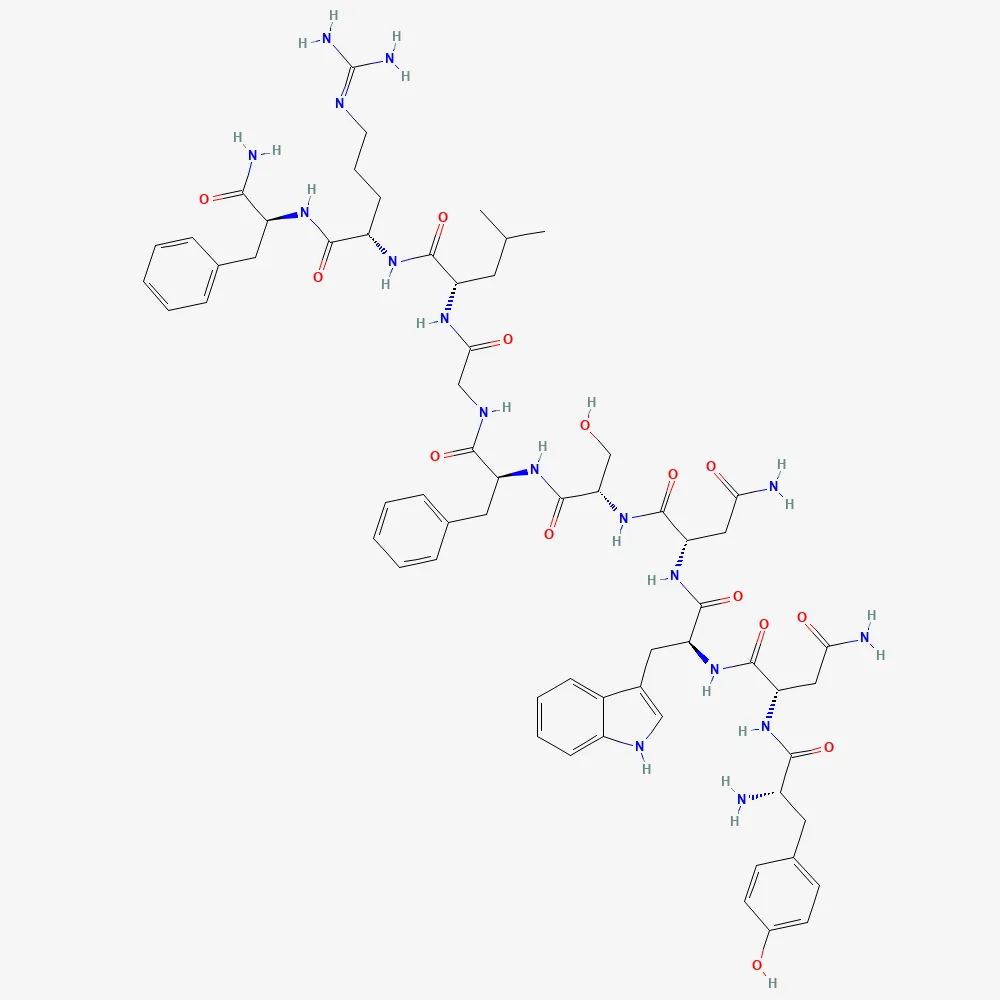
- Molecular formula
- C63H83N17O14
- Molecular weight
- 1302.4 g/mol
- Length
- 10 amino acids
- Sequence
- YNWNSFGLRF
- Modifications
- C-terminal amide (kisspeptin 45-54).
- PubChem CID
- 25240297
The diagram is kisspeptin-10, the form FDA reviewed for compounding and the one usually sold. Kisspeptin-54 is a longer 54-residue form of the same gene product.
Identity checked against Journal of Chromatography B (2013), via PubMed.
How kisspeptin works
Kisspeptin binds KISS1R on the hypothalamic neurons that release GnRH. That sends pulses of GnRH into the pituitary’s blood supply (the pituitary portal circulation). The pituitary then releases luteinizing hormone (LH) and follicle-stimulating hormone (FSH).
LH and FSH control ovulation, sperm production and sex-steroid production. Kisspeptin sits upstream of this GnRH axis, not beside it, and that is established human physiology.
Kisspeptin benefits: what the research shows
FDA’s 2024 review is the most complete public account of the human data. It found:
- One clinical study of a subcutaneous dose, in about 35 healthy women.
- No studies at all of the intramuscular route the nominator proposed.
- Intravenous infusions in healthy volunteers and in small numbers of people with hypothalamic amenorrhoea, hypogonadotropic hypogonadism, low testosterone with type 2 diabetes, hyperprolactinaemia or polycystic ovary syndrome.
- Short exposure throughout. The longest continuous dosing in any published study was 24 hours, and most studies used one or two doses.
A small series of placebo-controlled academic trials also looked at sexual and romantic brain processing in healthy men. Volunteers had functional brain scans while viewing sexual and romantic images. Kisspeptin increased activity in brain regions linked to sexual arousal and reduced negative mood.
That is real, controlled human research. But it was a single-dose lab finding in healthy volunteers, not a trial that treated anyone’s sexual dysfunction and measured whether it improved.
Half-life
FDA’s review identifies one human figure for kisspeptin-10. Given as an intravenous bolus, its half-life is about 3.8 (±0.3) minutes in healthy men, and about 4.1 (±0.4) minutes in women in the follicular and preovulatory phases.
FDA notes that the concentration-time profile differs when kisspeptin-10 is injected under the skin. A fast intravenous figure doesn’t describe a subcutaneous injection bought online.
Kisspeptin-54 lasts longer. A 2005 placebo-controlled study in six healthy men Dhillo 2005 - Dhillo WS, Chaudhri OB, Patterson M et al. Kisspeptin-54 stimulates the hypothalamic-pituitary gonadal axis in human males. J Clin Endocrinol Metab. 2005;90(12):6609-15., in the references below measured its plasma half-life during a 90-minute intravenous infusion at about 27.6 (±1.1) minutes.
What is not established: dose, duration and effects
- More dosing does not mean more effect. Frequent high-dose exposure can switch the hormone response off rather than build it (tachyphylaxis, covered under side effects). No human study has tested an overdose.
- No long-term use has been studied. No human study has tested repeated dosing for longer than two weeks.
- Weight gain has been reported once, in a single adverse-event report covered under side effects.
- No study has measured muscle mass. The human research tracks LH, FSH, sex-steroid levels and, in a small series, brain activity linked to sexual arousal. None of it measured strength, lean mass or body composition, so a muscle-building claim has no evidence either way.
Kisspeptin dosage
There is no FDA-approved or trial-established dose. Dosing guides describe a common protocol of 50-200 mcg injected under the skin once or twice a day, in 1-6 week cycles. No source gives a specific break period. That is common practice, not a dose tested in a trial.
The published human studies used single research doses, far below that range and by different routes. The kisspeptin dosage page has the study-by-study breakdown.
Kisspeptin side effects
There is no approved label, and no study has run long enough, or at the doses a treatment would use, to give a full picture. What follows comes from FDA’s 2024 review of the published studies and its search of adverse-event databases.
Reported in studies
- No serious adverse events were reported across the roughly 300 subjects in the studies FDA reviewed. Those studies were short and small, and often didn’t record adverse-event detail, so this is limited reassurance rather than a clean safety record.
- Weight gain and a rise in estrone (one case). FDA’s adverse-event database holds one report: a 17-year-old man who gained weight, with raised estrone, after six weeks of daily compounded kisspeptin-10 injections meant to raise testosterone. As FDA notes, one report can’t show that kisspeptin caused it, but it is a documented signal.
- Loss of response (tachyphylaxis). Continuous or frequent high-dose exposure quickly blunts the hormone response. This was seen in animal studies and in a 2009 human trial of twice-daily kisspeptin-54 for two weeks, where the gonadotropin response weakened over time. Raising the dose or frequency risks switching the response off.
- Immune reactions: an FDA concern, not a documented reaction. FDA says kisspeptin-10 “may pose a significant risk for immunogenicity” when injected under the skin or into muscle. Peptide impurities and aggregation, which the nominator’s data did not rule out, could make that worse.
For redness, itching or swelling at the injection site, see injection-site reactions.
Full dosing detail: kisspeptin dosage.
Is kisspeptin legal?
US legal status - Research use only
No kisspeptin product is FDA-approved for any indication. Kisspeptin-10 has no USP/NF monograph and is not part of any FDA-approved drug. In its October 2024 briefing for the Pharmacy Compounding Advisory Committee, FDA proposed not adding it to the 503A Bulks List, so it is not currently eligible for lawful 503A compounding for the use FDA evaluated.
FDA gave these reasons for leaving it off the list:
- Kisspeptin-10 “is not well characterized from the physical and chemical characterization perspective”. Key impurity and aggregate data were missing from both the nomination and the published literature.
- FDA is “concerned about the potential for immunogenicity of kisspeptin-10” when made for injection under the skin or into muscle, a risk that aggregation and impurities can increase.
- “There is insufficient evidence to make a conclusion on the effectiveness of kisspeptin-10 as a treatment option for men with secondary hypogonadism,” the one use the nomination proposed.
- No published study looked at adverse events at the doses and frequencies a reproductive disorder would need. The studies were short, mostly single-dose, and in healthy volunteers.
The WADA 2026 Prohibited List names kisspeptin and its agonist analogues under section S2.2.1, testosterone-stimulating peptides banned at all times in male athletes. The reason is that kisspeptin-driven LH release can raise testosterone.
I couldn’t verify a scheduling status for kisspeptin under Australia’s current Poisons Standard. It doesn’t appear in the instrument I checked, so I report that status as unverified rather than guess.
Regulatory changes for this compound and others, as they happen: US peptide regulation tracker.
What this means if you are considering it
Kisspeptin isn’t built on invented science. Its effects on LH and FSH, and on sexual brain processing, are real, published human results. That is why the gap matters: FDA reviewed the same studies and still couldn’t conclude it is safe or effective at the doses and schedules a consumer product would need. No dosing schedule has been shown safe for repeated, unsupervised use, including the common protocol above.
Related
How it differs from the approved fertility hormone: Kisspeptin vs HCG.
How Kisspeptin compares
Reproductive hormones. Doses for unapproved compounds are common practice, not trial-established. All hormones and sexual health peptides →
| Compound | Main use | Evidence | Usual dose | US status |
|---|---|---|---|---|
| Kisspeptin | Studied in hospital-based human research as a reproductive-hormone signal - it stimulates LH and FSH release upstream of GnRH - and, in a small number of academic trials, for its effect on sexual and romantic brain processing. Sold to consumers for sexual desire and fertility use, a use no regulator has evaluated as safe or effective. | Limited human data | 50-200 mcg, once or twice daily, 50-200 mcg per injection | Research use only |
| Gonadorelin | FDA approved decades ago as a diagnostic test of pituitary function (Factrel) and as a pulsatile treatment for hypothalamic amenorrhea (Lutrepulse). Both approved products are discontinued. Today it is mainly sold through compounding pharmacies and research-peptide sellers to men on testosterone therapy, paired with TRT to keep the pituitary-testicular signal running - a use no trial has tested. | Moderate human evidence | 50-100 mcg, 2-3 times weekly, subcutaneous, spaced through the week (e.g. Monday/Thursday or Monday/Wednesday/Friday), alongside testosterone therapy | Unapproved drug |
| Human Chorionic Gonadotropin | FDA-approved prescription injection for prepubertal cryptorchidism, selected cases of male hypogonadotropic hypogonadism, and induction of ovulation in anovulatory, infertile women pretreated with menotropins. | Strong human evidence | FDA label | FDA-approved · prescription only |
| Human Menopausal Gonadotropin | FDA-approved prescription injection (Menopur) for development of multiple follicles and pregnancy in ovulatory women as part of an Assisted Reproductive Technology (ART) cycle. Not approved for any indication in men. | Strong human evidence | FDA label | FDA-approved · prescription only |
| Oxytocin | An approved injectable medicine in obstetrics. Sold online as a nasal spray for libido, connection and anxiety. | Moderate human evidence | FDA label | FDA-approved · prescription only |
Where to buy Kisspeptin for research
Each vendor is checked against my vendor checklist.
1.Next Level PharmFeatured
Kisspeptin-10 10 mg vial
- No FDA warning letter found
- Names its testing lab
- Batch COAs published
- Takes card payment
2.Spartan Peptides
10 mg vial
- No FDA warning letter found
- Names its testing lab
3.BioEdge Research Labs
10 mg vial
- No FDA warning letter found
- Names its testing lab
- Batch COAs published
Common questions
What is kisspeptin?
A hormone your hypothalamus makes to switch on the reproductive system. It triggers GnRH release and, downstream, LH and FSH. The human research is real but small: single-dose and short-infusion studies in healthy volunteers. No kisspeptin product is FDA-approved.
What is the usual kisspeptin dose?
No approved or trial-tested dose exists. Dosing guides describe 50-200 mcg injected under the skin once or twice a day, in 1-6 week cycles, with no break period given. That is common practice, not trial evidence. Published studies used very different research doses, down to IV amounts as small as 0.01 microgram/kg; see the [kisspeptin dosage page](/kisspeptin-dosage/).
Is kisspeptin FDA-approved?
No. FDA has not approved any kisspeptin or kisspeptin-analogue product for any use. FDA's list of novel drug approvals for 2026 contains none, and a DailyMed search for kisspeptin returns zero drug labels.
What does kisspeptin actually do in the body?
It binds the KISS1 receptor on GnRH-releasing neurons in the hypothalamus, which triggers GnRH release. GnRH then drives the pituitary to release LH and FSH, which control ovulation, sperm production and sex-steroid output.
Why did FDA decline to add kisspeptin-10 to the compounding bulks list?
FDA's 2024 evaluation cited three gaps. Kisspeptin-10 is not well characterised physically and chemically. Injecting it carries an unresolved risk of immune reactions. And the studies were too small and short to show it works for secondary hypogonadism in men.
Is kisspeptin banned in sport?
Yes. The WADA 2026 Prohibited List includes kisspeptin and its agonist analogues under section S2.2.1, testosterone-stimulating peptides in males, banned at all times.
What are the side effects of kisspeptin?
No serious adverse events were reported in the roughly 300 subjects of the studies FDA reviewed, but those studies were short and small. FDA's database holds one report of weight gain and raised estrone in a young man after six weeks of daily compounded injections. Frequent high doses can blunt the hormone response (tachyphylaxis), and FDA flags an unresolved immune-reaction risk for injections.
Can kisspeptin cause weight gain?
There is one documented case: a 17-year-old man gained weight, with a rise in estrone, after six weeks of daily compounded kisspeptin-10 injections meant to raise testosterone. FDA notes one case report can't prove kisspeptin caused it. No controlled trial has measured weight, so this is a signal, not a settled effect.
What happens if you take too much kisspeptin?
No human study has tested an overdose. The data do show that more is not better: frequent high-dose exposure causes tachyphylaxis, a rapid loss of hormone response, in animals and in a 2009 human trial of twice-daily kisspeptin-54 for two weeks. No human safety data exist above single-session research doses.
How long can I stay on kisspeptin?
No study has followed anyone on a fixed schedule for more than two weeks. The longest continuous dosing FDA found was a 24-hour infusion, and in the longest repeated-dose study, twice-daily injections for two weeks, the hormone response weakened by the end. No duration has been shown safe, and this page doesn't set one.
Can kisspeptin increase muscle mass?
No study of kisspeptin has measured muscle mass or body composition. The human research measures LH, FSH, sex steroids and, in a small series, brain activity linked to sexual arousal. A muscle-building claim is not supported by the evidence FDA reviewed.
What does taking kisspeptin do?
In short studies, a dose raises LH and FSH, and in men it raised testosterone. Repeated dosing weakens that: in a two-week trial of twice-daily injections in women with hypothalamic amenorrhoea, the hormone rise had largely gone by day 14. FDA found too little evidence to judge it as a treatment for secondary hypogonadism in men.
Does kisspeptin raise testosterone?
In short studies, yes. A 90-minute kisspeptin-54 infusion raised LH, FSH and testosterone in six healthy men, and a 22.5-hour kisspeptin-10 infusion raised testosterone in four men. FDA still found too little evidence to call it a treatment for secondary hypogonadism, and WADA bans it at all times for male athletes for this reason.
References (5 sources)
Bibliographic detail is fetched from PubMed, not written by me - so a citation here cannot drift from the paper it names. Study design comes from PubMed's own tags rather than my judgement.
- 1.Dhillo WS, Chaudhri OB, Patterson M et al. Kisspeptin-54 stimulates the hypothalamic-pituitary gonadal axis in human males. J Clin Endocrinol Metab. 2005;90(12):6609-15.Randomised trialPMID 16174713
- 2.FDA Briefing Document, Pharmacy Compounding Advisory Committee, 29 October 2024 - full evaluation of kisspeptin-10, including the human pharmacokinetic, safety and effectiveness review and the proposal not to add it to the 503A Bulks List.- US Food and Drug Administrationregulatory
- 3.FDA Novel Drug Approvals for 2026 - the full list of new FDA drug approvals for the year, on which no kisspeptin product appears.- US Food and Drug Administrationregulatory
- 4.DailyMed search for "kisspeptin" - zero drug package labels found.- DailyMed, National Library of Medicinedatabase
- 5.WADA 2026 Prohibited List - section S2.2.1 lists kisspeptin and its agonist analogues among testosterone-stimulating peptides prohibited in males.- World Anti-Doping Agencyregulatory