
Survodutide: Benefits, Dosage, Side Effects and Legal Status
Survodutide benefits, dosage, side effects and legal status - the dual GLP-1/glucagon peptide still in Phase 3 trials.

The short version
Survodutide (BI 456906) is an injectable peptide that activates two hormone receptors at once: GLP-1 and glucagon. Its sponsor, Boehringer Ingelheim, has completed Phase 3 trials for weight loss and cardiovascular safety and is also studying it for liver disease. No regulator has approved it. It is also sold to consumers as an unapproved research chemical, a different, unregulated product from the trial drug.
- Unlike orforglipron, the other new GLP-1 drug on this site, it is a true peptide and is injected, not swallowed.
- Two Phase 3 trials are complete. The published one, SYNCHRONIZE-1, found 12.2-13.0% average weight loss at 76 weeks against 5.4% on placebo (sponsor-funded).
- Not approved anywhere. A research-labelled vial bought online is a different, unregulated product from the trial drug.
Survodutide at a glance
- What it is
- Synthetic dual GLP-1/glucagon receptor agonist peptide
- Main use
- An investigational injectable peptide, not approved for any use. Its sponsor, Boehringer Ingelheim, is studying it in Phase 3 trials for chronic weight management and, in a separate programme, for MASH (metabolic dysfunction-associated steatohepatitis). It is also sold directly to consumers as a research chemical outside those trials.
- Also called
- BI 456906
- Molecular formula
- C192H289N47O61 (4232 g/mol) Structure
- Evidence
- Moderate human evidence
- US status
- Research use only
- Half-life
- Not established in humans
- How it is taken
- Subcutaneous injection
- Common protocol
- 0.6-6 mg, once weekly, starting around 0.6 mg; the phase 2 trial titrated over about 20 weeks to a 2.4-4.8 mg maintenance dose, while the published phase 3 SYNCHRONIZE-1 trial randomizes to a higher 3.6 or 6.0 mg maintenance target using a slower, flexible up-titration (common practice, not trial-established) Dosing page
Survodutide (also called BI 456906) is an injectable peptide that activates two hormone receptors instead of one. It belongs to the GLP-1 family covered elsewhere on this site. Unlike orforglipron it is a true peptide, and unlike semaglutide, tirzepatide or orforglipron it is not yet approved for anything.
Dosing: what the published trials used.
US legal status - Research use only
Survodutide is not FDA-approved and has not been reviewed by any regulator for any indication. It remains an investigational drug inside Boehringer Ingelheim-sponsored trials. Outside those trials, it is sold to consumers as a "research use only" peptide - a different, unregulated product, not a cheaper version of the trial drug.
What is Survodutide?
Survodutide is a synthetic peptide from Boehringer Ingelheim, being tested for obesity and for MASH (metabolic dysfunction-associated steatohepatitis, a form of fatty liver disease). In its trials it is injected under the skin once a week.
Survodutide structure
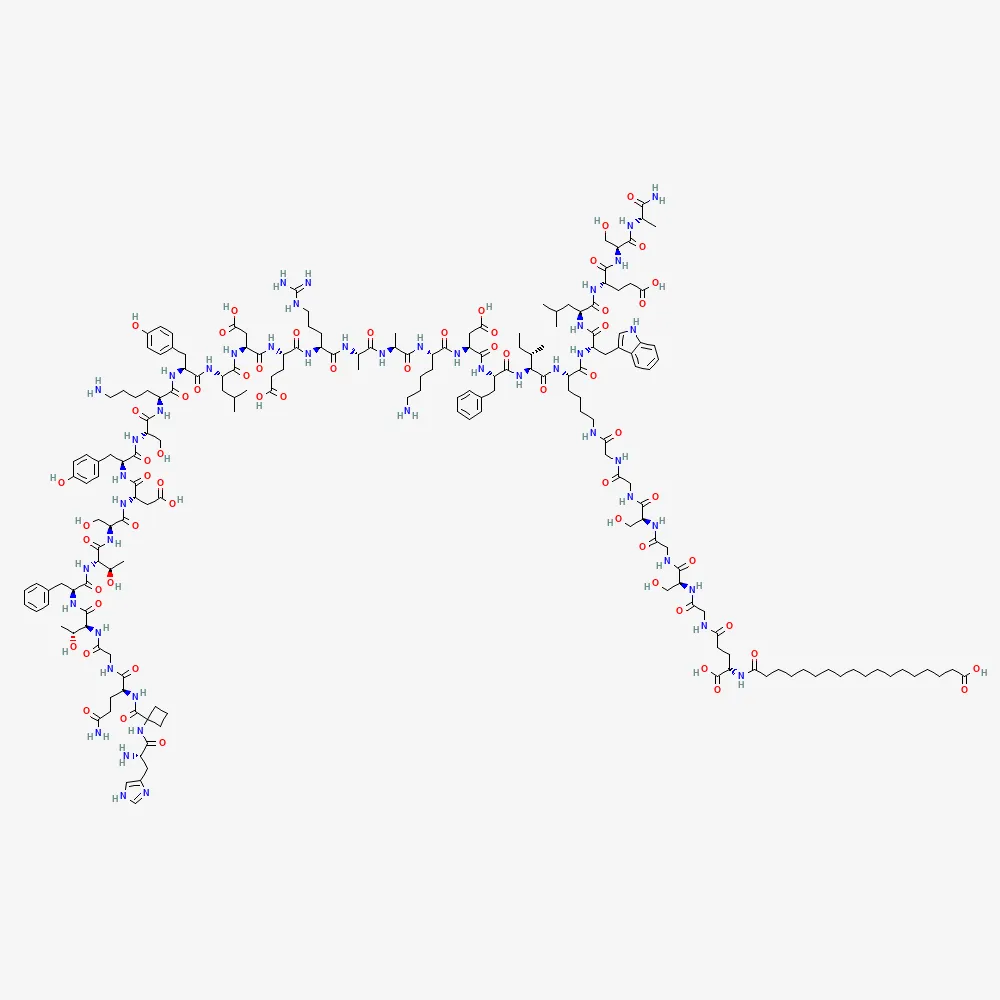
- Molecular formula
- C192H289N47O61
- Molecular weight
- 4232 g/mol
- Length
- 29 amino acids
- Sequence
- HXQGTFTSDYSKYLDERAAKDFIKWLESA
- Modifications
- X at position 2 = 1-aminocyclobutane-1-carboxylic acid; Lys24 carries a C18 fatty diacid via a gamma-Glu-Gly-Ser-Gly-Ser-Gly-Gly linker; C-terminal amide.
- PubChem CID
- 171378821
PubChem lists this record without a title (synonyms: Survodutide, BI-456906, CAS 2805997-46-8). It is the only one of PubChem's three survodutide records with all-L residues, matching the published chemical name.
Identity checked against KEGG DRUG.
How survodutide works
One molecule binds and activates two receptors:
- the GLP-1 receptor, the same target as semaglutide and tirzepatide
- the glucagon receptor
Boehringer Ingelheim proposes that the glucagon activity raises energy use and fat burning in the liver. That is its stated reason for testing survodutide in both obesity and MASH. It is the sponsor’s explanation, not a mechanism independently established in people.
Survodutide benefits: what the research shows
Multiple randomised trials, though with limitations. Two Phase 3, randomised, double-blind, placebo-controlled trials are registered as completed on ClinicalTrials.gov - SYNCHRONIZE-1 for weight loss and SYNCHRONIZE-CVOT for cardiovascular safety - both sponsored by Boehringer Ingelheim. SYNCHRONIZE-1 is published in a peer-reviewed journal (NEJM, 2026); SYNCHRONIZE-CVOT results were not published in a source this page checked. No regulator has reviewed or approved the drug.
ClinicalTrials.gov, the public registry, confirms two sponsor-run Phase 3 trials:
- SYNCHRONIZE-1 is randomised, double-blind and placebo-controlled. It tested 3.6 mg and 6.0 mg doses, injected weekly, against placebo for 76 weeks in adults with overweight or obesity and no type 2 diabetes. It started in November 2023. The registry lists primary completion (the last primary-outcome measurement) as 2 December 2025, and overall completion as 20 February 2026.
- SYNCHRONIZE-CVOT tests the same drug and doses for time to a first major cardiovascular event. It enrolled people with established cardiovascular disease, chronic kidney disease, or at least two cardiovascular risk factors. Its registry listed a planned completion date of 30 June 2026.
Published results
SYNCHRONIZE-1 has been published in a peer-reviewed journal le 2026 - le Roux CW, Wharton S, Startseva E et al. Survodutide Once Weekly for the Treatment of Adults with Obesity. N Engl J Med. 2026;395(8):776-787., in the references below. In 725 adults with obesity and no diabetes, at 76 weeks:
| Group | Average weight loss | Lost at least 5% |
|---|---|---|
| Survodutide, up to 3.6 mg | 12.2% | 72.6% |
| Survodutide, up to 6.0 mg | 13.0% | 71.9% |
| Placebo | 5.4% | 46.3% |
These figures use the trial’s treatment-regimen analysis, which counts people who stopped the drug early. Boehringer Ingelheim funded the trial. I found no published results for SYNCHRONIZE-CVOT or the rest of the programme, so treat any figures for those as company-reported.
Survodutide dosage
There is no approved dose, because there is no approved product. Dosing guides and trials describe weekly injections under the skin starting around 0.6 mg, but differ on the maintenance dose:
- A phase 2-based dosing guide steps up over about 20 weeks to 2.4-4.8 mg.
- The published phase 3 SYNCHRONIZE-1 trial uses a slower, flexible step-up to a higher 3.6 or 6.0 mg.
That is common practice, not a single trial-established or FDA-approved dose. Two published Phase 2 trials also tested survodutide directly, up to 4.8 mg (obesity) and 6.0 mg (MASH). Full detail and both trial tables: Survodutide dosage.
Survodutide side effects
This is based on one published Phase 3 trial. Survodutide has no FDA label, so there is no regulator-reviewed list of side effects.
- Digestive symptoms were the most common, mostly mild to moderate: 80.9% on 3.6 mg and 89.7% on 6.0 mg, versus 47.9% on placebo. No deaths were reported le 2026 - le Roux CW, Wharton S, Startseva E et al. Survodutide Once Weekly for the Treatment of Adults with Obesity. N Engl J Med. 2026;395(8):776-787., in the references below.
- The same pattern as approved GLP-1 drugs (nausea, vomiting, diarrhoea), as expected from the shared GLP-1 action. The added glucagon activity has no separate published human safety record yet.
- Grey-market risks. FDA’s documented concerns about unapproved GLP-1 products (dosing errors, counterfeit product, fraudulent labelling) apply to any research-labelled survodutide vial, since none of it is the sponsor’s trial drug.
For the injection itself, see injection-site reactions for what is ordinary and what needs attention.
Get medical care for severe or persistent abdominal pain, persistent vomiting, or signs of gallbladder trouble. These are reasons to stop with other GLP-1 drugs; for survodutide they are inferred from the shared mechanism, not from its own trial data.
Is Survodutide legal?
FDA has not approved survodutide for any use, and as far as I could confirm, neither has any other regulator. It is still an investigational drug in its sponsor’s trial and review programme, with a liver-disease (MASH) programme alongside the obesity one. I did not confirm its Australian status.
The grey market sits in that gap. Several online peptide vendors sell survodutide labelled “research use only”, the same pattern this site documents for BPC-157, retatrutide and other unapproved peptides. FDA’s concerns about unapproved GLP-1 products (dosing errors, counterfeit product, fraudulent labelling) apply to this market, and nothing exempts survodutide. A seller’s vial is not the drug dosed in Boehringer Ingelheim’s trials, has no comparable manufacturing oversight, and no regulator checks that it matches its label.
How this differs from orforglipron
Survodutide and orforglipron are the two newest entries in this site’s GLP-1 coverage, and they differ on every axis:
| Orforglipron | Survodutide | |
|---|---|---|
| Chemistry | Non-peptide small molecule | Peptide |
| Status | FDA-approved as Foundayo | Unapproved |
| Route | Daily pill | Weekly injection |
| Targets | GLP-1 | GLP-1 and glucagon |
What I would need to change this page
A regulator’s approval decision, or published results from the rest of the Phase 3 programme, above all the SYNCHRONIZE-CVOT cardiovascular safety trial. Until then, survodutide is documented here as a registry-confirmed trial drug that is not recommended, approved or verified for human use outside the trials testing it.
Related
- Orforglipron (Foundayo): the oral, non-peptide exception
- Semaglutide (Ozempic, Wegovy)
- Tirzepatide (Mounjaro, Zepbound)
- Retatrutide
- Cagrilintide
- Best GLP-1 for weight loss: the approved options compared
- Are peptides safe?
Regulatory changes for this compound and others, as they happen: US peptide regulation tracker.
How Survodutide compares
GLP-1 and related medicines. Doses for unapproved compounds are common practice, not trial-established. All weight loss and metabolism peptides →
| Compound | Main use | Evidence | Usual dose | US status |
|---|---|---|---|---|
| Survodutide | An investigational injectable peptide, not approved for any use. Its sponsor, Boehringer Ingelheim, is studying it in Phase 3 trials for chronic weight management and, in a separate programme, for MASH (metabolic dysfunction-associated steatohepatitis). It is also sold directly to consumers as a research chemical outside those trials. | Moderate human evidence | 0.6-6 mg, once weekly, starting around 0.6 mg; the phase 2 trial titrated over about 20 weeks to a 2.4-4.8 mg maintenance dose, while the published phase 3 SYNCHRONIZE-1 trial randomizes to a higher 3.6 or 6.0 mg maintenance target using a slower, flexible up-titration | Research use only |
| Semaglutide | FDA-approved for type 2 diabetes in adults (Ozempic injection and tablets, Rybelsus), including cardiovascular risk reduction and, for the Ozempic injection, kidney-disease progression; and as Wegovy injection and tablets for chronic weight management and cardiovascular risk reduction in adults with obesity or overweight. The Wegovy injection is also approved for weight management from age 12 and for MASH with moderate to advanced liver fibrosis in adults. | Strong human evidence | FDA label | FDA-approved · prescription only |
| Tirzepatide | FDA-approved to improve glycemic control in type 2 diabetes in adults and children 10 years and older, and to reduce cardiovascular risk in adults with type 2 diabetes (Mounjaro), and for chronic weight management and moderate-to-severe obstructive sleep apnoea in adults with obesity (Zepbound). | Strong human evidence | FDA label | FDA-approved · prescription only |
| Liraglutide | FDA-approved as a once-daily injection under two brands: Saxenda, for chronic weight management alongside diet and exercise in adults and in children 12 years and older with obesity who weigh more than 60 kg, and Victoza, for glycemic control in type 2 diabetes in adults and children 10 years and older, and for reducing major adverse cardiovascular events in adults with type 2 diabetes and established cardiovascular disease. | Strong human evidence | FDA label | FDA-approved · prescription only |
| Orforglipron | FDA-approved as Foundayo, in combination with a reduced-calorie diet and increased physical activity, to reduce excess body weight and maintain weight reduction long term in adults with obesity, or adults with overweight who have at least one weight-related condition. | Strong human evidence | FDA label | FDA-approved · prescription only |
| Retatrutide | Investigational in Phase 3 trials for obesity, type 2 diabetes and related conditions. Not approved for any indication in the US. Sold outside the trial system as an unapproved research chemical, often alongside semaglutide and tirzepatide. | Moderate human evidence | 2-12 mg, once weekly, starting at 2 mg and titrating up every 4 weeks to a 4-12 mg maintenance dose | Research use only |
| Mazdutide | Approved in China for chronic weight management and for glycemic control in type 2 diabetes. Not FDA-approved in the United States, where it is sold to consumers as a research-chemical vial. | Moderate human evidence | 3-9 mg, once weekly, titrated upward from a lower starting dose | Research use only |
| Cagrilintide | Investigational amylin analogue studied alone and, more prominently, combined with semaglutide as the fixed-dose combination CagriSema, for chronic weight management. Not approved for any indication in the US; the combination is under FDA review following the sponsor's New Drug Application. | Moderate human evidence | 0.25-4.5 mg, once weekly, titrating from a 0.25-0.6 mg starting dose up to a 2.4-4.5 mg maintenance dose | Research use only |
Where to buy Survodutide for research
Each vendor is checked against my vendor checklist.
I don't list a vendor for Survodutide yet. Before buying from anyone, work through the vendor checklist.
Common questions
Is survodutide FDA-approved?
No. FDA and other regulators have not approved it for any use. It is an investigational drug from Boehringer Ingelheim that has completed Phase 3 trials for weight management and cardiovascular safety, with a liver-disease (MASH) programme still underway. A regulator still has to review the full results before it can be prescribed.
What does survodutide actually do?
It activates two receptors at once: the GLP-1 receptor, the same target as semaglutide and tirzepatide, and the glucagon receptor. Boehringer Ingelheim proposes that the glucagon activity raises energy use and fat burning in the liver, which is why it is testing the drug in both obesity and MASH. That is the sponsor's account, not a mechanism independently confirmed in people.
What trial evidence actually exists for survodutide?
ClinicalTrials.gov lists 2 completed Phase 3, randomised, double-blind, placebo-controlled trials, both sponsored by Boehringer Ingelheim: SYNCHRONIZE-1 (weight loss without diabetes) and SYNCHRONIZE-CVOT (cardiovascular safety). SYNCHRONIZE-1 was published in the New England Journal of Medicine in 2026. Among 725 adults, average weight fell 12.2% on up to 3.6 mg and 13.0% on up to 6.0 mg at 76 weeks, against 5.4% on placebo. I found no published SYNCHRONIZE-CVOT results.
Is survodutide the same as the research peptide sold online?
No. The trial drug is made, dosed and quality-controlled by Boehringer Ingelheim under regulatory oversight. A vial labelled survodutide from a research-peptide seller has none of that behind it, and no regulator checks that it matches its label.
What is the difference between survodutide and orforglipron?
Survodutide is a peptide, injected, and still unapproved. Orforglipron is a non-peptide small molecule, FDA-approved as Foundayo, and taken as a pill. Both act on the GLP-1 receptor; survodutide also activates the glucagon receptor. See the orforglipron page for more.
Is "research use only" survodutide legal to buy?
It is sold that way, but the label is not a legal category. With other unapproved research-labelled peptides, FDA has said it looks at a seller's marketing and intended use, not the label, and treats products sold with human dosing information as meant for humans. I found no case applying this to a survodutide seller, but it is the general rule for grey-market GLP-1-class peptides.
Is survodutide available now?
No. It is not approved or available on prescription anywhere, and there is no over-the-counter version. Its Phase 3 trials are complete but have not been reviewed by a regulator. What is sold online as "research use only" survodutide is a different, unregulated product, not early access to the trial drug.
How does survodutide compare to Ozempic?
Ozempic (semaglutide) is FDA-approved; survodutide is not. Ozempic activates only the GLP-1 receptor, and its label covers blood-sugar control, cardiovascular risk reduction and kidney protection in adults with type 2 diabetes. Survodutide adds the glucagon receptor and has no approved use; its Phase 3 trials are complete but not yet regulator-reviewed. See the semaglutide page.
How does survodutide compare to Mounjaro?
Mounjaro (tirzepatide) is FDA-approved; survodutide is not. Mounjaro activates the GIP and GLP-1 receptors and is approved for blood-sugar control and cardiovascular risk reduction in type 2 diabetes; the weight-management version is sold as Zepbound. Survodutide pairs GLP-1 with the glucagon receptor instead of GIP, and its Phase 3 trials are not yet regulator-reviewed. See the tirzepatide page.
What is the strongest weight loss injection?
"Strongest" is not a clinical measure, and trial populations, doses and follow-up differ too much to rank injections fairly. Survodutide is not a legal option whatever its potency, because it is not approved for any use. To compare approved GLP-1-class injections, talk to a doctor about specific regulator-reviewed products.
What are the side effects of survodutide?
The one published Phase 3 trial reports digestive symptoms, mostly mild to moderate, in 80.9% of people on 3.6 mg and 89.7% on 6.0 mg, versus 47.9% on placebo. No deaths were reported. That matches the approved GLP-1 drugs. Survodutide has no FDA label, so there is no regulator-reviewed warning list, and a research-labelled vial has no verified purity.
What organ is Ozempic hard on?
Ozempic's (semaglutide's) label carries organ warnings for the pancreas, gallbladder and kidneys. Acute pancreatitis has been reported, gallstones (cholelithiasis) occurred in trials, and post-marketing reports describe kidney injury, usually from dehydration after vomiting or diarrhoea. It also has a boxed warning about thyroid C-cell tumours in rodents, of unknown relevance to people. This is about Ozempic, not survodutide, which has no label or independent long-term safety record.
What is the usual survodutide dose?
There is no approved dose, because there is no approved product. Sources describe weekly injections under the skin starting around 0.6 mg. A phase 2-based guide steps up over about 20 weeks to 2.4-4.8 mg; the phase 3 SYNCHRONIZE-1 trial steps up more slowly to 3.6 or 6.0 mg. That is common practice, not an approved dose. Two Phase 2 trials tested up to 4.8 mg (obesity) and 6.0 mg (MASH); see the dosage page.
References (5 sources)
Bibliographic detail is fetched from PubMed, not written by me - so a citation here cannot drift from the paper it names. Study design comes from PubMed's own tags rather than my judgement.
- 1.le Roux CW, Wharton S, Startseva E et al. Survodutide Once Weekly for the Treatment of Adults with Obesity. N Engl J Med. 2026;395(8):776-787.Randomised trialPMID 42253238
- 2.ClinicalTrials.gov - registry of record for the Phase 3 SYNCHRONIZE-1 (weight loss, without diabetes) and SYNCHRONIZE-CVOT (cardiovascular safety) trials of survodutide (BI 456906), both sponsored by Boehringer Ingelheim. Confirms sponsor, phase, dose arms and completion status. Search "survodutide" on the site to find both listings directly.- ClinicalTrials.gov, US National Library of Medicinedatabase
- 3.FDA's Concerns with Unapproved GLP-1 Drugs Used for Weight Loss - the grey-market pattern (dosing errors, counterfeit product, fraudulent labelling) FDA has documented for unapproved GLP-1-class products generally.- US Food and Drug Administrationregulatory
- 4.DailyMed FDA label for OZEMPIC (semaglutide) injection - source for its approved indications, boxed warning and organ-specific risks (pancreatitis, cholelithiasis, acute kidney injury, thyroid C-cell tumours in rodent studies).- DailyMed, US National Library of Medicinelabel
- 5.DailyMed FDA label for Mounjaro (tirzepatide) injection - source for its GIP/GLP-1 dual mechanism and approved type 2 diabetes indications.- DailyMed, US National Library of Medicinelabel