GHRP-6: Benefits, Dosage, Side Effects and Legal Status
What GHRP-6 is, how it works, dosing guides, side effects and its FDA and WADA status - decades-old data, never approved.

The short version
GHRP-6 is one of the oldest growth hormone secretagogues, studied in small human doses since the 1980s. No regulator has ever approved it, FDA flags it as a compounding safety risk, and it is banned in sport at all times.
- Not FDA-approved for any use; sold only as a research chemical.
- FDA lists it as a bulk substance with potential significant safety risks.
- Older human studies show it raises growth hormone, but not that it builds muscle or aids recovery.
- Banned at all times in sport under WADA S2.2.4.
GHRP-6 at a glance
- What it is
- Synthetic hexapeptide growth hormone secretagogue
- Main use
- One of the original growth hormone-releasing peptides, studied since the 1980s as a pituitary GH secretagogue. Marketed to consumers for muscle and recovery goals, an application never approved anywhere.
- Also called
- Growth Hormone Releasing Peptide-6, GHRP6, His-D-Trp-Ala-Trp-D-Phe-Lys-NH2
- Molecular formula
- C46H56N12O6 (873.0 g/mol) Structure
- Evidence
- Limited human data
- US status
- Research use only
- Half-life
- About 2.5 hours (elimination) after a single intravenous dose, from one pharmacokinetic study in nine healthy men; the distribution half-life was about 7.6 minutes. Not established for repeated or subcutaneous dosing.
- How it is taken
- Subcutaneous injection
- Common protocol
- 100-300 mcg, 2 to 3 times daily, on an empty stomach, spaced at least 3-4 hours apart, for 8-12 weeks (common practice, not trial-established) Dosage chart
Dosing: what the pharmacokinetic study used.
GHRP-6 is one of the original growth hormone-releasing peptides, first described in the 1980s. It predates the modern grey market by decades. Even so, no regulator in any country has ever approved it for any use.
US legal status - Research use only
Sold for laboratory research use only. Not approved by the FDA for human use, and cannot be lawfully marketed as a supplement or a medicine. Products sold this way are not made to pharmaceutical quality standards, and their contents are not verified by anyone.
What is GHRP-6?
GHRP-6 is a synthetic chain of 6 amino acids (His-D-Trp-Ala-Trp-D-Phe-Lys-NH2). It came out of a research programme looking for small molecules that could release growth hormone without using growth hormone itself. It acts on the growth hormone secretagogue receptor, later identified as the ghrelin receptor (GHS-R1a), to make the pituitary release growth hormone.
Unlike some later, more selective compounds from the same programme, GHRP-6 also raises ACTH and cortisol (stress hormones) and stimulates appetite. That appetite effect helped lead to the discovery of ghrelin, the body’s own hunger hormone.
The papers behind this pharmacology aren’t yet in my source registry, so I describe it in general terms rather than citing a specific study.
GHRP-6 structure
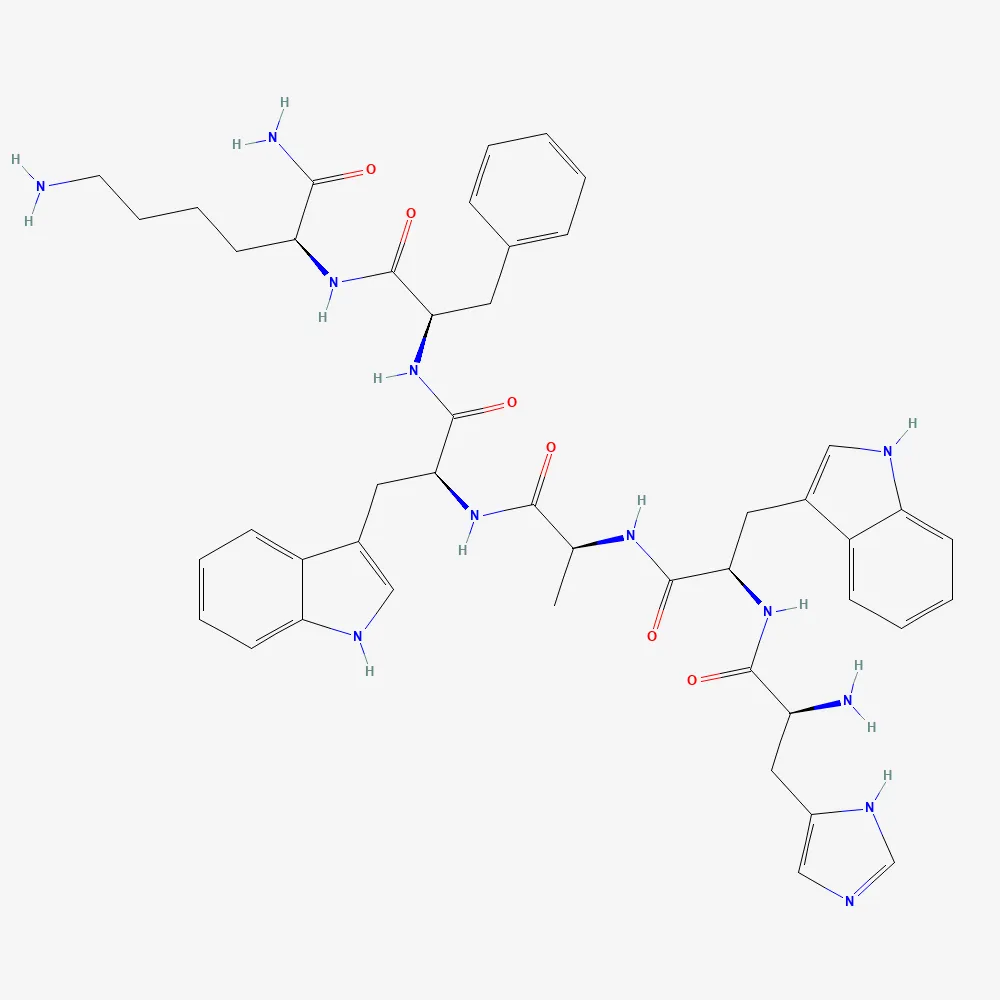
- Molecular formula
- C46H56N12O6
- Molecular weight
- 873.0 g/mol
- Length
- 6 amino acids
- Sequence
- HWAWFK
- Modifications
- D-Trp at position 2 and D-Phe at position 5; C-terminal amide (His-D-Trp-Ala-Trp-D-Phe-Lys-NH2).
- PubChem CID
- 9919153
PubChem's record titled "Ghrp-6" (CID 4345065) has no stereochemistry, so this correctly configured record is used instead.
Identity checked against Journal of Neuroendocrinology (1996), via PubMed.
GHRP-6 benefits: what the research shows
GHRP-6 has a longer human record than most peptides sold alongside it. It reliably raises growth hormone in people, which made it a standard research tool. A pharmacokinetic study in 9 healthy men measured how quickly it clears from the blood Cabrales 2013 - Cabrales A, Gil J, Fernández E et al. Pharmacokinetic study of Growth Hormone-Releasing Peptide 6 (GHRP-6) in nine male healthy volunteers. Eur J Pharm Sci. 2013;48(1-2):40-6., in the references below.
The most interesting recent work comes from Cuba, where researchers gave GHRP-6 by drip with epidermal growth factor after acute ischaemic stroke:
- A small phase I-II trial reported the combination as safe, with better neurological and functional scores Hernández-Bernal 2024 - Hernández-Bernal F, Estenoz-García D, Gutiérrez-Ronquillo JH et al. Combination therapy of Epidermal Growth Factor and Growth Hormone-Releasing Hexapeptide in acute ischemic stroke: a phase I/II non-blinded, randomized clinical trial. Front Neurol. 2024;15:1303402., in the references below.
- A phase III trial in 188 patients missed its primary endpoint. The authors reported possible benefit in moderate to severe stroke and called for more study Hernández-Bernal 2026 - Hernández-Bernal F, Subirós-Martínez N, Gutiérrez-Ronquillo JH et al. Phase III Open-Label, Randomized Clinical Trial of Epidermal Growth Factor and Growth Hormone Releasing Hexapeptide in Acute Ischemic Stroke. J Clin Neurosci. 2026;152:112195., in the references below.
None of that tests what GHRP-6 is sold for today. The hormone studies measured a short-term rise in growth hormone, and the stroke trials gave it in hospital, by drip, with another drug. No controlled trial has tested it for muscle building, recovery or fat loss.
What I do not know
One published human study, a single intravenous dose in 9 healthy men, reports two half-life figures for GHRP-6 (one for spreading through the body, one for clearance). The dosing page gives the numbers. That is a single-dose IV profile in a small study, not a basis for a schedule of injections under the skin, which no study has tested. I don’t treat other half-life figures on vendor and forum sites as established.
There is no long-term human safety data. Its effect on ACTH, cortisol and appetite, which newer and more selective compounds in the class avoid, hasn’t been studied as a long-term safety question in any modern research I could find.
GHRP-6 dosage
The common GHRP-6 dose is 100-300 mcg, 2 to 3 times daily, on an empty stomach, spaced at least 3-4 hours apart. From a 5 mg vial mixed with 2 mL of bacteriostatic water, 200 mcg is 8 units (0.08 mL) on a U-100 insulin syringe.
Community dosing guides most often describe 100-300 mcg injected under the skin, 2 to 3 times a day on an empty stomach, for an 8-12 week cycle with a 4-week break. That is common practice, not a dose any trial or regulator has set, and no study has tested repeated injections under the skin. The published human dosing is one single-dose pharmacokinetic study and two hospital stroke trials that gave it by drip with another drug. Full detail, including that study’s numbers: GHRP-6 dosage.
GHRP-6 side effects
What is known comes from old human pharmacology studies from the 1980s-90s, GHRP-6’s mechanism, and FDA’s compounding safety flag. There is no modern controlled safety study.
Reported in studies
In the small studies that established its effect, GHRP-6 raised ACTH and cortisol along with growth hormone, and increased appetite. That is reported pharmacology, not a measured side-effect rate.
For redness, itching or swelling at the injection site, see injection-site reactions.
With no FDA approval, there is no FDA-reviewed side-effect list. FDA lists GHRP-6 in Category 2 of its interim compounding-safety policy, for nominated bulk substances with potential significant safety risks. Because of its effect on cortisol and ACTH, people with a pituitary or adrenal condition have no regulator-reviewed basis for using it on their own.
Is GHRP-6 legal?
GHRP-6 is not FDA-approved for any use in the US. It is not legally marketed for human use and is sold as a research chemical, usually labelled not for human use.
Since 29 September 2023, FDA has listed GHRP-6 in category 2 of its interim compounding policies, for nominated substances where it found potential significant safety risks. Category 2 is an interim policy on FDA’s website, not a codified rule, and it doesn’t spell out every enforcement consequence. It shows FDA has flagged the substance; it is not a verdict on safety either way.
The WADA 2026 Prohibited List names GHRP-6 under S2.2.4, growth hormone releasing factors, with other GH-releasing peptides. It is banned at all times, in and out of competition. If you are a tested athlete, check the current WADA list yourself.
I checked only US federal law and the current WADA list, not US states or other countries.
Related compounds
GHRP-6 is in the same growth-hormone secretagogue family as two compounds I cover in more detail:
- CJC-1295 - a synthetic GHRH analogue rather than a GHRP, also unapproved and also named in the WADA 2026 Prohibited List under S2.2.4.
- Ipamorelin - a later, more selective secretagogue developed in part to avoid the cortisol and ACTH rise seen with GHRP-6, also unapproved and also listed under WADA S2.2.4.
Regulatory changes for this compound and others, as they happen: US peptide regulation tracker.
How GHRP-6 compares
Secretagogues (act on the ghrelin receptor). Doses for unapproved compounds are common practice, not trial-established. All growth hormone and muscle peptides →
| Compound | Main use | Evidence | Usual dose | US status |
|---|---|---|---|---|
| Ipamorelin | Investigated for postoperative ileus, reaching Phase 2 before being discontinued for insufficient efficacy. Marketed to consumers for growth hormone release, an application never approved anywhere. | Limited human data | 100-300 mcg, once nightly on 5 days a week in physician-supervised protocols, up to three times daily on an empty stomach in less structured use | Research use only |
| MK-677 (Ibutamoren) | Developed as an oral, non-injectable alternative to peptide growth hormone secretagogues. Published trials in healthy older adults and obese men found it raised growth hormone and IGF-1 and increased fat-free mass; FDA references a hip-fracture trial that was stopped early. Marketed to consumers as a research chemical for muscle and recovery, a use never approved by any regulator. | Limited human data | 12.5-25 mg, once daily by mouth; the published 2008 trial dosed each morning, while compounding-pharmacy protocols commonly move dosing to before bed | Research use only |
| GHRP-2 | Sold to consumers as a growth-hormone-release research chemical for muscle and recovery use, an application never approved anywhere. Historically investigated as a pituitary growth-hormone stimulus and diagnostic agent. | Limited human data | 100-300 mcg, 2 to 3 times daily, on an empty stomach, 5 days a week (5 on, 2 off) | Research use only |
| GHRP-6 | One of the original growth hormone-releasing peptides, studied since the 1980s as a pituitary GH secretagogue. Marketed to consumers for muscle and recovery goals, an application never approved anywhere. | Limited human data | 100-300 mcg, 2 to 3 times daily, on an empty stomach, spaced at least 3-4 hours apart | Research use only |
| Hexarelin | Investigated since the 1990s as a growth hormone-releasing peptide (GHRP), including for growth-hormone stimulation testing. Sold to consumers as a research chemical for muscle and recovery use, an application with no controlled human trial behind it. | Limited human data | 80-160 mcg, once or twice daily (morning and/or before bed), on an empty stomach | Research use only |
Where to buy GHRP-6 for research
Each vendor is checked against my vendor checklist.
I don't list a vendor for GHRP-6 yet. Before buying from anyone, work through the vendor checklist.
Common questions
Does GHRP-6 work?
It is a potent trigger of growth hormone release from the pituitary, and it also raises ACTH, cortisol and appetite. That is pharmacology, not a shown benefit for muscle or recovery. No adequately sized trial supports the uses it is marketed for.
Is GHRP-6 legal in the United States?
It is not an FDA-approved drug. Since 29 September 2023 FDA has listed it in Category 2 of its interim compounding policies, for nominated substances with potential significant safety risks. It is sold to consumers as a research chemical labelled not for human use.
Is GHRP-6 banned in sport?
Yes. The World Anti-Doping Agency's 2026 Prohibited List names GHRP-6 under S2.2.4, growth hormone releasing factors, banned at all times, in and out of competition.
Does GHRP-6 increase weight?
It is reported to raise appetite as well as growth hormone, ACTH and cortisol, but no controlled human trial shows that leads to weight gain. The old studies measured a hormone spike after one dose, not body weight over weeks or months.
Does GHRP-6 increase muscle growth?
No adequately sized trial has measured that in people. The human data show a rise in growth hormone after a dose, not a change in training, recovery or body composition, so a muscle-building benefit isn't established.
What is the strongest peptide to build muscle?
No independent, controlled study ranks GHRP-6 or other growth hormone secretagogues for building muscle in healthy adults, and none is FDA-approved for that use. Rankings by muscle-building strength aren't supported by the evidence.
What age is too late for HGH?
Age isn't the deciding factor. FDA has approved recombinant human growth hormone only for specific diagnosed conditions, such as confirmed growth hormone deficiency, not for age-related decline with normal hormone levels. Selling or promoting HGH, or a peptide claimed to raise it, as an anti-aging treatment is illegal marketing under US law at any age.
What is the best peptide stack for men?
No regulator review or published trial has tested GHRP-6 combined with other peptides in men, so no stack can be called best. Online stacks come from vendors and forums, not controlled research, and combining unapproved research chemicals adds unknown interaction risks. This page gives no schedule, dose or combination for GHRP-6, because none is evidence-based.
What is the usual GHRP-6 dose?
Community guides most often describe 100-300 mcg injected under the skin 2 to 3 times a day on an empty stomach, for 8-12 weeks with a 4-week break. That is common practice, not a dose any trial or regulator has set. See the dosage page for the one published human pharmacokinetic study.
What are the side effects of GHRP-6?
There is no FDA-reviewed side-effect list. Old pharmacology studies describe it raising ACTH and cortisol along with growth hormone, and increasing appetite; no modern safety trial has measured side-effect rates. FDA lists it as a Category 2 compounding safety risk.
Public cases involving GHRP-6
Official decisions naming GHRP-6, each linked to the announcement. They record what the ruling body found, not whether GHRP-6 works.
Official decisions and statements
Chad MendesUFC fighterOfficial statement
USADA announced a two-year sanction for Mendes after an out-of-competition urine test on 17 May 2016 was positive for GHRP-6.
USADA sanction announcement, 20 July 2016. Source: U.S. Anti-Doping Agency
References (7 sources)
Bibliographic detail is fetched from PubMed, not written by me - so a citation here cannot drift from the paper it names. Study design comes from PubMed's own tags rather than my judgement.
- 1.Cabrales A, Gil J, Fernández E et al. Pharmacokinetic study of Growth Hormone-Releasing Peptide 6 (GHRP-6) in nine male healthy volunteers. Eur J Pharm Sci. 2013;48(1-2):40-6.Clinical trialPMID 23099431
- 2.Hernández-Bernal F, Estenoz-García D, Gutiérrez-Ronquillo JH et al. Combination therapy of Epidermal Growth Factor and Growth Hormone-Releasing Hexapeptide in acute ischemic stroke: a phase I/II non-blinded, randomized clinical trial. Front Neurol. 2024;15:1303402.StudyPMID 38638315full text
- 3.Hernández-Bernal F, Subirós-Martínez N, Gutiérrez-Ronquillo JH et al. Phase III Open-Label, Randomized Clinical Trial of Epidermal Growth Factor and Growth Hormone Releasing Hexapeptide in Acute Ischemic Stroke. J Clin Neurosci. 2026;152:112195.Randomised trialPMID 42462342
- 4.FDA - Certain Bulk Drug Substances for Use in Compounding that May Present Significant Safety Risks (503B category 2 table lists GHRP-6, added 29 September 2023)- US Food and Drug Administrationregulatory
- 5.WADA Prohibited List, section S2.2.4 - growth hormone releasing factors, GH-releasing peptides (GHRPs) naming GHRP-6 explicitly, prohibited at all times- World Anti-Doping Agencyregulatory
- 6.FDA enforcement story archive 2002 - recombinant hGH marketed for anti-aging is distribution of an unapproved drug for an unauthorised use, no rhGH product is FDA-approved for anti-aging- US Food and Drug Administrationregulatory
- 7.DailyMed - GENOTROPIN (somatropin) prescribing information: indicated for pediatric growth failure due to inadequate growth hormone secretion and for adults with diagnosed growth hormone deficiency- National Library of Medicine (DailyMed)regulatory