Hexarelin: Benefits, Dosage, Side Effects and Legal Status
The 1990s GH pharmacology studies, the 80-160 mcg protocol, the safety data that exists, and hexarelin's legal and WADA status.

The short version
Hexarelin is a research growth hormone secretagogue first described in the 1990s. Human data comes from short diagnostic pharmacology studies of GH release, not from trials of muscle gain, fat loss or recovery. It is not FDA-approved and is sold only as a research chemical.
- Not FDA-approved for any indication.
- Small human studies show it releases growth hormone strongly, including when injected under the skin; none tested muscle, fat or recovery.
- Widely reported as a listed growth hormone-releasing peptide under WADA rules; verify the current list yourself.
Hexarelin at a glance
- What it is
- Synthetic hexapeptide growth hormone secretagogue (GHRP)
- Main use
- Investigated since the 1990s as a growth hormone-releasing peptide (GHRP), including for growth-hormone stimulation testing. Sold to consumers as a research chemical for muscle and recovery use, an application with no controlled human trial behind it.
- Also called
- Examorelin, HEXA
- Molecular formula
- C47H58N12O6 (887.0 g/mol) Structure
- Evidence
- Limited human data
- US status
- Research use only
- Half-life
- Not established in humans
- How it is taken
- Subcutaneous injection
- Common protocol
- 80-160 mcg, once or twice daily (morning and/or before bed), on an empty stomach, for 4-8 weeks (common practice, not trial-established) Dosage chart
Hexarelin is one of the older growth-hormone-releasing peptides (GHRPs), described decades before today’s research-chemical market. In people it is one of the stronger growth hormone releasers in its class, and animal work suggests it may also protect the heart through a separate receptor. It is now sold for muscle and recovery, which the human studies were not designed to test.
Dosing: what the pharmacology studies used.
US legal status - Research use only
Sold for laboratory research use only. Not approved by the FDA for human use, and cannot be lawfully marketed as a supplement or a medicine. Products sold this way are not made to pharmaceutical quality standards, and their contents are not verified by anyone.
What is hexarelin?
Hexarelin, also written examorelin, is a synthetic peptide of six amino acids: His-D-2-methyl-Trp-Ala-Trp-D-Phe-Lys-NH2. It belongs to the GHRP family with GHRP-6 and GHRP-2. These small synthetic peptides, first characterised in the 1980s and 1990s, trigger growth hormone release through a receptor separate from the body’s own growth-hormone-releasing hormone (GHRH) pathway.
That receptor is now known as GHS-R1a, the growth-hormone-secretagogue receptor, which the hormone ghrelin also acts on. The literature reports hexarelin as one of the more potent GHRPs at this receptor.
Some pharmacology work proposes that hexarelin also acts on a second receptor, CD36. Animal studies describe heart protection through it that doesn’t depend on growth hormone at all. Both mechanisms are proposals from pharmacology studies, not effects shown in people.
Hexarelin structure
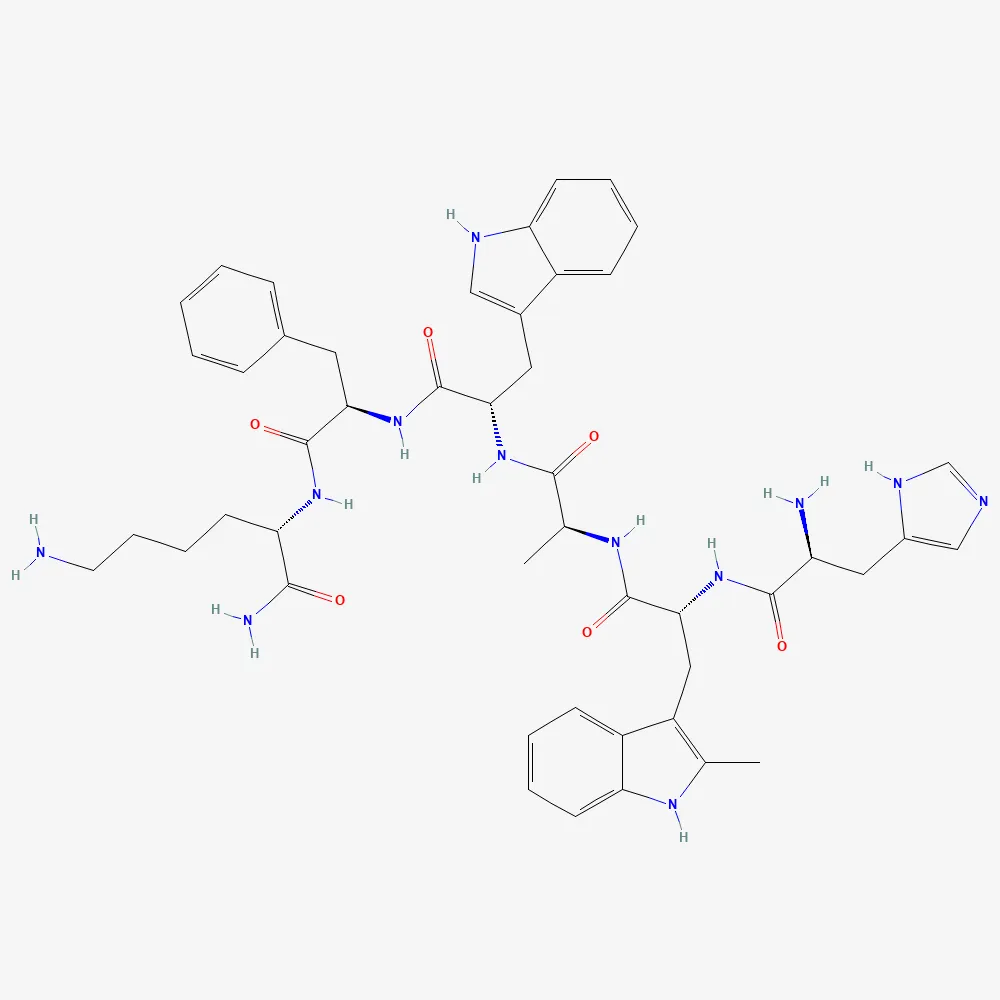
- Molecular formula
- C47H58N12O6
- Molecular weight
- 887.0 g/mol
- Length
- 6 amino acids
- Sequence
- HWAWFK
- Modifications
- Position 2 is D-2-methyl-tryptophan; D-Phe at position 5; C-terminal amide.
- PubChem CID
- 6918297
Examorelin is its INN.
Identity checked against ChEMBL (examorelin).
Hexarelin benefits: what the research shows
Small or uncontrolled human studies. Too little to settle the question either way. Human hexarelin data is old and narrow: short 1990s and 2000s studies measuring growth-hormone release after single or short-course doses, mostly to test how much GH a person can release. I could not find a controlled human trial for muscle gain, body composition, fat loss or exercise recovery, the uses it is marketed for, and none is registered with a verifiable id in the registry this site cites from.
The human results on growth hormone release are strong:
- Twice the release of the natural hormone. In 12 healthy young volunteers, an intravenous dose released about twice as much growth hormone as the same dose of the body’s own releasing hormone. The response was highly reproducible, and injection under the skin worked too, with about 77% bioavailability Ghigo 1994 - Ghigo E, Arvat E, Gianotti L et al. Growth hormone-releasing activity of hexarelin, a new synthetic hexapeptide, after intravenous, subcutaneous, intranasal, and oral administration in man. J Clin Endocrinol Metab. 1994;78(3):693-8., in the references below.
- More than additive with GHRH. Given with GHRH to 6 healthy men, it produced a higher growth hormone peak than the two given separately, added together Massoud 1996 - Massoud AF, Hindmarsh PC, Matthews DR et al. The effect of repeated administration of hexarelin, a growth hormone releasing peptide, and growth hormone releasing hormone on growth hormone responsivity. Clin Endocrinol (Oxf). 1996;44(5):555-62., in the references below.
Researchers used hexarelin, like other GHRPs, to test how much growth hormone a person’s pituitary could still release. That is a legitimate diagnostic question, not a performance one. The studies cited here are published, PubMed-indexed papers; I found no hexarelin trial with a registry id I could verify.
Pharmacokinetics
I could not verify hexarelin’s human half-life against a primary source, so I don’t print one. Figures circulate on vendor and forum pages, but I couldn’t trace them to a study, and repeating an unverified number is how it comes to be treated as fact. Any dosing interval built on those figures has no evidence behind it.
Hexarelin dosage
No published human trial sets a dose for the uses hexarelin is sold for today. Guides commonly describe 80-160 mcg injected under the skin, once or twice daily, fasted, over a 4-8 week cycle with an equal break. That is common practice, not a tested dose. The full dosage page has the sources and the pharmacology-study doses.
Hexarelin side effects
There is no long-term human safety study of hexarelin. What follows comes from short 1990s studies built to measure hormone release, plus one inference from the wider class, labelled as such.
Reported in studies
The dose-response study cited here found that hexarelin raises cortisol and prolactin as well as growth hormone Massoud 1996 - Massoud AF, Hindmarsh PC, Brook CG. Hexarelin-induced growth hormone, cortisol, and prolactin release: a dose-response study. J Clin Endocrinol Metab. 1996;81(12):4338-41., in the references below. That is a real short-term hormone effect, not a long-term safety profile. The studies used single doses or repeated doses on one day, not weeks or months of use.
Inferred from the wider GHRP class, not measured for hexarelin itself
Fluid retention, joint pain and insulin resistance are commonly reported with sustained growth-hormone rises from any GHRP. Long-term excess is linked to high blood pressure and heart changes. None of this has been measured for hexarelin at the doses people use today.
Hexarelin is also sold as an unregulated research chemical, labelled not for human use. No regulator checks that a vial matches its label, and as far as I could establish, no public testing programme does either.
For redness, itching or swelling at the injection site, see injection-site reactions.
Full dosing detail, including the studies these findings come from: hexarelin dosage.
How hexarelin compares
No study has put hexarelin head-to-head against another growth-hormone secretagogue in people. The comparisons below set out what is known about each compound separately, not a tested ranking.
Hexarelin vs sermorelin
They are different classes. Hexarelin is a GHRP acting on the ghrelin receptor; sermorelin is a fragment of growth-hormone-releasing hormone acting on the GHRH receptor.
A 1999 clinical review describes sermorelin as a diagnostic test for growth-hormone deficiency. It reports that a higher once-daily dose gave sustained gains in growth rate in some children with the condition, smaller than with growth hormone itself Prakash 1999 - Prakash A, Goa KL. Sermorelin: a review of its use in the diagnosis and treatment of children with idiopathic growth hormone deficiency. BioDrugs. 1999;12(2):139-57., in the references below. I searched DailyMed on 24 September 2026 and found no sermorelin product listed. Hexarelin has no equivalent review and no controlled trial for muscle, fat loss or recovery.
Hexarelin vs ipamorelin
Both are GHRPs acting on the ghrelin receptor. Ipamorelin was designed to release growth hormone more selectively. In a 1998 study it raised growth hormone in rats and pigs, and in the pig tests it didn’t raise cortisol or ACTH the way GHRP-6 and GHRP-2 did Raun 1998 - Raun K, Hansen BS, Johansen NL et al. Ipamorelin, the first selective growth hormone secretagogue. Eur J Endocrinol. 1998;139(5):552-61., in the references below.
That cortisol and ACTH result wasn’t measured in rats or people and didn’t include hexarelin, so it can’t rank the two. Neither has a controlled human trial for muscle, fat loss or recovery.
Hexarelin vs tesamorelin
Tesamorelin is an approved medicine: a GHRH analogue sold as Egrifta SV and Egrifta WR, both listed on DailyMed when I checked on 24 September 2026. It is approved, on randomised trial evidence, to reduce excess visceral abdominal fat in adults with HIV-associated lipodystrophy Falutz 2010 - Falutz J, Potvin D, Mamputu JC et al. Effects of tesamorelin, a growth hormone-releasing factor, in HIV-infected patients with abdominal fat accumulation: a randomized placebo-controlled trial with a safety extension. J Acquir Immune Defic Syndr. 2010;53(3):311-22., in the references below.
Hexarelin has never been approved and has no comparable trials. An approval for one narrow population doesn’t show that tesamorelin releases more growth hormone or is safer, and no study has tested the two against each other.
Is hexarelin legal?
Sport. Growth hormone-releasing peptides, including hexarelin, are widely reported, including in third-party summaries of the current list, to fall under the World Anti-Doping Agency’s category for peptide hormones, growth factors and related substances, banned at all times. When I wrote this page I couldn’t reach wada-ama.org to quote its wording, so I don’t cite a specific clause or page. If you are a tested athlete, check the current list at wada-ama.org yourself.
I checked only US federal status, not individual states or other countries.
Related reading
Hexarelin is one of several GHRPs sold in the same research-chemical channel. CJC-1295 is a GHRH analogue that works through a different receptor, and ipamorelin is a more selective GHRP from the same family. None of the three is FDA-approved, and none has a controlled human trial for the muscle or recovery uses they are sold for.
Regulatory changes for this compound and others, as they happen: US peptide regulation tracker.
How Hexarelin compares
Secretagogues (act on the ghrelin receptor). Doses for unapproved compounds are common practice, not trial-established. All growth hormone and muscle peptides →
| Compound | Main use | Evidence | Usual dose | US status |
|---|---|---|---|---|
| Ipamorelin | Investigated for postoperative ileus, reaching Phase 2 before being discontinued for insufficient efficacy. Marketed to consumers for growth hormone release, an application never approved anywhere. | Limited human data | 100-300 mcg, once nightly on 5 days a week in physician-supervised protocols, up to three times daily on an empty stomach in less structured use | Research use only |
| MK-677 (Ibutamoren) | Developed as an oral, non-injectable alternative to peptide growth hormone secretagogues. Published trials in healthy older adults and obese men found it raised growth hormone and IGF-1 and increased fat-free mass; FDA references a hip-fracture trial that was stopped early. Marketed to consumers as a research chemical for muscle and recovery, a use never approved by any regulator. | Limited human data | 12.5-25 mg, once daily by mouth; the published 2008 trial dosed each morning, while compounding-pharmacy protocols commonly move dosing to before bed | Research use only |
| GHRP-2 | Sold to consumers as a growth-hormone-release research chemical for muscle and recovery use, an application never approved anywhere. Historically investigated as a pituitary growth-hormone stimulus and diagnostic agent. | Limited human data | 100-300 mcg, 2 to 3 times daily, on an empty stomach, 5 days a week (5 on, 2 off) | Research use only |
| GHRP-6 | One of the original growth hormone-releasing peptides, studied since the 1980s as a pituitary GH secretagogue. Marketed to consumers for muscle and recovery goals, an application never approved anywhere. | Limited human data | 100-300 mcg, 2 to 3 times daily, on an empty stomach, spaced at least 3-4 hours apart | Research use only |
| Hexarelin | Investigated since the 1990s as a growth hormone-releasing peptide (GHRP), including for growth-hormone stimulation testing. Sold to consumers as a research chemical for muscle and recovery use, an application with no controlled human trial behind it. | Limited human data | 80-160 mcg, once or twice daily (morning and/or before bed), on an empty stomach | Research use only |
Where to buy Hexarelin for research
Each vendor is checked against my vendor checklist.
1.Next Level PharmFeatured
2 mg vial
- No FDA warning letter found
- Names its testing lab
- Batch COAs published
- Takes card payment
Common questions
Does hexarelin work for muscle growth?
I could not find a controlled human trial of hexarelin for muscle gain, body composition or athletic performance. The human data come from short studies measuring growth-hormone release, which is a hormone signal, not a change in body composition.
What is the usual hexarelin dose?
No published human trial sets a dose for the muscle or recovery uses it is sold for. Guides commonly describe 80-160 mcg injected under the skin once or twice daily on an empty stomach, for 4-8 weeks with an equal break. That is common practice, not a tested dose. See the [full dosage page](/hexarelin-dosage/) for the sources and the study doses.
Is hexarelin legal in the United States?
It is not FDA-approved for anything, and no hexarelin product is listed on DailyMed. It is sold as a research chemical labelled not for human use, which is a label, not a legal category.
Is hexarelin banned in sport?
It is widely reported, including in third-party summaries of the current list, that growth hormone-releasing peptides such as hexarelin fall under WADA's banned-at-all-times category for peptide hormones and growth factors. I could not confirm the exact wording on wada-ama.org myself. A tested athlete should check the current list directly.
Is hexarelin better than sermorelin?
No trial has compared them, so the evidence can't say. They use different receptors: hexarelin the ghrelin receptor, sermorelin the growth-hormone-releasing-hormone receptor. Sermorelin has a published clinical review of its diagnostic and paediatric use; hexarelin has nothing equivalent. Neither has a trial for muscle, fat loss or recovery, and DailyMed listed no sermorelin product on 24 September 2026.
Is hexarelin better than ipamorelin?
No trial has compared them, so the evidence can't say. Both act on the ghrelin receptor, but ipamorelin was designed to release growth hormone more selectively: in 1998 pig tests it didn't raise cortisol or ACTH the way GHRP-6 and GHRP-2 did. Hexarelin wasn't tested, and neither has a controlled human trial for muscle, fat loss or recovery.
Is hexarelin stronger than tesamorelin?
They aren't comparable on strength. Tesamorelin is an FDA-approved medicine (Egrifta) for a specific population, backed by randomised trials. Hexarelin has never been approved and has no such trials. No head-to-head study has been run, so no evidence says which is stronger.
What are the side effects of hexarelin?
There is no long-term human safety study. A short dose-response study found it raises cortisol and prolactin as well as growth hormone. Fluid retention, joint pain and insulin resistance are commonly reported with sustained growth-hormone rises from any GHRP, and long-term excess is linked to high blood pressure and heart changes, but none of that has been measured for hexarelin itself. As a research chemical, no regulator checks that a vial matches its label.
What shouldn't you mix with peptides like hexarelin?
No study has tested hexarelin with other drugs, supplements or peptides, so no specific interaction is known either way. Combining it with prescription hormone therapy, diabetes medicine or other unapproved peptides adds unknown risk to a product that is already unstudied. If you take prescribed medication, raise any research chemical with your prescriber rather than follow vendor or forum stacking advice.
Who should not use hexarelin peptide?
No trial has defined who should avoid it, because none has tested it in the people now buying it. It is not FDA-approved and is labelled not for human use, so I don't consider it appropriate for anyone, rather than listing excluded groups. No regulator checks that a vial matches its label. If you are on prescribed hormone therapy or other medication, raise any research chemical with your prescriber.
References (6 sources)
Bibliographic detail is fetched from PubMed, not written by me - so a citation here cannot drift from the paper it names. Study design comes from PubMed's own tags rather than my judgement.
- 1.Prakash A, Goa KL. Sermorelin: a review of its use in the diagnosis and treatment of children with idiopathic growth hormone deficiency. BioDrugs. 1999;12(2):139-57.StudyPMID 18031173
- 2.Raun K, Hansen BS, Johansen NL et al. Ipamorelin, the first selective growth hormone secretagogue. Eur J Endocrinol. 1998;139(5):552-61.StudyPMID 9849822
- 3.Falutz J, Potvin D, Mamputu JC et al. Effects of tesamorelin, a growth hormone-releasing factor, in HIV-infected patients with abdominal fat accumulation: a randomized placebo-controlled trial with a safety extension. J Acquir Immune Defic Syndr. 2010;53(3):311-22.Randomised trialPMID 20101189
- 4.Massoud AF, Hindmarsh PC, Brook CG. Hexarelin-induced growth hormone, cortisol, and prolactin release: a dose-response study. J Clin Endocrinol Metab. 1996;81(12):4338-41.Randomised trialPMID 8954038
- 5.Ghigo E, Arvat E, Gianotti L et al. Growth hormone-releasing activity of hexarelin, a new synthetic hexapeptide, after intravenous, subcutaneous, intranasal, and oral administration in man. J Clin Endocrinol Metab. 1994;78(3):693-8.StudyPMID 8126144
- 6.Massoud AF, Hindmarsh PC, Matthews DR et al. The effect of repeated administration of hexarelin, a growth hormone releasing peptide, and growth hormone releasing hormone on growth hormone responsivity. Clin Endocrinol (Oxf). 1996;44(5):555-62.Randomised trialPMID 8762732