5-Amino-1MQ: Capsules, Dosage, Side Effects and Legal Status
5-Amino-1MQ capsules: what oral dosing was tested (in rats, not people), the 50-150 mg common protocol, mouse safety data and FDA's warning letter.

The short version
5-Amino-1MQ is sold alongside injectable research peptides for fat loss, but it is a small synthetic molecule that blocks an enzyme called NNMT, not a peptide. Every result showing it reduces fat comes from mice, and I found no published human trial, safety study or dosing study. FDA has named it in at least one warning letter as an ingredient a compounding pharmacy was not allowed to use.
- It is a small molecule (a quinolinium salt), not a peptide, despite being sold next to peptides under similar branding.
- Every efficacy result I could find is from mice; no published human trial exists.
- FDA named it directly in a January 2026 warning letter as ineligible for compounding.
- Not FDA-approved and not a legal dietary supplement, whatever the product label says.
- It is widely sold as capsules, but the mouse fat-loss results came from injections, and I found no test of it by mouth in people.
5-Amino-1MQ at a glance
- What it is
- Small-molecule quinolinium salt - not a peptide
- Main use
- An NNMT-inhibiting research chemical marketed for fat loss and metabolic health. Every efficacy result I could locate comes from mouse studies; no published human trial exists.
- Also called
- 5-amino-1-methylquinolinium, 5-Amino-1MQ iodide, 5A1MQ
- Molecular formula
- C10H11N2+ (159.21 g/mol) Structure
- Evidence
- Animal / lab only
- US status
- Unapproved drug
- Half-life
- Not established in humans
- How it is taken
- By mouth
- Common protocol
- 50-150 mg, once daily, for 8-12 weeks (common practice, not trial-established) Dosing page
5-Amino-1MQ is a small molecule, not a peptide. It is sold on the same shelves, as a “research compound”, often to buyers looking for a GLP-1 alternative. Its different chemical class changes what is known about it.
It is sold as capsules and the common protocol is taken by mouth, but the mouse fat-loss results came from injections. I found no test of it by mouth in people.
Dosing: why no human dose exists.
Studied in cells or animals. No controlled trials in humans. Every efficacy result I could locate comes from mouse studies. I could not find a published human trial of any phase, or any published human pharmacokinetic, safety or dosing data.
What is 5-Amino-1MQ, and how does it work?
5-Amino-1MQ blocks an enzyme called nicotinamide N-methyltransferase (NNMT). NNMT is found in fat and other tissue. It uses up S-adenosylmethionine (SAM), a methyl donor cells need elsewhere, and is linked to how cells turn over NAD+.
Researchers propose that blocking NNMT pushes cells to burn more fat and energy, by keeping more NAD+ available and freeing SAM for other uses. That idea comes from cell and animal work. It is a plausible story that hasn’t been tested in people.
5-Amino-1MQ structure
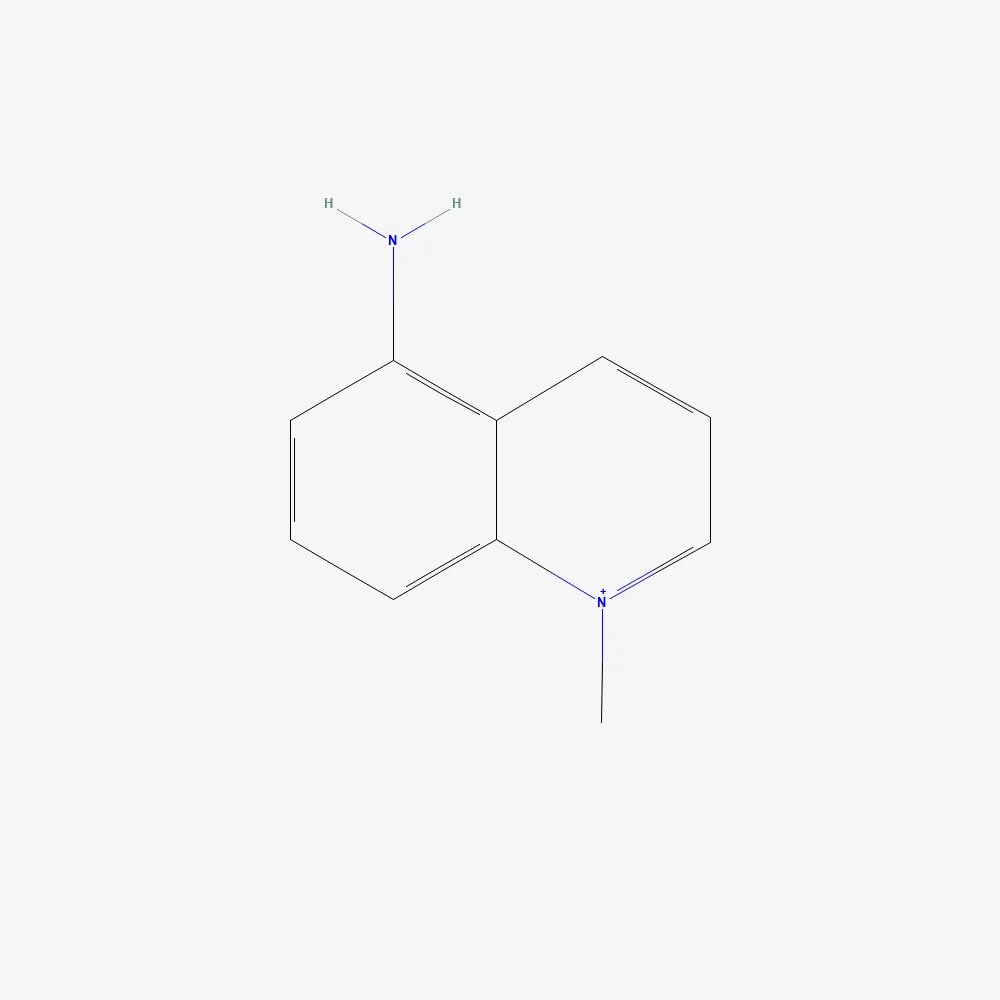
- Molecular formula
- C10H11N2+
- Molecular weight
- 159.21 g/mol
- PubChem CID
- 950107
A small quinolinium molecule, not a peptide. It is sold as the iodide salt; the diagram shows the active 5-amino-1-methylquinolinium cation without the iodide counter-ion.
Identity checked against ChEMBL (EMBL-EBI).
How does 5-Amino-1MQ’s NNMT mechanism compare to NAD+ precursors?
Some vendors group 5-Amino-1MQ with NAD+ precursor supplements such as nicotinamide riboside (NR) and nicotinamide mononucleotide (NMN), because all three come up in talk about NAD+ levels. They work differently.
- NR and NMN are raw materials cells use to make NAD+.
- 5-Amino-1MQ supplies nothing. By blocking NNMT, it is proposed to reduce how much NAD+ gets used up.
No study has compared the two approaches head-to-head, in mice or humans, so there is no basis for claiming one works better for any outcome.
5-Amino-1MQ benefits: what the research shows
The mouse results are promising. In mice made obese by diet, published reports describe 5-Amino-1MQ reversing obesity and improving glucose tolerance over a course of daily dosing.
In the first mouse obesity study, treated mice lost body weight and white fat, their fat cells shrank and their total cholesterol fell. They didn’t eat less, and there were no observable adverse effects Neelakantan 2018 - Neelakantan H, Vance V, Wetzel MD et al. Selective and membrane-permeable small molecule inhibitors of nicotinamide N-methyltransferase reverse high fat diet-induced obesity in mice. Biochem Pharmacol. 2018;147:141-152., in the references below. The authors concluded that NNMT is a viable target for treating obesity, and the mechanism above explains why it might work.
The rest of the record is cell, mouse and rat work. I found no human data of any kind. For 5-Amino-1MQ there is no:
- registered or completed human clinical trial
- published human pharmacokinetic study
- published human safety or tolerability study
- validated human dose
5-Amino-1MQ dosage
No human trial has set a dose. The protocol most often used is 50-150 mg by mouth once a day. People typically start at 50 mg for the first 1-2 weeks, then move to 100-150 mg, over an 8-12 week cycle with a 4-8 week break. That is common practice, not a tested dose. The full dosage page covers the protocol’s sourcing and the mouse-study dosing.
5-Amino-1MQ capsules: does it work orally?
5-Amino-1MQ is sold as capsules, and the common protocol above is taken by mouth. Strengths vary 100-fold. On 3 October 2026 I found 500 mcg capsules listed as a “supplement” on Amazon, and 50 mg capsules from a research-chemical seller marked for research use only.
The oral evidence comes from animals:
- Mice, fat loss. The mouse obesity study gave 5-Amino-1MQ as three injections under the skin a day, not by mouth Neelakantan 2018 - Neelakantan H, Vance V, Wetzel MD et al. Selective and membrane-permeable small molecule inhibitors of nicotinamide N-methyltransferase reverse high fat diet-induced obesity in mice. Biochem Pharmacol. 2018;147:141-152., in the references below. Its cell tests, which estimate absorption from the gut, showed high permeability.
- Rats, absorption. In rats, about 38% of an oral dose reached the bloodstream, and the half-life after an oral dose was about 7 hours Awosemo 2021 - Awosemo O, Neelakantan H, Watowich S et al. Development & validation of LC-MS/MS assay for 5-amino-1-methyl quinolinium in rat plasma: Application to pharmacokinetic and oral bioavailability studies. J Pharm Biomed Anal. 2021;204:114255., in the references below.
- Mice, absorption. A later mouse study chose injections because 5-Amino-1MQ is poorly absorbed by mouth in mice, unlike in rats Dimet-Wiley 2022 - Dimet-Wiley A, Wu Q, Wiley JT et al. Reduced calorie diet combined with NNMT inhibition establishes a distinct microbiome in DIO mice. Sci Rep. 2022;12(1):484., in the references below.
So absorption by mouth differs between two rodent species. I found no measurement of it in people, and no study testing whether 5-Amino-1MQ taken by mouth changes body fat in any species.
Which peptides and lookalikes work by mouth, and which don’t: oral peptides.
5-Amino-1MQ side effects
No human trial exists, so no human side-effect rate has ever been recorded. The main published safety data I found come from one mouse study.
Reported in studies
In that study Neelakantan 2018 - Neelakantan H, Vance V, Wetzel MD et al. Selective and membrane-permeable small molecule inhibitors of nicotinamide N-methyltransferase reverse high fat diet-induced obesity in mice. Biochem Pharmacol. 2018;147:141-152., in the references below, researchers first tested doses up to a total of 150 mg/kg a day. They reported no observed adverse effects at up to 60 mg/kg a day, and the main 11-day experiment used about 34 mg/kg a day.
That is one obesity model in mice, over 11 days. It doesn’t show any dose is safe in a person, and no published data covers drug interactions, organ toxicity or long-term use.
Is 5-Amino-1MQ legal?
US legal status - Unapproved drug
Not FDA-approved for any use, and not a lawful dietary supplement, whatever a product label claims. Sold as a "research use only" chemical. In a warning letter dated 20 January 2026, FDA stated that a compounding facility had used bulk drug substances 'not eligible for the use in compounding under section 503B, including 5-amino-1-methylquinolinium (5-Amino-1MQ)' because the substance does not appear on the 503B bulks list and was not being used to compound a drug on FDA's drug-shortage list.
That letter went to one compounding facility, not every seller. But its reasoning applies to anyone compounding or dispensing 5-Amino-1MQ as a drug in the US: it is not an approved or list-eligible bulk drug substance.
Why it belongs in the same conversation as the GLP-1 lookalikes
5-Amino-1MQ is sold by the same research-chemical vendors, often in the same bundles, as unapproved semaglutide, tirzepatide and other “GLP-1 lookalike” products. It has none of the human trials or FDA review behind the medicines it sits next to. It is also at an earlier stage than most of them: no human data at all, rather than thin or negative human data.
Related
- Semaglutide (Ozempic, Wegovy): the approved label, not the grey market
- AOD-9604: the hGH-fragment peptide whose own trial failed
- Tesofensine: a shelved neuro drug repositioned for obesity
- Are peptides safe?
Regulatory changes for this compound and others, as they happen: US peptide regulation tracker.
How 5-Amino-1MQ compares
Other fat-loss compounds. Doses for unapproved compounds are common practice, not trial-established. All weight loss and metabolism peptides →
| Compound | Main use | Evidence | Usual dose | US status |
|---|---|---|---|---|
| AOD-9604 | Originally developed as an anti-obesity drug candidate; its developer reported that its Phase IIb human obesity trial did not succeed, and development for that indication was discontinued. Now sold to consumers as a research-chemical fat-loss product. | Limited human data | 250-500 mcg, once daily, fasted (some protocols run 5 days on, 2 days off) | Unapproved drug |
| HGH Fragment 176-191 | Sold to consumers as a research-chemical fat-loss product, marketed on the claim that this slice of growth hormone carries its fat-metabolising activity without the growth-promoting or blood-sugar effects of the whole hormone. Never developed into an approved drug under this exact sequence. | Animal / lab only | 200-500 mcg, once or twice daily, fasted | Unapproved drug |
| Adipotide | Developed at MD Anderson Cancer Center as a targeted anti-obesity drug candidate that induces apoptosis in the blood vessels feeding white fat. A first-in-human Phase 1 trial in men with prostate cancer and obesity was terminated early with no published results, and it is now sold to consumers as an unregulated research-chemical weight-loss product. | Animal / lab only | No consistent protocol | Unapproved drug |
| 5-Amino-1MQ | An NNMT-inhibiting research chemical marketed for fat loss and metabolic health. Every efficacy result I could locate comes from mouse studies; no published human trial exists. | Animal / lab only | 50-150 mg, once daily | Unapproved drug |
| Tesofensine | Originally developed for Parkinson's and Alzheimer's disease; weight loss observed as a side effect in those trials led to its repositioning as an obesity candidate. It has completed placebo-controlled obesity trials but remains unapproved everywhere, and is now also sold as a grey-market research chemical. | Limited human data | 0.25-1 mg, once daily, in the morning, titrated upward over several weeks | Unapproved drug |
Where to buy 5-Amino-1MQ for research
Each vendor is checked against my vendor checklist.
1.Next Level PharmFeatured
10 mg vial
- No FDA warning letter found
- Names its testing lab
- Batch COAs published
- Takes card payment
2.BioEdge Research Labs
10 mg vial
- No FDA warning letter found
- Names its testing lab
- Batch COAs published
5-Amino-1MQ capsules
Taken by mouth, and a different product from the vial: ask for a COA for the capsule batch.
- BioEdge Research Labs: 50 mg capsules, 60 count$145.00 as of 3 October 2026 View →
Common questions
What is 5-Amino-1MQ?
A small synthetic molecule, not a peptide, sold as a research chemical for fat loss. It blocks an enzyme called NNMT, a mechanism shown in mice. There is no published human trial, safety study or dosing study, and it is not FDA-approved or a lawful dietary supplement.
What is the usual 5-Amino-1MQ dose?
The protocol most often used is 50-150 mg by mouth once a day in the morning, for 8-12 weeks with a 4-8 week break. That is common practice, not a tested dose; no human trial exists. The 5-Amino-1MQ dosage page covers the mouse-study dosing and why it doesn't translate to a human number.
What are the side effects of 5-Amino-1MQ?
They are unknown, because there is no published human safety data. The main published mouse study reported no observed adverse effects at the doses it tested, but that was mice over 11 days. The side effects section of this page has the detail.
Is 5-Amino-1MQ a peptide?
No. It is a small synthetic molecule, 5-amino-1-methylquinolinium, a quinolinium salt with a molecular weight of about 159 g/mol. Peptides are chains of amino acids, and 5-Amino-1MQ isn't built from amino acids at all. Vendors group it with peptides because it is sold to the same buyers for the same fat-loss use.
What does 5-Amino-1MQ do?
It blocks an enzyme called nicotinamide N-methyltransferase (NNMT), which uses up a methyl donor (SAM) and is linked to NAD+ turnover in fat tissue. Researchers propose that blocking NNMT shifts cells toward burning fat rather than storing it. That comes from cell and mouse experiments; nobody has shown it happens in a person.
Has 5-Amino-1MQ been tested in humans?
Not that I could find. I found no published human trial of any phase, and no human safety, pharmacokinetic or dosing data. Every efficacy finding, including reversal of diet-induced obesity and better glucose tolerance, comes from mice.
Is 5-Amino-1MQ FDA-approved or legal to sell as a supplement?
No to both. It is not FDA-approved for any use and is not a lawful dietary supplement, whatever the marketing says. It is sold as 'research use only'. In a 20 January 2026 warning letter, FDA named 5-amino-1-methylquinolinium directly: compounded products using it were ineligible under section 503B of the FD&C Act because it is not on the 503B bulks list.
Is 5-Amino-1MQ dangerous?
Nobody knows yet, because there are no published human data. The main mouse study reported no observable adverse effects, which is encouraging for an early compound but is not evidence of human safety. Any dosing protocol you see online is untested in people.
How long does it take for 5-Amino-1MQ to work?
That hasn't been established. No human study has measured a time to effect, so any timeline you see quoted isn't based on human data. In the main mouse study, fat loss was measured after 11 days of injections, and a mouse timeline wouldn't predict a human one.
What are the risks of using 5-Amino-1MQ?
They are unknown, because no human safety study exists. The main mouse study reported no observed adverse effects, but mouse data can't stand in for human tolerability, drug interactions or long-term safety. No regulator checks that a 'research use only' product matches its label, and FDA has not reviewed the compound for use in people.
Is 5-Amino-1MQ legal in the United States?
No. It is not FDA-approved for any human use and is not a lawful dietary supplement, whatever the label says. FDA named 5-amino-1-methylquinolinium in a 20 January 2026 warning letter as ineligible for compounding under section 503B of the FD&C Act, because it is not on the 503B bulks list.
Does 5-Amino-1MQ shrink fat cells?
In mice, yes: published reports describe it reducing fat mass, shrinking fat cells and reversing diet-induced obesity over a course of daily dosing. Whether it does this in people hasn't been tested, because no human trial exists.
Does 5-Amino-1MQ work orally?
I found no study of it taken by mouth in people. In rats, about 38% of an oral dose reached the bloodstream. Researchers report it is poorly absorbed by mouth in mice, and the mouse fat-loss studies injected it under the skin. Whether a capsule reaches useful levels in a person is unknown.
Which 5-Amino-1MQ supplement is the best?
I don't rank them, and none is a lawful dietary supplement in the US. Labels I found ranged from 500 mcg to 50 mg per capsule, a 100-fold spread. If you are judging a seller, look for a batch certificate of analysis from a named, independent lab, and check that it matches the capsule strength on the label.
Are peptides illegal?
No single rule makes every peptide illegal. In the US, status is set compound by compound: some peptides are FDA-approved prescription drugs, some can be legally compounded from an approved bulk list, and others aren't approved for any use. 5-Amino-1MQ, which isn't even a peptide, is in that last group. Check the specific compound.
References (6 sources)
Bibliographic detail is fetched from PubMed, not written by me - so a citation here cannot drift from the paper it names. Study design comes from PubMed's own tags rather than my judgement.
- 1.Neelakantan H, Vance V, Wetzel MD et al. Selective and membrane-permeable small molecule inhibitors of nicotinamide N-methyltransferase reverse high fat diet-induced obesity in mice. Biochem Pharmacol. 2018;147:141-152.StudyPMID 29155147full text
- 2.Awosemo O, Neelakantan H, Watowich S et al. Development & validation of LC-MS/MS assay for 5-amino-1-methyl quinolinium in rat plasma: Application to pharmacokinetic and oral bioavailability studies. J Pharm Biomed Anal. 2021;204:114255.StudyPMID 34304009
- 3.Dimet-Wiley A, Wu Q, Wiley JT et al. Reduced calorie diet combined with NNMT inhibition establishes a distinct microbiome in DIO mice. Sci Rep. 2022;12(1):484.StudyPMID 35013352full text
- 4.Amazon listing "5 Amino 1mq Supplement Capsules 500MCG 60ct (3RD Party Tested)", Health & Household category (checked 3 October 2026)- Amazon.comother
- 5.Bulk Peptide Supply, "5-AMINO 1MQ 50 mg Capsules (60 ct)" product page, labelled for research purposes only, do not use in humans (checked 3 October 2026)- Bulk Peptide Supplyother
- 6.FDA warning letter to GenoGenix LLC (#718739), 20 January 2026. Names 5-amino-1-methylquinolinium (5-Amino-1MQ) as a bulk drug substance ineligible for use in compounding under section 503B.- US Food and Drug Administrationregulatory