Dihexa: Benefits, Dosage, Side Effects and Legal Status
What dihexa is, how it may work, common dosing, side effects and its US legal status - with zero published human trials.

The short version
Dihexa is a synthetic small molecule sold online as a research chemical for memory and cognition. It was developed from angiotensin IV, and lab work suggests it mimics brain-derived neurotrophic factor (BDNF). No human trial has been published. FDA says it found no human exposure data on dihexa acetate by any route, and lacks the information to know whether it would harm people.
- No published human trial of dihexa exists; every finding comes from cells and animals.
- FDA found no human exposure data for dihexa acetate by any route.
- Not on the 503A Bulks List, so no pharmacy can lawfully compound it.
- No human half-life or dose has been established.
Dihexa at a glance
- What it is
- Synthetic small-molecule analog of angiotensin IV
- Main use
- Sold online as a research chemical for cognition and memory. FDA has not identified any human exposure data on drug products containing dihexa acetate by any route.
- Also called
- N-hexanoic-Tyr-Ile-(6) aminohexanoic amide, Dihexa acetate, PNB-0408, ATH-1001
- Molecular formula
- C27H44N4O5 (504.7 g/mol) Structure
- Evidence
- Animal / lab only
- US status
- Research use only
- Half-life
- Not established in humans
- How it is taken
- By mouth
- Common protocol
- 10-100 mg, 1 to 3 times a week, not daily; sources describe starting around 10-20 mg and titrating up to 50-100 mg as tolerated, for 4-8 weeks (common practice, not trial-established) Dosing page
Dosing: what the rat studies used. No human dose exists.
Dihexa was designed in a university lab as a possible dementia drug, and its first rat results were striking. In the paper that introduced it, it reversed chemically induced memory loss and improved performance in aged rats. It is now sold online for memory and cognition.
It has not yet been tested in a human trial. FDA’s review of bulk substances says it has found no human exposure data for dihexa acetate by any route. So everything written about dihexa, here and elsewhere, comes from cells and animals.
US legal status - Research use only
Not an FDA-approved drug. No USP or NF monograph exists for dihexa or dihexa acetate, neither is a component of an approved drug, and neither is on the 503A Bulks List, so dihexa is not currently eligible for lawful pharmacy compounding.
What is Dihexa?
Dihexa is the common name for N-hexanoic-Tyr-Ile-(6) aminohexanoic amide, a synthetic small molecule developed from angiotensin IV. It is not strictly a peptide, a natural chain of amino acids, but it is sold alongside research peptides and usually described as one.
FDA’s list of bulk substances that may pose safety risks calls it “dihexa acetate”, the salt form most often sold. FDA’s entry is short. It has found no human exposure data for dihexa acetate by any route, and it lacks important safety information, including whether the compound would harm people.
Dihexa structure
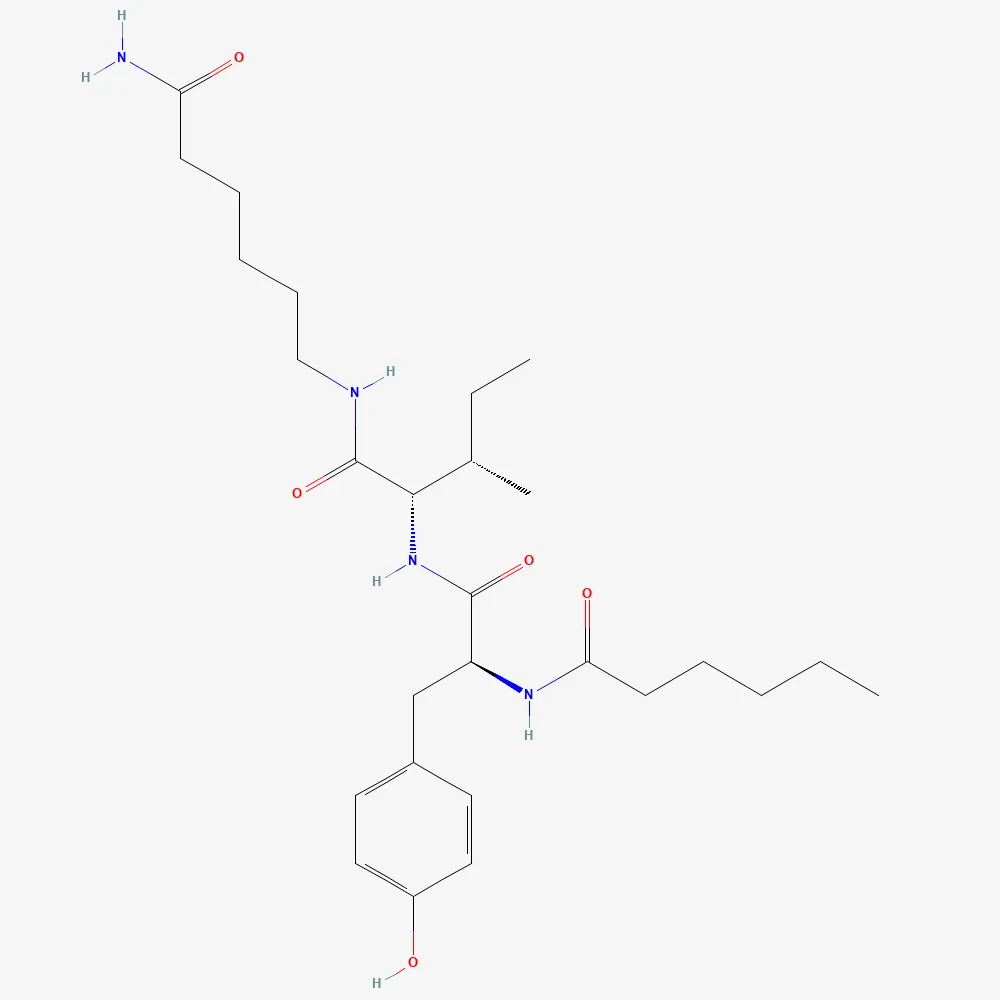
- Molecular formula
- C27H44N4O5
- Molecular weight
- 504.7 g/mol
- Modifications
- Not a standard peptide: N-hexanoyl-L-Tyr-L-Ile capped at the C-terminus with 6-aminohexanoic amide.
- PubChem CID
- 129010512
Vials are usually sold as dihexa acetate; the diagram is the parent molecule.
Identity checked against Journal of Pharmacology and Experimental Therapeutics (2013), via PubMed.
How Dihexa works
The researchers who developed dihexa propose that it activates the hepatocyte growth factor/c-Met receptor system. That in turn drives synaptogenesis, the growth of new connections between neurons. This is why dihexa is described as a small-molecule mimic of brain-derived neurotrophic factor (BDNF), and why it is marketed for memory.
That account comes from the compound’s own cell and animal development work, not from an independent human study. It is a hypothesis, not a mechanism confirmed in people.
Dihexa benefits: what the research shows
Studied in cells or animals. No controlled trials in humans. A PubMed search for dihexa, run 24 September 2026, returns 18 records and zero indexed under a clinical-trial or randomised-controlled-trial publication type. FDA's bulk drug substances safety-risk page states it has not identified any human exposure data on drug products containing dihexa acetate by any route. Published work is preclinical only.
The lab results are why people are interested. The 2013 paper that introduced dihexa came from the Washington State University group that developed it McCoy 2013 - McCoy AT, Benoist CC, Wright JW et al. Evaluation of metabolically stabilized angiotensin IV analogs as procognitive/antidementia agents. J Pharmacol Exp Ther. 2013;344(1):141-54., in the references below. In rats, dihexa:
- reversed memory deficits caused by the drug scopolamine in a water-maze test
- improved performance in aged rats
- worked when given by mouth
- showed strong growth of new connections between neurons
The authors suggested it may have potential in conditions such as Alzheimer’s disease. In 2021 the journal published a notice of concern about that paper Anon 2021 - Anon. Notice of Concern: McCoy AT, Benoist CC, Wright JW, Kawas LH, Bule-Ghogare JM, Zhu M, Appleyard SM, Wayman GA, and Harding JW (2013) Evaluation of Metabolically Stabilized Angiotensin IV Analogs as Procognitive/Antidementia Agents, J Pharmacol Exp Ther, 344: 141-154; DOI: https://doi.org/10.1124/jpet.112.199497. J Pharmacol Exp Ther. 2021;378(3):313., in the references below. That matters for a result that has not been repeated in people.
No human trials
Of the 18 dihexa records on PubMed, none is indexed as a clinical trial or randomised controlled trial. Indexing can miss a real trial that was tagged wrongly, so a zero count is strong evidence, not proof. FDA’s review closes the gap: it does not rely on PubMed tags, and it found no human exposure data for dihexa acetate. Two independent checks give the same answer: no verifiable published human trial of dihexa exists.
Pharmacokinetics
Dihexa’s half-life in humans is not established, and neither is any other human pharmacokinetic figure. FDA found no human exposure data by any route, so there is no measured absorption, distribution, clearance or half-life. Any dosing interval you see online is not built on a human measurement.
Dihexa dosage
Clinic and vendor dosing guides commonly describe dihexa taken by mouth, starting around 10-20 mg and working up to 50-100 mg, 1-3 times a week. The sources I checked agree it should not be taken daily. Courses run about 4-8 weeks with a 4-week break.
That is common practice, not a dose set by any trial or regulator, because no published human trial has given anyone dihexa. The full dosage page also gives the rat-study numbers: Dihexa dosage.
Dihexa side effects
No published human study has reported side effects, so there are no figures for how often, when or how severe.
“Dihexa” or “dihexa acetate” sold online is a research chemical, not a pharmaceutical product. It is not made to pharmaceutical quality standards, and no regulator checks that what you buy matches its label for identity, purity or concentration. Dihexa is sold as an oral capsule or taken under the tongue, not injected, so there is no injection-site guidance here.
Is Dihexa legal?
Dihexa is not an FDA-approved drug for any use. It is sold as a research chemical, not as a dietary supplement or a cosmetic.
The 503A compounding question
Under section 503A(b)(1)(A)(i) of the Federal Food, Drug, and Cosmetic Act, a pharmacy may compound with a bulk substance only if it:
- has an applicable USP or NF monograph,
- is a component of an FDA-approved drug, or
- is on FDA’s 503A Bulks List.
Dihexa and dihexa acetate meet none of the three, so dihexa is not currently eligible for lawful 503A compounding.
What “nominated but withdrawn” does not mean
Dihexa acetate was nominated for the 503A Bulks List and, like several other peptides and peptide-like compounds, the nomination was withdrawn. FDA’s safety-risk page now lists it in a table of withdrawn nominations, not in the active Category 2 table. That describes where the nomination sits in FDA’s review. It is not approval, and it is not the same as being on the 503A Bulks List, which is what a pharmacy checks. See US Peptide Regulation: What Changed and When for the dated account across this group of compounds.
What “research use only” means
It is a label, not a legal category. FDA classifies a product by its intended use, and treats seller websites and marketing claims as evidence of that intent, whatever the label says.
Dihexa or semax: what “better” would need
Neither has enough published human evidence to compare them. Dihexa has no published human trials. Semax has a few decades-old Russian-language clinical trials that are hard to obtain or verify and have not been replicated in the literature most researchers cite. Semax has more papers, but paper count is not verified human evidence. Neither clears the bar for calling it “better” at anything, and both are sold as unapproved research chemicals.
How Dihexa compares
Brain, mood and sleep. Doses for unapproved compounds are common practice, not trial-established. All brain, mood and sleep peptides →
| Compound | Main use | Evidence | Usual dose | US status |
|---|---|---|---|---|
| Semax | Sold as a nootropic for focus, memory and mood. Used clinically within Russian medicine. | Limited human data | 100-600 mcg, once daily for a fixed telehealth-prescribed protocol, up to twice daily in a wider clinic-published range | Research use only |
| Selank | Sold as a nootropic for focus, memory and mood. Used clinically within Russian medicine. | Limited human data | 250-900 mcg, 1-3 times daily, spaced through waking hours; the published Russian GAD clinical-trial protocol used a fixed 3 times daily schedule (900 mcg per dose, 2.7 mg/day total) for a 14-day course | Research use only |
| Adamax | Sold as a nootropic, marketed as a longer-acting, more potent successor to Semax, aimed at the same cognitive-enhancement buyers. | No meaningful evidence | No consistent protocol | Unapproved drug |
| Cerebrolysin | A prescription drug in Russia, China, several Eastern European and other markets for acute ischaemic stroke, traumatic brain injury and vascular dementia. Also sold outside those markets, including to US buyers, as an unregulated "research" or grey-market vial for self-injection, which is not how it is used where it is actually approved. | Limited human data | No consistent protocol | Unapproved drug |
| PE-22-28 | Studied only in mice as a candidate fast-acting antidepressant. Never tested in a single published human trial, and sold to consumers as an unregulated research-chemical mood/depression product. | Animal / lab only | No consistent protocol | Unapproved drug |
| Dihexa | Sold online as a research chemical for cognition and memory. FDA has not identified any human exposure data on drug products containing dihexa acetate by any route. | Animal / lab only | 10-100 mg, 1 to 3 times a week, not daily; sources describe starting around 10-20 mg and titrating up to 50-100 mg as tolerated | Research use only |
| DSIP | Sold for sleep. Named in the 1970s after a proposed role in promoting delta-wave sleep. | Limited human data | 100-500 mcg, once nightly, 30-60 minutes before intended sleep onset; anywhere from 5-14 nights a month to nightly use depending on the protocol | Research use only |
Where to buy Dihexa for research
Each vendor is checked against my vendor checklist.
1.BioEdge Research Labs
5 mg capsules, 60 count
- No FDA warning letter found
- Names its testing lab
- Batch COAs published
Common questions
Has dihexa been tested in humans?
No verifiable human trial has been published. A PubMed search on 24 September 2026 returned 18 records, none indexed as a clinical trial or randomised controlled trial. FDA separately says it has found no human exposure data for dihexa acetate by any route.
Is dihexa legal in the United States?
It is not an FDA-approved drug. It has no USP or NF monograph, is not part of an approved drug, and is not on the 503A Bulks List, so it meets none of the three conditions for lawful pharmacy compounding under section 503A. It is sold to consumers as a research chemical.
What is the half-life of dihexa in humans?
Not established. FDA found no human exposure data for dihexa acetate at all, so there is no absorption or clearance figure, and no dosing interval can be built on one.
Is dihexa safe?
Unknown. FDA says it lacks important safety information on dihexa acetate, including whether it would cause harm in humans. No human safety study has been published.
Is dihexa a stimulant?
The published literature does not describe it as one. Its proposed mechanism is receptor activation and synaptogenesis (new connections between neurons), not the monoamine mechanism of stimulant drugs. No human study has measured stimulant-type effects, so this is a distinction based on mechanism, not a confirmed absence in people.
What are dihexa's side effects?
Not established. No published human study has reported side effects. FDA says it has found no human exposure data for dihexa acetate by any route, and lacks the information to know whether it would harm people.
What is the usual dihexa dose?
Clinic and vendor guides most often describe taking it by mouth, starting around 10-20 mg and working up to 50-100 mg, 1-3 times a week rather than daily, in cycles of about 4-8 weeks with a 4-week break. That is common practice, not a tested dose, because no published trial has given anyone dihexa. The dosage page has the original rat-study numbers.
What is another name for dihexa?
It is also known by the development codes PNB-0408 and ATH-1001, the CAS number 1401708-83-5, and the chemical name N-hexanoic-Tyr-Ile-(6) aminohexanoic amide. Sellers use these names interchangeably.
Where can I buy Dihexa peptide?
This site does not name, rank or recommend any dihexa seller. It is not FDA-approved and not on the 503A Bulks List, so there is no prescription or pharmacy route to get it for human use. What is sold online is labelled for laboratory research only, which describes the seller's stated intended use, not safety or quality. If you are still weighing a supplier, read the vendor checklist at /peptide-vendor-checklist/ and the COA guide at /how-to-read-a-peptide-coa/ first.
References (6 sources)
Bibliographic detail is fetched from PubMed, not written by me - so a citation here cannot drift from the paper it names. Study design comes from PubMed's own tags rather than my judgement.
- 1.McCoy AT, Benoist CC, Wright JW et al. Evaluation of metabolically stabilized angiotensin IV analogs as procognitive/antidementia agents. J Pharmacol Exp Ther. 2013;344(1):141-54.StudyPMID 23055539full text
- 2.Anon. Notice of Concern: McCoy AT, Benoist CC, Wright JW, Kawas LH, Bule-Ghogare JM, Zhu M, Appleyard SM, Wayman GA, and Harding JW (2013) Evaluation of Metabolically Stabilized Angiotensin IV Analogs as Procognitive/Antidementia Agents, J Pharmacol Exp Ther, 344: 141-154; DOI: https://doi.org/10.1124/jpet.112.199497. J Pharmacol Exp Ther. 2021;378(3):313.StudyPMID 34551989
- 3.FDA - Certain Bulk Drug Substances for Use in Compounding That May Present Significant Safety Risks. Dihexa acetate appears in the table of nominations withdrawn by the nominators (content current as of 22 April 2026).- US Food and Drug Administrationregulatory
- 4.NCBI E-utilities esearch: dihexa, restricted to the clinical-trial publication type, zero records (queried 24 September 2026).- National Center for Biotechnology Information, US National Library of Medicinedatabase
- 5.NCBI E-utilities esearch: dihexa, all publication types, 18 records (queried 24 September 2026).- National Center for Biotechnology Information, US National Library of Medicinedatabase
- 6.PubChem compound record for dihexa (CID 129010512): synonyms PNB-0408 and ATH-1001, CAS 1401708-83-5, IUPAC/chemical names (queried 24 September 2026).- National Center for Biotechnology Information, US National Library of Medicinedatabase