PE-22-28: What the Mouse Research Actually Shows
PE-22-28: a shortened spadin analogue studied only in mice for fast antidepressant-like effects. No human trial has ever tested it.

The short version
PE-22-28 is a lab-designed, shortened version of spadin, a peptide that blocks the TREK-1 potassium channel. In mice it produced fast antidepressant-like effects and raised a marker of new neuron growth within days. No published trial has tested it in a person, so every figure in circulation comes from mouse studies.
- PE-22-28 is a designed, shortened analogue of spadin, built to last longer (up to 23 hours vs. spadin's 7).
- The only published study is in cells and mice; a PubMed search for PE-22-28 in humans returns no results.
- It is marketed for depression, a serious condition, but has not been tested for safety or benefit in people.
- Real sources give no common dosing protocol; the dosing page explains why.
PE-22-28 at a glance
- What it is
- Synthetic 7-amino-acid peptide, a shortened analogue of spadin (itself a 17-residue fragment released from the sorting receptor sortilin)
- Main use
- Studied only in mice as a candidate fast-acting antidepressant. Never tested in a single published human trial, and sold to consumers as an unregulated research-chemical mood/depression product.
- Also called
- PE 22-28, Shortened spadin analogue
- Molecular formula
- C35H55N11O9 (773.9 g/mol) Structure
- Evidence
- Animal / lab only
- US status
- Unapproved drug
- Half-life
- Not established in humans
- Dose
- No consistent protocol in circulation Dosing page
Dosing: what real sources say - and don’t say.
PE-22-28 is a clever piece of drug design. Researchers built it from spadin, a natural peptide with fast antidepressant-like effects in rodents, to last longer. In the one published study it bound its target far more tightly than spadin and worked in mice within 4 days, faster than standard antidepressants usually act in those tests.
It has not yet been tested in a person. Every claim made to consumers, including as an alternative to antidepressants, rests on mouse studies.
Studied in cells or animals. No controlled trials in humans. One published study describes PE-22-28 directly, and it is entirely in cells (channel-binding tests) and mice (behaviour and new-neuron tests). No Phase 1 safety study or human trial of any kind has been registered or published.
What is PE-22-28?
PE-22-28 is a designed, 7-amino-acid version of spadin. Spadin is a natural 17-amino-acid peptide that a French research group described in 2011 as a fast-acting antidepressant candidate in rodents. It is cut from sortilin, a sorting receptor, as the cell processes it in the Golgi apparatus.
The researchers designed PE-22-28 from the pieces spadin breaks into in the blood. The aim was to fix spadin’s short action, about 7 hours.
PE-22-28 structure
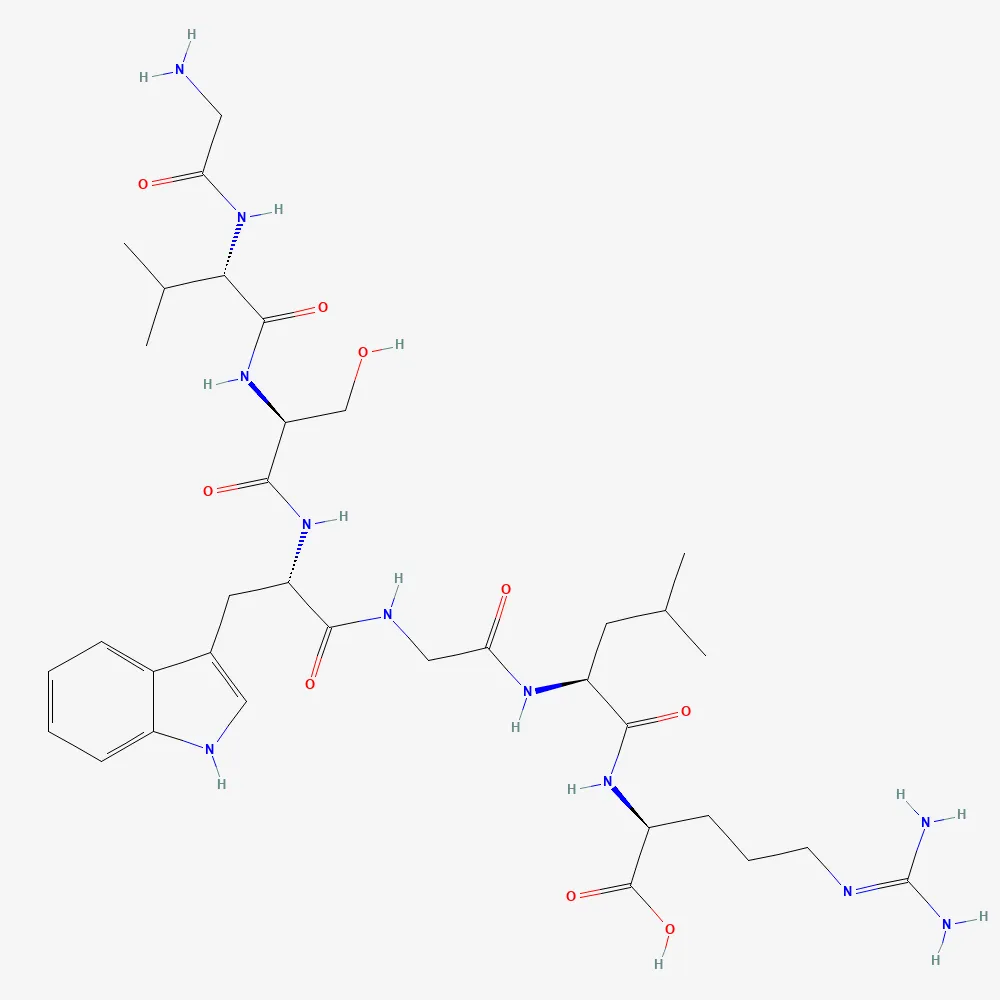
- Molecular formula
- C35H55N11O9
- Molecular weight
- 773.9 g/mol
- Length
- 7 amino acids
- Sequence
- GVSWGLR
- PubChem CID
- 165437303
Identity checked against Frontiers in Pharmacology (Djillani et al. 2017), via PubMed.
How PE-22-28 works
Both spadin and PE-22-28 block the TREK-1 potassium channel Djillani 2017 - Djillani A, Pietri M, Moreno S et al. Shortened Spadin Analogs Display Better TREK-1 Inhibition, In Vivo Stability and Antidepressant Activity. Front Pharmacol. 2017;8:643., in the references below, which the same group has studied since it found spadin. Researchers link blocking TREK-1 to antidepressant-like effects that appear faster in mice than with standard antidepressants.
In tests on cells engineered to carry human TREK-1, PE-22-28 blocked the channel at an IC50 of 0.12 nM, against 40-60 nM for spadin. That makes it roughly 300-500 times more potent in that test. Its effect lasted up to 23 hours, against spadin’s 7.
PE-22-28 benefits: what the research shows
In mice, PE-22-28 and close variants worked after just 4 days of treatment Djillani 2017 - Djillani A, Pietri M, Moreno S et al. Shortened Spadin Analogs Display Better TREK-1 Inhibition, In Vivo Stability and Antidepressant Activity. Front Pharmacol. 2017;8:643., in the references below:
- Mice spent less time immobile in the forced swim test, a standard rodent screen for antidepressant-like effects.
- They started eating sooner in a new environment (the novelty-suppressed feeding test).
- Mouse brain cells showed more signs of new neurons and new connections (PSD-95, a protein at nerve junctions).
PE-22-28 dosage
No published trial has given PE-22-28 to a person. Research-market pages that quote a “human range” are extrapolating from mouse doses, and they disagree on how to do that. Full sourcing: PE-22-28 dosage.
PE-22-28 side effects
There are no human safety data at all. In the mouse study, treated animals showed no reported toxicity at the doses tested. A related spadin study found that 3 weeks of treatment didn’t affect blood pressure, pulse or heart function in rodents. That is short-term tolerability in another species, not human safety.
Is PE-22-28 legal?
US legal status - Unapproved drug
Not FDA-approved for anything and not a dietary supplement. No human trial has been registered, so no regulator has reviewed it for human use. Sold online as a research chemical, "not for human consumption."
- No FDA approval, and no public path toward one. No human trial has been registered.
- Not a dietary supplement. It is sold outside the FDA-regulated supply chain, so no regulator checks that a vial matches its label or how pure it is.
- Vendors disclaim human use. Their pages label it “for research and laboratory use only, not for human consumption,” while also describing it to buyers as a depression treatment.
Regulatory changes for this compound and others, as they happen: US peptide regulation tracker.
Related reading
- Semax - a Russian nootropic peptide with a longer, but still limited, human evidence base
- Selank - Semax’s anxiolytic counterpart, same research tradition
- Delta sleep-inducing peptide (DSIP) - another sleep/mood-adjacent research peptide with thin human data
- Research peptides and the law
- Are peptides safe?
How PE-22-28 compares
Brain, mood and sleep. Doses for unapproved compounds are common practice, not trial-established. All brain, mood and sleep peptides →
| Compound | Main use | Evidence | Usual dose | US status |
|---|---|---|---|---|
| Semax | Sold as a nootropic for focus, memory and mood. Used clinically within Russian medicine. | Limited human data | 100-600 mcg, once daily for a fixed telehealth-prescribed protocol, up to twice daily in a wider clinic-published range | Research use only |
| Selank | Sold as a nootropic for focus, memory and mood. Used clinically within Russian medicine. | Limited human data | 250-900 mcg, 1-3 times daily, spaced through waking hours; the published Russian GAD clinical-trial protocol used a fixed 3 times daily schedule (900 mcg per dose, 2.7 mg/day total) for a 14-day course | Research use only |
| Adamax | Sold as a nootropic, marketed as a longer-acting, more potent successor to Semax, aimed at the same cognitive-enhancement buyers. | No meaningful evidence | No consistent protocol | Unapproved drug |
| Cerebrolysin | A prescription drug in Russia, China, several Eastern European and other markets for acute ischaemic stroke, traumatic brain injury and vascular dementia. Also sold outside those markets, including to US buyers, as an unregulated "research" or grey-market vial for self-injection, which is not how it is used where it is actually approved. | Limited human data | No consistent protocol | Unapproved drug |
| PE-22-28 | Studied only in mice as a candidate fast-acting antidepressant. Never tested in a single published human trial, and sold to consumers as an unregulated research-chemical mood/depression product. | Animal / lab only | No consistent protocol | Unapproved drug |
| Dihexa | Sold online as a research chemical for cognition and memory. FDA has not identified any human exposure data on drug products containing dihexa acetate by any route. | Animal / lab only | 10-100 mg, 1 to 3 times a week, not daily; sources describe starting around 10-20 mg and titrating up to 50-100 mg as tolerated | Research use only |
| DSIP | Sold for sleep. Named in the 1970s after a proposed role in promoting delta-wave sleep. | Limited human data | 100-500 mcg, once nightly, 30-60 minutes before intended sleep onset; anywhere from 5-14 nights a month to nightly use depending on the protocol | Research use only |
Where to buy PE-22-28 for research
Each vendor is checked against my vendor checklist.
1.Next Level PharmFeatured
10 mg vial
- No FDA warning letter found
- Names its testing lab
- Batch COAs published
- Takes card payment
2.BioEdge Research Labs
10 mg vial
- No FDA warning letter found
- Names its testing lab
- Batch COAs published
Common questions
What is the usual PE-22-28 dose?
There is none, because no published trial has dosed a person with PE-22-28. Pages that quote a human figure are extrapolating from mouse studies. The dosing page has the sources and explains why I report no common protocol.
What are the side effects of PE-22-28?
None are documented, because it has never been studied in people. The one mouse study reported no toxicity at the doses tested, and a related spadin study found no effect on blood pressure, pulse or heart function over three weeks in rodents. Human safety has never been assessed.
What are the differences between PE-22-28 and Selank?
Both are seven amino acids long, but they come from different research traditions. PE-22-28 is a spadin analogue that blocks the TREK-1 potassium channel; I found published work on it only in cells and mice. Selank is derived from tuftsin, was developed in Russia as an anxiolytic and is used clinically there, with a small Russian-language trial literature. Neither is approved in the US. See [Selank](/selank/).
References (1 sources)
Bibliographic detail is fetched from PubMed, not written by me - so a citation here cannot drift from the paper it names. Study design comes from PubMed's own tags rather than my judgement.