Selank: Benefits, Dosage, Side Effects and the Research
Selank, the Russian anxiolytic peptide: what the two controlled trials found, the common intranasal dose, reported side effects, and US legal status.

The short version
Selank is a synthetic peptide derived from tuftsin, developed in Russia as an anti-anxiety drug and used there clinically. Elsewhere it is sold as a research chemical for anxiety and focus. Its human evidence is real but narrow: 2 controlled trials in Russian-language journals, about a decade old, not independently replicated.
- Of 135 Selank records on PubMed, 33 are Russian-language and six are tagged as clinical trials.
- Two controlled human trials exist, comparing Selank against the anti-anxiety drugs medazepam and phenazepam.
- The 2008 trial used 900 mcg per dose, 3 times a day, for 14 days; the 2015 trial's available abstract gives no dose.
- Animal studies report doses around 0.1-1 mg/kg in rats, not a human dose.
- Not approved for human use in the US and sold through research-chemical channels.
Selank at a glance
- What it is
- Tuftsin-derived heptapeptide
- Main use
- Sold as a nootropic for focus, memory and mood. Used clinically within Russian medicine.
- Also called
- N-acetyl selank, Tuftsin analogue
- Molecular formula
- C33H57N11O9 (751.9 g/mol) Structure
- Evidence
- Limited human data
- US status
- Research use only
- Half-life
- Not established in humans
- How it is taken
- Nasal spray or drops
- Common protocol
- 250-900 mcg, 1-3 times daily, spaced through waking hours; the published Russian GAD clinical-trial protocol used a fixed 3 times daily schedule (900 mcg per dose, 2.7 mg/day total) for a 14-day course, for 2-8 weeks (common practice, not trial-established) Dosing page
Dosing: what the two human trials do (and don’t) establish. Semax, its usual pairing, now has its own page; the two compared side by side: Semax vs Selank. Regulatory changes for this compound and others, as they happen: US peptide regulation tracker.
Selank is one of the few research peptides with controlled human trials behind it. In two Russian trials it worked about as well as an established anti-anxiety drug and made a benzodiazepine easier to tolerate. That is why people are curious about it as a nootropic for anxiety and focus.
It is also true that the research is mostly older Russian studies. The details below matter more than either summary.
What is Selank?
Selank is a short synthetic peptide derived from tuftsin. It was developed in Russia and is used there as an anti-anxiety drug. Elsewhere it is sold as a research chemical and marketed as a nootropic for anxiety, focus and mood.
Selank structure
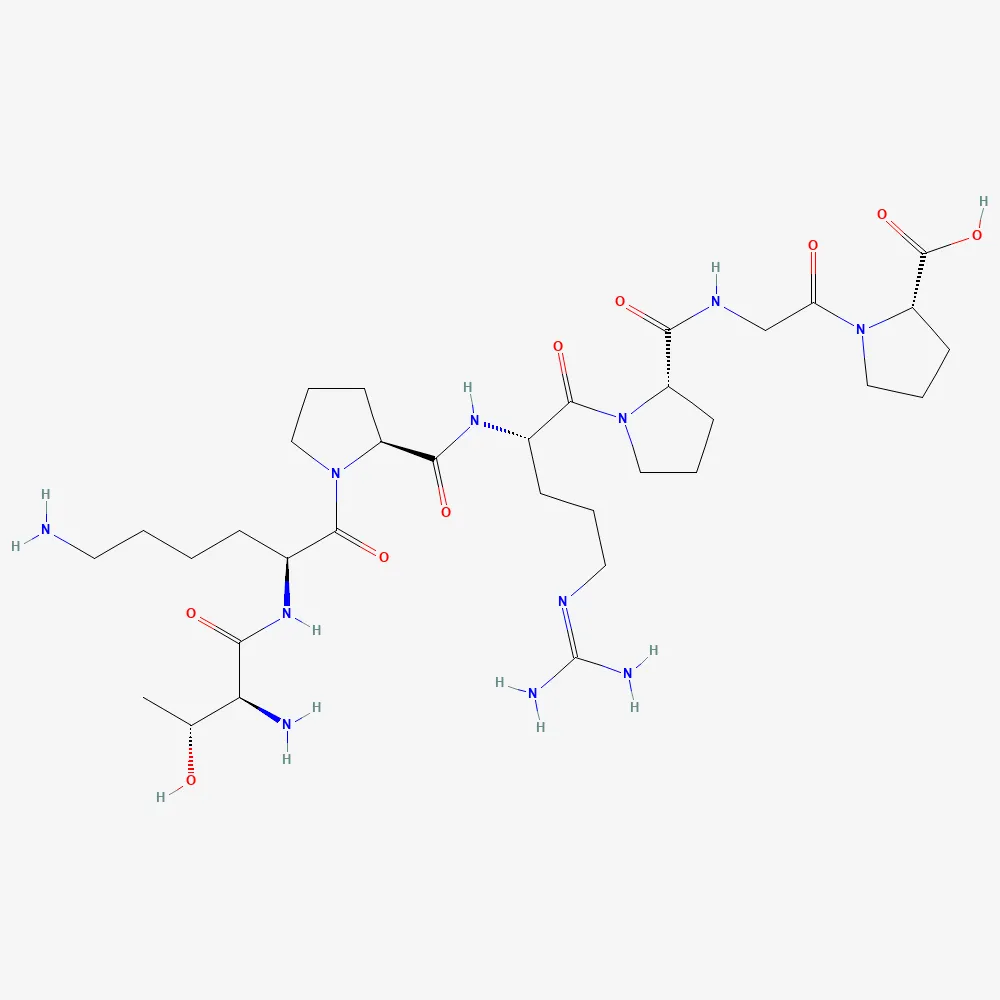
- Molecular formula
- C33H57N11O9
- Molecular weight
- 751.9 g/mol
- Length
- 7 amino acids
- Sequence
- TKPRPGP
- Modifications
- Free N- and C-termini; all L-amino acids. The tuftsin sequence (TKPR) extended with Pro-Gly-Pro.
- PubChem CID
- 11765600
This is Selank itself. 'N-acetyl selank', listed as an alternative name, is a different molecule with an acetylated N-terminus.
Identity checked against FDA Global Substance Registration System (UNII TS9JR8EP1G).
Selank benefits: what the research shows
The literature, counted
Of the 3 records tagged as randomised, one is a paper on muscle strength and growth that seems to be a search false positive. The other 2 are the controlled human trials below.
The two human trials
Both trials appeared in the same Russian-language neurology journal, about a decade apart. Both compared Selank with an established anti-anxiety drug rather than with a placebo alone.
- 2008. 62 patients with generalised anxiety disorder or neurasthenia, given Selank or the anti-anxiety drug medazepam Zozulia 2008 - Zozulia AA, Neznamov GG, Siuniakov TS et al. [Efficacy and possible mechanisms of action of a new peptide anxiolytic selank in the therapy of generalized anxiety disorders and neurasthenia]. Zh Nevrol Psikhiatr Im S S Korsakova. 2008;108(4):38-48., in the references below. The 2 drugs had similar anti-anxiety effects, and Selank also reduced fatigue (an antiasthenic effect) and had a stimulating effect. This trial states a dose: a 0.15% nasal solution at 2.7 mg/day (36 drops), split into 3 daily doses of 900 mcg, for 14 days.
- 2015. 70 patients with anxiety-spectrum disorders: 40 given Selank plus the anti-anxiety drug phenazepam, and 30 given phenazepam alone Medvedev 2015 - Medvedev VE, Tereshchenko ON, Kost NV et al. [Optimization of the treatment of anxiety disorders with selank]. Zh Nevrol Psikhiatr Im S S Korsakova. 2015;115(6):33-40., in the references below. Adding Selank made phenazepam work sooner, reduced its side effects and improved quality of life. The English abstract on PubMed gives no milligram dose or drop schedule.
What the animal studies show instead
The other dosing evidence with a number I can verify comes from rat studies using injection into the abdomen (intraperitoneal injection):
| Study | Species | Dose | Model |
|---|---|---|---|
| Kolik 2014 Kolik 2014 - Kolik LG, Nadorova AV, Kozlovskaya MM. Efficacy of peptide anxiolytic selank during modeling of withdrawal syndrome in rats with stable alcoholic motivation. Bull Exp Biol Med. 2014;157(1):52-5., in the references below | Outbred rats, alcohol-preferring | 0.3 mg/kg, single dose | Alcohol-withdrawal syndrome |
| Fomenko 2017 Fomenko 2017 - Fomenko EV, Bobyntsev II, Kryukov AA et al. Effect of Selank on Functional State of Rat Hepatocytes under Conditions of Restraint Stress. Bull Exp Biol Med. 2017;163(4):415-418., in the references below | Male Wistar rats | 100, 300 or 1000 mcg/kg | Restraint stress, hepatocyte function |
What this means
The studies are not worthless. Non-English research is research, and Selank came out of a serious programme and is used in clinical practice.
But the 2 controlled trials sit inside one research tradition and are about a decade old. Nobody has independently replicated them in the literature that most readers, clinicians and regulators can access and judge.
Selank dosage
One published human trial states a dose. The 2008 trial in anxiety and neurasthenia used 900 mcg per dose, 3 times a day (2.7 mg/day in total), for 14 days.
Outside that trial, research-community sources describe common practice rather than one agreed dose:
- 250-900 mcg per nasal spray
- 1-3 times a day, spaced through waking hours
- courses of 2-8 weeks, then a 2-4 week break.
Full sourcing, and why the rat doses (0.1-1 mg/kg) don’t convert to a human number: Selank dosage.
Selank side effects
There is no FDA label and no published safety trial for the injectable or nasal research product. What exists is what the 2 trials say in passing, plus reports from outside the clinical literature.
Reported in studies
Neither trial reports side effects for Selank itself. The 2015 trial found that adding Selank reduced the side effects phenazepam caused on its own: poorer attention and memory, sedation, longer sleep, sexual problems and emotional flatness Medvedev 2015 - Medvedev VE, Tereshchenko ON, Kost NV et al. [Optimization of the treatment of anxiety disorders with selank]. Zh Nevrol Psikhiatr Im S S Korsakova. 2015;115(6):33-40., in the references below. That shows Selank softening another drug’s effects, not a safety finding about Selank alone.
Reported by users
I couldn’t find an independent survey, case report or reputable reporting on what users experience. The effects that circulate (nasal irritation, mild headache, lightheadedness and drowsiness) come from sellers’ and clinics’ own pages. I note them without treating them as evidence.
Selank is usually taken as a nasal spray rather than injected, so the nasal irritation comes from that route. Outside Russia it is sold as a research chemical, and no regulator checks that a vial matches its label.
There is no label or trial threshold for when to seek care. A severe or lasting reaction is a reason to see a doctor whatever the cause. See dosing for what the trials and animal studies used.
Is Selank legal?
US legal status - Research use only
Sold for laboratory research use only. Not approved by the FDA for human use, and cannot be lawfully marketed as a supplement or a medicine. Products sold this way are not made to pharmaceutical quality standards, and their contents are not verified by anyone.
Selank is not approved for human use in the US and is sold through research-chemical channels, where no regulator checks that a vial matches its label. It is used clinically in Russia, which is why vendors sometimes call it an approved medicine. That is true there, not where it is usually bought.
Related
- N-acetyl Semax and Selank amidate
- Selank dosage: what the human and animal studies show
- Semax: its own page
- Semax vs Selank, side by side
- Semax and Selank: the shared guide this page was split from
- US peptide regulation tracker
How Selank compares
Brain, mood and sleep. Doses for unapproved compounds are common practice, not trial-established. All brain, mood and sleep peptides →
| Compound | Main use | Evidence | Usual dose | US status |
|---|---|---|---|---|
| Semax | Sold as a nootropic for focus, memory and mood. Used clinically within Russian medicine. | Limited human data | 100-600 mcg, once daily for a fixed telehealth-prescribed protocol, up to twice daily in a wider clinic-published range | Research use only |
| Selank | Sold as a nootropic for focus, memory and mood. Used clinically within Russian medicine. | Limited human data | 250-900 mcg, 1-3 times daily, spaced through waking hours; the published Russian GAD clinical-trial protocol used a fixed 3 times daily schedule (900 mcg per dose, 2.7 mg/day total) for a 14-day course | Research use only |
| Adamax | Sold as a nootropic, marketed as a longer-acting, more potent successor to Semax, aimed at the same cognitive-enhancement buyers. | No meaningful evidence | No consistent protocol | Unapproved drug |
| Cerebrolysin | A prescription drug in Russia, China, several Eastern European and other markets for acute ischaemic stroke, traumatic brain injury and vascular dementia. Also sold outside those markets, including to US buyers, as an unregulated "research" or grey-market vial for self-injection, which is not how it is used where it is actually approved. | Limited human data | No consistent protocol | Unapproved drug |
| PE-22-28 | Studied only in mice as a candidate fast-acting antidepressant. Never tested in a single published human trial, and sold to consumers as an unregulated research-chemical mood/depression product. | Animal / lab only | No consistent protocol | Unapproved drug |
| Dihexa | Sold online as a research chemical for cognition and memory. FDA has not identified any human exposure data on drug products containing dihexa acetate by any route. | Animal / lab only | 10-100 mg, 1 to 3 times a week, not daily; sources describe starting around 10-20 mg and titrating up to 50-100 mg as tolerated | Research use only |
| DSIP | Sold for sleep. Named in the 1970s after a proposed role in promoting delta-wave sleep. | Limited human data | 100-500 mcg, once nightly, 30-60 minutes before intended sleep onset; anywhere from 5-14 nights a month to nightly use depending on the protocol | Research use only |
Where to buy Selank for research
Each vendor is checked against my vendor checklist.
1.Next Level PharmFeatured
10 mg vial
- No FDA warning letter found
- Names its testing lab
- Batch COAs published
- Takes card payment
2.BioEdge Research Labs
N-acetyl Selank amidate 10 mg vial
- No FDA warning letter found
- Names its testing lab
- Batch COAs published
Common questions
Is there real research on Selank?
Yes, though it is narrower than its promoters or critics suggest. There are 2 controlled human trials, both in a Russian-language neurology journal, comparing Selank with established anti-anxiety drugs. Neither has been independently replicated in the literature most readers can access.
Does Selank work for anxiety?
That is what it is studied and used for in Russia. Two controlled trials compared it with medazepam and phenazepam in patients with anxiety-spectrum disorders and found it comparable or helpful. What is missing is independent replication outside that one research tradition.
What dose of Selank do studies use?
One does. The 2008 trial (62 patients with generalised anxiety disorder or neurasthenia, Selank against medazepam) used a 0.15% nasal solution at 2.7 mg/day (36 drops), split into 3 doses of 900 mcg, for 14 days. The 2015 trial's English abstract gives no dose. Rat studies used roughly 0.1 to 1 mg/kg by injection, which is not a human dose and has no published conversion.
What are the side effects of Selank?
Neither controlled trial reports side effects for Selank on its own; the 2015 trial found that adding it to phenazepam reduced that drug's side effects. Outside the trials, nasal irritation, mild headache, dizziness and fatigue are commonly reported. Those are user reports, not clinical findings, and there is no FDA label or safety trial to give a rate.
What is the usual Selank dose?
The 2008 trial in anxiety and neurasthenia used 900 mcg per dose, 3 times a day (2.7 mg/day), for 14 days. Outside that trial, research-community sources describe 250-900 mcg per nasal spray, 1-3 times a day, in courses of 2-8 weeks with a 2-4 week break. That is common practice, not an agreed dose. The dosing page has the sourcing and the animal doses.
References (4 sources)
Bibliographic detail is fetched from PubMed, not written by me - so a citation here cannot drift from the paper it names. Study design comes from PubMed's own tags rather than my judgement.
- 1.Zozulia AA, Neznamov GG, Siuniakov TS et al. [Efficacy and possible mechanisms of action of a new peptide anxiolytic selank in the therapy of generalized anxiety disorders and neurasthenia]. Zh Nevrol Psikhiatr Im S S Korsakova. 2008;108(4):38-48.Randomised trialPMID 18454096
- 2.Medvedev VE, Tereshchenko ON, Kost NV et al. [Optimization of the treatment of anxiety disorders with selank]. Zh Nevrol Psikhiatr Im S S Korsakova. 2015;115(6):33-40.Randomised trialPMID 26356395
- 3.Kolik LG, Nadorova AV, Kozlovskaya MM. Efficacy of peptide anxiolytic selank during modeling of withdrawal syndrome in rats with stable alcoholic motivation. Bull Exp Biol Med. 2014;157(1):52-5.StudyPMID 24913576
- 4.Fomenko EV, Bobyntsev II, Kryukov AA et al. Effect of Selank on Functional State of Rat Hepatocytes under Conditions of Restraint Stress. Bull Exp Biol Med. 2017;163(4):415-418.StudyPMID 28853100