HGH Fragment 176-191: Dosage, Side Effects and AOD-9604 Compared
HGH Fragment 176-191 explained: how it differs from AOD-9604, the mostly-animal research behind it, common dosing, side effects and legal status.

The short version
HGH Fragment 176-191 is a lab-made piece of human growth hormone, sold as a research-chemical fat-loss product. It is closely related to AOD-9604 but differs by one amino acid, which most sellers don't explain. No published human trial has tested this exact sequence. There is a 1978 rat study and a 2022 cell study, and neither shows the fat loss it is marketed for.
- It is the native 176-191 sequence of hGH; AOD-9604 is 177-191 plus an added tyrosine, a small but real difference many sellers ignore.
- No human trial of this exact sequence exists; the only related human trial tested AOD-9604, a different molecule.
- The one directly relevant animal study, from 1978, found that it raised blood sugar and insulin, not that it caused fat loss.
- It is not FDA-approved and does not appear by name on FDA's compounding safety-risk list; AOD-9604 does.
HGH Fragment 176-191 at a glance
- What it is
- Synthetic 16-amino-acid peptide, the unmodified 176-191 C-terminal sequence of human growth hormone
- Main use
- Sold to consumers as a research-chemical fat-loss product, marketed on the claim that this slice of growth hormone carries its fat-metabolising activity without the growth-promoting or blood-sugar effects of the whole hormone. Never developed into an approved drug under this exact sequence.
- Also called
- Fragment 176-191, Frag 176-191, HGH Frag, hGH 176-191
- Molecular formula
- C78H123N23O22S2 (1799.1 g/mol) Structure
- Evidence
- Animal / lab only
- US status
- Unapproved drug
- Half-life
- Not established in humans
- How it is taken
- Subcutaneous injection
- Common protocol
- 200-500 mcg, once or twice daily, fasted, for 4-12 weeks (common practice, not trial-established) Dosage chart
HGH Fragment 176-191 is a synthetic 16-amino-acid peptide taken from the tail end of human growth hormone, sold as a research-chemical fat-loss product. It is closely related to AOD-9604, and many sellers treat the two as interchangeable, but they are different molecules. This page covers how they differ and what the mostly animal research on this exact sequence shows.
Dosing: the common protocol and what has actually been studied.
Studied in cells or animals. No controlled trials in humans. I could not find any published human trial of the unmodified 176-191 sequence. There is a 1978 rat study of this and related hGH fragments, and a 2022 cell study pairing it with a cancer drug. Neither tests the fat loss it is marketed for in people.
What is HGH Fragment 176-191?
HGH Fragment 176-191 is amino acids 176-191 from the tail (C-terminal) end of human growth hormone, with nothing added or removed. Researchers first made and tested this and several neighbouring tail fragments in the 1970s, and reported that some kept part of the hormone’s metabolic activity in rats Ng 1978 - Ng FM, Bornstein J. Hyperglycemic action of synthetic C-terminal fragments of human growth hormone. Am J Physiol. 1978;234(5):E521-6., in the references below.
The sales pitch is that this piece carries the hormone’s fat-burning signal without its growth or blood-sugar effects. That claim is borrowed from a related peptide, AOD-9604. Nobody has shown it for this sequence.
HGH Fragment 176-191 structure
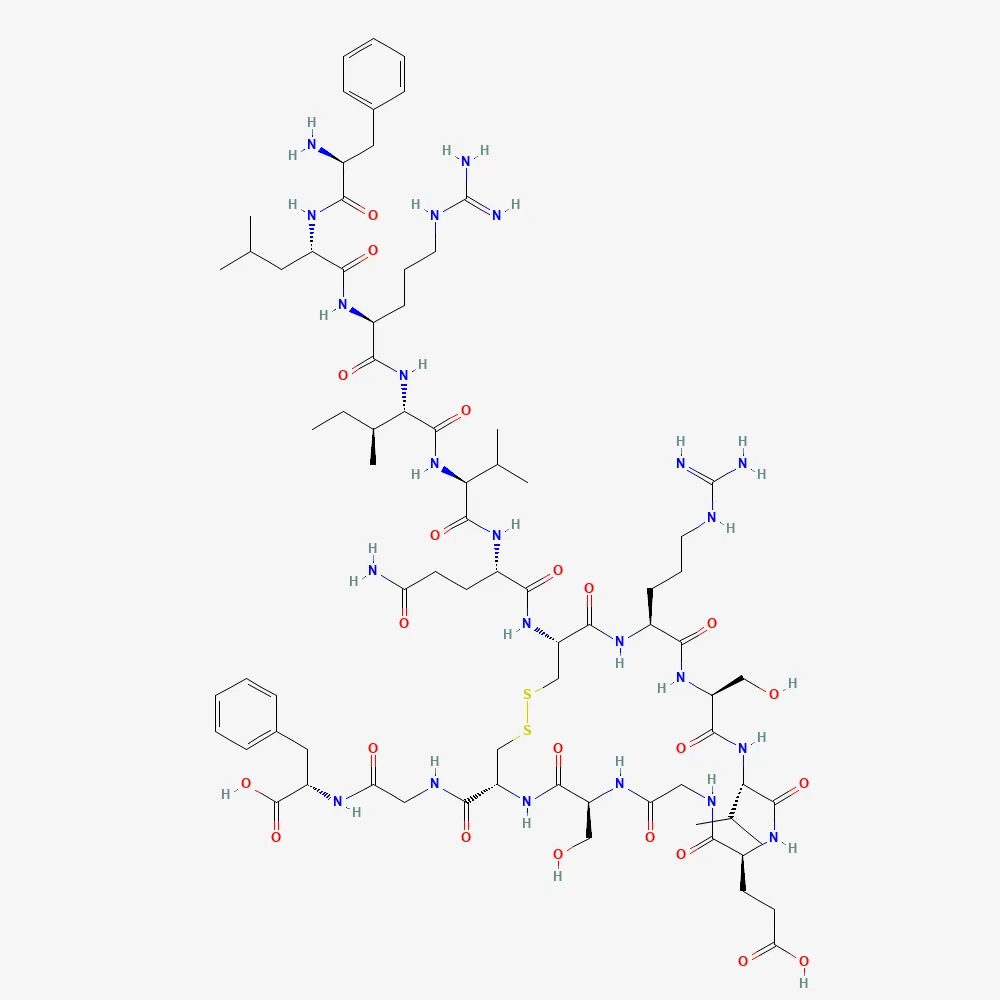
- Molecular formula
- C78H123N23O22S2
- Molecular weight
- 1799.1 g/mol
- Length
- 16 amino acids
- Sequence
- FLRIVQCRSVEGSCGF
- Modifications
- Human growth hormone residues 176-191; disulfide between the two Cys (as in growth hormone).
- PubChem CID
- 172966177
PubChem's record has no common name, only a systematic name. It is drawn with the disulfide found in growth hormone; whether a given vial is in the disulfide form is not verifiable.
Identity checked against UniProt (P01241, human growth hormone).
HGH Fragment 176-191 vs AOD-9604: the one-residue difference that matters
The two names are often used for the same vial. They describe different molecules.
| HGH Fragment 176-191 | AOD-9604 | |
|---|---|---|
| Sequence | Native hGH amino acids 176-191, unmodified | hGH amino acids 177-191, with an added tyrosine at the N-terminal end |
| Length | 16 amino acids | 16 amino acids |
| Human trial | None located | Company-run Phase IIb obesity trial; did not meet its primary endpoint |
| On FDA’s compounding safety-risk list | Not by this name | Yes - “nominated but withdrawn” table |
AOD-9604 drops native residue 176 and puts a synthetic tyrosine in front of the 177-191 stretch. HGH Fragment 176-191 keeps residue 176 and adds nothing. Because of that swap, AOD-9604’s clinical and regulatory history, covered on its own page, doesn’t automatically apply to what is sold as “Fragment 176-191.”
HGH Fragment 176-191 research: what the studies show
Almost everything published on this exact sequence is animal or lab work, and there is little of it.
The 1978 origin study. Researchers made six tail fragments of hGH, including 176-191, and tested them in normal rats Ng 1978 - Ng FM, Bornstein J. Hyperglycemic action of synthetic C-terminal fragments of human growth hormone. Am J Physiol. 1978;234(5):E521-6., in the references below:
- Four of the six, including 176-191, caused a short rise in blood sugar and a longer rise in insulin. The other two did nothing in the same tests.
- A single dose of 5 nanomoles per kilogram of the fragments containing the 178-191 sequence, which includes 176-191, significantly reduced insulin sensitivity in an insulin-tolerance test.
So this fragment raised blood sugar and insulin. That is the opposite direction from a fat-loss benefit, and unlike the insulin-neutral profile later reported for AOD-9604.
A 2022 cell study, unrelated to fat loss. Researchers combined hGH fragment 176-191 with a chemotherapy drug loaded into nanoparticles and tested it on breast cancer cells in the lab, using computer docking models and a cell-survival test Habibullah 2022 - Habibullah MM, Mohan S, Syed NK et al. Human Growth Hormone Fragment 176-191 Peptide Enhances the Toxicity of Doxorubicin-Loaded Chitosan Nanoparticles Against MCF-7 Breast Cancer Cells. Drug Des Devel Ther. 2022;16:1963-1974., in the references below. The combination killed more cancer cells than the chemotherapy drug alone. It is recent, peer-reviewed work on the exact sequence, but it was in cells and says nothing about weight loss.
HGH Fragment 176-191 dosage
The common HGH Fragment 176-191 dose is 200-500 mcg, once or twice daily, fasted. From a 5 mg vial mixed with 2 mL of bacteriostatic water, 350 mcg is 14 units (0.14 mL) on a U-100 insulin syringe.
Research-chemical dosing guides most often describe 200-500 mcg injected under the skin once or twice daily, fasted, in cycles of roughly 4-12 weeks. That is common practice compiled from those guides, not a dose any trial or regulator has set. Full sourcing: HGH Fragment 176-191 dosage.
HGH Fragment 176-191 side effects
There is no published human side-effect profile for this sequence. The only controlled data is the 1978 rat study above: a short rise in blood sugar, a longer rise in insulin, and lower insulin sensitivity at the dose tested Ng 1978 - Ng FM, Bornstein J. Hyperglycemic action of synthetic C-terminal fragments of human growth hormone. Am J Physiol. 1978;234(5):E521-6., in the references below.
No FDA safety review exists for HGH Fragment 176-191 by this name. The comparison table above shows what FDA says about the related AOD-9604.
For injection technique and site problems, see injection site reactions.
Is HGH Fragment 176-191 legal?
US legal status - Unapproved drug
Not FDA-approved for anything, and not a dietary supplement. "HGH Fragment 176-191" does not appear by that name on the FDA bulk drug substances compounding safety-risk page. The related AOD-9604 does appear there, in the "nominated but withdrawn" table, with its own immune-reaction and adverse-event concerns. That listing does not extend to this separate, unmodified fragment.
HGH Fragment 176-191 vs AOD-9604 vs full HGH
All three come from the same 191-amino-acid hormone, but they are not interchangeable:
- Full-length human growth hormone is FDA-approved only for specific diagnosed conditions, by prescription. It has the growth and blood-sugar effects the fragments are marketed as avoiding.
- AOD-9604 is a modified slice of the tail: amino acids 177-191 plus an added tyrosine. It reached a human obesity trial and did not meet its goal.
- HGH Fragment 176-191 is the unmodified 176-191 slice, with no human trial found.
None of the three has an approved use for fat loss.
Related
- AOD-9604: the closely related fragment, its obesity trials and FDA’s safety concerns
- Tesofensine: a shelved neuro drug repositioned for obesity
- 5-Amino-1MQ: a small molecule sold as a metabolic peptide
- Are peptides safe?
- Peptide vendor checklist: what to check before buying a research chemical
Regulatory changes for this compound and others, as they happen: US peptide regulation tracker.
How HGH Fragment 176-191 compares
Other fat-loss compounds. Doses for unapproved compounds are common practice, not trial-established. All weight loss and metabolism peptides →
| Compound | Main use | Evidence | Usual dose | US status |
|---|---|---|---|---|
| AOD-9604 | Originally developed as an anti-obesity drug candidate; its developer reported that its Phase IIb human obesity trial did not succeed, and development for that indication was discontinued. Now sold to consumers as a research-chemical fat-loss product. | Limited human data | 250-500 mcg, once daily, fasted (some protocols run 5 days on, 2 days off) | Unapproved drug |
| HGH Fragment 176-191 | Sold to consumers as a research-chemical fat-loss product, marketed on the claim that this slice of growth hormone carries its fat-metabolising activity without the growth-promoting or blood-sugar effects of the whole hormone. Never developed into an approved drug under this exact sequence. | Animal / lab only | 200-500 mcg, once or twice daily, fasted | Unapproved drug |
| Adipotide | Developed at MD Anderson Cancer Center as a targeted anti-obesity drug candidate that induces apoptosis in the blood vessels feeding white fat. A first-in-human Phase 1 trial in men with prostate cancer and obesity was terminated early with no published results, and it is now sold to consumers as an unregulated research-chemical weight-loss product. | Animal / lab only | No consistent protocol | Unapproved drug |
| 5-Amino-1MQ | An NNMT-inhibiting research chemical marketed for fat loss and metabolic health. Every efficacy result I could locate comes from mouse studies; no published human trial exists. | Animal / lab only | 50-150 mg, once daily | Unapproved drug |
| Tesofensine | Originally developed for Parkinson's and Alzheimer's disease; weight loss observed as a side effect in those trials led to its repositioning as an obesity candidate. It has completed placebo-controlled obesity trials but remains unapproved everywhere, and is now also sold as a grey-market research chemical. | Limited human data | 0.25-1 mg, once daily, in the morning, titrated upward over several weeks | Unapproved drug |
Where to buy HGH Fragment 176-191 for research
Each vendor is checked against my vendor checklist.
1.Next Level PharmFeatured
5 mg vial
- No FDA warning letter found
- Names its testing lab
- Batch COAs published
- Takes card payment
Common questions
Is HGH Fragment 176-191 the same as AOD-9604?
No, though they are often sold as if they were. AOD-9604 is amino acids 177-191 of hGH with an added tyrosine at the front (N-terminal) end, in place of native residue 176. HGH Fragment 176-191 is the unmodified 176-191 sequence. Only AOD-9604 went into a human clinical trial.
Does HGH Fragment 176-191 work for fat loss?
No human evidence I could verify shows it. The one animal study of this sequence, from 1978, measured blood sugar and insulin, not fat loss, and found it raised blood sugar. A 2022 lab study paired it with a cancer drug in cells. The fat-loss claim rests on its resemblance to AOD-9604, whose own human obesity trial failed.
What is the usual HGH Fragment 176-191 dosage?
Research-chemical dosing guides most often describe 200-500 mcg injected under the skin once or twice daily, fasted, in cycles of roughly 4-12 weeks. That is common practice, not a dose any trial or regulator has set. The dosage page has the sources and cycle detail.
What are the side effects of HGH Fragment 176-191?
There is no published human side-effect profile. The only controlled data is a 1978 rat study: a short rise in blood sugar, a longer rise in insulin, and lower insulin sensitivity at the dose tested. That is a blood-sugar-raising effect in rats, not a safety profile. No FDA safety review exists for this compound by this name.
What is the difference between HGH Fragment 176-191, AOD-9604 and full HGH?
Full-length hGH is the whole 191-amino-acid hormone, FDA-approved only for specific diagnosed conditions, with growth and blood-sugar effects. HGH Fragment 176-191 is its last 16 amino acids, unmodified. AOD-9604 is amino acids 177-191 plus an added tyrosine, and is the only fragment that reached a human trial, which did not meet its goal.
Why do sellers use "AOD-9604" and "HGH Frag 176-191" as if they are the same product?
They differ by one native residue and an added tyrosine, come from the same region of the hormone, and marketing rarely separates them. Even a 2026 peer-reviewed review calls AOD9604 "hGH 176-191". They are still different molecules, and only AOD-9604 has human trial evidence.
Where can I buy HGH Fragment 176-191?
I don't name, rank or recommend sellers. There is no FDA-approved product and no prescription route. What is sold online is labelled "research use only", which means it is not intended for human use and FDA has not reviewed its safety or quality. If you are assessing a seller anyway, read my peptide vendor checklist first.
References (4 sources)
Bibliographic detail is fetched from PubMed, not written by me - so a citation here cannot drift from the paper it names. Study design comes from PubMed's own tags rather than my judgement.
- 1.Ng FM, Bornstein J. Hyperglycemic action of synthetic C-terminal fragments of human growth hormone. Am J Physiol. 1978;234(5):E521-6.StudyPMID 645904
- 2.Habibullah MM, Mohan S, Syed NK et al. Human Growth Hormone Fragment 176-191 Peptide Enhances the Toxicity of Doxorubicin-Loaded Chitosan Nanoparticles Against MCF-7 Breast Cancer Cells. Drug Des Devel Ther. 2022;16:1963-1974.StudyPMID 35783198full text
- 3.Dominikowski A, Rękoś Z, Olejarz M et al. The emerging landscape of performance-enhancing peptides modulating GH-IGF1 axis: bridging the gap between clinical evidence and patient self-administration. Front Endocrinol (Lausanne). 2026;17:1822475.ReviewPMID 42395176full text
- 4.FDA - Certain Bulk Drug Substances for Use in Compounding That May Present Significant Safety Risks. AOD-9604 entry quoted on this page; HGH Fragment 176-191 does not appear on the page by that name.- US Food and Drug Administrationregulatory