AOD-9604: Dosage, Side Effects and Legal Status
AOD-9604's developer reported its oral Phase IIb obesity trial missed its endpoint. The capsule and tablet trials, the common protocol, and FDA's concerns.

The short version
AOD-9604 is a lab-made fragment of human growth hormone, developed in the 1990s as an anti-obesity drug. Its developer and news reports say its larger human obesity trial did not show the fat loss it was designed to prove, and the company stopped development; the efficacy results were never published. It is not FDA-approved or a dietary supplement, and is now sold as a "research chemical" for the same fat-loss use.
- Company announcements and news reports say its Phase IIb obesity trial missed its primary endpoint; the results were never published and it is not on ClinicalTrials.gov.
- Development for obesity stopped after that result, and it was never approved.
- Safety data from six randomised trials (oral for up to 24 weeks, or single IV doses) showed side effects at placebo-like rates. None tested injection under the skin.
- FDA lists it among bulk substances not eligible for lawful compounding, and flags immunogenicity and impurity concerns.
- It is sold alongside GLP-1 lookalikes, with none of the trial record behind the approved GLP-1 drugs.
AOD-9604 at a glance
- What it is
- Synthetic 16-amino-acid fragment of human growth hormone
- Main use
- Originally developed as an anti-obesity drug candidate; its developer reported that its Phase IIb human obesity trial did not succeed, and development for that indication was discontinued. Now sold to consumers as a research-chemical fat-loss product.
- Also called
- Tyr-hGH Fragment 177-191, AOD9604, HGH Fragment 176-191
- Molecular formula
- C78H123N23O23S2 (1815.1 g/mol) Structure
- Evidence
- Limited human data
- US status
- Unapproved drug
- Half-life
- Not established in humans
- How it is taken
- Subcutaneous injection
- Common protocol
- 250-500 mcg, once daily, fasted (some protocols run 5 days on, 2 days off), for 8-24 weeks (common practice, not trial-established) Dosage chart
AOD-9604 is a synthetic fragment of human growth hormone, built on purpose to be an obesity drug. Unlike most “fat-loss peptides”, it has real human data. Six randomised, placebo-controlled trials produced a published safety record that looked much like placebo, and an early trial was reported as a success. The larger trial designed to confirm the fat-loss effect did not, by the developer’s own account.
Small or uncontrolled human studies. Too little to settle the question either way. The developer ran six randomised, placebo-controlled human trials, and their safety data were published in 2013, with side effects at placebo-like rates. Its announcements and news reports on the 2007 discontinuation say its Phase IIb obesity trial missed its primary endpoint. The efficacy results were never published in a journal and the trial is not on ClinicalTrials.gov, so the verdict rests on the company's own account, which argues against the effect AOD-9604 is marketed for.
What is AOD-9604?
The name is short for Anti-Obesity Drug, compound 9604. It is a 16-amino-acid peptide matching the tail end of human growth hormone (amino acids 177-191), with an extra tyrosine added at the front. It was developed at an Australian university in the early 1990s.
The idea was that this slice of growth hormone carries its fat-burning signal without the whole hormone’s effects on growth and insulin resistance. Cell and animal studies describe more fat breakdown (lipolysis) and less fat storage (lipogenesis), without much rise in IGF-1, the growth factor behind most of growth hormone’s tissue growth and risks. That is the proposed mechanism, not a shown effect in people, and AOD-9604’s own trials show why the difference matters.
AOD-9604 structure
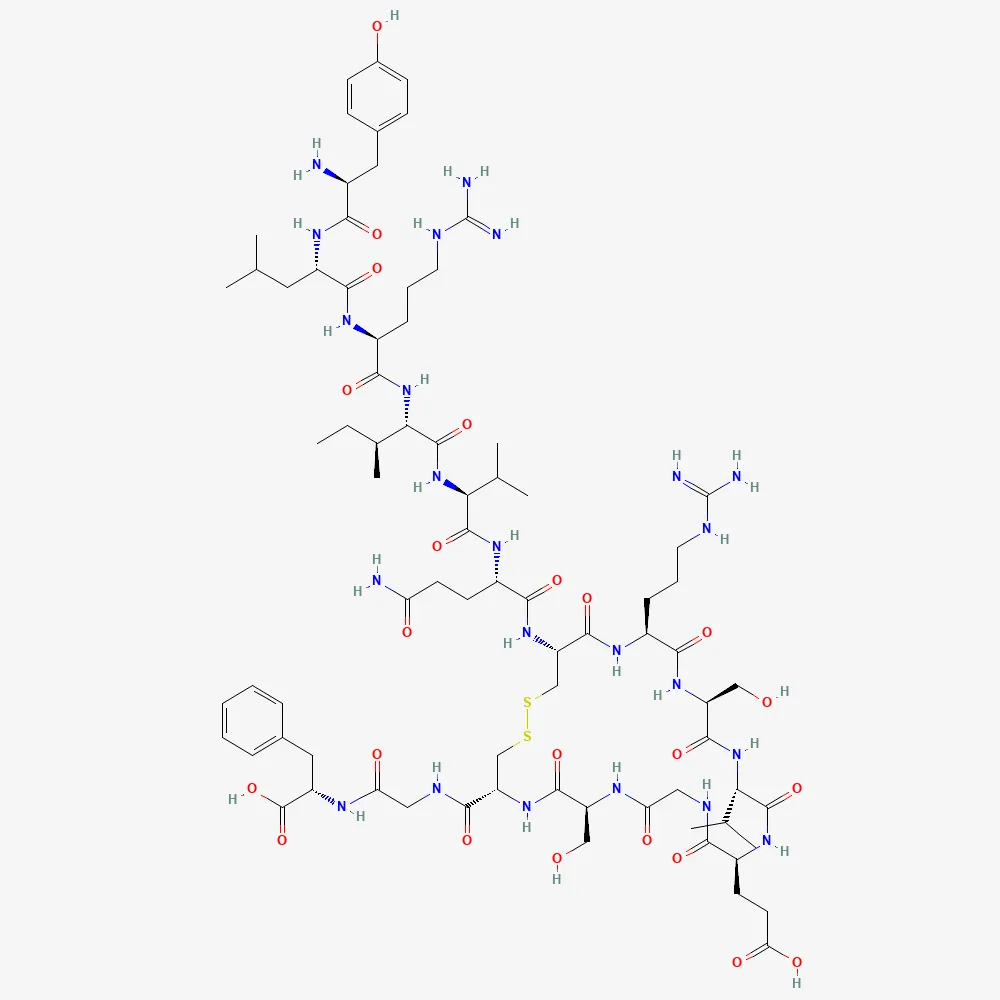
- Molecular formula
- C78H123N23O23S2
- Molecular weight
- 1815.1 g/mol
- Length
- 16 amino acids
- Sequence
- YLRIVQCRSVEGSCGF
- Modifications
- Human growth hormone residues 177-191 with an added N-terminal tyrosine; disulfide between the two Cys (as in growth hormone).
- PubChem CID
- 71300630
PubChem draws the Cys-Cys disulfide ring found in growth hormone.
Identity checked against Drug Testing and Analysis (2015), via PubMed.
AOD-9604 benefits: what the research shows
The early signal was encouraging. In December 2004 the developer, Metabolic Pharmaceuticals, announced a 12-week trial in 300 obese adults. The group taking 1 mg a day by mouth lost an average of 2.8 kg, against 0.8 kg on placebo (company announcement, as reported by News-Medical). I found no journal publication of those figures.
The company then ran a larger Phase IIb trial, described as randomised and placebo-controlled, to test whether AOD-9604 produced meaningful weight loss. Its announcements and news reports on the 2007 discontinuation say the trial did not meet its primary endpoint against placebo. Development for obesity stopped, and no regulator I could find has approved it since.
The efficacy results were never published. I found no peer-reviewed paper and no ClinicalTrials.gov entry. The one journal paper on the developer’s trials is a safety summary (covered under side effects), and it does not report weight loss.
What is sold today as a fat-loss “research peptide” is the same molecule. Its trial history - an encouraging early result, side effects at placebo-like rates, then a larger trial that did not confirm the effect - is the most relevant evidence a buyer has. It rarely appears on a vendor’s product page.
AOD-9604 dosage
The common AOD-9604 dose is 250-500 mcg, once daily, fasted (some protocols run 5 days on, 2 days off). From a 5 mg vial mixed with 2 mL of bacteriostatic water, 400 mcg is 16 units (0.16 mL) on a U-100 insulin syringe.
Clinic and community sources commonly describe 250-500 mcg injected under the skin once a day, fasted, for 8-24 weeks with a 4-8 week break. That is common practice, not a tested dose. The developer’s trials gave it only by mouth (0.25-54 mg a day) or as single intravenous doses, never by injection under the skin, and none established an effective dose. Full protocol and sourcing: AOD-9604 dosage.
Oral AOD-9604: the capsules and tablets in the trials
AOD-9604’s human trials mostly gave it by mouth. Four of its developer’s six trials used oral capsules or tablets, according to the safety summary by Stier, Vos and Kenley:
- Capsules, single doses: 9, 27 or 54 mg, in 17 men with obesity.
- Capsules, 7 days: 9, 27 or 54 mg a day, in 36 men with obesity.
- Capsules, 12 weeks: 1-30 mg a day, in 300 adults with obesity.
- Tablets, 24 weeks: 0.25, 0.5 or 1 mg a day, in 502 adults with obesity. This is the larger Phase IIb trial described above. A review reports that development stopped in 2007 because a 24-week trial of 536 people showed no significant weight loss Valentino 2010 - Valentino MA, Lin JE, Waldman SA. Central and peripheral molecular targets for antiobesity pharmacotherapy. Clin Pharmacol Ther. 2010;87(6):652-62., in the references below.
The other two trials gave single intravenous doses. In animals, obese rats given 500 mcg/kg a day by mouth for 19 days gained less than half as much weight as untreated rats Ng 2000 - Ng FM, Sun J, Sharma L et al. Metabolic studies of a synthetic lipolytic domain (AOD9604) of human growth hormone. Horm Res. 2000;53(6):274-8., in the references below.
None of the three vendors I check sells AOD-9604 as a capsule or tablet. As of 3 October 2026, Spartan Peptides, Next Level Pharm and BioEdge Research Labs listed it only as injectable vials. So the oral form has human trial data, while the vials they sell are used for injection under the skin, a route no trial tested.
What is not known: how much of an oral dose reaches the blood. The safety summary reports no blood levels of AOD-9604, and no study I found has compared oral and injected doses. Other compounds sold as pills are compared in oral peptides.
AOD-9604 side effects
The developer’s six randomised, double-blind, placebo-controlled trials covered about 900 adults, given AOD-9604 by mouth for up to 24 weeks or as single intravenous doses. Stier, Vos and Kenley published the safety data in 2013 in the Journal of Endocrinology and Metabolism (listed in this guide’s sources). They report:
- Side effects at rates similar to placebo, most often headache, diarrhoea and other gut symptoms, with more gut symptoms at the highest oral dose (54 mg).
- In one intravenous study, 5 of 23 men reported mild or moderate euphoria judged possibly related to AOD-9604.
- No change in IGF-1, no worsening of glucose tolerance, and no antibodies to AOD-9604 in the patients tested.
- No treatment-related withdrawals. Apart from one episode of diarrhoea after a single 54 mg dose, judged possibly related, no serious adverse event was attributed to the drug. Five cancers in the 12-week trial were judged unrelated by the investigator.
Two caveats. The developer funded all six trials and the authors disclose ties to it. And none of the trials used injection under the skin, the route in today’s protocols.
FDA adds a warning on its compounding safety-risk page. Compounded drugs containing AOD-9604 “may pose significant risk for immunogenicity for certain routes of administration and may have complexities with regard to peptide-related impurities and API characterization.” FDA says it has identified no, or only limited, safety-related information, and that “the agency lacks sufficient information to know whether the drug would cause harm when administered to humans.” It has also identified serious adverse events that may be associated with AOD-9604, “though causality is not clear.”
For injection technique and site problems, see injection site reactions.
Is AOD-9604 legal?
US legal status - Unapproved drug
Not FDA-approved for any use, and not a dietary supplement, although some marketing calls it one; I found no FDA source supporting that claim. FDA lists AOD-9604 in the "bulk drug substances nominated but withdrawn" table on its compounding safety-risk page. The nominator withdrew it in 2024, which takes it off that review track; it is not a safety clearance.
Why it belongs in the same conversation as the GLP-1 lookalikes
AOD-9604 is sold by the same research-chemical vendors and grey-market compounders as unapproved semaglutide and tirzepatide “lookalikes”, often as a fat-loss add-on. It has none of the trial record or FDA review behind the approved GLP-1 medicines. Its own record is mixed: side effects at placebo-like rates, but no confirmed fat loss.
AOD-9604 vs tesamorelin
Only one of these growth-hormone-derived peptides is approved. Tesamorelin, sold as Egrifta, is FDA-approved for reducing excess abdominal fat in HIV-infected adults with lipodystrophy, based on randomised controlled trials. AOD-9604 is approved for nothing, and its Phase IIb obesity trial, by its developer’s account, did not meet its endpoint. They are not substitutes: one has a narrow, FDA-reviewed use and the other has none.
Cost
There is no approved AOD-9604 product, so there is no regulated price. As of 3 October 2026, the three vendors I check listed a 5 mg vial at $30.99 (Next Level Pharm, which also sells 2 mg and 10 mg), $47 (BioEdge Research Labs) and $99 (Spartan Peptides).
A higher or lower price doesn’t tell you anything about purity, potency or safety. None of these sellers face the manufacturing and testing oversight an approved drug does.
Related
- HGH Fragment 176-191: how it differs from AOD-9604
- Semaglutide (Ozempic, Wegovy): the approved label, not the grey market
- 5-Amino-1MQ: a small molecule sold as a metabolic peptide
- Tesofensine: a shelved neuro drug repositioned for obesity
- Are peptides safe?
Regulatory changes for this compound and others, as they happen: US peptide regulation tracker.
How AOD-9604 compares
Other fat-loss compounds. Doses for unapproved compounds are common practice, not trial-established. All weight loss and metabolism peptides →
| Compound | Main use | Evidence | Usual dose | US status |
|---|---|---|---|---|
| AOD-9604 | Originally developed as an anti-obesity drug candidate; its developer reported that its Phase IIb human obesity trial did not succeed, and development for that indication was discontinued. Now sold to consumers as a research-chemical fat-loss product. | Limited human data | 250-500 mcg, once daily, fasted (some protocols run 5 days on, 2 days off) | Unapproved drug |
| HGH Fragment 176-191 | Sold to consumers as a research-chemical fat-loss product, marketed on the claim that this slice of growth hormone carries its fat-metabolising activity without the growth-promoting or blood-sugar effects of the whole hormone. Never developed into an approved drug under this exact sequence. | Animal / lab only | 200-500 mcg, once or twice daily, fasted | Unapproved drug |
| Adipotide | Developed at MD Anderson Cancer Center as a targeted anti-obesity drug candidate that induces apoptosis in the blood vessels feeding white fat. A first-in-human Phase 1 trial in men with prostate cancer and obesity was terminated early with no published results, and it is now sold to consumers as an unregulated research-chemical weight-loss product. | Animal / lab only | No consistent protocol | Unapproved drug |
| 5-Amino-1MQ | An NNMT-inhibiting research chemical marketed for fat loss and metabolic health. Every efficacy result I could locate comes from mouse studies; no published human trial exists. | Animal / lab only | 50-150 mg, once daily | Unapproved drug |
| Tesofensine | Originally developed for Parkinson's and Alzheimer's disease; weight loss observed as a side effect in those trials led to its repositioning as an obesity candidate. It has completed placebo-controlled obesity trials but remains unapproved everywhere, and is now also sold as a grey-market research chemical. | Limited human data | 0.25-1 mg, once daily, in the morning, titrated upward over several weeks | Unapproved drug |
Where to buy AOD-9604 for research
Each vendor is checked against my vendor checklist.
1.Next Level PharmFeatured
5 mg vial
- No FDA warning letter found
- Names its testing lab
- Batch COAs published
- Takes card payment
2.Spartan Peptides
5 mg vial
- No FDA warning letter found
- Names its testing lab
3.BioEdge Research Labs
5 mg vial
- No FDA warning letter found
- Names its testing lab
- Batch COAs published
Common questions
Did AOD-9604 work in human trials?
Not in the trial that mattered most. In 2004 the developer announced a 12-week result: 2.8 kg average weight loss on 1 mg a day against 0.8 kg on placebo. Its larger Phase IIb trial, by the company's account and news reports on the 2007 discontinuation, missed its primary endpoint, and development stopped. Those efficacy results were never published, so they can't be checked.
Is AOD-9604 FDA-approved?
No, never for any use. FDA lists it in the "bulk drug substances nominated but withdrawn" table on its compounding safety-risk page. The nominator withdrew it in 2024, which takes it off that review track; it does not mean FDA cleared it as safe or effective.
Is AOD-9604 safe?
That isn't established. The developer-funded summary of its six trials (Stier, Vos and Kenley, 2013) found side effects at placebo-like rates, but only for oral dosing up to 24 weeks or single intravenous doses, not injection under the skin. FDA says compounded AOD-9604 may pose immunogenicity and impurity risks, that "the agency lacks sufficient information to know whether the drug would cause harm when administered to humans", and that it has seen serious adverse events that may be linked, "though causality is not clear."
Why is AOD-9604 still sold if its trial failed?
Because "research use only" is a legal label, not a verdict on the evidence. A vial sold with fat-loss dosing instructions is being sold for the use its larger trial did not confirm. That trial result rarely appears on product pages.
Is AOD-9604 effective for weight loss?
Not according to its developer. Its Phase IIb obesity trial was built to test exactly that and, per company announcements and news reports on the 2007 discontinuation, missed its primary endpoint. The results were never published. Fat-burning signals in cell and animal studies don't show the same effect in people.
Is Tesamorelin better than AOD-9604?
They are not interchangeable, and only one is approved. Tesamorelin (Egrifta) is FDA-approved, on the strength of randomised trials, for reducing excess abdominal fat in HIV-infected adults with lipodystrophy. AOD-9604 has never been approved for anything, and its own obesity trial did not succeed, according to its developer.
How much does AOD-9604 cost?
There is no regulated price, because there is no approved product. As of 3 October 2026, the three vendors I check listed a 5 mg vial at $30.99 (Next Level Pharm), $47 (BioEdge Research Labs) and $99 (Spartan Peptides). Price differences say nothing about purity, potency or safety.
What is the best peptide combination for weight loss?
There is no evidence-based ranking. AOD-9604 missed the primary endpoint of its own Phase IIb obesity trial, according to its developer, so it is not a proven building block. The peptides with trial evidence for weight loss are the approved GLP-1 medicines, semaglutide and tirzepatide, each reviewed by FDA on its own label, not in combination with research chemicals. See my semaglutide and tirzepatide pages.
Where can I buy AOD-9604 peptide?
There is no approved product, so there is no prescription route. What is sold online is "research use only" material: legally not for human use, and never reviewed by FDA for safety or quality. The vendors I have checked are listed on this page, and a listing is not a recommendation. If you are assessing a seller, read my peptide vendor checklist and my guide to reading a certificate of analysis first.
What is the pill form of AOD-9604, and is oral AOD-9604 sold?
The developer's trials used oral capsules (up to 54 mg a day) and, in the largest trial, tablets of 0.25-1 mg a day for 24 weeks. That tablet trial missed its primary endpoint, by the developer's account. None of the three vendors I check sells AOD-9604 as a capsule or tablet; all three list injectable vials only, as of 3 October 2026.
What is the recommended cycle length for AOD-9604?
No regulator or published trial has set one. The developer's six trials, the longest giving it by mouth for 24 weeks, are not the source of the cycles circulating online. Clinic and community sources commonly describe 8-24 weeks on with a 4-8 week break: common practice, not a tested protocol. See the dosage page for details.
What are the side effects of AOD-9604?
In the developer's six placebo-controlled trials (about 900 adults, oral for up to 24 weeks or single IV doses), side effects matched placebo rates, most often headache and gut symptoms, with more gut symptoms at the top oral dose of 54 mg. IGF-1 and glucose tolerance did not change, and no antibodies were found in those tested. The developer funded all six trials, and none used injection under the skin. FDA flags possible immunogenicity and impurity risks, and serious adverse events that may be linked, "though causality is not clear."
References (9 sources)
Bibliographic detail is fetched from PubMed, not written by me - so a citation here cannot drift from the paper it names. Study design comes from PubMed's own tags rather than my judgement.
- 1.Ng FM, Sun J, Sharma L et al. Metabolic studies of a synthetic lipolytic domain (AOD9604) of human growth hormone. Horm Res. 2000;53(6):274-8.StudyPMID 11146367
- 2.Valentino MA, Lin JE, Waldman SA. Central and peripheral molecular targets for antiobesity pharmacotherapy. Clin Pharmacol Ther. 2010;87(6):652-62.StudyPMID 20445536full text
- 3.Spartan Peptides - AOD-9604 product page: 5 mg vial, the only size, $99 for one vial; the catalogue has no capsule or oral products, as of 3 October 2026.- Spartan Peptidesother
- 4.Next Level Pharm - AOD9604 product page: 2, 5 and 10 mg lyophilised vials ($25.99, $30.99 and $36.99); the catalogue sells no capsule products, as of 3 October 2026.- Next Level Pharmother
- 5.BioEdge Research Labs - AOD-9604 (5mg) product page: 5 mg vial, $47; its capsule range does not include AOD-9604, as of 3 October 2026.- BioEdge Research Labsother
- 6.FDA - Certain Bulk Drug Substances for Use in Compounding That May Present Significant Safety Risks. Lists AOD-9604 in the "nominated but withdrawn" table with the immunogenicity, impurity and adverse-event language quoted on this page.- US Food and Drug Administrationregulatory
- 7.Stier H, Vos E, Kenley D. Safety and Tolerability of the Hexadecapeptide AOD9604 in Humans. J Endocrinol Metab 2013;3(1-2):7-15. Open-access summary of the safety data from six randomised, double-blind, placebo-controlled trials (oral and intravenous dosing), funded by the developer; it reports safety and tolerability, not efficacy. Source for the human trial doses and safety findings on this page.- Journal of Endocrinology and Metabolism (Elmer Press)other
- 8.DailyMed - EGRIFTA WR (tesamorelin) prescribing information. Source for the approved indication quoted in the tesamorelin comparison on this page.- US National Library of Medicinelabel
- 9.News-Medical, 16 December 2004 - Obesity drug codenamed AOD9604 highly successful in trials. Reports Metabolic Pharmaceuticals' announcement of a 12-week trial in 300 obese adults at five sites, doses 1-30 mg; the 1 mg group lost an average of 2.8 kg against 0.8 kg on placebo. A company announcement, not a peer-reviewed paper.- News-Medicalnews