Tesofensine: Benefits, Dosage, Side Effects and Legal Status
Tesofensine benefits, dosage, capsules and pills, side effects and legal status: a shelved neuro drug repositioned for obesity, not FDA-approved anywhere.

The short version
Tesofensine was designed to treat Parkinson's and Alzheimer's disease. It didn't help either, but patients lost weight, so it was redeveloped for obesity. It has real human trials behind it, including a completed Phase 3 programme in Mexico, but no regulator has approved it. It is not a peptide, and it is now also sold, unapproved, as a research chemical to the same fat-loss market as GLP-1 lookalikes.
- It is a small-molecule drug, not a peptide: chemically closer to a stimulant or antidepressant than to BPC-157 or semaglutide.
- Weight loss was an unexpected finding in neurological trials, not the original aim.
- Human obesity trials exist, including a completed Phase 3 programme, but no regulator has approved it anywhere, as far as I could confirm.
- Its developer paired it with a beta-blocker to offset rises in heart rate and blood pressure; grey-market vials sold alone skip that safeguard.
Tesofensine at a glance
- What it is
- Small-molecule triple monoamine reuptake inhibitor - not a peptide
- Main use
- Originally developed for Parkinson's and Alzheimer's disease; weight loss observed as a side effect in those trials led to its repositioning as an obesity candidate. It has completed placebo-controlled obesity trials but remains unapproved everywhere, and is now also sold as a grey-market research chemical.
- Also called
- NS 2330, Tesomet (fixed-dose combination with metoprolol)
- Molecular formula
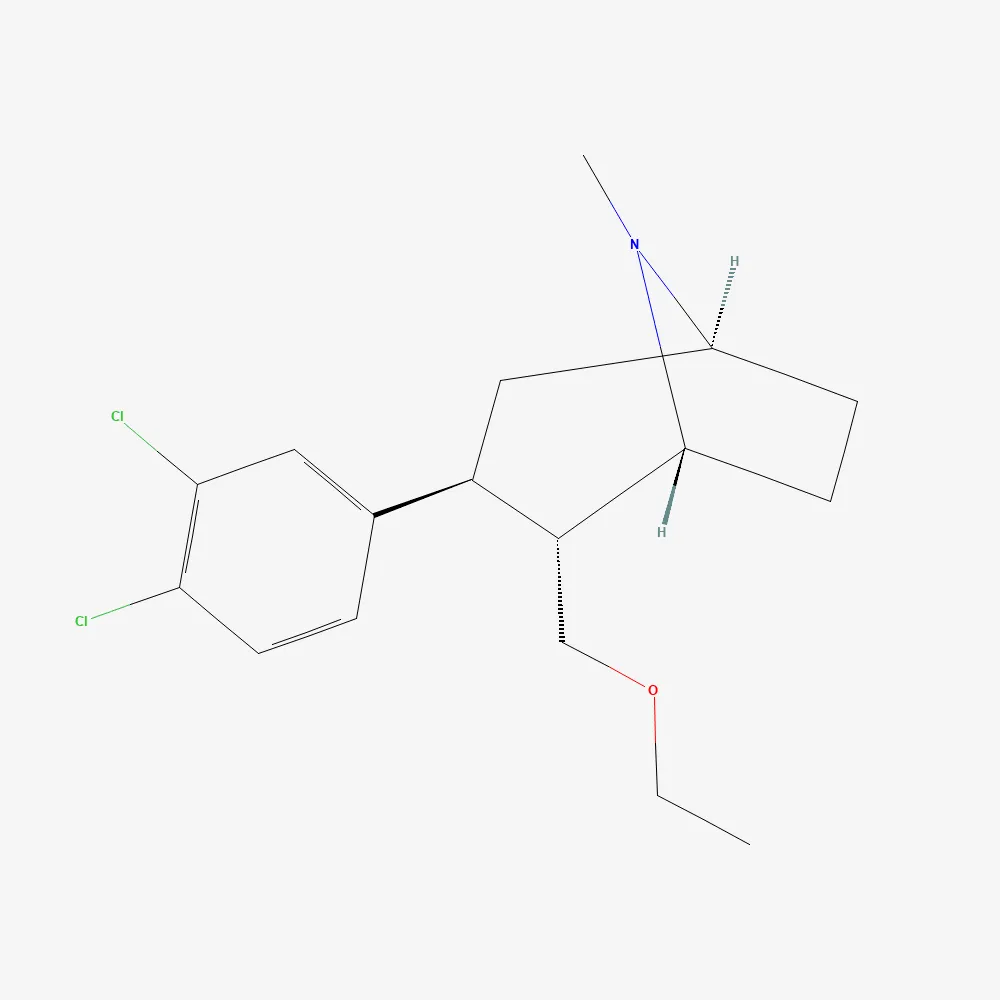
- C17H23Cl2NO (328.3 g/mol) Structure
- Evidence
- Limited human data
- US status
- Unapproved drug
- Half-life
- Not established in humans
- How it is taken
- By mouth
- Common protocol
- 0.25-1 mg, once daily, in the morning, titrated upward over several weeks, for 24 weeks (common practice, not trial-established) Dosing page
Tesofensine is not a peptide. It is a small-molecule drug that failed at the conditions it was built for, turned out to cause substantial weight loss, and has spent nearly two decades in development as an obesity medicine. It has placebo-controlled human trials behind it but no approval yet. It is now also sold, unapproved, in the same grey market as GLP-1 lookalike peptides.
Dosing: what the published obesity trial used.
What is Tesofensine?
Tesofensine was developed by the Danish company NeuroSearch under the code NS 2330 and tested in clinical trials for Parkinson’s and Alzheimer’s disease. It showed no benefit for either.
What it did do, consistently, was cause weight loss. That was a side effect of its action on serotonin, noradrenaline and dopamine, not something the neurological trials set out to measure. NeuroSearch decided to develop it for obesity instead, which is the only reason it is still a drug candidate today.
Tesofensine structure
Tesofensine benefits: what the research shows
Small or uncontrolled human studies. Too little to settle the question either way. Tesofensine has been through placebo-controlled human obesity trials, including a completed Phase 3 programme the sponsor reports met its endpoints. I rate it 'limited' because that data comes from sponsor and public-record reporting, not a peer-reviewed source in my citation registry, and because no regulator has approved the drug as of the most recent update I could confirm.
The one published, placebo-controlled Phase 2 trial gave 203 adults with obesity tesofensine or placebo for 24 weeks, on a calorie-restricted diet Astrup 2008 - Astrup A, Madsbad S, Breum L et al. Effect of tesofensine on bodyweight loss, body composition, and quality of life in obese patients: a randomised, double-blind, placebo-controlled trial. Lancet. 2008;372(9653):1906-1913., in the references below. Mean weight loss was:
- 4.5% on 0.25 mg
- 9.2% on 0.5 mg
- 10.6% on 1.0 mg
- 2.0% on diet and placebo
The authors suggested the 0.5 mg dose might produce twice the weight loss of the obesity drugs approved at the time. The Lancet later published a formal expression of concern about the trial Anon 2013 - Anon. Expression of concern--effect of tesofensine on bodyweight loss, body composition, and quality of life in obese patients: a randomised, double-blind, placebo-controlled trial. Lancet. 2013;381(9873):1167., in the references below, covered under side effects below.
Public and company sources also describe a later Phase 3 obesity programme, run in Mexico by the drug’s Latin American partner. The sponsor reported that it met its primary and secondary weight-loss endpoints against placebo. That is a larger, later-stage human record than AOD-9604 or 5-Amino-1MQ has.
I report the Phase 3 as the sponsor’s account; I have no peer-reviewed source for it to cite. Positive trial results are also not an approval, and tesofensine has none anywhere that I could confirm.
Tesofensine dosage
The protocol most often used is 0.25-1 mg by mouth once a day, in the morning, raised gradually from a low starting dose over several weeks under provider supervision. It usually runs for the 24 weeks the trial used; the sources describe no repeating cycle or fixed break. That is common practice, not an approved dose.
A telehealth clinic source advises against combining tesofensine with GLP-1 drugs such as semaglutide or tirzepatide without provider clearance.
The one published Phase II trial tested 0.25 mg, 0.5 mg or 1.0 mg once a day for 24 weeks, under medical monitoring, in adults with obesity. It is the trial The Lancet later flagged over under-reported adverse effects. Full detail: Tesofensine dosage.
Tesofensine capsules and pills
Tesofensine is a drug taken by mouth, so a capsule or pill is its normal form. The trials I found gave it once a day:
- Parkinson’s and Alzheimer’s disease. Four trials gave 968 patients oral tesofensine or placebo once a day for 14 weeks. Weight fell with dose, by 2.8% at 1 mg against a 0.5% gain on placebo Astrup 2008 - Astrup A, Meier DH, Mikkelsen BO et al. Weight loss produced by tesofensine in patients with Parkinson's or Alzheimer's disease. Obesity (Silver Spring). 2008;16(6):1363-9., in the references below.
- Half-life. Blood levels from 320 Alzheimer’s patients on repeated oral doses gave a half-life of about 234 hours, close to 10 days Lehr 2007 - Lehr T, Staab A, Tillmann C et al. Population pharmacokinetic modelling of NS2330 (tesofensine) and its major metabolite in patients with Alzheimer's disease. Br J Clin Pharmacol. 2007;64(1):36-48., in the references below. Its main breakdown product lasted longer, about 374 hours.
- Obesity. The Phase 2 trial above gave 0.25, 0.5 or 1 mg once a day for 24 weeks Astrup 2008 - Astrup A, Madsbad S, Breum L et al. Effect of tesofensine on bodyweight loss, body composition, and quality of life in obese patients: a randomised, double-blind, placebo-controlled trial. Lancet. 2008;372(9653):1906-1913., in the references below.
- Hypothalamic obesity. A 24-week trial in 21 adults gave Tesomet daily: 0.5 mg of tesofensine with 50 mg of metoprolol, a beta-blocker added to offset tesofensine’s heart effects. Heart rate and blood pressure did not differ from placebo Huynh 2022 - Huynh K, Klose M, Krogsgaard K et al. Randomized controlled trial of Tesomet for weight loss in hypothalamic obesity. Eur J Endocrinol. 2022;186(6):687-700., in the references below.
None of the three vendors I check sells tesofensine in any form, as of 3 October 2026. It is sold online elsewhere, including as a dietary supplement. Anti-doping researchers in Cologne obtained one such product online, labelled 500 mcg per capsule, and measured 483 mcg Krug 2026 - Krug O, Thomas A, Thevis M. Investigations Into the Metabolism and Elimination of Tesofensine in Human Urine. Drug Test Anal. 2026;18(9):1163-1173., in the references below. After one capsule, tesofensine took 150-550 hours (about 6-23 days) to clear from six volunteers’ urine, and some breakdown products lasted longer than 500 hours.
That test covers one product. I found no independent testing of other tesofensine capsules, so their contents are unverified. Peptides and other compounds sold as pills are compared in oral peptides.
Tesofensine side effects
Tesofensine has never been approved, so there is no FDA label. This section draws on the one published, placebo-controlled Phase 2 obesity trial and on the developer’s own response to its heart effects.
Reported in studies
- Most common adverse events: dry mouth, nausea, constipation, hard stools, diarrhoea and insomnia Astrup 2008 - Astrup A, Madsbad S, Breum L et al. Effect of tesofensine on bodyweight loss, body composition, and quality of life in obese patients: a randomised, double-blind, placebo-controlled trial. Lancet. 2008;372(9653):1906-1913., in the references below.
- Heart rate rose with dose: up 7.4 beats per minute at 0.5 mg versus placebo (p=0.0001). Blood pressure did not rise significantly at 0.25 mg or 0.5 mg Astrup 2008 - Astrup A, Madsbad S, Breum L et al. Effect of tesofensine on bodyweight loss, body composition, and quality of life in obese patients: a randomised, double-blind, placebo-controlled trial. Lancet. 2008;372(9653):1906-1913., in the references below.
- The Lancet later published a formal expression of concern about the trial Anon 2013 - Anon. Expression of concern--effect of tesofensine on bodyweight loss, body composition, and quality of life in obese patients: a randomised, double-blind, placebo-controlled trial. Lancet. 2013;381(9873):1167., in the references below, so read its results, including the side-effect tally, with caution.
The trade-off its developer built a fix for
Earlier trials found tesofensine raised heart rate at therapeutic doses, with mild, sporadic rises in blood pressure at higher doses Huynh 2022 - Huynh K, Klose M, Krogsgaard K et al. Randomized controlled trial of Tesomet for weight loss in hypothalamic obesity. Eur J Endocrinol. 2022;186(6):687-700., in the references below. The developer took these seriously enough to create a fixed-dose combination with metoprolol, a beta-blocker, to offset them.
A research-chemical vial sold on its own has none of that offset and no clinical monitoring. It is usually sold as an oral compound, not an injection, so there is no injection-site risk. No regulator checks that a vial matches its label.
Get medical care for chest pain, a racing or irregular heartbeat, or fainting. Those warrant attention with any drug that raises heart rate, though tesofensine has no label setting a threshold.
Is Tesofensine legal?
US legal status - Unapproved drug
Never FDA-approved for any indication; still an Investigational New Drug in the United States. In a warning letter dated 8 December 2025, FDA named tesofensine among active pharmaceutical ingredients ineligible for use in human drug compounding under section 503A of the FD&C Act.
Outside the US, its developer’s Mexican partner applied to Mexico’s regulator, COFEPRIS, for an obesity approval. At the most recent public update I could verify, COFEPRIS had not approved it, and the application was being revised and resubmitted. I could not confirm an approval in any country as of this page’s publication date.
Why it belongs in the same conversation as the GLP-1 lookalikes
Tesofensine is increasingly sold through the same research-chemical and grey-market compounding channels as unapproved semaglutide and tirzepatide, marketed as a fat-loss alternative. It has more human obesity-trial evidence than most compounds in that market. It still has none of the FDA review behind the medicines it is sold alongside, and it carries a heart-rate trade-off its own developer engineered around.
Because the clinic source on the dosing page advises against combining it with GLP-1 drugs without provider clearance, this page doesn’t describe it as a stacking add-on for them.
Related
- Semaglutide (Ozempic, Wegovy): the approved label, not the grey market
- AOD-9604: the hGH-fragment peptide whose own trial failed
- 5-Amino-1MQ: a small molecule sold as a metabolic peptide
- Are peptides safe?
Regulatory changes for this compound and others, as they happen: US peptide regulation tracker.
How Tesofensine compares
Other fat-loss compounds. Doses for unapproved compounds are common practice, not trial-established. All weight loss and metabolism peptides →
| Compound | Main use | Evidence | Usual dose | US status |
|---|---|---|---|---|
| AOD-9604 | Originally developed as an anti-obesity drug candidate; its developer reported that its Phase IIb human obesity trial did not succeed, and development for that indication was discontinued. Now sold to consumers as a research-chemical fat-loss product. | Limited human data | 250-500 mcg, once daily, fasted (some protocols run 5 days on, 2 days off) | Unapproved drug |
| HGH Fragment 176-191 | Sold to consumers as a research-chemical fat-loss product, marketed on the claim that this slice of growth hormone carries its fat-metabolising activity without the growth-promoting or blood-sugar effects of the whole hormone. Never developed into an approved drug under this exact sequence. | Animal / lab only | 200-500 mcg, once or twice daily, fasted | Unapproved drug |
| Adipotide | Developed at MD Anderson Cancer Center as a targeted anti-obesity drug candidate that induces apoptosis in the blood vessels feeding white fat. A first-in-human Phase 1 trial in men with prostate cancer and obesity was terminated early with no published results, and it is now sold to consumers as an unregulated research-chemical weight-loss product. | Animal / lab only | No consistent protocol | Unapproved drug |
| 5-Amino-1MQ | An NNMT-inhibiting research chemical marketed for fat loss and metabolic health. Every efficacy result I could locate comes from mouse studies; no published human trial exists. | Animal / lab only | 50-150 mg, once daily | Unapproved drug |
| Tesofensine | Originally developed for Parkinson's and Alzheimer's disease; weight loss observed as a side effect in those trials led to its repositioning as an obesity candidate. It has completed placebo-controlled obesity trials but remains unapproved everywhere, and is now also sold as a grey-market research chemical. | Limited human data | 0.25-1 mg, once daily, in the morning, titrated upward over several weeks | Unapproved drug |
Where to buy Tesofensine for research
Each vendor is checked against my vendor checklist.
I don't list a vendor for Tesofensine yet. Before buying from anyone, work through the vendor checklist.
Common questions
What is the usual tesofensine dose?
The protocol most often used is 0.25-1 mg by mouth once a day, in the morning, raised gradually from a low starting dose over several weeks under provider supervision. It usually runs for the 24 weeks the published trial used; the sources describe no repeating cycle or fixed break. That is common practice, not an approved dose. A telehealth clinic source advises against combining it with GLP-1 drugs such as semaglutide or tirzepatide without provider clearance. Full detail: [tesofensine dosage](/tesofensine-dosage/).
Is tesofensine a pill or an injection?
A pill. The Parkinson's and Alzheimer's trials gave it by mouth once a day, and the 24-week obesity trial gave 0.25-1 mg once a day. It is also sold online, including as capsules marketed as a dietary supplement; one product labelled 500 mcg per capsule held 483 mcg when anti-doping researchers tested it. None of the three vendors I check sells tesofensine.
How long does tesofensine stay in your system?
A long time. In 320 Alzheimer's patients taking it by mouth, its half-life was about 234 hours, close to 10 days, and its main breakdown product lasted about 374 hours. After a single 483 mcg capsule, it took 150-550 hours (about 6-23 days) to clear from volunteers' urine.
Is tesofensine a peptide?
No. It is a small-molecule phenyltropane compound, unrelated to peptides. It blocks the reuptake of serotonin, noradrenaline and dopamine, a mechanism shared with some stimulants and antidepressants. Research-chemical sites sell it alongside injectable peptides, which hides the difference.
Why was tesofensine developed as a weight-loss drug if it was made for Parkinson's and Alzheimer's?
Because it failed at its original job. The Danish company NeuroSearch developed it as NS 2330 and tested it in Parkinson's and Alzheimer's disease, where it showed no benefit. Weight loss kept showing up as a side effect, so the company redeveloped it as an obesity drug.
Has tesofensine been through human obesity trials?
Yes, more than most compounds in the grey-market weight-loss category. There is a published Phase 2 obesity trial. Public and company sources also describe a completed Phase 3 programme in Mexico, run by the drug's Latin American partner, which the sponsor said met its primary and secondary endpoints. I couldn't check that Phase 3 against a peer-reviewed source, so treat it as the sponsor's account.
Is tesofensine FDA-approved?
No. FDA has never approved it for anything, and it remains an Investigational New Drug in the US. In an 8 December 2025 warning letter, FDA named tesofensine among active ingredients that can't be used in human drug compounding under section 503A of the FD&C Act.
Is tesofensine approved anywhere in the world?
Not that I could verify. Its developer's Mexican partner applied to Mexico's regulator, COFEPRIS, for an obesity approval. At the most recent public update I could confirm, COFEPRIS had not approved it and the application was being revised and resubmitted. Treat any claim that it is 'approved in Mexico' or elsewhere as unverified until you check the regulator's own record.
What are the safety concerns with tesofensine?
Trials found it raised heart rate at therapeutic doses, with mild, sporadic rises in blood pressure at higher doses. Its developer took that seriously enough to build a fixed-dose combination with the beta-blocker metoprolol to offset it. A grey-market vial contains no such offset.
Is tesofensine bad for you?
It has documented risks, and no regulator has approved it, so no agency has formally weighed them. Its developer's trials found rises in heart rate and blood pressure serious enough to justify a companion beta-blocker product. A grey-market vial sold alone carries the same cardiovascular signal with no offset and no clinical monitoring.
Is tesofensine similar to Phentermine?
Both suppress appetite through stimulant-type brain chemicals, but they are different drugs, and only phentermine is approved. Phentermine's FDA label classes it as a sympathomimetic amine anorectic and a Schedule IV controlled substance, for short-term use alongside diet, exercise and behaviour change. Tesofensine blocks the reuptake of serotonin, noradrenaline and dopamine rather than releasing them, and has no confirmed approval anywhere.
How long does it take to feel tesofensine?
There is no verified answer, because tesofensine has no approved dosing regimen anywhere. The onset claims on research-chemical and vendor sites aren't backed by any source I could check. It has only been given in clinical trials, which don't translate into a timeline for unsupervised use.
Does tesofensine keep you up at night?
I couldn't verify this from a source that meets this site's evidence bar. The published Phase 2 trial lists insomnia among its most common adverse events, but no FDA record or other source I could check describes its effect on sleep in detail.
Can tesofensine cause hair loss?
I couldn't verify this from a source that meets this site's evidence bar. No FDA record or source I could check reports hair loss with tesofensine. With so little public trial reporting, no report isn't proof of no risk, so treat any claim either way as unverified.
What are the side effects of tesofensine?
The one published Phase 2 obesity trial lists dry mouth, nausea, constipation, hard stools, diarrhoea and insomnia as the most common adverse events, plus a dose-dependent rise in heart rate. The Lancet later published an expression of concern about that trial, so read its side-effect tally with caution. Its developer built a companion product with a beta-blocker to offset the heart effects; a research-chemical vial has no such offset.
References (8 sources)
Bibliographic detail is fetched from PubMed, not written by me - so a citation here cannot drift from the paper it names. Study design comes from PubMed's own tags rather than my judgement.
- 1.Astrup A, Madsbad S, Breum L et al. Effect of tesofensine on bodyweight loss, body composition, and quality of life in obese patients: a randomised, double-blind, placebo-controlled trial. Lancet. 2008;372(9653):1906-1913.Randomised trialPMID 18950853
- 2.Anon. Expression of concern--effect of tesofensine on bodyweight loss, body composition, and quality of life in obese patients: a randomised, double-blind, placebo-controlled trial. Lancet. 2013;381(9873):1167.StudyPMID 23561987
- 3.Lehr T, Staab A, Tillmann C et al. Population pharmacokinetic modelling of NS2330 (tesofensine) and its major metabolite in patients with Alzheimer's disease. Br J Clin Pharmacol. 2007;64(1):36-48.Randomised trialPMID 17324246full text
- 4.Astrup A, Meier DH, Mikkelsen BO et al. Weight loss produced by tesofensine in patients with Parkinson's or Alzheimer's disease. Obesity (Silver Spring). 2008;16(6):1363-9.Meta-analysisPMID 18356831
- 5.Huynh K, Klose M, Krogsgaard K et al. Randomized controlled trial of Tesomet for weight loss in hypothalamic obesity. Eur J Endocrinol. 2022;186(6):687-700.Randomised trialPMID 35294397full text
- 6.Krug O, Thomas A, Thevis M. Investigations Into the Metabolism and Elimination of Tesofensine in Human Urine. Drug Test Anal. 2026;18(9):1163-1173.StudyPMID 42320973full text
- 7.FDA warning letter to Darmerica, LLC (#716152), 8 December 2025. Names tesofensine among active pharmaceutical ingredients ineligible for use in human drug compounding under section 503A of the FD&C Act.- US Food and Drug Administrationregulatory
- 8.DailyMed - phentermine hydrochloride prescribing information. Source for the drug class, mechanism, Schedule IV status and approved indication quoted in the phentermine comparison FAQ on this page.- US National Library of Medicinelabel