ARA-290 (Cibinetide): Dosage, Side Effects and Legal Status
ARA-290 (cibinetide) dosage, side effects and its FDA orphan-drug record: what four published patient trials and FDA databases actually show.

The short version
ARA-290, also called cibinetide, is an 11-amino-acid peptide built from a piece of erythropoietin. Its developer, Araim Pharmaceuticals, ran small randomised human trials in a few conditions and won four FDA orphan drug designations between 2009 and 2016. None led to approval. It is not an approved drug or a dietary supplement, and is sold to consumers as a research chemical.
- PubMed lists 3 published randomised human trials: more than most research peptides, and still not enough for approval.
- Four FDA orphan drug designations were granted; every one is still marked "Not FDA Approved for Orphan Indication."
- No verified human half-life or dosing schedule exists; a developer-linked review gives about 2 minutes without saying whether that was measured in people or animals.
ARA-290 (Cibinetide) at a glance
- What it is
- Synthetic 11-amino-acid peptide, derived from erythropoietin Helix B
- Main use
- An investigational peptide developed by Araim Pharmaceuticals for neuropathic pain and inflammation-related conditions. Never reached FDA approval for any indication; now sold to consumers as a research chemical.
- Also called
- Cibinetide, ARA290
- Molecular formula
- C51H84N16O21 (1257.3 g/mol) Structure
- Evidence
- Moderate human evidence
- US status
- Research use only
- Half-life
- Not established in humans
- How it is taken
- Subcutaneous injection
- Common protocol
- 1-8 mg, twice weekly to once daily, subcutaneous - a compounding pharmacy protocol titrates 2 mg toward 4 mg twice weekly, while the published phase 2b trial dosed 1, 4 or 8 mg once daily, for 4-6 weeks (common practice, not trial-established) Dosage chart
Dosing: what the published trials used.
ARA-290, also known as cibinetide, is unusual among research peptides. It has real published human trials, run by its developer, and it still never reached approval.
I am not claiming it works or that it doesn’t. This page reports what FDA’s databases, PubMed and the trials themselves show, and nothing beyond that.
US legal status - Research use only
Not an FDA-approved drug for any indication. Four FDA orphan drug designations exist for this peptide; none has been approved. It does not appear on FDA's bulk drug substances compounding safety-risk list, in either direction. Sold to consumers as a research chemical, outside any pharmacy or prescriber pathway.
What is ARA-290?
ARA-290 is a synthetic peptide of 11 amino acids, matching a looped section of erythropoietin called Helix B. Its developer, Araim Pharmaceuticals, gave it the international non-proprietary name cibinetide.
Erythropoietin is best known for driving red blood cell production, through a pair of erythropoietin receptors. Researchers have also reported that it protects tissue and calms inflammation through a different pairing: the erythropoietin receptor joined with the beta-common receptor (CD131).
According to its developer, cibinetide was engineered to switch on that second pathway, dubbed the innate repair receptor, without stimulating red cell production Collino 2015 - Collino M, Thiemermann C, Cerami A et al. Flipping the molecular switch for innate protection and repair of tissues: Long-lasting effects of a non-erythropoietic small peptide engineered from erythropoietin. Pharmacol Ther. 2015;151:32-40., in the references below. The mechanism is disputed. An independent 2018 lab study found that the outer parts of the two receptors didn’t specifically pair up, with or without ARA-290 present Cheung 2018 - Cheung Tung Shing KS, Broughton SE, Nero TL et al. EPO does not promote interaction between the erythropoietin and beta-common receptors. Sci Rep. 2018;8(1):12457., in the references below.
ARA-290 (Cibinetide) structure
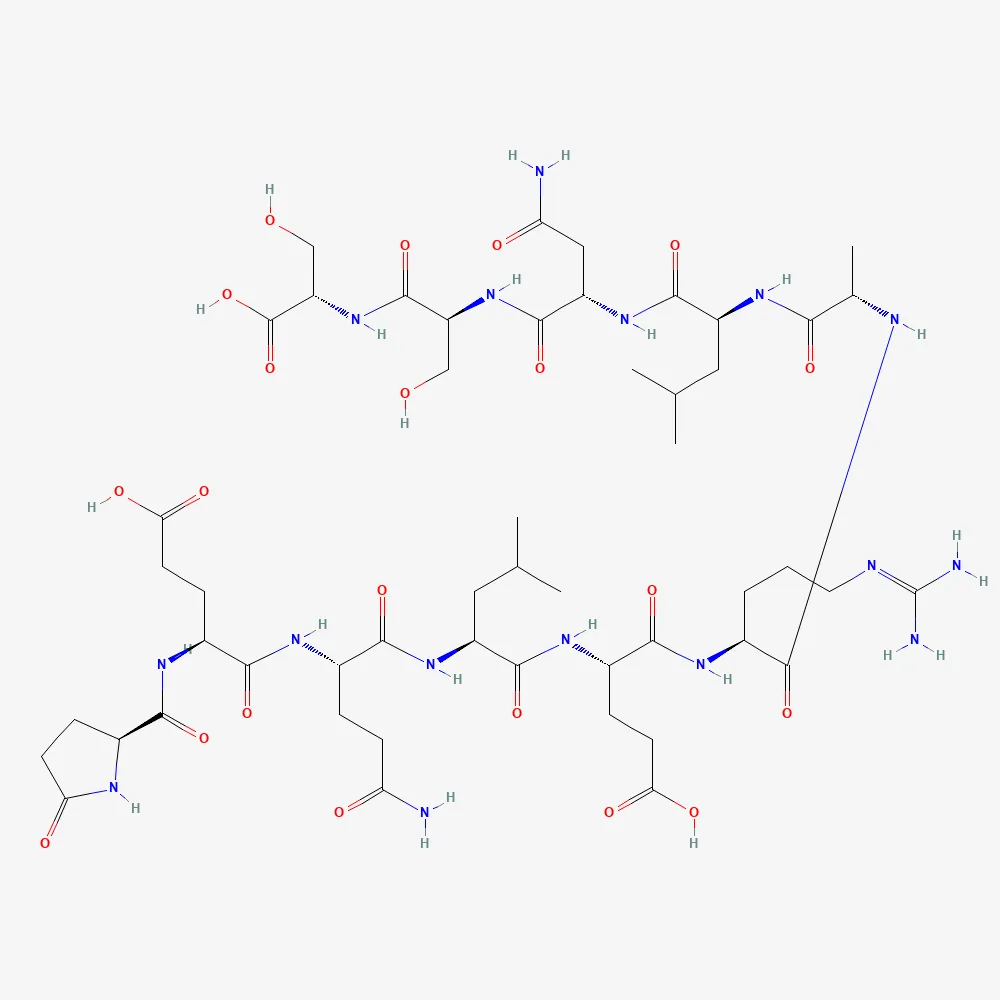
- Molecular formula
- C51H84N16O21
- Molecular weight
- 1257.3 g/mol
- Length
- 11 amino acids
- Sequence
- QEQLERALNSS
- Modifications
- N-terminal pyroglutamate (Gln1 cyclised to pGlu); C-terminal free acid. An 11-residue peptide modelled on helix B of erythropoietin.
- PubChem CID
- 91810664
The diagram is the peptide itself; research vials are usually a salt (e.g. acetate) of it.
Identity checked against ChEMBL (EMBL-EBI).
ARA-290 benefits: what the research shows
Multiple randomised trials, though with limitations. PubMed indexes 3 cibinetide/ARA-290 publications as randomised controlled trials and 4 as clinical trials of any type (NCBI E-utilities query, 24 September 2026). That confirms several published human randomised trials, more than most compounds on this site. Every patient trial traces to the same sponsor, and none led to FDA approval.
A PubMed search on 24 September 2026 returned 3 randomised controlled trials of cibinetide/ARA-290, and 4 records across all clinical-trial types (the exact queries are in the references). That is a real, checkable human record, not the single null abstract behind some other research peptides.
What the trials found, in order of publication:
- Sarcoidosis pilot, 2012. 22 people with sarcoidosis and small-fibre nerve damage got 2 mg of ARA-290 intravenously three times a week, or placebo, for 4 weeks. Neuropathy symptom scores improved more on ARA-290; pain and fatigue scores improved equally in both groups Heij 2012 - Heij L, Niesters M, Swartjes M et al. Safety and efficacy of ARA 290 in sarcoidosis patients with symptoms of small fiber neuropathy: a randomized, double-blind pilot study. Mol Med. 2012;18(1):1430-6., in the references below.
- Sarcoidosis, 2013. In a blinded, placebo-controlled trial, 28 days of daily injections under the skin improved nerve symptoms. This was linked to denser corneal nerve fibres and a longer 6-minute walk Dahan 2013 - Dahan A, Dunne A, Swartjes M et al. ARA 290 improves symptoms in patients with sarcoidosis-associated small nerve fiber loss and increases corneal nerve fiber density. Mol Med. 2013;19(1):334-45., in the references below.
- Type 2 diabetes, 2015. In a phase 2 trial in people with type 2 diabetes and painful nerve damage, 28 days of daily 4 mg injections were followed by better HbA1c, blood fats and nerve symptom scores Brines 2015 - Brines M, Dunne AN, van Velzen M et al. ARA 290, a nonerythropoietic peptide engineered from erythropoietin, improves metabolic control and neuropathic symptoms in patients with type 2 diabetes. Mol Med. 2015;20(1):658-66., in the references below.
- Sarcoidosis phase 2b, 2017. In 64 people, only the 4 mg daily dose significantly increased corneal nerve fibre area, the main outcome; 1 mg and 8 mg did not. Pain improved in all groups, including placebo Culver 2017 - Culver DA, Dahan A, Bajorunas D et al. Cibinetide Improves Corneal Nerve Fiber Abundance in Patients With Sarcoidosis-Associated Small Nerve Fiber Loss and Neuropathic Pain. Invest Ophthalmol Vis Sci. 2017;58(6):BIO52-BIO60., in the references below.
Separately, a randomised, double-blind study gave 2 mg of ARA-290 or placebo to 36 healthy volunteers and tested them a week later. It had no effect on mood, and its effects on emotional processing didn’t clearly point to an antidepressant action Cerit 2015 - Cerit H, Veer IM, Dahan A et al. Testing the antidepressant properties of the peptide ARA290 in a human neuropsychological model of drug action. Eur Neuropsychopharmacol. 2015;25(12):2289-99., in the references below.
All of these trials are small and short, and the patient trials all come from the developer. Whatever they showed, it wasn’t enough to bring cibinetide to approval for any use studied. No marketing approval has followed in the years since its last orphan designation in 2016.
Is there a better peptide for neuropathy?
No peptide, ARA-290 included, is FDA-approved to treat neuropathy. Approved medicines for nerve pain exist, and none is a peptide. Pregabalin, for example, has an FDA-approved indication for “management of neuropathic pain associated with diabetic peripheral neuropathy” (DailyMed label).
ARA-290’s only regulatory link to neuropathy is narrower: a 2011 orphan designation for neuropathic pain in sarcoidosis, which never became a marketed product. I found no trial comparing cibinetide with an approved nerve-pain medicine or with any other peptide.
Pharmacokinetics
ARA-290’s human half-life is not established in any source I could verify. A 2015 review co-written by developer scientists gives a plasma half-life of about 2 minutes, with effects it says outlast the peptide in animal models and trials. Its abstract doesn’t say whether the 2-minute figure comes from people or animals Collino 2015 - Collino M, Thiemermann C, Cerami A et al. Flipping the molecular switch for innate protection and repair of tissues: Long-lasting effects of a non-erythropoietic small peptide engineered from erythropoietin. Pharmacol Ther. 2015;151:32-40., in the references below.
I found no human pharmacokinetic study measuring absorption, distribution, clearance or half-life. Dosing schedules in vendor marketing don’t rest on a verified human number, and I don’t publish one.
ARA-290 dosage
The common ARA-290 (Cibinetide) dose is 1-8 mg, twice weekly to once daily, subcutaneous - a compounding pharmacy protocol titrates 2 mg toward 4 mg twice weekly, while the published phase 2b trial dosed 1, 4 or 8 mg once daily. From a 10 mg vial mixed with 1 mL of bacteriostatic water, 4.5 mg is 45 units (0.45 mL) on a U-100 insulin syringe.
A licensed compounding pharmacy protocol works up from 2 mg toward 4 mg under the skin, twice weekly. The phase 2b trial instead used 1, 4 or 8 mg once daily. Together that spans 1-8 mg, twice weekly to daily, over a 4-6 week course. That is common practice, not a dose any trial or regulator has set, and the two sources disagree on frequency.
The four published patient trials used 1-8 mg, injected into a vein or under the skin, each over 4 weeks under sponsor monitoring, not as a consumer protocol. Trial-by-trial detail: ARA-290 dosage.
ARA-290 side effects
The only safety information comes from ARA-290’s own small trials. No regulator has independently reviewed it.
Reported in studies
- In the 22-person sarcoidosis pilot, clinical and lab checks raised no safety concerns over 4 weeks Heij 2012 - Heij L, Niesters M, Swartjes M et al. Safety and efficacy of ARA 290 in sarcoidosis patients with symptoms of small fiber neuropathy: a randomized, double-blind pilot study. Mol Med. 2012;18(1):1430-6., in the references below.
- In the type 2 diabetes trial (28 days of treatment, then a month of follow-up), the authors identified no potential safety issues Brines 2015 - Brines M, Dunne AN, van Velzen M et al. ARA 290, a nonerythropoietic peptide engineered from erythropoietin, improves metabolic control and neuropathic symptoms in patients with type 2 diabetes. Mol Med. 2015;20(1):658-66., in the references below.
Those abstracts don’t list adverse events by type or give rates. Trials this small and short can’t pick up uncommon or long-term effects, so they don’t add up to a side-effect profile. The missing FDA review cuts both ways: FDA has published no safety concern, and none of the reassurance a completed review would bring.
Every trial and vendor protocol I found uses injection. For redness, itching or swelling at the injection site, see injection-site reactions. No study has looked at this for ARA-290, so treat that page as general information.
The FDA orphan drug record, precisely
The four designations, in the order FDA granted them:
- Preventing delayed graft function after kidney transplant (18 September 2009).
- Neuropathic pain in people with sarcoidosis (13 September 2011).
- Improving survival and function of pancreatic islets after transplant (13 June 2016).
- Sarcoidosis itself (13 June 2016).
Orphan designation is a development incentive. It brings tax credits and market exclusivity if a product is later approved, but it says nothing about whether a drug works. Each designation needs its own marketing application, judged on its own evidence, to become an approval. None of these four has done so in the 10-17 years since.
Cibinetide also appears nowhere on FDA’s list of bulk drug substances evaluated for compounding. It is in neither the category-2 table of substances flagged for significant safety risks nor the table of withdrawn nominations. Nobody has nominated it, so FDA has issued none of the immune-reaction, impurity or characterisation findings it has published for BPC-157, KPV or the GHRPs.
Is ARA-290 legal?
ARA-290/cibinetide is not an FDA-approved drug for any use, a dietary supplement or a cosmetic. It is sold to consumers as a research chemical. FDA has repeatedly warned that this market carries dosing errors, counterfeit product and unverified manufacturing, whatever the compound.
I checked only US federal status, not individual states or other countries.
What I would need to change my mind
A published FDA review of cibinetide’s trial data, or an approval for any of its four orphan uses, would change this page substantially. Neither exists as of 24 September 2026. Until then, cibinetide has something rare among research chemicals, a real multi-trial human record from its own sponsor, and no approval built on it.
Regulatory changes for this compound and others, as they happen: US peptide regulation tracker.
How ARA-290 (Cibinetide) compares
Immune and inflammation. Doses for unapproved compounds are common practice, not trial-established. All immune and inflammation peptides →
| Compound | Main use | Evidence | Usual dose | US status |
|---|---|---|---|---|
| Thymosin alpha-1 | Licensed in a number of countries, classically for chronic hepatitis B. Sold online for general immune support. | Strong human evidence | 1.6 mg, twice weekly, subcutaneous injection, spaced 3-4 days apart | Research use only |
| LL-37 | An antimicrobial peptide naturally present in human neutrophils, skin and mucosal surfaces. Sold as a research chemical for innate-immune and antimicrobial research; FDA has not approved it for any human use. | Limited human data | 100-2000 mcg, 3-5 times weekly to once daily, subcutaneous, starting low and titrating up | Research use only |
| VIP | Sold to consumers as a research peptide marketed for immune modulation and inflammation. It is not an FDA-approved drug for any indication, and this site could not verify a completed human trial establishing benefit for that consumer use. | Limited human data | 50 mcg, 4-8 sprays a day, split across the day, alternating nostrils | Research use only |
| ARA-290 (Cibinetide) | An investigational peptide developed by Araim Pharmaceuticals for neuropathic pain and inflammation-related conditions. Never reached FDA approval for any indication; now sold to consumers as a research chemical. | Moderate human evidence | 1-8 mg, twice weekly to once daily, subcutaneous - a compounding pharmacy protocol titrates 2 mg toward 4 mg twice weekly, while the published phase 2b trial dosed 1, 4 or 8 mg once daily | Research use only |
Where to buy ARA-290 (Cibinetide) for research
Each vendor is checked against my vendor checklist.
1.Next Level PharmFeatured
10 mg vial
- No FDA warning letter found
- Names its testing lab
- Batch COAs published
- Takes card payment
2.BioEdge Research Labs
16 mg vial
- No FDA warning letter found
- Names its testing lab
- Batch COAs published
Common questions
Has ARA-290 been tested in humans?
Yes, more than most compounds on this site. On 24 September 2026, PubMed returned 3 randomised controlled trials of cibinetide/ARA-290 and 4 clinical trials in all. Every patient trial traces to one sponsor, Araim Pharmaceuticals, and none produced an approved product. One small healthy-volunteer study from Leiden University lists no author from the developer.
Is ARA-290 FDA-approved?
No. FDA's orphan drug database lists 4 designations, granted 2009-2016: neuropathic pain in sarcoidosis, sarcoidosis itself, preventing delayed graft function after kidney transplant, and pancreatic islet survival after transplant. Every one is marked "Not FDA Approved for Orphan Indication." Orphan designation is a development incentive, not proof of safety or effectiveness.
What is the usual ARA-290 dose?
A compounding pharmacy protocol works up from 2 mg toward 4 mg under the skin twice weekly; the phase 2b trial used 1, 4 or 8 mg once daily. Together that spans 1-8 mg, twice weekly to daily, over 4-6 weeks. That is common practice, not an established dose, and the two sources disagree on frequency. Detail: [ARA-290 dosage](/ara-290-dosage/).
What is the half-life of ARA-290 in humans?
Not established in any source I could verify. A 2015 review co-written by developer scientists gives a plasma half-life of about 2 minutes, but doesn't say whether that was measured in people or animals. I found no human pharmacokinetic study, so no dosing interval online rests on a verified human number.
Is ARA-290 legal to buy in the United States?
It is sold as a research chemical, not as an approved drug or a dietary supplement. It is not on FDA's list of bulk drug substances evaluated for pharmacy compounding, so FDA has published no compounding safety-risk finding for it either way.
Does ARA-290 actually work?
No independent trial has confirmed it. The patient trials were small, short and run by the developer. In sarcoidosis nerve damage, a 22-person pilot improved neuropathy scores more than placebo, and a 64-person trial found only the 4 mg dose increased corneal nerve fibre area. A 28-day diabetes trial reported better HbA1c, blood fats and nerve symptoms. None led to an approved product.
What are the side effects of taking ARA-290?
No side-effect profile has been established. The sarcoidosis pilot raised no safety concerns, and the 28-day diabetes trial found no potential safety issues, but these were small 4-week trials whose abstracts don't list adverse events by type. FDA has never reviewed cibinetide's safety, so I can only say no side effect has been documented, not that none exists.
Can you take ARA-290 and BPC-157 together?
No combination or interaction data exist in any source I could verify. Neither has an established human dosing schedule, and no study has tested them together. Using two unapproved substances adds an unknown interaction to two unresolved safety pictures. The common ARA-290 protocol, on its own, is in the dosage section.
References (12 sources)
Bibliographic detail is fetched from PubMed, not written by me - so a citation here cannot drift from the paper it names. Study design comes from PubMed's own tags rather than my judgement.
- 1.Heij L, Niesters M, Swartjes M et al. Safety and efficacy of ARA 290 in sarcoidosis patients with symptoms of small fiber neuropathy: a randomized, double-blind pilot study. Mol Med. 2012;18(1):1430-6.Randomised trialPMID 23168581full text
- 2.Dahan A, Dunne A, Swartjes M et al. ARA 290 improves symptoms in patients with sarcoidosis-associated small nerve fiber loss and increases corneal nerve fiber density. Mol Med. 2013;19(1):334-45.Randomised trialPMID 24136731full text
- 3.Brines M, Dunne AN, van Velzen M et al. ARA 290, a nonerythropoietic peptide engineered from erythropoietin, improves metabolic control and neuropathic symptoms in patients with type 2 diabetes. Mol Med. 2015;20(1):658-66.Clinical trialPMID 25387363full text
- 4.Culver DA, Dahan A, Bajorunas D et al. Cibinetide Improves Corneal Nerve Fiber Abundance in Patients With Sarcoidosis-Associated Small Nerve Fiber Loss and Neuropathic Pain. Invest Ophthalmol Vis Sci. 2017;58(6):BIO52-BIO60.Randomised trialPMID 28475703
- 5.Cerit H, Veer IM, Dahan A et al. Testing the antidepressant properties of the peptide ARA290 in a human neuropsychological model of drug action. Eur Neuropsychopharmacol. 2015;25(12):2289-99.Randomised trialPMID 26431906
- 6.Cheung Tung Shing KS, Broughton SE, Nero TL et al. EPO does not promote interaction between the erythropoietin and beta-common receptors. Sci Rep. 2018;8(1):12457.StudyPMID 30127368full text
- 7.Collino M, Thiemermann C, Cerami A et al. Flipping the molecular switch for innate protection and repair of tissues: Long-lasting effects of a non-erythropoietic small peptide engineered from erythropoietin. Pharmacol Ther. 2015;151:32-40.ReviewPMID 25728128
- 8.FDA Orphan Drug Product designation database - search results for sponsor "Araim Pharmaceuticals, Inc.", showing four orphan designations for this undecapeptide, each marked "Not FDA Approved for Orphan Indication" (searched 24 September 2026).- US Food and Drug Administration, Office of Orphan Products Developmentregulatory
- 9.FDA - Certain Bulk Drug Substances for Use in Compounding That May Present Significant Safety Risks. Cibinetide/ARA-290 does not appear in either the category-2 or the nominated-but-withdrawn table (content current as of 22 April 2026, checked 24 September 2026).- US Food and Drug Administrationregulatory
- 10.NCBI E-utilities esearch: cibinetide/ARA-290, restricted to the randomised-controlled-trial publication type, three records (queried 24 September 2026).- National Center for Biotechnology Information, US National Library of Medicinedatabase
- 11.NCBI E-utilities esearch: cibinetide/ARA-290, restricted to the clinical-trial publication type, four records (queried 24 September 2026).- National Center for Biotechnology Information, US National Library of Medicinedatabase
- 12.DailyMed - PREGABALIN capsule label, indicated for "management of neuropathic pain associated with diabetic peripheral neuropathy" - a non-peptide, FDA-approved example, cited for contrast only (checked 24 September 2026).- US National Library of Medicine, DailyMedlabel