LL-37 Peptide: Dosage, Side Effects and Legal Status
LL-37 peptide dosage, side effects and legal status: what its human wound trials, FDA's compounding review and vendor protocols actually show.

The short version
LL-37 is a peptide the body already makes; neutrophils and skin cells release it to fight microbes and signal the immune system. It is sold online as a research chemical for immune support. FDA reviewed it as a compounding ingredient and found too little human safety data, plus unresolved animal findings on reproduction and tumour promotion. No safe or effective human dose has been established.
- LL-37 is naturally occurring; most published research measures it in the body rather than giving it to people.
- FDA found no sufficient safety data on giving cathelicidin LL-37 to humans.
- FDA cites animal findings on male reproduction and tumour promotion that remain unresolved.
- Not FDA-approved and not on the 503A Bulks List, so no pharmacy can lawfully compound it.
LL-37 at a glance
- What it is
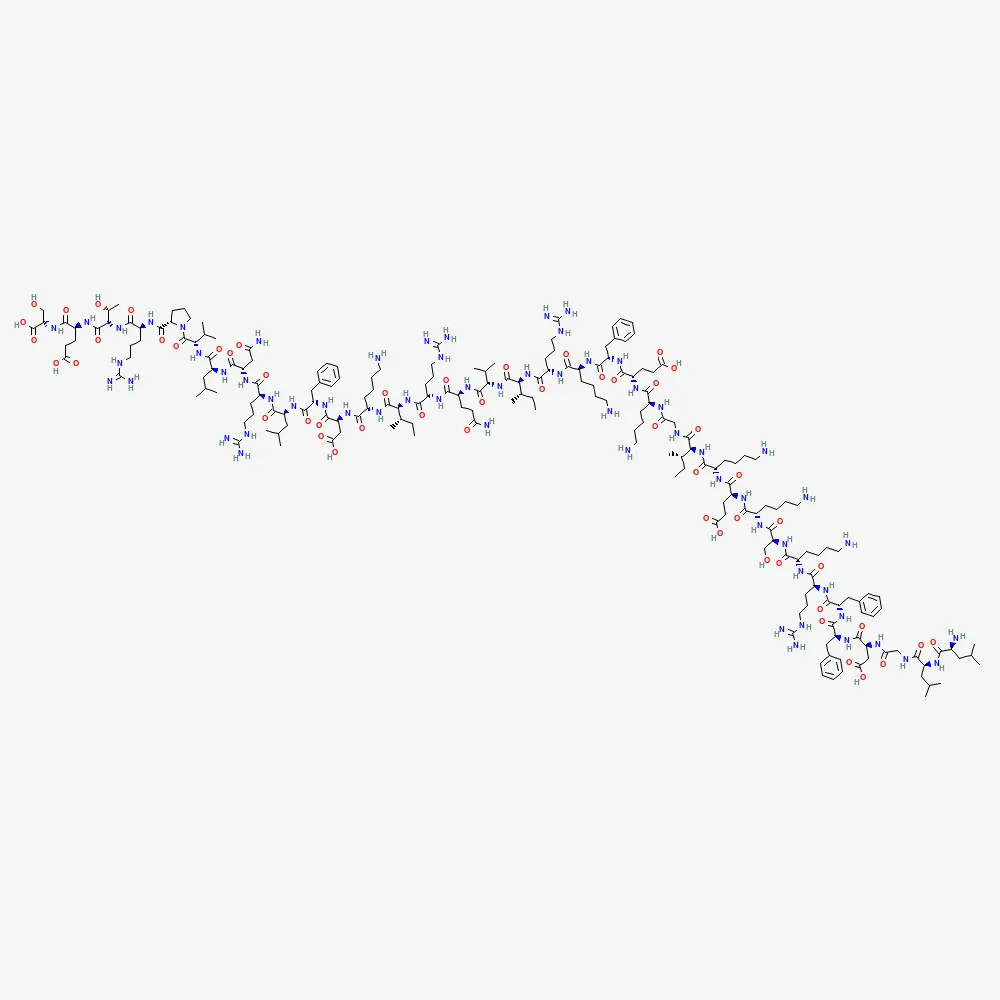
- Human cathelicidin antimicrobial peptide (37 residues, the C-terminal fragment of the hCAP18/CAMP precursor protein)
- Main use
- An antimicrobial peptide naturally present in human neutrophils, skin and mucosal surfaces. Sold as a research chemical for innate-immune and antimicrobial research; FDA has not approved it for any human use.
- Also called
- Cathelicidin LL-37, hCAP18 (37-146), CAMP gene product
- Molecular formula
- C205H340N60O53 (4493 g/mol) Structure
- Evidence
- Limited human data
- US status
- Research use only
- Half-life
- Not established in humans
- How it is taken
- Subcutaneous injection
- Common protocol
- 100-2000 mcg, 3-5 times weekly to once daily, subcutaneous, starting low and titrating up, for 4-12 weeks (common practice, not trial-established) Dosage chart
LL-37 is a peptide the human body already makes, part of the immune system’s first line of defence. When it has been given to people, as a solution or cream on chronic wounds, early trials reported faster healing and no safety concerns. That is a promising start. But most of the large literature studies the LL-37 people already carry, not extra doses, and no trial has tested the injections sold online.
This page covers what has been measured, by whom, and what FDA says about LL-37 as a compounding ingredient. Where the evidence stops, I say so.
Dosing: what the human wound-healing trials used.
US legal status - Research use only
Sold for laboratory research use only. Not approved by the FDA for human use, and cannot be lawfully marketed as a supplement or a medicine. Products sold this way are not made to pharmaceutical quality standards, and their contents are not verified by anyone.
What is LL-37?
LL-37 is a 37-amino-acid peptide, named for its first two amino acids (leucine, leucine) and its length. It is the end fragment of a larger protein, hCAP18, which neutrophils store in their granules. The enzyme proteinase 3 cuts it free after neutrophils release hCAP18, outside the cell; no cutting was detected inside neutrophils after they had engulfed microbes Sørensen 2001 - Sørensen OE, Follin P, Johnsen AH et al. Human cathelicidin, hCAP-18, is processed to the antimicrobial peptide LL-37 by extracellular cleavage with proteinase 3. Blood. 2001;97(12):3951-9., in the references below. Skin cells (keratinocytes) and the lining cells of mucous membranes also make it.
It is the only cathelicidin found in humans; other mammals carry several. It is positively charged on one face and fat-soluble on the other (cationic and amphipathic). That shape lets it bind and break open the negatively charged membranes of many bacteria.
It also works as a signal, recruiting and activating neutrophils, monocytes and T cells. It has been studied in wound healing and in inflammatory skin conditions such as psoriasis and rosacea, where levels run unusually high. All of this describes what the body’s own peptide does, not what extra LL-37 from a vial does.
LL-37 structure
LL-37 benefits: what the research shows
Small or uncontrolled human studies. Too little to settle the question either way. LL-37 has a large PubMed footprint because it is measured constantly as a biomarker, not because it has been tested as an administered drug. Four small trials have given it to people - topically on leg and foot ulcers, and orally as an engineered bacterial product in COVID-19 - and the larger leg-ulcer trial found no overall benefit over placebo; none tested an injection. FDA's own compounding review states it lacks sufficient safety-related information regarding cathelicidin LL-37 to know whether the drug would cause harm when administered to humans.
A PubMed search on 24 September 2026 returned 2,533 records mentioning LL-37 in the title or abstract. Sixty carry the clinical-trial tag.
That number mostly reflects measurement, not dosing. Everyone has LL-37 in their blood, skin and wound fluid, so most studies measure it as a marker in research on vitamin D, psoriasis, wound fluid or gum disease. A trial can measure LL-37 without giving it to anyone. I didn’t check how many of the 60 trial-tagged records actually dosed people, so I don’t list them.
Four trials I have read did give people LL-37:
- Venous leg ulcers, first-in-human trial. In 34 people with hard-to-heal ulcers, the healing rate at the two lower strengths was roughly six and three times that on placebo (statistically significant for the lowest), and mean ulcer area fell by 68% and 50%. The highest strength did no better than placebo Grönberg 2014 - Grönberg A, Mahlapuu M, Ståhle M et al. Treatment with LL-37 is safe and effective in enhancing healing of hard-to-heal venous leg ulcers: a randomized, placebo-controlled clinical trial. Wound Repair Regen. 2014;22(5):613-21., in the references below.
- Venous leg ulcers, larger trial. In 148 people, the topical solution showed no significant improvement in healing over placebo across the whole group Mahlapuu 2021 - Mahlapuu M, Sidorowicz A, Mikosinski J et al. Evaluation of LL-37 in healing of hard-to-heal venous leg ulcers: A multicentric prospective randomized placebo-controlled clinical trial. Wound Repair Regen. 2021;29(6):938-950., in the references below.
- Diabetic foot ulcers. Wounds treated with LL-37 cream built healing tissue faster than placebo at every weekly check Miranda 2023 - Miranda E, Bramono K, Yunir E et al. Efficacy of LL-37 cream in enhancing healing of diabetic foot ulcer: a randomized double-blind controlled trial. Arch Dermatol Res. 2023;315(9):2623-2633., in the references below.
- COVID-19. People in hospital took an oral product of bacteria engineered to make LL-37 Zhao 2023 - Zhao Y, Zhang H, Zhao Z et al. Efficacy and safety of Oral LL-37 against the Omicron BA.5.1.3 variant of SARS-COV-2: A randomized trial. J Med Virol. 2023;95(8):e29035., in the references below.
None of the four tested an injection.
FDA’s assessment is the clearest statement on giving it to people. Reviewing LL-37 as a proposed compounding ingredient, FDA says it lacks sufficient safety-related information regarding cathelicidin LL-37 to know whether the drug would cause harm when administered to humans. The safety question is open.
How it ranks against other peptides sold for inflammation: peptides for inflammation.
LL-37 dosage
The common LL-37 dose is 100-2000 mcg, 3-5 times weekly to once daily, subcutaneous, starting low and titrating up. From a 5 mg vial mixed with 2 mL of bacteriostatic water, 1 mg is 40 units (0.4 mL) on a U-100 insulin syringe.
Practitioner and vendor guides describe 100 mcg to 2 mg injected under the skin, 3-5 times a week to once a day, usually starting low and working up. Courses run 4-12 weeks with a 4-week break between them. That is common practice, not a dose any trial or regulator has set, and the sources disagree more than for most protocols on this site.
The human trials used different routes and doses entirely: a solution or cream on leg and foot ulcers, and in one COVID-19 trial an oral bacterial product. Full detail on both: LL-37 dosage.
LL-37 side effects
This section draws on FDA’s compounding-safety review and on the human trials that actually gave people LL-37.
FDA’s safety language for LL-37, kept on its compounding substances page, goes beyond “not enough data”. It names two animal or lab findings: possible harm to male reproduction, and evidence that the peptide can promote tumours (protumorigenic) in some tissues. Neither has been seen in a person, and FDA lists both as open questions of unknown size.
FDA also flags a risk of immune reactions for some routes of use. It notes problems with peptide-related impurities and with characterising the active ingredient. That is a caution about how consistently a product can be made and checked, not about the biology of the peptide.
Reported in studies
- Leg ulcers, 2014. The randomised, placebo-controlled first-in-human trial of topical LL-37 reported no local or whole-body safety concerns at any of the three strengths Grönberg 2014 - Grönberg A, Mahlapuu M, Ståhle M et al. Treatment with LL-37 is safe and effective in enhancing healing of hard-to-heal venous leg ulcers: a randomized, placebo-controlled clinical trial. Wound Repair Regen. 2014;22(5):613-21., in the references below.
- Leg ulcers, 2021. In 148 people, the topical solution was well tolerated and safe at both strengths Mahlapuu 2021 - Mahlapuu M, Sidorowicz A, Mikosinski J et al. Evaluation of LL-37 in healing of hard-to-heal venous leg ulcers: A multicentric prospective randomized placebo-controlled clinical trial. Wound Repair Regen. 2021;29(6):938-950., in the references below.
- COVID-19, 2023. In 238 people in hospital taking the oral bacterial product, there were no severe adverse events during the stay and follow-up Zhao 2023 - Zhao Y, Zhang H, Zhao Z et al. Efficacy and safety of Oral LL-37 against the Omicron BA.5.1.3 variant of SARS-COV-2: A randomized trial. J Med Virol. 2023;95(8):e29035., in the references below.
These are small trials of a product on an open wound or taken by mouth. They say nothing about an injected dose or about other uses.
Vendor protocols are usually injections under the skin, a route none of these trials used. No study has looked at injection-site reactions for LL-37; for redness, itching or swelling at the site in general, see injection-site reactions.
Is LL-37 legal?
LL-37 is not an FDA-approved drug. A DailyMed search on 24 September 2026 returned no results for “LL-37”: no approved product contains it.
It was nominated as a bulk ingredient for 503A compounding, and the nominator withdrew it. FDA keeps it in a table of withdrawn nominations, with the safety language above still attached. It has no USP or NF monograph and is not part of any FDA-approved drug, so pharmacies can’t currently compound it. Unlike BPC-157 and KPV, it was not on the agenda of FDA’s July 2026 Pharmacy Compounding Advisory Committee meeting, so it hasn’t had the same public review.
It is sold as a research chemical labelled not for human use. That label is not a legal shield: FDA judges a product by its intended use and treats the seller’s marketing as evidence of it.
Key risks
- FDA lacks enough safety information to know whether LL-37 would cause harm in humans.
- Animal and lab findings on male reproduction and tumour promotion remain unresolved.
- FDA flags immune-reaction risk for some routes, plus impurity and characterisation problems.
- The size of the LL-37 literature reflects how often the body’s own peptide is measured, not how well a dose has been tested. Record counts are not evidence of safety or effect.
- I found no verifiable human half-life, dose or route, so I don’t publish one.
Regulatory changes for this compound and others, as they happen: US peptide regulation tracker.
How LL-37 compares
Immune and inflammation. Doses for unapproved compounds are common practice, not trial-established. All immune and inflammation peptides →
| Compound | Main use | Evidence | Usual dose | US status |
|---|---|---|---|---|
| Thymosin alpha-1 | Licensed in a number of countries, classically for chronic hepatitis B. Sold online for general immune support. | Strong human evidence | 1.6 mg, twice weekly, subcutaneous injection, spaced 3-4 days apart | Research use only |
| LL-37 | An antimicrobial peptide naturally present in human neutrophils, skin and mucosal surfaces. Sold as a research chemical for innate-immune and antimicrobial research; FDA has not approved it for any human use. | Limited human data | 100-2000 mcg, 3-5 times weekly to once daily, subcutaneous, starting low and titrating up | Research use only |
| VIP | Sold to consumers as a research peptide marketed for immune modulation and inflammation. It is not an FDA-approved drug for any indication, and this site could not verify a completed human trial establishing benefit for that consumer use. | Limited human data | 50 mcg, 4-8 sprays a day, split across the day, alternating nostrils | Research use only |
| ARA-290 (Cibinetide) | An investigational peptide developed by Araim Pharmaceuticals for neuropathic pain and inflammation-related conditions. Never reached FDA approval for any indication; now sold to consumers as a research chemical. | Moderate human evidence | 1-8 mg, twice weekly to once daily, subcutaneous - a compounding pharmacy protocol titrates 2 mg toward 4 mg twice weekly, while the published phase 2b trial dosed 1, 4 or 8 mg once daily | Research use only |
Where to buy LL-37 for research
Each vendor is checked against my vendor checklist.
1.Next Level PharmFeatured
5 mg vial
- No FDA warning letter found
- Names its testing lab
- Batch COAs published
- Takes card payment
2.BioEdge Research Labs
5 mg vial
- No FDA warning letter found
- Names its testing lab
- Batch COAs published
Common questions
What is the usual LL-37 dose?
Practitioner and vendor guides describe 100 mcg to 2 mg injected under the skin, 3-5 times a week to once a day, usually starting low, for 4-12 weeks with a 4-week break between courses. That is common practice, not a tested dose, and the sources disagree more than for most protocols on this site. Full detail, including the human trials: [LL-37 dosage](/ll-37-dosage/).
Is LL-37 the same thing as being sold online?
The name refers to a specific sequence, but no regulator checks that a vendor vial matches its label or its stated purity. FDA's review of LL-37 as a compounding ingredient flags impurities and how the active ingredient is characterised as open concerns. That is a caution about manufacturing, not about the natural peptide.
Has LL-37 been tested in people?
It is measured in people constantly, because everyone makes it: researchers track LL-37 in blood, skin and wound fluid as a marker of infection or inflammation. Giving someone extra, synthetic LL-37 is a different question. FDA says it lacks enough safety information to know whether LL-37 would cause harm when given to humans.
Is LL-37 legal in the United States?
It is not an FDA-approved drug, and DailyMed lists no approved product containing it. Its nomination for FDA's 503A Bulks List was withdrawn, it has no USP or NF monograph, and it is not part of any approved drug, so pharmacies can't currently compound it. It is sold as a research chemical, not for human use.
Is LL-37 safe?
That hasn't been established. FDA says it lacks enough safety information to know whether LL-37 would cause harm in humans. It also cites animal and lab research suggesting harm to male reproduction and tumour promotion in some tissues. Those findings aren't proven human harms, but they aren't resolved either.
What are the side effects of LL-37 treatment?
None have been established for injected LL-37, the way vendor protocols use it. The human trials used a solution or cream on leg and foot ulcers, or an oral product of bacteria engineered to make LL-37, and found no safety concerns or no severe adverse events. FDA says it lacks enough safety information on giving LL-37 to humans, flags a risk of immune reactions for some routes, and lists the unresolved animal findings on reproduction and tumours.
Can LL-37 peptide help with weight loss?
No. LL-37 is not studied or approved for weight loss. It is an antimicrobial and immune-signalling peptide, and FDA's compounding review doesn't address weight. I found no verifiable clinical evidence for that use.
Is LL-37 more effective than antibiotics?
That hasn't been tested in humans. No completed human trial has compared it with a licensed antibiotic for treating infection, and FDA says it lacks enough safety information on giving it to people. Its antimicrobial activity has mostly been studied against bacteria in a dish, which is not a clinical comparison.
What is LL-37 peptide good for?
In the body, it helps fight infection: it disrupts bacterial membranes and recruits and activates immune cells such as neutrophils, monocytes and T cells. Those roles were measured in the peptide people already make. Giving extra, synthetic LL-37 has not been shown to be safe or effective, and no such use is FDA-approved.
References (10 sources)
Bibliographic detail is fetched from PubMed, not written by me - so a citation here cannot drift from the paper it names. Study design comes from PubMed's own tags rather than my judgement.
- 1.Grönberg A, Mahlapuu M, Ståhle M et al. Treatment with LL-37 is safe and effective in enhancing healing of hard-to-heal venous leg ulcers: a randomized, placebo-controlled clinical trial. Wound Repair Regen. 2014;22(5):613-21.Randomised trialPMID 25041740
- 2.Mahlapuu M, Sidorowicz A, Mikosinski J et al. Evaluation of LL-37 in healing of hard-to-heal venous leg ulcers: A multicentric prospective randomized placebo-controlled clinical trial. Wound Repair Regen. 2021;29(6):938-950.Randomised trialPMID 34687253full text
- 3.Miranda E, Bramono K, Yunir E et al. Efficacy of LL-37 cream in enhancing healing of diabetic foot ulcer: a randomized double-blind controlled trial. Arch Dermatol Res. 2023;315(9):2623-2633.Randomised trialPMID 37480520full text
- 4.Zhao Y, Zhang H, Zhao Z et al. Efficacy and safety of Oral LL-37 against the Omicron BA.5.1.3 variant of SARS-COV-2: A randomized trial. J Med Virol. 2023;95(8):e29035.Randomised trialPMID 37605995
- 5.Sørensen OE, Follin P, Johnsen AH et al. Human cathelicidin, hCAP-18, is processed to the antimicrobial peptide LL-37 by extracellular cleavage with proteinase 3. Blood. 2001;97(12):3951-9.StudyPMID 11389039
- 6.FDA - Certain Bulk Drug Substances for Use in Compounding That May Present Significant Safety Risks. Cathelicidin LL-37 appears in the "nominated but withdrawn" table (content current as of 22 April 2026).- US Food and Drug Administrationregulatory
- 7.DailyMed search for "LL-37", zero drug label results (searched 24 September 2026).- National Library of Medicinedatabase
- 8.NCBI E-utilities esearch: "LL-37" OR "cathelicidin LL-37" in title/abstract, 2,533 records (queried 24 September 2026).- National Center for Biotechnology Information, US National Library of Medicinedatabase
- 9.NCBI E-utilities esearch: the same LL-37 search restricted to the clinical-trial publication type, 60 records (queried 24 September 2026).- National Center for Biotechnology Information, US National Library of Medicinedatabase
- 10.FDA - July 23-24, 2026 Meeting of the Pharmacy Compounding Advisory Committee. Agenda and briefing materials name BPC-157, KPV, TB-500, MOTs-C, emideltide (DSIP), Semax and Epitalon; cathelicidin LL-37 is not among them (checked 24 September 2026).- US Food and Drug Administrationregulatory