MOTS-c: Benefits, Dosage, Side Effects and Legal Status
What MOTS-c is, how it works, common dosing, whether MOTS-c tablets work, side effects and legal status - human data is exercise studies, not injections.

The short version
MOTS-c is a small peptide your own mitochondria make. In mice it prevented diet-induced obesity and insulin resistance, and human studies show exercise raises it. No completed human trial has tested injecting it; a placebo-controlled Phase 2 trial in prediabetes is under way. The dosing charts online are extrapolated from mice and from exercise studies.
- Your body already makes it, and exercise raises it.
- No completed human trial has tested injecting MOTS-c. A Phase 2 trial is due to finish in 2027.
- It is not approved for human use, and it is banned in sport.
- I found no human study of MOTS-c taken by mouth, and the vendors I check sell vials, not tablets.
MOTS-c at a glance
- What it is
- Mitochondrial-derived peptide (16 amino acids)
- Main use
- Sold for metabolic health, fat loss and longevity. Studied in humans as a biomarker of exercise response.
- Also called
- Mitochondrial ORF of the 12S rRNA type-c, MOTS-C peptide
- Molecular formula
- C101H152N28O22S2 (2174.6 g/mol) Structure
- Evidence
- Animal / lab only
- US status
- Research use only
- Half-life
- Not established in humans
- How it is taken
- Subcutaneous injection
- Common protocol
- 2.5-10 mg, 2 to 3 times a week is most common, with some protocols ramping toward daily dosing at higher amounts, for 4-12 weeks (common practice, not trial-established) Dosage chart
MOTS-c is one of the more interesting compounds in the longevity world. Your own mitochondria make it, your body makes more of it when you exercise, and in mice it prevented diet-induced obesity and insulin resistance. A placebo-controlled trial is now testing it in people with prediabetes.
No completed human trial has tested injecting it yet, so the dosing charts and injection schedules online are ahead of the evidence.
Dosing: no human trial has ever injected MOTS-c - here is what the mouse study used.
What is MOTS-c?
MOTS-c is a 16-amino-acid peptide encoded inside mitochondrial DNA, in the 12S rRNA region, rather than in the cell nucleus. That is unusual, and it is most of why the peptide drew attention.
It was described in 2015 as helping keep metabolism in balance, working largely through AMPK Lee 2015 - Lee C, Zeng J, Drew BG et al. The mitochondrial-derived peptide MOTS-c promotes metabolic homeostasis and reduces obesity and insulin resistance. Cell Metab. 2015;21(3):443-54., in the references below, the same energy-sensing pathway that exercise and metformin act on. The lab and animal research since then is substantial, and reviews cover its proposed roles in metabolism, insulin sensitivity and ageing Zheng 2023 - Zheng Y, Wei Z, Wang T. MOTS-c: A promising mitochondrial-derived peptide for therapeutic exploitation. Front Endocrinol (Lausanne). 2023;14:1120533., in the references below Kong 2023 - Kong BS, Lee C, Cho YM. Mitochondrial-Encoded Peptide MOTS-c, Diabetes, and Aging-Related Diseases. Diabetes Metab J. 2023;47(3):315-324., in the references below.
MOTS-c structure
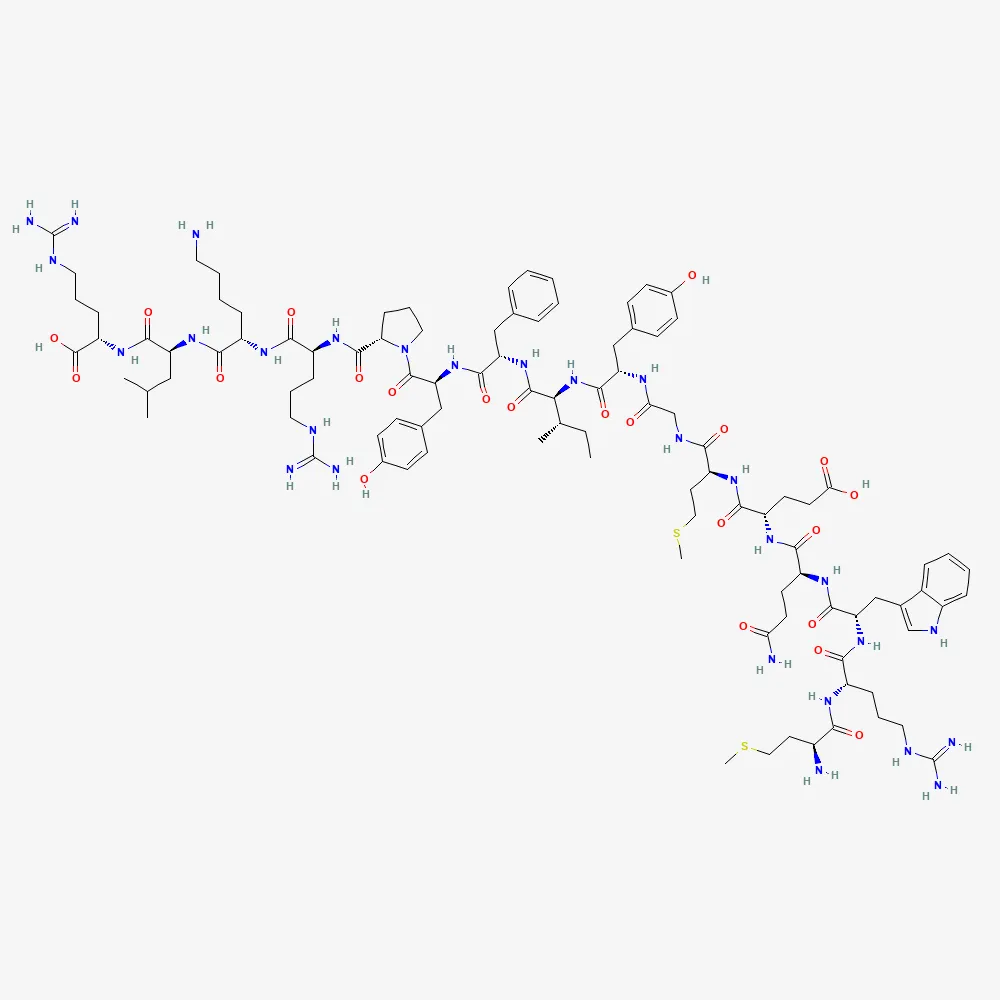
- Molecular formula
- C101H152N28O22S2
- Molecular weight
- 2174.6 g/mol
- Length
- 16 amino acids
- Sequence
- MRWQEMGYIFYPRKLR
- PubChem CID
- 146675088
Identity checked against UniProt (A0A0C5B5G6).
MOTS-c benefits: what the research shows
What’s promising. The 2015 paper that described MOTS-c found that, in mice, it prevented diet-induced obesity and insulin resistance Lee 2015 - Lee C, Zeng J, Drew BG et al. The mitochondrial-derived peptide MOTS-c promotes metabolic homeostasis and reduces obesity and insulin resistance. Cell Metab. 2015;21(3):443-54., in the references below. In people, your own MOTS-c responds to exercise, heat and metformin. That fits a peptide involved in how the body handles metabolic stress.
What’s missing. PubMed lists four MOTS-c records tagged as randomised controlled trials, and none gave anybody MOTS-c. They measured the MOTS-c people already had:
- Acute endurance exercise raised circulating mitochondrial-derived peptides von 2021 - von Walden F, Fernandez-Gonzalo R, Norrbom J et al. Acute endurance exercise stimulates circulating levels of mitochondrial-derived peptides in humans. J Appl Physiol (1985). 2021;131(3):1035-1042., in the references below.
- Aerobic and resistance exercise affected MOTS-c levels Dieli-Conwright 2021 - Dieli-Conwright CM, Sami N, Norris MK et al. Effect of aerobic and resistance exercise on the mitochondrial peptide MOTS-c in Hispanic and Non-Hispanic White breast cancer survivors. Sci Rep. 2021;11(1):16916., in the references below.
- Metformin treatment was associated with circulating MOTS-c levels in breast cancer patients Cuyàs 2022 - Cuyàs E, Verdura S, Martin-Castillo B et al. Circulating levels of MOTS-c in patients with breast cancer treated with metformin. Aging (Albany NY). 2022;15(4):892-897., in the references below.
- Repeated heat stress changed MOTS-c levels in active men Elhusseiny 2025 - Elhusseiny R, Ihsan M, Labidi M et al. Repeated Heat Stress Modulates the Levels of the Mitokines MOTS-C and FGF21 in Active Men during Calf Muscle Immobilization. Med Sci Sports Exerc. 2025;57(12):2764-2774., in the references below.
The one trial that does inject it
A placebo-controlled trial is giving MOTS-c by injection under the skin to adults with prediabetes and measuring insulin sensitivity. It was recruiting at my last check and has not reported anything.
That trial is why this compound is worth following. Until it reports, nobody can say what injected MOTS-c does in a person.
MOTS-c dosage
The common MOTS-c dose is 2.5-10 mg, 2 to 3 times a week is most common, with some protocols ramping toward daily dosing at higher amounts. From a 10 mg vial mixed with 1 mL of bacteriostatic water, 6.5 mg is 65 units (0.65 mL) on a U-100 insulin syringe.
There is no tested human dose yet. The Phase 2 trial above enrols 120 people and gives a fixed dose once a day by injection under the skin for 12 weeks, with primary completion listed for February 2027. Its registry entry doesn’t give the milligram amount. Until it reports, every published dose predates the one study designed to set one.
Clinics, practitioners and vendors most often describe 2.5-10 mg injected under the skin 2-3 times a week, for 4-12 weeks with a break between cycles. That is common practice, not a tested dose.
Where the charts actually come from
Mostly from mice, and from inference. The protocols agree closely with each other, but that mainly reflects shared sources rather than independent confirmation. Where a number traces to anything, it is an animal dose scaled by bodyweight, a clinician’s practice, or another website. Several sites that publish dosage charts admit, below the chart, that no completed human trial has validated a dose.
MOTS-c tablets and oral forms
MOTS-c tablets have no human data behind them: I found no human study that gave MOTS-c by mouth. The Phase 2 trial above injects it under the skin.
The three vendors I check sell it only as injectable powder. As of 3 October 2026, Spartan Peptides listed a 10 mg vial, and Next Level Pharm and BioEdge Research Labs listed 10 mg and 40 mg vials. None sells a tablet or capsule.
One mouse study tested the oral route directly. In mice with chemically induced colitis, MOTS-c injected into the abdomen eased the disease, but MOTS-c given by mouth made no significant difference Jiang 2023 - Jiang J, Chang X, Nie Y et al. Orally administered MOTS-c analogue ameliorates dextran sulfate sodium-induced colitis by inhibiting inflammation and apoptosis. Eur J Pharmacol. 2023;939:175469., in the references below. The authors then attached a cell-penetrating chain to it, and that modified molecule did work by mouth. It is a different compound from MOTS-c itself.
What is not known: whether any MOTS-c survives digestion and reaches the blood in a person, from a tablet or any other oral form. No published study I found has measured it. Other compounds sold as pills are compared in oral peptides.
MOTS-c side effects
No completed human trial has injected MOTS-c, so there is no human side-effect data for the injected product. The four human studies on this page all measure the MOTS-c a person’s own body makes. The Phase 2 trial in prediabetes hasn’t reported a safety result. The 2015 mouse study behind the dosage page measured body weight, glucose and food intake, not side effects.
That means there is no established safety threshold, no drug-interaction data and no regulator-reviewed list of who should avoid it. For redness, itching or swelling at the injection site, see injection-site reactions.
Is MOTS-c legal, and is it banned in sport?
US legal status - Research use only
Sold for laboratory research use only. Not approved by the FDA for human use, and cannot be lawfully marketed as a supplement or a medicine. Products sold this way are not made to pharmaceutical quality standards, and their contents are not verified by anyone.
MOTS-c is not approved for human use. Vendors sell it as a research chemical, and products in that channel aren’t made to pharmaceutical standards. No regulator checks that a vial matches its label. A third-party COA covers one batch’s identity and purity, not your vial or its sterility.
That may change. In July 2026 FDA’s Pharmacy Compounding Advisory Committee narrowly voted to recommend adding MOTS-c to the list of substances pharmacies may compound from, as ABC News reported. That is a recommendation to FDA, not a decision, and it would not make MOTS-c an approved drug.
MOTS-c is banned in sport, and USADA has published guidance on it specifically. If you are tested, this is not a grey area, whatever a seller’s page says.
Regulatory changes for this compound and others, as they happen: US peptide regulation tracker.
Related
How MOTS-c compares
Mitochondrial and metabolic. Doses for unapproved compounds are common practice, not trial-established. All longevity and mitochondria peptides →
| Compound | Main use | Evidence | Usual dose | US status |
|---|---|---|---|---|
| MOTS-c | Sold for metabolic health, fat loss and longevity. Studied in humans as a biomarker of exercise response. | Animal / lab only | 2.5-10 mg, 2 to 3 times a week is most common, with some protocols ramping toward daily dosing at higher amounts | Research use only |
| SS-31 | FDA-approved (accelerated approval, 2025) as Forzinity to improve muscle strength in Barth syndrome, a rare genetic mitochondrial disease. Sold online as a longevity and cellular-energy peptide. | Moderate human evidence | FDA label | FDA-approved · prescription only |
| Humanin | Sold online for anti-aging and neuroprotection claims. Studied almost entirely in cell cultures and rodents; no completed human efficacy trial was located for this page. | Animal / lab only | 0.5-5 mg, commonly once daily; some protocols use 2 to 3 times a week instead | Research use only |
| NAD+ (injection) | Sold by IV-therapy clinics and compounding pharmacies, by subcutaneous injection or IV infusion, for marketed energy, anti-aging, cognition and addiction-recovery claims. | Limited human data | 50-500 mg, 1-3 times a week by subcutaneous injection; many protocols start low, once weekly, and increase only if tolerated | Unapproved drug |
| SLU-PP-332 | A laboratory research chemical studied in mice as an "exercise mimetic" - it triggers some of the same muscle and metabolic gene programs endurance exercise does. Sold to consumers as a research chemical for that same effect, with no human study behind that use. | Animal / lab only | No consistent protocol | Unapproved drug |
| AICAR | Studied as an AMPK-activating "exercise mimetic" that boosted running endurance in sedentary mice; separately studied in humans, under the name acadesine, as an intravenous cardioprotective drug during heart bypass surgery - a use large trials found did not work. Now sold to consumers as an unapproved research-chemical endurance and metabolic product. | Limited human data | No consistent protocol | Unapproved drug |
| L-Carnitine (injection) | FDA-approved, as CARNITOR, for treating carnitine deficiency (a defined metabolic/biochemical condition): the injection also for the prevention and treatment of carnitine deficiency in dialysis patients, and the tablets and oral solution (including sugar-free CARNITOR SF) for primary and inherited-metabolic-disorder carnitine deficiency. This page covers the injection. Sold off-label, and through compounding and aesthetic-medicine clinics, as a "fat-burning" or metabolism-support injection for people without diagnosed deficiency. | Strong human evidence | FDA label | FDA-approved · prescription only |
Where to buy MOTS-c for research
Each vendor is checked against my vendor checklist.
1.Next Level PharmFeatured
10 mg vial
- No FDA warning letter found
- Names its testing lab
- Batch COAs published
- Takes card payment
2.Spartan Peptides
10 mg vial
- No FDA warning letter found
- Names its testing lab
3.BioEdge Research Labs
10 mg vial
- No FDA warning letter found
- Names its testing lab
- Batch COAs published
Common questions
Is there human evidence for MOTS-c?
Yes, but not the kind most people assume. The human studies measure the MOTS-c your own body makes, and show it rising with endurance exercise, resistance exercise, metformin and heat stress. They treat MOTS-c as a marker, not as a drug.
Has anyone tested injecting MOTS-c in people?
One placebo-controlled trial giving MOTS-c by injection under the skin to adults with prediabetes is recruiting and has not reported. No completed human trial has tested injected MOTS-c for insulin sensitivity, fat loss, performance or ageing.
What is the correct MOTS-c dosage?
No completed human trial has validated a dose. A Phase 2 study of 120 people is testing a fixed once-daily injection over 12 weeks, due to finish in February 2027; its registry entry doesn't give the milligram amount. The figures in dosage charts are extrapolated from mouse studies and from exercise research in which nobody was injected.
Is MOTS-c allowed in sport?
No. It is a prohibited substance, and USADA has published guidance on it specifically. If a seller says otherwise, check the current WADA list yourself.
What is the usual MOTS-c dose?
No completed human trial has tested a dose. Clinics, practitioners and vendors most often describe 2.5-10 mg injected under the skin 2-3 times a week, for 4-12 weeks with a break between cycles; some protocols build towards daily dosing at higher amounts. That is common practice, not a tested or approved dose.
Does MOTS-c come in pill form, and can it be taken orally?
The three vendors I check sell MOTS-c only as injectable vials, not tablets. I found no human study that gave it by mouth. In one mouse study of colitis, injected MOTS-c helped but oral MOTS-c made no significant difference; only a modified version with an added cell-penetrating chain worked by mouth.
What are the side effects of MOTS-c?
No completed human trial has injected MOTS-c, so there is no human side-effect data for the injected product. There is no established safety threshold, no drug-interaction data and no regulator-reviewed list of who should avoid it.
Is MOTS-c legal?
It is not approved for human use by the FDA or any other regulator. It is sold as a research chemical, which is the basis a vendor sells it on, not a claim that it is safe or works. It is also banned in sport, and USADA has published guidance on it specifically.
Is MOTS-c good for weight loss?
That hasn't been shown in people. No completed human trial has tested injected MOTS-c for weight or fat loss; the human studies measure the MOTS-c your body makes, for example during exercise. Weight-loss claims trace to mouse research. A Phase 2 trial in prediabetes, measuring insulin sensitivity and side effects rather than weight, is due to finish in February 2027.
Is it safe to take MOTS-c every day?
Nobody knows yet. With no completed human trial, there is no human safety data for any schedule. The Phase 2 trial gives a fixed dose once a day for 12 weeks but hasn't reported. The protocol most often described is 2-3 times a week, some building towards daily: common practice, not a tested regimen.
What peptide gets rid of belly fat?
MOTS-c hasn't been shown to reduce belly fat in people. Tesamorelin (Egrifta WR) is FDA-approved to reduce excess abdominal fat, but only in adults with HIV and lipodystrophy. Wegovy (semaglutide) and Zepbound (tirzepatide) are approved for chronic weight management, meaning overall weight, not belly fat specifically. Each is a prescriber's decision.
References (12 sources)
Bibliographic detail is fetched from PubMed, not written by me - so a citation here cannot drift from the paper it names. Study design comes from PubMed's own tags rather than my judgement.
- 1.Lee C, Zeng J, Drew BG et al. The mitochondrial-derived peptide MOTS-c promotes metabolic homeostasis and reduces obesity and insulin resistance. Cell Metab. 2015;21(3):443-54.StudyPMID 25738459full text
- 2.Zheng Y, Wei Z, Wang T. MOTS-c: A promising mitochondrial-derived peptide for therapeutic exploitation. Front Endocrinol (Lausanne). 2023;14:1120533.ReviewPMID 36761202full text
- 3.Kong BS, Lee C, Cho YM. Mitochondrial-Encoded Peptide MOTS-c, Diabetes, and Aging-Related Diseases. Diabetes Metab J. 2023;47(3):315-324.ReviewPMID 36824008full text
- 4.von Walden F, Fernandez-Gonzalo R, Norrbom J et al. Acute endurance exercise stimulates circulating levels of mitochondrial-derived peptides in humans. J Appl Physiol (1985). 2021;131(3):1035-1042.Randomised trialPMID 34351816full text
- 5.Dieli-Conwright CM, Sami N, Norris MK et al. Effect of aerobic and resistance exercise on the mitochondrial peptide MOTS-c in Hispanic and Non-Hispanic White breast cancer survivors. Sci Rep. 2021;11(1):16916.Randomised trialPMID 34413391full text
- 6.Cuyàs E, Verdura S, Martin-Castillo B et al. Circulating levels of MOTS-c in patients with breast cancer treated with metformin. Aging (Albany NY). 2022;15(4):892-897.Randomised trialPMID 36490309full text
- 7.Elhusseiny R, Ihsan M, Labidi M et al. Repeated Heat Stress Modulates the Levels of the Mitokines MOTS-C and FGF21 in Active Men during Calf Muscle Immobilization. Med Sci Sports Exerc. 2025;57(12):2764-2774.Randomised trialPMID 40674654
- 8.Jiang J, Chang X, Nie Y et al. Orally administered MOTS-c analogue ameliorates dextran sulfate sodium-induced colitis by inhibiting inflammation and apoptosis. Eur J Pharmacol. 2023;939:175469.StudyPMID 36528071
- 9.Spartan Peptides - MOTS-c product page: 10 mg vial, the only size; the catalogue has no capsule or oral products, as of 3 October 2026.- Spartan Peptidesother
- 10.Next Level Pharm - MOTS-c product page: 10 mg and 40 mg lyophilised vials; the catalogue sells no capsule products, as of 3 October 2026.- Next Level Pharmother
- 11.BioEdge Research Labs - MOTS-C product page: 10 mg and 40 mg vials; its capsule range does not include MOTS-c, as of 3 October 2026.- BioEdge Research Labsother
- 12.ABC News, 24 July 2026 - FDA advisers narrowly vote to add 6 peptides, including MOTS-c and Epitalon, to a drug compounding list; the vote is a recommendation to FDA, not a final decision.- ABC Newsnews