Humanin: Benefits, Dosage, Side Effects and the Research
Humanin: the preclinical evidence behind the anti-aging claims, the common practice dose, side effects, and its legal status.

The short version
Humanin is a small peptide encoded in mitochondrial DNA rather than a normal gene. Cell and rodent studies show it protecting cells under stress, and that work underpins its anti-aging marketing. No completed human trial has given humanin to people, and no human half-life has been measured, so none of those effects is established in humans.
- Encoded in mitochondrial DNA, not a normal nuclear gene.
- The research is in cells and rodents. I found no completed human trial.
- Not approved for human use anywhere, and no human half-life is established.
Humanin at a glance
- What it is
- Mitochondrial-derived peptide (24 amino acids)
- Main use
- Sold online for anti-aging and neuroprotection claims. Studied almost entirely in cell cultures and rodents; no completed human efficacy trial was located for this page.
- Also called
- HN
- Molecular formula
- C119H204N34O32S2 (2687.2 g/mol) Structure
- Evidence
- Animal / lab only
- US status
- Research use only
- Half-life
- Not established in humans
- How it is taken
- Subcutaneous injection
- Common protocol
- 0.5-5 mg, commonly once daily; some protocols use 2 to 3 times a week instead, for 4-12 weeks (common practice, not trial-established) Dosage chart
Humanin is a peptide made from mitochondrial DNA rather than a normal gene. Cell and rodent studies describe it protecting cells under stress, including against proteins linked to Alzheimer’s disease. It has not yet been given to people in a completed trial, so its anti-aging use rests on that early lab work for now.
Dosing: no human trial has ever given anyone an injection.
Studied in cells or animals. No controlled trials in humans. I found no completed human trial that gave humanin to people. The published research is cell and rodent work on brain protection, metabolic signalling and cardiovascular stress. The human studies that exist measure the humanin already in someone's blood as a marker, not the effect of giving it.
What is humanin?
Most peptides are made from instructions in the cell nucleus. Humanin is encoded by a short stretch of mitochondrial DNA, in the region that also codes for 16S ribosomal RNA. It is a 24-amino-acid peptide.
Researchers first described it in studies of how cells respond to mitochondrial stress. It is now one of a small family of “mitochondrial-derived peptides” that also includes MOTS-c. That origin is why it comes up in aging research, but it isn’t evidence that taking humanin does anything.
Humanin structure
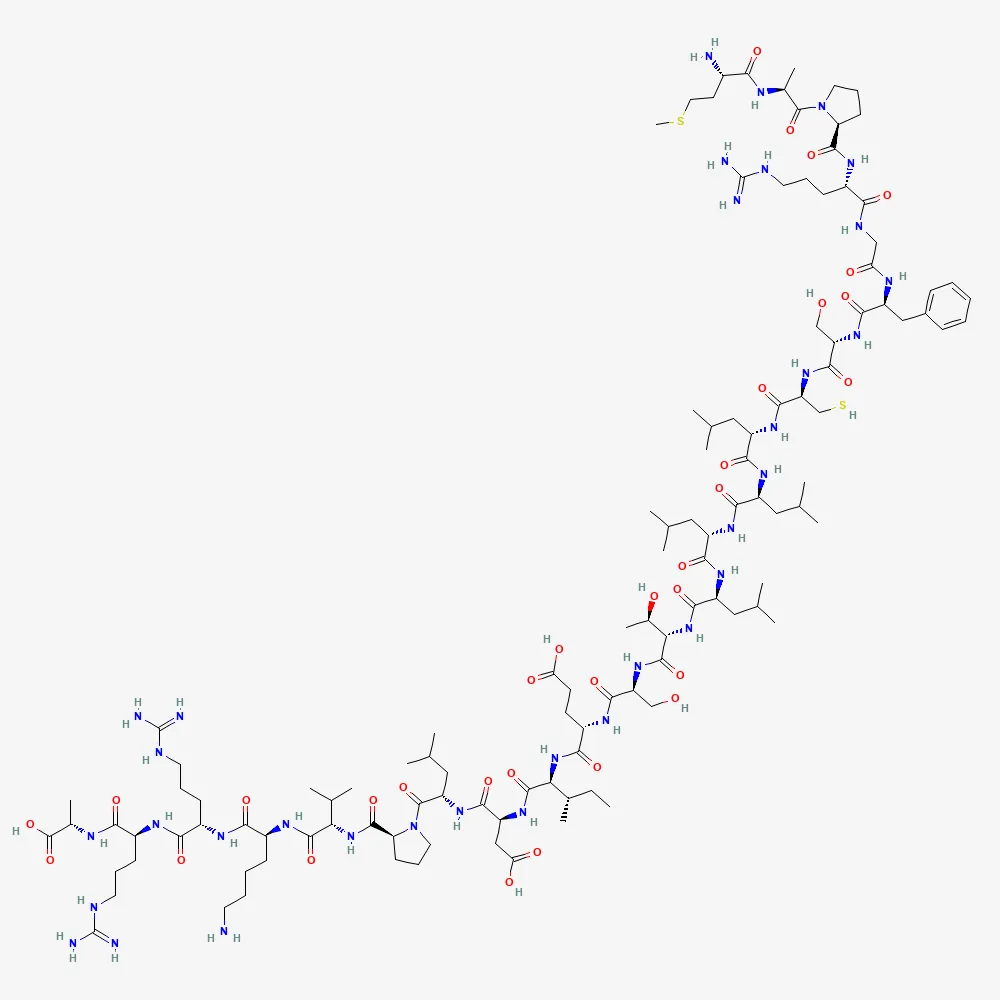
- Molecular formula
- C119H204N34O32S2
- Molecular weight
- 2687.2 g/mol
- Length
- 24 amino acids
- Sequence
- MAPRGFSCLLLLTSEIDLPVKRRA
- PubChem CID
- 16131438
Identity checked against UniProt (Q8IVG9).
How humanin works
Researchers propose that mitochondria release humanin as a signal when cells are under stress. It binds receptors that overlap with insulin-like growth factor and immune-signalling (cytokine) pathways. That is a plausible picture from cell and animal experiments, not yet confirmed in a living person.
Humanin benefits: what the research shows
The research I found is cell and rodent work on brain protection (neuroprotection), metabolic signalling and protection against cardiovascular stress. That work is real. It is why humanin is discussed in longevity science, and it is a reasonable basis for wanting a human trial.
The human research is a different kind of study. It measures the humanin people already make, in their blood, and links that level to age or disease. That shows what natural humanin does or predicts, not what happens if you take more, because nobody in those studies was given a dose. I found no completed human trial giving humanin as a treatment, for aging or anything else.
The most specific disease link is Alzheimer’s disease. NIH’s Pharos druggable-genome database describes humanin protecting cells against familial Alzheimer’s disease genes and amyloid-beta protein. It also lists humanin as a “Tdark” target, NIH’s label for a protein with very little published research. I name Alzheimer’s specifically because it is the link I could verify directly from a trusted source.
Humanin dosage
The common Humanin dose is 0.5-5 mg, commonly once daily; some protocols use 2 to 3 times a week instead. From a 5 mg vial mixed with 1 mL of bacteriostatic water, 3 mg is 60 units (0.6 mL) on a U-100 insulin syringe.
I found no human pharmacokinetic study, so there is no established human half-life, and no completed trial has tested a dose. Community and vendor sources commonly describe 0.5-5 mg of native humanin injected under the skin, once a day or a few times a week, for 4-12 weeks with breaks between cycles. That is common practice, not a tested dose. Full protocol and sourcing: humanin dosage.
Humanin side effects
No completed trial has given humanin to people, so there is no human side-effect profile at all. In practice that means:
- No side-effect data. Human studies only measure the humanin someone already makes, so they can’t show what happens when more is given.
- No pharmacokinetic data. Nobody knows how the body clears it, so there is no evidence-based way to judge one dose or schedule as more or less risky than another.
- Unverified product. Humanin sold online is an unregulated research chemical. No regulator checks that a vial matches its label for purity or contents, which is a risk separate from anything the peptide itself might do.
For redness, itching or swelling at the injection site, see injection-site reactions.
Is humanin legal?
US legal status - Research use only
Humanin is not FDA-approved for any use. I found no verified approval in any country. It is sold online as a research chemical, which is not made, tested or labelled to any pharmaceutical standard for human use.
I found nothing establishing humanin as an approved medicine, a regulated supplement, or a substance cleared for human use anywhere. A specific anti-aging dose on a product page goes beyond what human research has tested.
Related
Regulatory changes for this compound and others, as they happen: US peptide regulation tracker.
How Humanin compares
Mitochondrial and metabolic. Doses for unapproved compounds are common practice, not trial-established. All longevity and mitochondria peptides →
| Compound | Main use | Evidence | Usual dose | US status |
|---|---|---|---|---|
| MOTS-c | Sold for metabolic health, fat loss and longevity. Studied in humans as a biomarker of exercise response. | Animal / lab only | 2.5-10 mg, 2 to 3 times a week is most common, with some protocols ramping toward daily dosing at higher amounts | Research use only |
| SS-31 | FDA-approved (accelerated approval, 2025) as Forzinity to improve muscle strength in Barth syndrome, a rare genetic mitochondrial disease. Sold online as a longevity and cellular-energy peptide. | Moderate human evidence | FDA label | FDA-approved · prescription only |
| Humanin | Sold online for anti-aging and neuroprotection claims. Studied almost entirely in cell cultures and rodents; no completed human efficacy trial was located for this page. | Animal / lab only | 0.5-5 mg, commonly once daily; some protocols use 2 to 3 times a week instead | Research use only |
| NAD+ (injection) | Sold by IV-therapy clinics and compounding pharmacies, by subcutaneous injection or IV infusion, for marketed energy, anti-aging, cognition and addiction-recovery claims. | Limited human data | 50-500 mg, 1-3 times a week by subcutaneous injection; many protocols start low, once weekly, and increase only if tolerated | Unapproved drug |
| SLU-PP-332 | A laboratory research chemical studied in mice as an "exercise mimetic" - it triggers some of the same muscle and metabolic gene programs endurance exercise does. Sold to consumers as a research chemical for that same effect, with no human study behind that use. | Animal / lab only | No consistent protocol | Unapproved drug |
| AICAR | Studied as an AMPK-activating "exercise mimetic" that boosted running endurance in sedentary mice; separately studied in humans, under the name acadesine, as an intravenous cardioprotective drug during heart bypass surgery - a use large trials found did not work. Now sold to consumers as an unapproved research-chemical endurance and metabolic product. | Limited human data | No consistent protocol | Unapproved drug |
| L-Carnitine (injection) | FDA-approved, as CARNITOR, for treating carnitine deficiency (a defined metabolic/biochemical condition): the injection also for the prevention and treatment of carnitine deficiency in dialysis patients, and the tablets and oral solution (including sugar-free CARNITOR SF) for primary and inherited-metabolic-disorder carnitine deficiency. This page covers the injection. Sold off-label, and through compounding and aesthetic-medicine clinics, as a "fat-burning" or metabolism-support injection for people without diagnosed deficiency. | Strong human evidence | FDA label | FDA-approved · prescription only |
Where to buy Humanin for research
Each vendor is checked against my vendor checklist.
1.Next Level PharmFeatured
10 mg vial
- No FDA warning letter found
- Names its testing lab
- Batch COAs published
- Takes card payment
2.BioEdge Research Labs
10 mg vial
- No FDA warning letter found
- Names its testing lab
- Batch COAs published
Common questions
Is there human evidence for humanin?
Only indirectly. I found cell and rodent work, plus human studies that measure the humanin already in people's blood. I found no completed human trial that gave humanin as a treatment, so its effects in people are not established.
Is humanin FDA-approved or legal to buy for human use?
No. It is not FDA-approved for any use, and I found no approval in any country I checked. It is sold online as a research chemical, which is not the same as a product made or labelled for human use.
What is the usual humanin dose?
No completed human trial has tested one. Community and vendor sources commonly describe 0.5-5 mg of native humanin injected under the skin, once a day or a few times a week, for 4-12 weeks with breaks between cycles. That is common practice, not a tested dose; see the humanin dosage page.
What diseases is humanin linked to?
Mainly Alzheimer's disease. NIH's Pharos database describes humanin protecting cells against familial Alzheimer's disease genes and amyloid-beta protein, in cell and animal studies. Cell and rodent research also explores roles in metabolic and cardiovascular stress. None of this shows it treats any condition in people.
What are the side effects of humanin?
None are established, because no completed trial has given humanin to people; human studies only measure the humanin already in someone's blood. There is no human pharmacokinetic study either, so no way to judge one dose as safer than another. No regulator checks that a research-chemical vial matches its label.
What is the most risky peptide?
I can't rank humanin or any peptide by risk, because most research peptides, humanin included, have no completed human trial to compare. What can be checked is regulatory status: approved drugs have measured risks on their labels, and unapproved research chemicals don't. See Are peptides safe? for how I assess that.
What is humanin peptide used for?
It is not FDA-approved for any medical use. Online it is sold as a research chemical for anti-aging, based on cell and rodent studies of cell stress, brain protection and metabolism. I found no completed human trial that gave it to people, so none of those uses is established in humans.
References (1 sources)
Bibliographic detail is fetched from PubMed, not written by me - so a citation here cannot drift from the paper it names. Study design comes from PubMed's own tags rather than my judgement.
- 1.Pharos druggable-genome database- NIH Pharosdatabase