Vesugen (KED): What the Research Shows, Dosage and Legal Status
Vesugen (KED): a Khavinson vascular tripeptide with cell-culture gene-expression work from one Russian lab, two small uncontrolled human studies, no FDA approval.

The short version
Vesugen, also written as the tripeptide KED, is one of Vladimir Khavinson's organ-specific bioregulator peptides, marketed for blood-vessel and cardiovascular aging. The evidence is mostly gene-expression work in cultured cells from one Russian research group. There are also two small Russian human studies with no control group, and one of them found a fall in blood stem cells, a possible side effect.
- Vesugen is the tripeptide Lys-Glu-Asp (KED), studied mainly for gene activity in blood-vessel lining cells.
- Almost all published research comes from one Russian institute and its collaborators.
- Two small human studies exist, neither with a control group; one found pro-oxidant activity and a fall in blood stem cells.
- Not approved by the FDA or any other regulator, and sold as a research chemical.
Vesugen at a glance
- What it is
- Synthetic tripeptide (Lys-Glu-Asp)
- Main use
- Marketed as a vascular-tissue bioregulator for cardiovascular and blood-vessel aging; more recent papers from the same research group also study it as a candidate for age-related cognitive decline.
- Also called
- KED, KED peptide, Lys-Glu-Asp
- Molecular formula
- C15H26N4O8 (390.39 g/mol) Structure
- Evidence
- Limited human data
- US status
- Research use only
- Half-life
- Not established in humans
- How it is taken
- Subcutaneous injection
- Common protocol
- 500-5000 mcg, once daily, subcutaneous, commonly started low and titrated upward over the first 1-3 weeks, for 1.4-2.9 weeks (common practice, not trial-established)
Vesugen is one of several Khavinson bioregulator peptides covered on this site, alongside Epitalon and Pinealon. The same applies to all of them: the research is real, but it comes mostly from one Russian research lineage, and most of it is lab work rather than trials in people.
Small or uncontrolled human studies. Too little to settle the question either way. Vesugen's PubMed record is mostly gene-expression work in cultured human cells and a promoter-binding study in blood-vessel lining cells, plus two small Russian human studies with no control group, largely from one research group and its collaborators. I found no controlled human trial. A 2021 review from that group says, citing earlier work, that oral KED improved memory and attention in elderly people with CNS disorders. I could not find that primary trial, so it is reported below as the review's claim, not evidence I have confirmed.
What is Vesugen?
Vesugen is a short synthetic peptide from Vladimir Khavinson’s organ-specific bioregulator programme, the same research tradition that produced Epitalon and Pinealon. The scientific literature calls it KED, after its three amino acids (Lys-Glu-Asp). It is marketed as a vascular or “blood vessel” peptide for cardiovascular changes that come with aging.
Vesugen structure
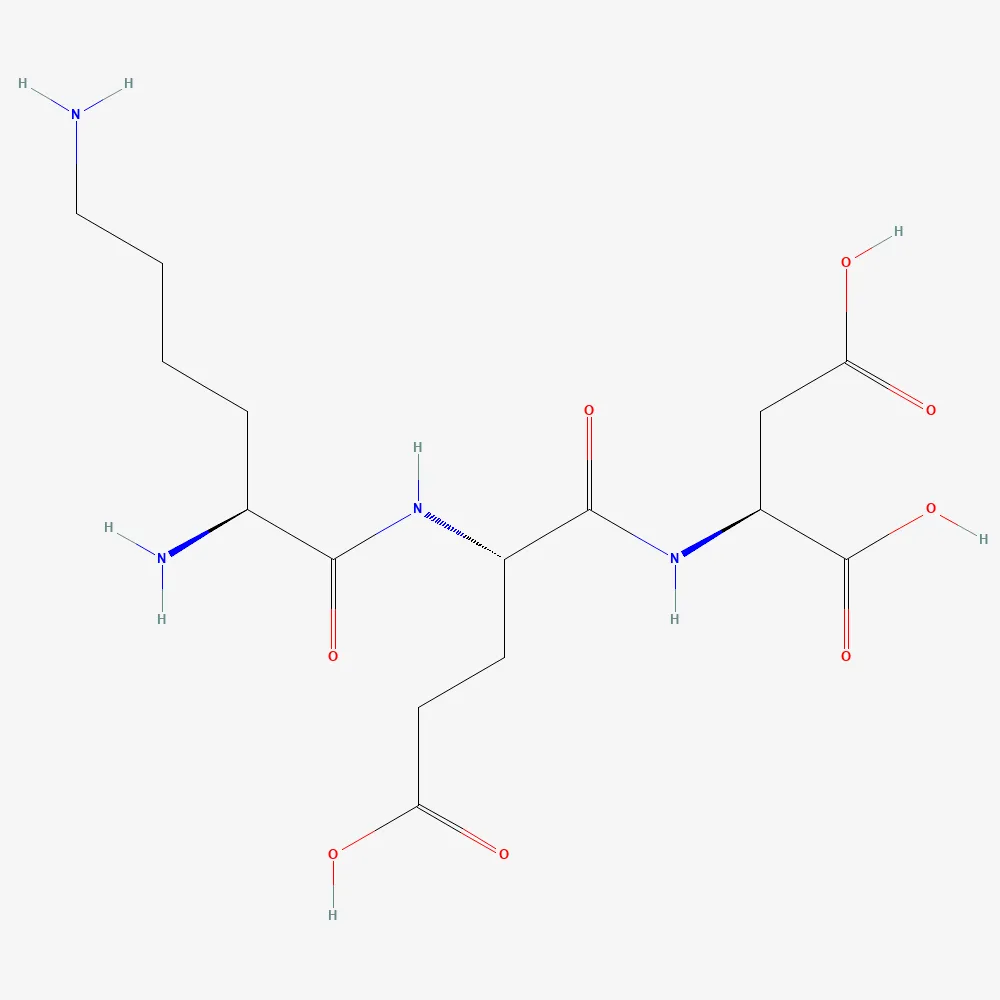
- Molecular formula
- C15H26N4O8
- Molecular weight
- 390.39 g/mol
- Length
- 3 amino acids
- Sequence
- KED
- PubChem CID
- 87571363
Identity checked against Molecules (2021 systematic review, PMID 34834147).
How Vesugen works
Researchers propose that KED acts directly on gene promoter regions rather than through a standard receptor on the cell surface. Two lab findings support that idea:
- In blood-vessel lining (endothelial) cells, a Khavinson-group study reports that Vesugen interacts with the promoter region of the Ki-67 gene. That triggers cell growth, a response the researchers say declines with age Khavinson 2014 - Khavinson VKh, Tarnovskaia SI, Lin'kova NS et al. [Epigenetic aspects of peptidergic regulation of vascular endothelial cell proliferation during aging]. Adv Gerontol. 2014;27(1):108-14., in the references below.
- In cultured human mesenchymal stem cells, KED and two related short peptides changed the activity of several genes tied to cell aging, including IGF1 and FOXO1 Ashapkin 2020 - Ashapkin V, Khavinson V, Shilovsky G et al. Gene expression in human mesenchymal stem cell aging cultures: modulation by short peptides. Mol Biol Rep. 2020;47(6):4323-4329., in the references below.
Both are gene-expression findings in cells in a dish. They don’t show an effect on blood vessels or aging in a living person.
Vesugen benefits: what the research shows
The vascular story above is the original framing. A newer line of work from the same group looks at something else: new nerve-cell growth and genes linked to Alzheimer’s disease. A 2021 review says KED regulates genes involved in cell aging and death, nerve-cell development and Alzheimer’s disease. Citing earlier reports rather than new trial data, it adds that oral KED improved memory and attention in elderly people with functional CNS disorders Khavinson 2021 - Khavinson VK, Lin'kova NS, Umnov RS. Peptide KED: Molecular-Genetic Aspects of Neurogenesis Regulation in Alzheimer's Disease. Bull Exp Biol Med. 2021;171(2):190-193., in the references below.
Two small human studies were published in Russian. Neither abstract describes a control group:
- Erectile dysfunction from atherosclerosis: in 41 men given Vesugen alone, blood flow in the main penile artery improved on clinical and instrument measures, before against after treatment Kitachev 2014 - Kitachev KV, Sazonov AB, Kozlov KL et al. [The efficacy of peptide bioregulators of vessels in lower limbs chronic arterial insufficiency treatment in old and elderly people]. Adv Gerontol. 2014;27(1):156-9., in the references below.
- Older adults with chronic illness: in 32 people aged 41-83 with several chronic illnesses and organic brain syndrome in remission, Vesugen and Pinealon slowed markers of “biological age”, Vesugen more so Meshchaninov 2015 - Meshchaninov VN, Tkachenko EL, Zharkov SV et al. [EFFECT OF SYNTHETIC PEPTIDES ON AGING OF PATIENTS WITH CHRONIC POLYMORBIDITY AND ORGANIC BRAIN SYNDROME OF THE CENTRAL NERVOUS SYSTEM IN REMISSION]. Adv Gerontol. 2015;28(1):62-7., in the references below.
Without a control group, neither study shows the peptide caused the change. Beyond these two studies and the review, I found no human trial of Vesugen for any outcome, and no controlled one at all.
Vesugen dosage
No published trial or regulator has set a dose. Research-chemical dosing guides describe 500 mcg to 5 mg injected under the skin once daily, from a 20 mg vial, in cycles of roughly 10-20 days. That is common practice, not trial-based, and the two sources I checked disagree a lot on the amount within that range.
Common protocol
What is commonly used, not a dose established in trials. No regulator has set a dose for Vesugen. Sources differ, so the ranges below span them.
- Dose per administration
- 500-5000 mcg
- How often
- once daily, subcutaneous, commonly started low and titrated upward over the first 1-3 weeks
- Route
- Subcutaneous injection
- Cycle length
- 1.4-2.9 weeks
- Common vial size
- 20 mg
Sources disagree sharply on the per-injection amount: one describes a titration from 500 mcg up to 1.5-2 mg over several weeks; the other describes 1-5 mg/day from the start of a fixed 10-day cycle. Both describe daily subcutaneous injection from a 20 mg vial and neither gives a specific break length between cycles, only that cycles are repeated periodically.
Plan a cycle in the protocol builder or work out injection volume in the dosage calculator.
The common Vesugen dose is 500-5000 mcg, once daily, subcutaneous, commonly started low and titrated upward over the first 1-3 weeks. From a 20 mg vial mixed with 2 mL of bacteriostatic water, 3 mg is 30 units (0.3 mL) on a U-100 insulin syringe.
Vesugen 20 mg vial: units per dose
Full 20 mg vial page: mixing, doses per vial, how long it lasts →
| Water added | Concentration | 1 unit = | 500 mcg | 3 mg | 5 mg |
|---|---|---|---|---|---|
| 1 mL | 20 mg/mL | 200 mcg | 2.5 units | 15 units | 25 units |
| 2 mL | 10 mg/mL | 100 mcg | 5 units | 30 units | 50 units |
| 3 mL | 6.67 mg/mL | 66.67 mcg | 7.5 units | 45 units | 75 units |
All Vesugen vial sizes: 20 mg
Units are on a standard U-100 insulin syringe (100 units = 1 mL), rounded to the nearest half unit - half-unit marks are on 0.3 mL syringes. Water volumes are examples: more water means more units per dose, not more doses per vial. For any other vial or dose, use the dosage calculator.
How many 20 mg vials a cycle takes
| Scenario | Dose | Doses a week | Weeks | Total | 20 mg vials |
|---|---|---|---|---|---|
| Low end of the common protocol | 500 mcg | 7 | 1.4 | 5 mg | 1 |
| High end of the common protocol | 5 mg | 7 | 2.9 | 100 mg | 5 |
Whole vials, rounded up. Plan a cycle with your own numbers in the protocol builder. Keep mixed vials cold and use them within the window in how long reconstituted peptides last; where to inject: subcutaneous injection sites.
Vesugen side effects
No study has systematically recorded Vesugen’s side effects, and no side-effect rate has been established in any peer-reviewed study.
The one safety-relevant human finding comes from the 32-person study above. The researchers found pro-oxidant activity and a fall in CD34+ blood stem cells, which they describe as significant suppression of blood-cell production Meshchaninov 2015 - Meshchaninov VN, Tkachenko EL, Zharkov SV et al. [EFFECT OF SYNTHETIC PEPTIDES ON AGING OF PATIENTS WITH CHRONIC POLYMORBIDITY AND ORGANIC BRAIN SYNDROME OF THE CENTRAL NERVOUS SYSTEM IN REMISSION]. Adv Gerontol. 2015;28(1):62-7., in the references below. The abstract doesn’t separate these results between Vesugen and Pinealon. The study found no change in how tightly chromatin was packed, which the authors took as a sign of safety in the cell nucleus, while saying it needs further study.
Vesugen is sold through unregulated research-chemical channels, where no regulator checks that a vial matches its label or purity. Because it is injected, see peptide injection-site reactions for what to watch for at the injection site, a general risk of injecting under the skin rather than something specific to this compound.
Is Vesugen legal?
US legal status - Research use only
Sold for laboratory research use only. Not approved by the FDA for human use, and cannot be lawfully marketed as a supplement or a medicine. Products sold this way are not made to pharmaceutical quality standards, and their contents are not verified by anyone.
Vesugen is not approved by the FDA or any other regulator for any use. It is sold through research-chemical channels rather than a regulated pharmaceutical supply chain.
Regulatory changes for this compound and others, as they happen: US peptide regulation tracker.
Related reading
- Bioregulator peptides: the Khavinson family, explained
- Epitalon - the longevity-focused peptide from the same research programme
- Pinealon - a cognition-focused peptide from the same programme
- Are peptides safe?
How Vesugen compares
Bioregulators. Doses for unapproved compounds are common practice, not trial-established. All bioregulators peptides →
| Compound | Main use | Evidence | Usual dose | US status |
|---|---|---|---|---|
| Vesugen | Marketed as a vascular-tissue bioregulator for cardiovascular and blood-vessel aging; more recent papers from the same research group also study it as a candidate for age-related cognitive decline. | Limited human data | 500-5000 mcg, once daily, subcutaneous, commonly started low and titrated upward over the first 1-3 weeks | Research use only |
| Epitalon | Sold for longevity and anti-aging on the basis of telomere research. | Animal / lab only | 5-10 mg, once nightly, every night, for the length of the cycle | Research use only |
| Pinealon | Sold for cognition, focus and healthy aging. | Limited human data | 1-2 mg, once daily, morning preferred; some protocols run 5 days a week rather than every day | Research use only |
| Cartalax | Marketed for cartilage and joint support, sold as a "cartilage bioregulator" for age-related joint wear. | Animal / lab only | 200 mcg, once daily | Research use only |
| Testagen | Marketed for testosterone and reproductive-system support, sold as a "testes bioregulator." | Animal / lab only | 10-20 mg, once daily by mouth | Research use only |
| Vilon | Marketed as a thymus and immune-system bioregulator, sold for immune support and healthy ageing. | Animal / lab only | 10-20 mg, once daily by mouth | Research use only |
| Cardiogen | Marketed as a heart-tissue bioregulator for cardiovascular aging, from the Khavinson organ-specific peptide programme. | Animal / lab only | 200-2000 mcg, once daily, subcutaneous, most commonly cited around 1 mg/day | Research use only |
| Prostamax | Marketed as a prostate-tissue bioregulator for age-related prostate change, from the Khavinson organ-specific peptide programme. | Animal / lab only | 750-2000 mcg, once daily, subcutaneous, often started lower and increased after 1-4 weeks | Research use only |
Where to buy Vesugen for research
Each vendor is checked against my vendor checklist.
1.BioEdge Research Labs
20 mg vial
- No FDA warning letter found
- Names its testing lab
- Batch COAs published
Common questions
What is the usual Vesugen dose?
No trial or regulator has set a dose. Two research-chemical dosing guides I checked describe one injection under the skin daily from a 20 mg vial, but disagree on the amount. One builds up from 500 mcg to 1.5-2 mg over several weeks; the other uses 1-5 mg/day from the start of a fixed 10-day cycle. See the dosing section below for the sources.
What are the side effects of Vesugen?
No study has systematically recorded its side effects, so there is no side-effect rate. One small study of 32 people given Vesugen and Pinealon, with no control group, found pro-oxidant activity and a fall in CD34+ blood stem cells, which the researchers called significant suppression of blood-cell production. The abstract doesn't separate the results by peptide.
References (5 sources)
Bibliographic detail is fetched from PubMed, not written by me - so a citation here cannot drift from the paper it names. Study design comes from PubMed's own tags rather than my judgement.
- 1.Khavinson VK, Lin'kova NS, Umnov RS. Peptide KED: Molecular-Genetic Aspects of Neurogenesis Regulation in Alzheimer's Disease. Bull Exp Biol Med. 2021;171(2):190-193.ReviewPMID 34173097
- 2.Ashapkin V, Khavinson V, Shilovsky G et al. Gene expression in human mesenchymal stem cell aging cultures: modulation by short peptides. Mol Biol Rep. 2020;47(6):4323-4329.StudyPMID 32399807
- 3.Khavinson VKh, Tarnovskaia SI, Lin'kova NS et al. [Epigenetic aspects of peptidergic regulation of vascular endothelial cell proliferation during aging]. Adv Gerontol. 2014;27(1):108-14.StudyPMID 25051766
- 4.Kitachev KV, Sazonov AB, Kozlov KL et al. [The efficacy of peptide bioregulators of vessels in lower limbs chronic arterial insufficiency treatment in old and elderly people]. Adv Gerontol. 2014;27(1):156-9.Clinical trialPMID 25051774
- 5.Meshchaninov VN, Tkachenko EL, Zharkov SV et al. [EFFECT OF SYNTHETIC PEPTIDES ON AGING OF PATIENTS WITH CHRONIC POLYMORBIDITY AND ORGANIC BRAIN SYNDROME OF THE CENTRAL NERVOUS SYSTEM IN REMISSION]. Adv Gerontol. 2015;28(1):62-7.StudyPMID 26390612