Pinealon: Dosage, Side Effects and Legal Status
The 1-2 mg protocol people use, the user-reported effects, and what Pinealon's 22-paper record actually shows.

The short version
Pinealon is a synthetic tripeptide from the Russian peptide-bioregulator programme, sold for cognition and ageing. PubMed holds 22 records for it: one tagged as a clinical trial, none randomised. There is a mechanism hypothesis and a few small Russian human studies reporting better psychological and biological-age scores, none with a placebo group described.
- 22 papers in total: one tagged as a clinical trial, no randomised trials.
- Most of the work is lab research; the human studies I could check are small Russian reports with no placebo group described.
- Not approved for human use; sold as a research chemical.
Pinealon at a glance
- What it is
- Synthetic tripeptide (Glu-Asp-Arg)
- Main use
- Sold for cognition, focus and healthy aging.
- Also called
- EDR peptide, Glu-Asp-Arg
- Molecular formula
- C15H26N6O8 (418.40 g/mol) Structure
- Evidence
- Limited human data
- US status
- Research use only
- Half-life
- Not established in humans
- How it is taken
- Subcutaneous injection
- Common protocol
- 1-2 mg, once daily, morning preferred; some protocols run 5 days a week rather than every day, for 1.4-3 weeks (common practice, not trial-established) Dosage chart
Dosing: what the evidence actually contains.
Pinealon has a small research record, so this is a short page. The interest in it is real: a proposed mechanism for how it regulates genes, a few small Russian human studies that reported improvements, and some well-known users who say it helped their sleep. What it doesn’t have yet is a randomised trial.
What is Pinealon?
Pinealon is a synthetic tripeptide of glutamic acid, aspartic acid and arginine, which is why the literature usually calls it EDR peptide. It comes from the same Russian peptide-bioregulator programme as Epitalon and shares that programme’s characteristics Khavinson 2002 - Khavinson VKh. Peptides and Ageing. Neuro Endocrinol Lett. 2002;23 Suppl 3:11-144., in the references below.
It is sold for cognition, focus and healthy ageing.
Pinealon structure
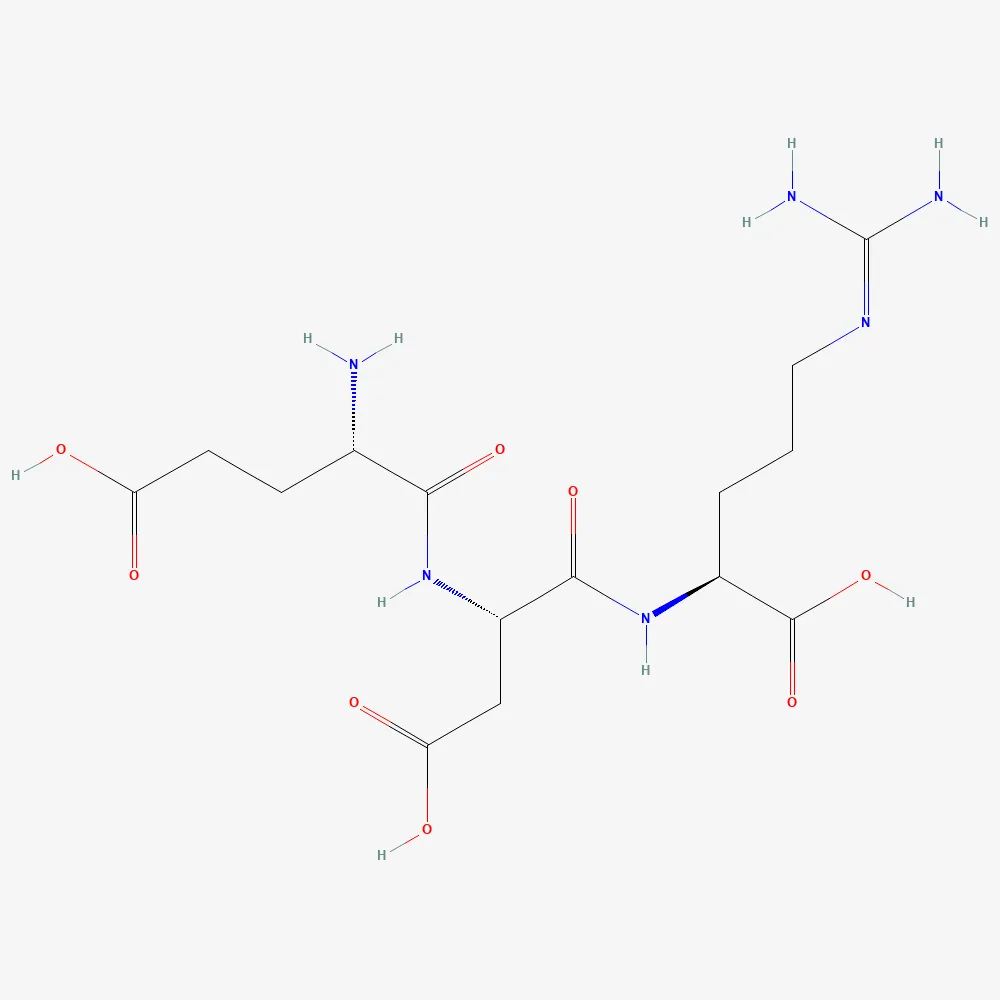
- Molecular formula
- C15H26N6O8
- Molecular weight
- 418.40 g/mol
- Length
- 3 amino acids
- Sequence
- EDR
- PubChem CID
- 10273502
Identity checked against Molecules (2021 systematic review, PMID 34834147).
Pinealon benefits: what the research shows
Most of the real work is lab research proposing how the peptide might regulate gene expression and protein synthesis Khavinson 2020 - Khavinson V, Linkova N, Kozhevnikova E et al. EDR Peptide: Possible Mechanism of Gene Expression and Protein Synthesis Regulation Involved in the Pathogenesis of Alzheimer's Disease. Molecules. 2020;26(1)., in the references below.
At least four Russian studies gave pinealon to people. None of their abstracts describes a placebo group:
- Lorry drivers, 2012. 150 professional drivers had better psychological and emotional scores after bioregulator peptides, with the best result from pinealon combined with vesugen. The abstract doesn’t say how many drivers got peptides or whether a placebo was used Bashkireva 2012 - Bashkireva AS, Artamonova VG. [The peptide correction of neurotic disorders among professional truck-drivers]. Adv Gerontol. 2012;25(4):718-28., in the references below.
- Adults with chronic illness, 2015. In adults aged 41-83 with several chronic conditions and organic brain syndrome, pinealon and vesugen slowed measures of biological age. The abstract gives 32 participants but a breakdown of 18 men and 12 women, which adds up to 30, and describes no control group Meshchaninov 2015 - Meshchaninov VN, Tkachenko EL, Zharkov SV et al. [EFFECT OF SYNTHETIC PEPTIDES ON AGING OF PATIENTS WITH CHRONIC POLYMORBIDITY AND ORGANIC BRAIN SYNDROME OF THE CENTRAL NERVOUS SYSTEM IN REMISSION]. Adv Gerontol. 2015;28(1):62-7., in the references below.
- Locomotive crews, 2012. Workers took one 100 mcg pinealon capsule by mouth twice a day for two weeks and had better biological-age and adaptation measures. The abstract gives no participant count and no comparison group Nazimko 2012 - Nazimko VA, Morgul' EV, Petrova OA et al. [Analysis of some parameters of biological age and adaptation possibilities of workers of locomotive brigades]. Adv Gerontol. 2012;25(1):57-62., in the references below.
- Anti-ageing methods compared, 2016. In 110 people, vesugen with pinealon had the most marked effect on biological-age indicators. The abstract doesn’t say the groups were randomised or give doses Myakotnykh 2016 - Myakotnykh VS, Torgashov MN, Egorin KV et al. [Comparative analysis of different methods of geroprotective]. Adv Gerontol. 2016;29(4):594-601., in the references below.
How pinealon compares with other peptides sold for sleep: peptides for sleep.
Pinealon dosage
The common Pinealon dose is 1-2 mg, once daily, morning preferred; some protocols run 5 days a week rather than every day. From a 10 mg vial mixed with 2 mL of bacteriostatic water, 1.5 mg is 30 units (0.3 mL) on a U-100 insulin syringe.
No clinical trial establishes a dose. Clinic and vendor guides commonly describe 1-2 mg injected under the skin once a day in the morning, with some protocols running it 5 days a week, for a 10-20 day cycle with a several-month break. That is common practice, not a trial-tested dose. The full dosage page gives the sourcing.
The one human study whose abstract states a dose used 100 mcg capsules by mouth twice a day for two weeks. That is an oral dose, not the injected protocol above Nazimko 2012 - Nazimko VA, Morgul' EV, Petrova OA et al. [Analysis of some parameters of biological age and adaptation possibilities of workers of locomotive brigades]. Adv Gerontol. 2012;25(1):57-62., in the references below.
Pinealon side effects
There is no systematic human safety data for Pinealon. With no controlled trial published, there is no adverse-reaction rate, no FDA label and no controlled tolerability study.
Reported in studies
- Blood-cell effects, 2015. In the study of adults given pinealon and vesugen, the authors recorded pro-oxidant activity on chemiluminescence testing and a fall in blood CD34+ stem cells. They called this significant inhibition of blood-cell formation, a possible side effect. The abstract doesn’t say which peptide caused it. The authors also found no change in chromatin condensation, which they read as safety at the level of the cell nucleus, while saying it needs more study Meshchaninov 2015 - Meshchaninov VN, Tkachenko EL, Zharkov SV et al. [EFFECT OF SYNTHETIC PEPTIDES ON AGING OF PATIENTS WITH CHRONIC POLYMORBIDITY AND ORGANIC BRAIN SYNDROME OF THE CENTRAL NERVOUS SYSTEM IN REMISSION]. Adv Gerontol. 2015;28(1):62-7., in the references below.
- No adverse-event data, 2012. The lorry-driver abstract reports none Bashkireva 2012 - Bashkireva AS, Artamonova VG. [The peptide correction of neurotic disorders among professional truck-drivers]. Adv Gerontol. 2012;25(4):718-28., in the references below.
- Rated safest, 2016. The comparison rated massage and the peptide preparations the safest of the methods tested, judged on biochemical and immune measures and clinical condition. Its abstract gives no adverse-event counts Myakotnykh 2016 - Myakotnykh VS, Torgashov MN, Egorin KV et al. [Comparative analysis of different methods of geroprotective]. Adv Gerontol. 2016;29(4):594-601., in the references below.
The lab work describes effects on gene and protein expression. That is a mechanism proposal, not a safety finding.
Reported by users
Andrew Huberman has said pinealon improved his sleep, while noting he doesn’t take it regularly; see what well-known people have said below. Beyond that, I couldn’t find an independent survey, case report or reputable reporting on users’ experience. The vivid dreams, mild headache and injection-site irritation that circulate come from sellers’ own pages, so I note them without treating them as evidence.
Because it is sold as a research chemical, no regulator checks that a vial’s purity and contents match its label. That is a separate risk on top of the missing safety data, not a side effect of the molecule itself.
For the injection itself, injection-site reactions explains what is ordinary and what needs attention.
Is Pinealon legal?
US legal status - Research use only
Sold for laboratory research use only. Not approved by the FDA for human use, and cannot be lawfully marketed as a supplement or a medicine. Products sold this way are not made to pharmaceutical quality standards, and their contents are not verified by anyone.
Not approved for human use, and sold as a research chemical, so no regulator checks that a vial matches its label. A third-party COA covers one batch’s identity and purity, not your vial or its sterility.
Regulatory changes for this compound and others, as they happen: US peptide regulation tracker.
Where this leaves you
I cover compounds people are actually buying, and Pinealon is one of them. I’ve kept this page short so its length matches the evidence rather than implying more of it.
For the full argument, the Epitalon and Semax and Selank pages cover this research tradition and what can and can’t be concluded from it. Pinealon sits at the thinnest end of it.
How Pinealon compares
Bioregulators. Doses for unapproved compounds are common practice, not trial-established. All bioregulators peptides →
| Compound | Main use | Evidence | Usual dose | US status |
|---|---|---|---|---|
| Pinealon | Sold for cognition, focus and healthy aging. | Limited human data | 1-2 mg, once daily, morning preferred; some protocols run 5 days a week rather than every day | Research use only |
| Epitalon | Sold for longevity and anti-aging on the basis of telomere research. | Animal / lab only | 5-10 mg, once nightly, every night, for the length of the cycle | Research use only |
| Cartalax | Marketed for cartilage and joint support, sold as a "cartilage bioregulator" for age-related joint wear. | Animal / lab only | 200 mcg, once daily | Research use only |
| Testagen | Marketed for testosterone and reproductive-system support, sold as a "testes bioregulator." | Animal / lab only | 10-20 mg, once daily by mouth | Research use only |
| Vilon | Marketed as a thymus and immune-system bioregulator, sold for immune support and healthy ageing. | Animal / lab only | 10-20 mg, once daily by mouth | Research use only |
| Vesugen | Marketed as a vascular-tissue bioregulator for cardiovascular and blood-vessel aging; more recent papers from the same research group also study it as a candidate for age-related cognitive decline. | Limited human data | 500-5000 mcg, once daily, subcutaneous, commonly started low and titrated upward over the first 1-3 weeks | Research use only |
| Cardiogen | Marketed as a heart-tissue bioregulator for cardiovascular aging, from the Khavinson organ-specific peptide programme. | Animal / lab only | 200-2000 mcg, once daily, subcutaneous, most commonly cited around 1 mg/day | Research use only |
| Prostamax | Marketed as a prostate-tissue bioregulator for age-related prostate change, from the Khavinson organ-specific peptide programme. | Animal / lab only | 750-2000 mcg, once daily, subcutaneous, often started lower and increased after 1-4 weeks | Research use only |
Where to buy Pinealon for research
Each vendor is checked against my vendor checklist.
1.Spartan PeptidesFeatured
20 mg vial
- No FDA warning letter found
- Names its testing lab
2.BioEdge Research Labs
20 mg vial
- No FDA warning letter found
- Names its testing lab
- Batch COAs published
Common questions
Is there any human evidence for Pinealon?
Very little. PubMed has 22 records: one tagged as a clinical trial, none as a randomised trial. At least four Russian studies gave pinealon to people, including 150 lorry drivers (2012), about 30 adults with chronic illness (2015), locomotive-crew workers (2012) and 110 people in a 2016 comparison. They reported better psychological or biological-age scores, but none of the abstracts describes a placebo group. Several other human-tagged records turn out to be about unrelated subjects.
What does the research that exists actually show?
Most of it is lab work proposing how the peptide might influence gene expression and protein synthesis. That is a hypothesis about how it could work, not evidence that it does. The small human studies I could check are Russian reports whose abstracts describe no placebo group.
What is the usual Pinealon dose?
No clinical trial establishes one. Clinic and vendor guides commonly describe 1-2 mg injected under the skin once a day in the morning (some run it 5 days a week), for a 10-20 day cycle with a several-month break. That is common practice, not a trial-tested number. See the [full dosage page](/pinealon-dosage/) for the sourcing.
What are the side effects of Pinealon?
With no controlled trial, there is no established side-effect rate. A small 2015 Russian study of about 30 adults given pinealon and vesugen reported pro-oxidant activity and a fall in blood stem cells (CD34+ cells), not attributed to either peptide specifically. Vivid dreams, mild headache and injection-site irritation are reported online, mostly on sellers' pages, with no controlled study behind them.
What is Pinealon good for?
It is sold for cognition, focus and healthy ageing, but that is a marketing use, not an established benefit. The evidence is mostly lab work on gene expression, plus a few small Russian human studies reporting better biological-age or psychological scores, with no placebo group described. No randomised trial shows it is good for anything.
How long does it take for Pinealon to work?
No study establishes a time to effect. The one human study that states a dose gave 100 mcg capsules by mouth twice a day for two weeks and reported changes in biological-age and adaptation measures, with no comparison group. Injected cycles commonly run 10-20 days, but that is common practice, not a measured onset.
Who should not take Pinealon?
No regulator or trial has defined that, because there is no approved label and I found no controlled safety study. It is sold as a research chemical, and one small study of people given it with vesugen reported a fall in blood stem cells. Nothing on this site recommends taking it; anyone on prescribed medication should ask their prescriber first.
What well-known people have said about Pinealon
Public statements, shown because people search for them. Each is one person's account, in their words or a faithful summary, with where and when they said it. None of it is evidence that Pinealon works or is safe; that is what the rest of this page is for.

Andrew HubermanStanford neuroscientist, host of Huberman LabSaid they use it
Huberman told guest Dr. Craig Koniver that he had been trying pinealon, including an injectable form combined with glycine, occasionally over the previous four to six months, and that it had improved his sleep, including on nights he did not take it. In a June 2026 episode with Dr. Abud Bakri he said he does not take it regularly.
“Pinealon has been incredible.”
Huberman Lab, 'Dr. Craig Koniver: Peptide & Hormone Therapies for Health, Performance & Longevity', 7 October 2024. Source: Huberman Lab (episode page and transcript) · Huberman Lab (2026-06-01 episode with Dr. Abud Bakri; he says he has tried pinealon a few times and does not take it regularly)
Photo: Jamesbrianbounds, CC BY-SA 4.0, via Wikimedia Commons
References (6 sources)
Bibliographic detail is fetched from PubMed, not written by me - so a citation here cannot drift from the paper it names. Study design comes from PubMed's own tags rather than my judgement.
- 1.Khavinson V, Linkova N, Kozhevnikova E et al. EDR Peptide: Possible Mechanism of Gene Expression and Protein Synthesis Regulation Involved in the Pathogenesis of Alzheimer's Disease. Molecules. 2020;26(1).ReviewPMID 33396470full text
- 2.Khavinson VKh. Peptides and Ageing. Neuro Endocrinol Lett. 2002;23 Suppl 3:11-144.ReviewPMID 12374906
- 3.Meshchaninov VN, Tkachenko EL, Zharkov SV et al. [EFFECT OF SYNTHETIC PEPTIDES ON AGING OF PATIENTS WITH CHRONIC POLYMORBIDITY AND ORGANIC BRAIN SYNDROME OF THE CENTRAL NERVOUS SYSTEM IN REMISSION]. Adv Gerontol. 2015;28(1):62-7.StudyPMID 26390612
- 4.Bashkireva AS, Artamonova VG. [The peptide correction of neurotic disorders among professional truck-drivers]. Adv Gerontol. 2012;25(4):718-28.Clinical trialPMID 23734521
- 5.Nazimko VA, Morgul' EV, Petrova OA et al. [Analysis of some parameters of biological age and adaptation possibilities of workers of locomotive brigades]. Adv Gerontol. 2012;25(1):57-62.StudyPMID 22708445
- 6.Myakotnykh VS, Torgashov MN, Egorin KV et al. [Comparative analysis of different methods of geroprotective]. Adv Gerontol. 2016;29(4):594-601.StudyPMID 28539017