Cartalax: What It Is, Dosage and What the Evidence Shows
Cartalax is sold as a cartilage bioregulator. No study uses that name; the evidence for its exact peptide is mostly kidney research in cells and rats, not cartilage.

The short version
Cartalax is a synthetic three-amino-acid peptide (Ala-Glu-Asp) from the Khavinson bioregulator programme in St Petersburg, sold as a "cartilage bioregulator" for joint ageing. No PubMed-indexed study uses the name Cartalax. The checkable studies of its exact sequence are mostly in kidney cells and rat kidneys, plus one rat bone-loss study, not cartilage.
- No study named "Cartalax" exists in PubMed; a title and abstract search returns zero results.
- The exact molecule (Ala-Glu-Asp, lab code T-31) has been tested, mostly in kidney cells and rat kidneys plus one rat bone-loss study, not cartilage.
- Dosing guides most often describe about 200 mcg injected under the skin once a day in 10-day courses. That is common practice, not a tested dose.
- Evidence for the whole bioregulator family comes mostly from one Russian research group.
Cartalax at a glance
- What it is
- Synthetic tripeptide (Ala-Glu-Asp), one of the Khavinson-group short peptide bioregulators
- Main use
- Marketed for cartilage and joint support, sold as a "cartilage bioregulator" for age-related joint wear.
- Also called
- AED peptide, Ala-Glu-Asp, T-31
- Molecular formula
- C12H19N3O8 (333.29 g/mol) Structure
- Evidence
- Animal / lab only
- US status
- Research use only
- Half-life
- Not established in humans
- How it is taken
- Subcutaneous injection
- Common protocol
- 200 mcg, once daily, for 1.4 weeks (common practice, not trial-established)
Cartalax is one of the Khavinson-group peptide bioregulators, sold for cartilage and joint health. In the published research, though, its exact peptide has mostly been tested on kidneys, not cartilage.
What is Cartalax?
Cartalax is a synthetic chain of three amino acids: Ala-Glu-Asp (alanine, glutamic acid, aspartic acid). It comes from the St Petersburg peptide-bioregulator programme described on the bioregulator hub page. Vendors market it for cartilage and joint ageing, while other short peptides in the family are sold for the thymus, pineal gland or other organs.
Cartalax structure
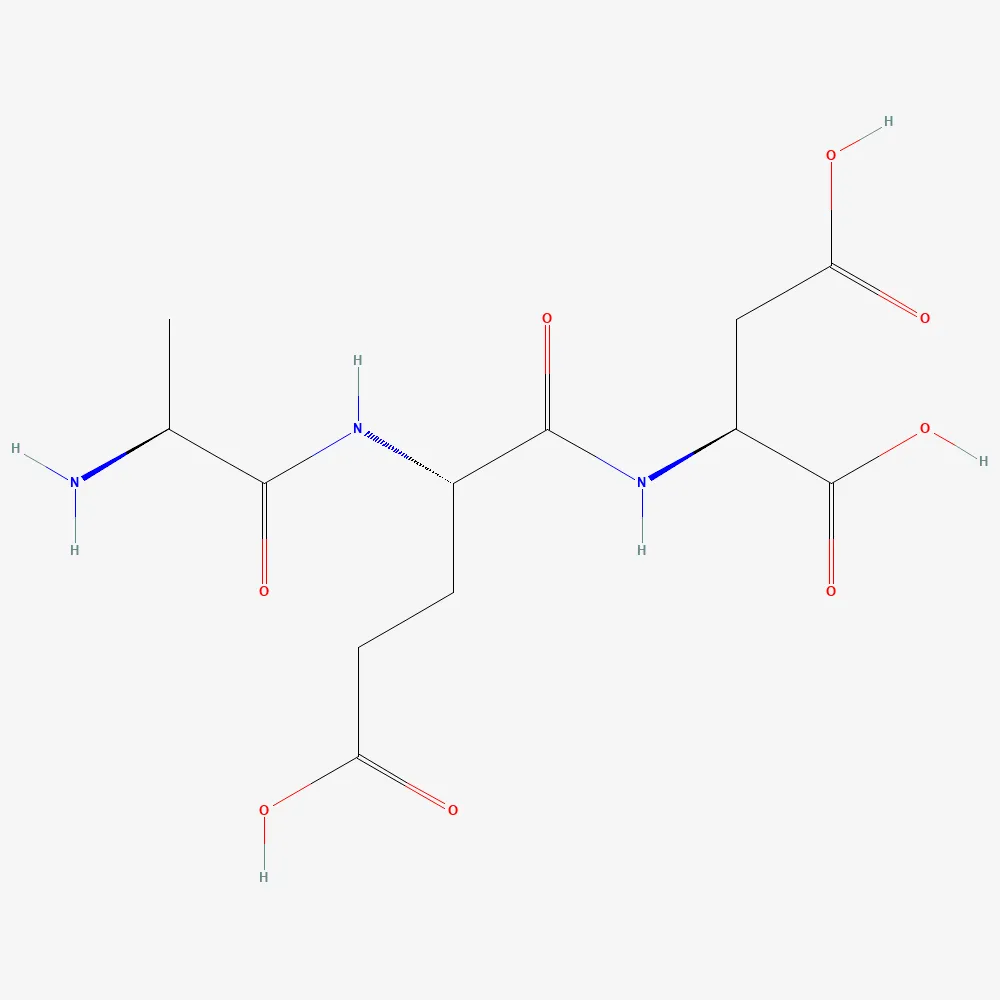
- Molecular formula
- C12H19N3O8
- Molecular weight
- 333.29 g/mol
- Length
- 3 amino acids
- Sequence
- AED
- PubChem CID
- 87815447
Also coded T-31 in the Khavinson-group papers.
Identity checked against Molecules (2021 systematic review, PMID 34834147).
How Cartalax works
The bioregulator theory holds that short peptides like this one enter cells and act on DNA-binding sites to shift which genes are switched on, towards tissue renewal and away from markers of cell ageing. That is a hypothesis for the whole peptide family, covered on the bioregulator hub page, not a finding about Cartalax and cartilage.
Cartalax benefits: what the research shows
Studied in cells or animals. No controlled trials in humans. No PubMed-indexed paper studies 'Cartalax' by that name; a title and abstract search returns zero results. Papers from the originating group test the identical Ala-Glu-Asp sequence, sometimes as 'T-31', in cultured rat kidney cells and in living rats (two kidney studies and one bone-loss model). That is real, checkable evidence for this exact molecule, but not in cartilage or any joint tissue, and not in people.
I found no PubMed-indexed study that names “Cartalax” or tests it in cartilage, cartilage cells (chondrocytes) or any joint tissue. The same research group has tested the identical sequence, as “T-31”, elsewhere:
- Kidney tissue from young and old rats. It raised the cell-growth marker Ki-67 and lowered the cell-death marker p53, though less than a calf-kidney polypeptide complex tested alongside it Chalisova 2015 - Chalisova NI, Lin'kova NS, Nichik TE et al. Peptide Regulation of Cells Renewal Processes in Kidney Tissue Cultures from Young and Old Animals. Bull Exp Biol Med. 2015;159(1):124-7., in the references below.
- Ageing kidney cells in culture. It increased cell growth and SIRT-6 levels and lowered the cell-ageing markers p16, p21 and p53 Khavinson 2014 - Khavinson VKh, Tarnovskaia SI, Lin'kova NS et al. [Tripeptides slow down aging process in renal cell culture]. Adv Gerontol. 2014;27(4):651-6., in the references below.
- Rats with cisplatin-induced kidney failure. It reduced protein and electrolytes in the urine. A kidney polypeptide complex and two related peptides normalised a wider range of kidney measures Zamorskii 2015 - Zamorskii II, Shchudrova TS, Lin'kova NS et al. Peptides Restore Functional State of the Kidneys During Cisplatin-Induced Acute Renal Failure. Bull Exp Biol Med. 2015;159(6):736-9., in the references below.
- Old rats. It was one of three treatments that raised urine output 1.2-1.4 times and, like a kidney polypeptide complex, reduced protein in the urine. The authors saw no signs of kidney toxicity Zamorskii 2018 - Zamorskii II, Shchudrova TS, Zeleniuk VG et al. [The influence of peptides on the morphofunctional state of old rats kidneys.]. Adv Gerontol. 2018;31(4):498-504., in the references below.
- Rats with their ovaries removed, a model of post-menopausal osteoporosis. A substance coded T-31 both prevented bone-density loss and restored density already lost, though less well than a cartilage-extract preparation tested alongside it Povorozniuk 2007 - Povorozniuk VV, Khavinson VKh, Makogonchuk AV et al. [Effect of peptide regulators on the structural and functional status of bone tissue in ageing rats]. Adv Gerontol. 2007;20(2):134-7., in the references below.
That bone study is the closest the research gets to the skeleton, and it measured bone density, not cartilage.
What is not established
- No study of any kind, in cells, animals or people, uses the name “Cartalax.”
- No cartilage or joint study exists for its sequence, and it has never been tested in a person.
- No dose has been shown safe or effective for any use, by any regulator.
Cartalax dosage
Dosing guides most often describe roughly 200 mcg injected under the skin once a day, for about 10 days, repeated periodically with a short break. That is common practice from online guides, not a dose any trial or regulator has set, and the guides disagree on whether the injection or the oral form is standard. A separate oral capsule product is dosed by capsule count, with no stated milligram amount of peptide.
Common protocol
What is commonly used, not a dose established in trials. No regulator has set a dose for Cartalax.
- Dose per administration
- 200 mcg
- How often
- once daily
- Route
- Subcutaneous injection
- Cycle length
- 1.4 weeks
- Break between cycles
- 1.5-3 weeks
- Timing
- Same time each day; morning, before or with breakfast, is the timing most sources describe.
Sources describe a 10-day injection course at roughly 200 mcg/day. A separate oral capsule version is also sold (2 capsules once daily before a meal, 1-3 month course per the vendor's own label), but that source does not state a peptide milligram amount per capsule, so it is not reflected in the numbers above.
Plan a cycle in the protocol builder or work out injection volume in the dosage calculator.
The common Cartalax dose is 200 mcg, once daily. From a 20 mg vial mixed with 2 mL of bacteriostatic water, 200 mcg is 2 units (0.02 mL) on a U-100 insulin syringe.
Cartalax 20 mg vial: units per dose
Full 20 mg vial page: mixing, doses per vial, how long it lasts →
| Water added | Concentration | 1 unit = | 200 mcg |
|---|---|---|---|
| 1 mL | 20 mg/mL | 200 mcg | 1 unit |
| 2 mL | 10 mg/mL | 100 mcg | 2 units |
| 3 mL | 6.67 mg/mL | 66.67 mcg | 3 units |
All Cartalax vial sizes: 20 mg
Units are on a standard U-100 insulin syringe (100 units = 1 mL), rounded to the nearest half unit - half-unit marks are on 0.3 mL syringes. Water volumes are examples: more water means more units per dose, not more doses per vial. For any other vial or dose, use the dosage calculator.
How many 20 mg vials a cycle takes
| Scenario | Dose | Doses a week | Weeks | Total | 20 mg vials |
|---|---|---|---|---|---|
| Low end of the common protocol | 200 mcg | 7 | 1.4 | 2 mg | 1 |
| High end of the common protocol | 200 mcg | 7 | 1.4 | 2 mg | 1 |
Whole vials, rounded up. Plan a cycle with your own numbers in the protocol builder. Keep mixed vials cold and use them within the window in how long reconstituted peptides last; where to inject: subcutaneous injection sites.
Cartalax side effects
There is no published human safety data for Cartalax at any dose, so no side-effect rate is known. The only safety observation is from rats: in old rats given this peptide and related ones, the authors reported higher antioxidant enzyme activity in kidney tissue and no signs of kidney toxicity on examination Zamorskii 2018 - Zamorskii II, Shchudrova TS, Zeleniuk VG et al. [The influence of peptides on the morphofunctional state of old rats kidneys.]. Adv Gerontol. 2018;31(4):498-504., in the references below. That is not a human safety record.
It is sold as a research chemical or an unregulated capsule or vial, so no regulator checks that a batch matches its label, or even that it contains this peptide. Because an injectable form is sold, see peptide injection-site reactions for the general risks of injecting under the skin.
Is Cartalax legal?
US legal status - Research use only
Sold for laboratory research use only. Not approved by the FDA for human use, and cannot be lawfully marketed as a supplement or a medicine. Products sold this way are not made to pharmaceutical quality standards, and their contents are not verified by anyone.
It is not approved for human use by the FDA or any regulator I can verify. It is sold internationally as a research chemical or an unregulated capsule product, outside any approved drug supply chain.
Regulatory changes for this compound and others, as they happen: US peptide regulation tracker.
Related
How Cartalax compares
Bioregulators. Doses for unapproved compounds are common practice, not trial-established. All bioregulators peptides →
| Compound | Main use | Evidence | Usual dose | US status |
|---|---|---|---|---|
| Cartalax | Marketed for cartilage and joint support, sold as a "cartilage bioregulator" for age-related joint wear. | Animal / lab only | 200 mcg, once daily | Research use only |
| Epitalon | Sold for longevity and anti-aging on the basis of telomere research. | Animal / lab only | 5-10 mg, once nightly, every night, for the length of the cycle | Research use only |
| Pinealon | Sold for cognition, focus and healthy aging. | Limited human data | 1-2 mg, once daily, morning preferred; some protocols run 5 days a week rather than every day | Research use only |
| Testagen | Marketed for testosterone and reproductive-system support, sold as a "testes bioregulator." | Animal / lab only | 10-20 mg, once daily by mouth | Research use only |
| Vilon | Marketed as a thymus and immune-system bioregulator, sold for immune support and healthy ageing. | Animal / lab only | 10-20 mg, once daily by mouth | Research use only |
| Vesugen | Marketed as a vascular-tissue bioregulator for cardiovascular and blood-vessel aging; more recent papers from the same research group also study it as a candidate for age-related cognitive decline. | Limited human data | 500-5000 mcg, once daily, subcutaneous, commonly started low and titrated upward over the first 1-3 weeks | Research use only |
| Cardiogen | Marketed as a heart-tissue bioregulator for cardiovascular aging, from the Khavinson organ-specific peptide programme. | Animal / lab only | 200-2000 mcg, once daily, subcutaneous, most commonly cited around 1 mg/day | Research use only |
| Prostamax | Marketed as a prostate-tissue bioregulator for age-related prostate change, from the Khavinson organ-specific peptide programme. | Animal / lab only | 750-2000 mcg, once daily, subcutaneous, often started lower and increased after 1-4 weeks | Research use only |
Where to buy Cartalax for research
Each vendor is checked against my vendor checklist.
1.Next Level PharmFeatured
20 mg vial
- No FDA warning letter found
- Names its testing lab
- Batch COAs published
- Takes card payment
2.BioEdge Research Labs
20 mg vial
- No FDA warning letter found
- Names its testing lab
- Batch COAs published
Common questions
Is there any published research on Cartalax specifically?
Not under that name: a PubMed title and abstract search for "Cartalax" returns zero results. Papers from the same group do test the identical Ala-Glu-Asp sequence, sometimes as "T-31", in cultured kidney cells and in rats (two kidney studies and one model of post-menopausal bone loss). None tests cartilage or joints, and none is in people.
What is the usual Cartalax dose?
Dosing guides most often describe about 200 mcg injected under the skin once a day, in a 10-day course repeated periodically with a 1-3 week break. That is common practice from online guides, not a dose any trial or regulator has set. An oral capsule product also exists; see the dosage section below.
What are the side effects of Cartalax?
There is no published human safety data at any dose, so no side-effect rate is known. The only safety observation is from a study in old rats, which found no signs of kidney toxicity. See the side effects section for what is known.
How long does it take for Cartalax to work?
There is no evidence-based timeline, because I found no study showing that Cartalax works for cartilage or joints in people. The 10-day injection course in dosing guides is common practice, not a tested schedule, and no trial has measured when any effect appears.
Is Cartalax legit?
The peptide is real: its exact Ala-Glu-Asp sequence has been tested in kidney cells and rats, plus one rat bone-loss study. But I found no study under the name Cartalax, none on cartilage or joints, and none in people. It is sold as an unregulated research chemical, so no regulator checks that a vial matches its label.
References (5 sources)
Bibliographic detail is fetched from PubMed, not written by me - so a citation here cannot drift from the paper it names. Study design comes from PubMed's own tags rather than my judgement.
- 1.Chalisova NI, Lin'kova NS, Nichik TE et al. Peptide Regulation of Cells Renewal Processes in Kidney Tissue Cultures from Young and Old Animals. Bull Exp Biol Med. 2015;159(1):124-7.StudyPMID 26033601
- 2.Khavinson VKh, Tarnovskaia SI, Lin'kova NS et al. [Tripeptides slow down aging process in renal cell culture]. Adv Gerontol. 2014;27(4):651-6.StudyPMID 25946838
- 3.Zamorskii II, Shchudrova TS, Lin'kova NS et al. Peptides Restore Functional State of the Kidneys During Cisplatin-Induced Acute Renal Failure. Bull Exp Biol Med. 2015;159(6):736-9.StudyPMID 26515176
- 4.Zamorskii II, Shchudrova TS, Zeleniuk VG et al. [The influence of peptides on the morphofunctional state of old rats kidneys.]. Adv Gerontol. 2018;31(4):498-504.StudyPMID 30607912
- 5.Povorozniuk VV, Khavinson VKh, Makogonchuk AV et al. [Effect of peptide regulators on the structural and functional status of bone tissue in ageing rats]. Adv Gerontol. 2007;20(2):134-7.StudyPMID 18306703