Cardiogen (AEDR): What the Research Shows, Dosage and Legal Status
Cardiogen (AEDR): a Khavinson heart-tissue tetrapeptide studied only in rats, with no human trial, no FDA approval, and common-practice dosing sourced and labelled.

The short version
Cardiogen is one of Vladimir Khavinson's organ-specific bioregulator peptides, marketed for heart and cardiovascular ageing. Every study I could find is in rats or cultured rat heart tissue. There is no published human trial of Cardiogen at all.
- Cardiogen is the four-amino-acid peptide Ala-Glu-Asp-Arg (AEDR), marketed as a heart-tissue bioregulator.
- Every study I found is in rats or rat tissue culture, not people.
- The research comes from one Russian lab and its collaborators, much of it in Russian.
- Not approved by the FDA or any other regulator, and sold as a research chemical.
Cardiogen at a glance
- What it is
- Synthetic tetrapeptide (Ala-Glu-Asp-Arg)
- Main use
- Marketed as a heart-tissue bioregulator for cardiovascular aging, from the Khavinson organ-specific peptide programme.
- Also called
- AEDR, AEDR peptide, Ala-Glu-Asp-Arg
- Molecular formula
- C18H31N7O9 (489.5 g/mol) Structure
- Evidence
- Animal / lab only
- US status
- Research use only
- Half-life
- Not established in humans
- How it is taken
- Subcutaneous injection
- Common protocol
- 200-2000 mcg, once daily, subcutaneous, most commonly cited around 1 mg/day, for 1.4-2.9 weeks (common practice, not trial-established)
Cardiogen is one of several Khavinson bioregulator peptides on this site, alongside Epitalon and Pinealon. As with those, the research is real but comes from one Russian research lineage, and for Cardiogen it goes no further than rats.
What is Cardiogen?
Cardiogen is a short synthetic four-amino-acid peptide, Ala-Glu-Asp-Arg (AEDR), from Vladimir Khavinson’s organ-specific bioregulator programme, which also produced Epitalon and Pinealon. It is marketed as a heart peptide for age-related changes in the heart and blood vessels.
Cardiogen structure
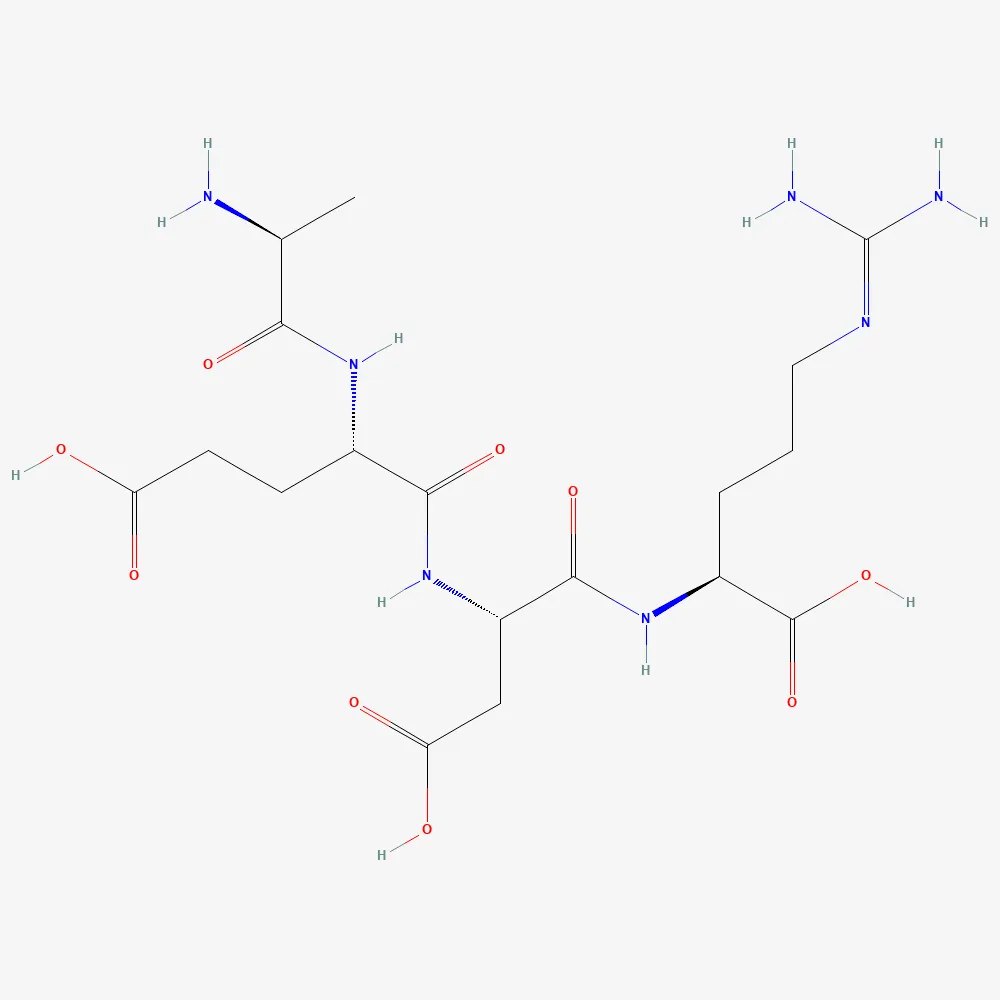
- Molecular formula
- C18H31N7O9
- Molecular weight
- 489.5 g/mol
- Length
- 4 amino acids
- Sequence
- AEDR
- Modifications
- Ala-Glu-Asp-Arg; free N- and C-termini; all L-amino acids.
- PubChem CID
- 11583989
PubChem's name lookup for 'cardiogen' returns L-carnitine, an unrelated molecule; this record was matched by structure (the L-configured tetrapeptide AEDR).
Identity checked against Khavinson et al., Int J Mol Sci 2022 (developers' review of their short peptides).
How Cardiogen works
Researchers propose that Cardiogen acts as a bioregulator with a selective effect on heart muscle tissue, rather than through a conventional receptor on the cell surface. Two rat studies looked at how it acts:
- Heart-tissue cultures. At a very low concentration, Cardiogen stimulated cell growth in heart-tissue cultures from young and old rats and lowered the p53 protein. The authors read that as evidence it blocks programmed cell death (apoptosis) in heart tissue Chalisova 2009 - Chalisova NI, Lesniak VV, Balykina NA et al. [The effect of the amino acids and cardiogen on the development of myocard tissue culture from young and old rats]. Adv Gerontol. 2009;22(3):409-13., in the references below.
- Rats with a transplanted sarcoma. Injected Cardiogen slowed tumour growth, more so at higher doses. The effect seemed to work through the tumour’s blood vessels and more tumour-cell apoptosis, not by poisoning the cells directly Levdik 2009 - Levdik NV, Knyazkin IV. Tumor-modifying effect of cardiogen peptide on M-1 sarcoma in senescent rats. Bull Exp Biol Med. 2009;148(3):433-6., in the references below.
Cardiogen benefits: what the research shows
Studied in cells or animals. No controlled trials in humans. Every Cardiogen study I found and read is an animal or cultured-tissue experiment, all from the same Russian research group and its collaborators. I found no published human trial of any kind for Cardiogen, not even a small or uncontrolled one.
I found no published human trial of Cardiogen for any outcome, whether heart health, longevity or anything else. The evidence is the two rat studies above, plus a broader tissue-culture study. That one tested Cardiogen alongside three related bioregulators (bronchogen, prostamax and pancragen) on heart, lung, prostate and pancreas tissue from young and old rats, and reported a stimulating effect on the matching tissue in each case.
Marketing claims that go beyond “studied in rats” aren’t supported by anything I could verify.
Cardiogen dosage
No published trial or regulator has set a dose. Research-chemical dosing guides describe 0.2-2 mg injected under the skin once a day (most often around 1 mg), from a 20 mg vial, in cycles of about 10-20 days. That is common practice, not a tested dose.
Common protocol
What is commonly used, not a dose established in trials. No regulator has set a dose for Cardiogen. Sources differ, so the ranges below span them.
- Dose per administration
- 200-2000 mcg
- How often
- once daily, subcutaneous, most commonly cited around 1 mg/day
- Route
- Subcutaneous injection
- Cycle length
- 1.4-2.9 weeks
- Break between cycles
- 26-52 weeks
- Common vial size
- 20 mg
Sources differ on the low end of the dose (0.2 mg vs a 1 mg 'typical' figure) but agree closely on route, daily frequency and a 10-20 day cycle. One source states the standard injectable protocol is repeated every 6-12 months; the same source separately describes a shorter 'intensive' variant using a 3-month break instead, so break length is not settled even within one source.
Plan a cycle in the protocol builder or work out injection volume in the dosage calculator.
The common Cardiogen dose is 200-2000 mcg, once daily, subcutaneous, most commonly cited around 1 mg/day. From a 20 mg vial mixed with 2 mL of bacteriostatic water, 1 mg is 10 units (0.1 mL) on a U-100 insulin syringe.
Cardiogen 20 mg vial: units per dose
Full 20 mg vial page: mixing, doses per vial, how long it lasts →
| Water added | Concentration | 1 unit = | 200 mcg | 1 mg | 2 mg |
|---|---|---|---|---|---|
| 1 mL | 20 mg/mL | 200 mcg | 1 unit | 5 units | 10 units |
| 2 mL | 10 mg/mL | 100 mcg | 2 units | 10 units | 20 units |
| 3 mL | 6.67 mg/mL | 66.67 mcg | 3 units | 15 units | 30 units |
All Cardiogen vial sizes: 20 mg
Units are on a standard U-100 insulin syringe (100 units = 1 mL), rounded to the nearest half unit - half-unit marks are on 0.3 mL syringes. Water volumes are examples: more water means more units per dose, not more doses per vial. For any other vial or dose, use the dosage calculator.
How many 20 mg vials a cycle takes
| Scenario | Dose | Doses a week | Weeks | Total | 20 mg vials |
|---|---|---|---|---|---|
| Low end of the common protocol | 200 mcg | 7 | 1.4 | 2 mg | 1 |
| High end of the common protocol | 2 mg | 7 | 2.9 | 40 mg | 2 |
Whole vials, rounded up. Plan a cycle with your own numbers in the protocol builder. Keep mixed vials cold and use them within the window in how long reconstituted peptides last; where to inject: subcutaneous injection sites.
Cardiogen side effects
There is no published human safety study of Cardiogen, so no side-effect rate, common or rare, is known. Neither rat study was designed to measure safety: one measured tissue growth and p53, the other tumour growth and apoptosis in rats with a transplanted cancer.
It is sold through unregulated research-chemical channels, so no regulator checks that a vial matches its label. Because it is injected, see peptide injection-site reactions for what to watch for at the site; that is a general risk of injection, not specific to Cardiogen.
Is Cardiogen legal?
US legal status - Research use only
Sold for laboratory research use only. Not approved by the FDA for human use, and cannot be lawfully marketed as a supplement or a medicine. Products sold this way are not made to pharmaceutical quality standards, and their contents are not verified by anyone.
Cardiogen is not approved by the FDA or any other regulator for any use. It is sold through research-chemical channels, not a regulated pharmaceutical supply chain.
Regulatory changes for this compound and others, as they happen: US peptide regulation tracker.
Related reading
- Bioregulator peptides: the Khavinson family, explained
- Epitalon - the longevity-focused peptide from the same research programme
- Pinealon - a cognition-focused peptide from the same programme
- Are peptides safe?
How Cardiogen compares
Bioregulators. Doses for unapproved compounds are common practice, not trial-established. All bioregulators peptides →
| Compound | Main use | Evidence | Usual dose | US status |
|---|---|---|---|---|
| Cardiogen | Marketed as a heart-tissue bioregulator for cardiovascular aging, from the Khavinson organ-specific peptide programme. | Animal / lab only | 200-2000 mcg, once daily, subcutaneous, most commonly cited around 1 mg/day | Research use only |
| Epitalon | Sold for longevity and anti-aging on the basis of telomere research. | Animal / lab only | 5-10 mg, once nightly, every night, for the length of the cycle | Research use only |
| Pinealon | Sold for cognition, focus and healthy aging. | Limited human data | 1-2 mg, once daily, morning preferred; some protocols run 5 days a week rather than every day | Research use only |
| Cartalax | Marketed for cartilage and joint support, sold as a "cartilage bioregulator" for age-related joint wear. | Animal / lab only | 200 mcg, once daily | Research use only |
| Testagen | Marketed for testosterone and reproductive-system support, sold as a "testes bioregulator." | Animal / lab only | 10-20 mg, once daily by mouth | Research use only |
| Vilon | Marketed as a thymus and immune-system bioregulator, sold for immune support and healthy ageing. | Animal / lab only | 10-20 mg, once daily by mouth | Research use only |
| Vesugen | Marketed as a vascular-tissue bioregulator for cardiovascular and blood-vessel aging; more recent papers from the same research group also study it as a candidate for age-related cognitive decline. | Limited human data | 500-5000 mcg, once daily, subcutaneous, commonly started low and titrated upward over the first 1-3 weeks | Research use only |
| Prostamax | Marketed as a prostate-tissue bioregulator for age-related prostate change, from the Khavinson organ-specific peptide programme. | Animal / lab only | 750-2000 mcg, once daily, subcutaneous, often started lower and increased after 1-4 weeks | Research use only |
Where to buy Cardiogen for research
Each vendor is checked against my vendor checklist.
1.Next Level PharmFeatured
20 mg vial
- No FDA warning letter found
- Names its testing lab
- Batch COAs published
- Takes card payment
2.BioEdge Research Labs
20 mg vial
- No FDA warning letter found
- Names its testing lab
- Batch COAs published
Common questions
What is the usual Cardiogen dose?
No trial or regulator has set a dose. Two research-chemical dosing guides I checked describe an injection under the skin once a day from a 20 mg vial, for 10-20 days, at about 0.2-2 mg per injection (most often around 1 mg). See the dosing section below for the sourcing.
What are the side effects of Cardiogen?
No published human safety study exists, so no side-effect rate is known. See the side effects section on this page for what is known.
References (2 sources)
Bibliographic detail is fetched from PubMed, not written by me - so a citation here cannot drift from the paper it names. Study design comes from PubMed's own tags rather than my judgement.
- 1.Levdik NV, Knyazkin IV. Tumor-modifying effect of cardiogen peptide on M-1 sarcoma in senescent rats. Bull Exp Biol Med. 2009;148(3):433-6.StudyPMID 20396706
- 2.Chalisova NI, Lesniak VV, Balykina NA et al. [The effect of the amino acids and cardiogen on the development of myocard tissue culture from young and old rats]. Adv Gerontol. 2009;22(3):409-13.StudyPMID 20210190