FOXO4-DRI: Benefits, Dosage, Side Effects and Legal Status
FOXO4-DRI senolytic research explained: what the cell and rodent studies show, reported dosing, side effects, and its US legal status.

The short version
FOXO4-DRI is a lab-designed peptide studied as a senolytic: something that selectively kills ageing (senescent) cells. The published record is cell and rodent work. No human study has been published, so there is no established human dose, half-life or safety record. It is sold online as a research chemical, not as a proven anti-ageing product.
- Every finding on FOXO4-DRI comes from cells and rodents, not people.
- PubMed indexes zero clinical trials of FOXO4-DRI as of September 2026.
- No human half-life or dose has ever been established.
- Not FDA-approved and not reviewed by FDA for pharmacy compounding.
FOXO4-DRI at a glance
- What it is
- Synthetic D-retro-inverso peptide (FOXO4-p53 interaction inhibitor)
- Main use
- Sold online as a senolytic research chemical for anti-aging use. Designed in the laboratory to disrupt an interaction between the FOXO4 and p53 proteins inside senescent cells; not studied in humans.
- Also called
- FOXO4-DRI peptide, FOXO4 D-retro-inverso peptide
- Molecular formula
- C228H388N86O64 (5358 g/mol) Structure
- Evidence
- Animal / lab only
- US status
- Research use only
- Half-life
- Not established in humans
- How it is taken
- Subcutaneous injection
- Common protocol
- 0.25-5 mg, reported protocols vary widely - some use daily dosing, others 3 to 5 days a week in short blocks, for 2-16 weeks (common practice, not trial-established) Dosage chart
Dosing: what the mouse study used. No human dose exists.
FOXO4-DRI is one of the more interesting ideas in ageing research. It is a senolytic: a compound designed to clear out ageing (“senescent”) cells rather than treat a specific disease. In cell and rodent studies it pushes senescent cells toward death while leaving healthy cells comparatively unaffected.
Everything published so far comes from cells in a dish and from rodents. No human study has been published, by any route. This page covers what the lab and animal record shows, and what would need to happen before it could be called established in people.
US legal status - Research use only
Not an FDA-approved drug. FOXO4-DRI doesn't appear in FDA's public list of bulk drug substances nominated for compounding, so it hasn't been through the review several other research peptides have. It is sold to consumers as a research chemical.
What is FOXO4-DRI?
FOXO4-DRI is a synthetic D-retro-inverso peptide. That means it is built from mirror-image amino acids, so ordinary enzymes break it down more slowly. It was designed to interfere with one interaction inside cells: between a protein called FOXO4 and the tumour-suppressor protein p53.
The idea behind its anti-ageing use runs in three steps. Senescent cells may drive some effects of ageing; a peptide might clear them selectively; and clearing them might help. Each step is a research question, and the last one, whether clearing them with this peptide helps a person, hasn’t been tested in anyone.
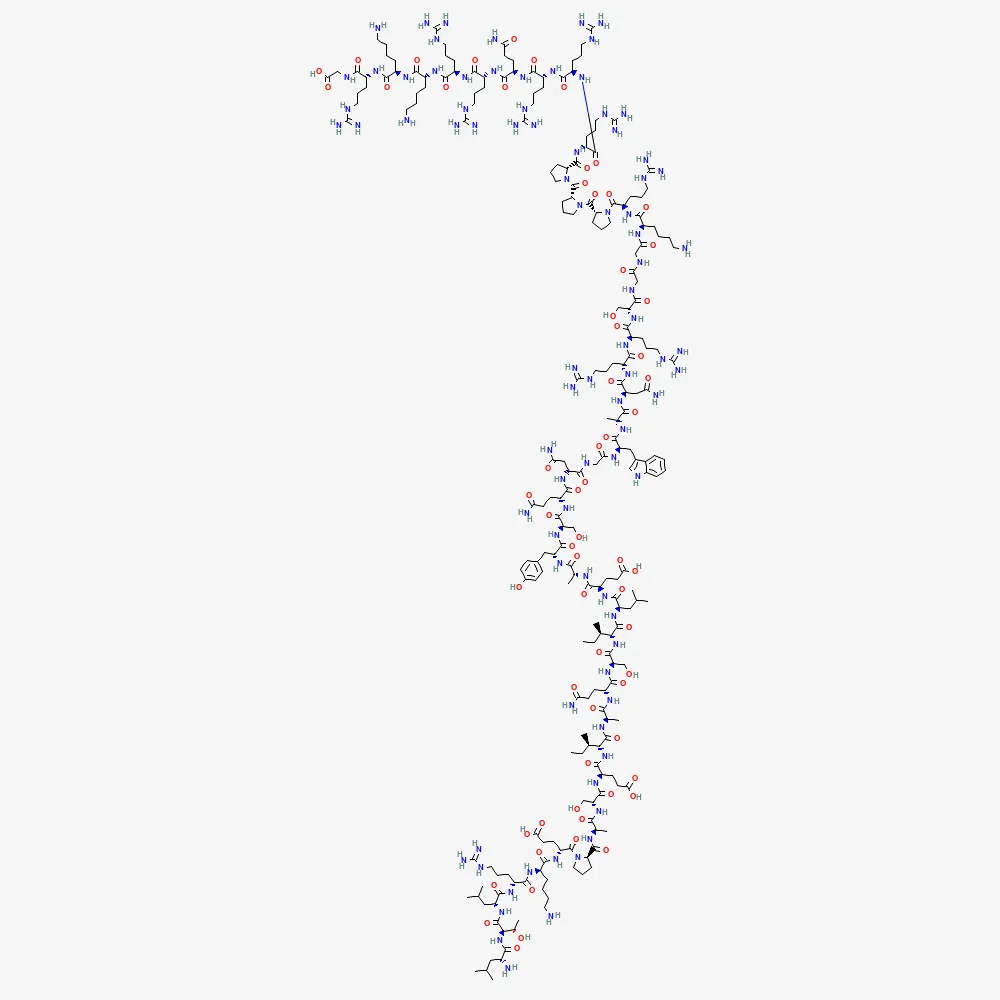
FOXO4-DRI structure
- Molecular formula
- C228H388N86O64
- Molecular weight
- 5358 g/mol
- Length
- 46 amino acids
- Sequence
- LTLRKEPASEIAQSILEAYSQNGWANRRSGGKRPPPRRRQRRKKRG
- Modifications
- Every residue is a D-amino acid (D-retro-inverso design): a reversed FOXO4 segment followed by a reversed HIV-TAT cell-penetrating segment; free N- and C-termini.
- PubChem CID
- 167312269
Matched by structure to the all-D sequence published by the developers. A second PubChem FOXO4-DRI record (CID 168431240) has mixed D/L stereochemistry and was not used. Research vials are usually the TFA salt.
Identity checked against Baar et al., Cell 2017.
How FOXO4-DRI works
Senescent cells have stopped dividing but haven’t died. They are reported to rely on the FOXO4-p53 interaction to stop p53 from triggering their own programmed cell death (apoptosis).
FOXO4-DRI competes with that interaction. Researchers propose this frees p53 to move to the mitochondria and trigger apoptosis in senescent cells. In the cell and rodent models tested, it affected senescent cells more than healthy ones. That selectivity is the whole point: a treatment that killed cells indiscriminately would be no use against ageing.
I couldn’t find a published human study confirming that this selectivity holds in a person, at any dose or by any route. For now it is a lab hypothesis, not a confirmed human pathway.
FOXO4-DRI benefits: what the research shows
Studied in cells or animals. No controlled trials in humans. A PubMed search for FOXO4-DRI, run 24 September 2026, returned 19 records and zero indexed under a clinical-trial or randomised-controlled-trial publication type. I could not identify any published human study of FOXO4-DRI, by any route.
There is a real lab literature here: 19 indexed records, built on cell-culture work and rodent models of ageing and of senescence caused by chemotherapy. None of those records is tagged as a clinical trial.
That is an indexing result, not absolute proof, since tagging can lag behind a real trial. It is still the strongest signal available, and it agrees with everything else I found: no documented study has given FOXO4-DRI to a human.
That puts it alongside several other anti-ageing research peptides: a real animal record, and no human one yet.
Pharmacokinetics
FOXO4-DRI’s half-life in humans is not established, and neither is any other human figure for absorption, distribution or clearance. No human dosing study exists to measure them, so no dose or schedule online rests on a measured human number.
FOXO4-DRI dosage
The common FOXO4-DRI dose is 0.25-5 mg, reported protocols vary widely - some use daily dosing, others 3 to 5 days a week in short blocks. From a 10 mg vial mixed with 2 mL of bacteriostatic water, 2.5 mg is 50 units (0.5 mL) on a U-100 insulin syringe.
No published human trial has given anyone FOXO4-DRI, so nothing here is trial-established. Vendor and community guides vary more than for most compounds on this site:
- roughly 0.25-5 mg injected under the skin
- daily in some protocols, three to five days a week in others
- in blocks of 2 to 16 weeks
- with a long break of roughly 12-26 weeks between blocks
That is common practice, not a dose any trial has tested. The only trial-grade numbers come from the original 2017 mouse study. The FOXO4-DRI dosage page has the full breakdown.
FOXO4-DRI side effects
No human safety data exists, because no human study of FOXO4-DRI has been published, by any route.
Reported in studies
The rodent and cell studies report selective effects on senescent cells without describing serious harm in those models. That is not the same as safe in humans. Rodents don’t predict every human effect, the studies weren’t designed as safety trials, and no one has looked for delayed, rare or dose-related harms in people.
For injection-site reactions, see peptide injection site reactions. With no human data, there is no source-backed guidance on when to stop beyond the general caution above.
Is FOXO4-DRI legal?
FOXO4-DRI is not an FDA-approved drug for any use, and it is not a dietary supplement. It is sold as a research chemical. That is a labelling choice, not a legal category: FDA classifies a product by its intended use, and treats seller marketing as evidence of that intent, whatever the label says.
On 24 September 2026, FOXO4-DRI did not appear in the Category 2 table or the withdrawn-nominations table on FDA’s page of bulk drug substances that may present significant safety risks. BPC-157, KPV, TB-500 and several other research peptides sit in that withdrawn-nominations table.
That page is narrower than the full 503A Bulks List nomination process. So its absence doesn’t show that FOXO4-DRI has never been nominated, evaluated or placed elsewhere in that process, only that it isn’t in this table. There is no FDA compounding decision to report, positive or negative.
Related guides
Regulatory changes for this compound and others, as they happen: US peptide regulation tracker.
How FOXO4-DRI compares
Longevity and mitochondria. Doses for unapproved compounds are common practice, not trial-established. All longevity and mitochondria peptides →
| Compound | Main use | Evidence | Usual dose | US status |
|---|---|---|---|---|
| MOTS-c | Sold for metabolic health, fat loss and longevity. Studied in humans as a biomarker of exercise response. | Animal / lab only | 2.5-10 mg, 2 to 3 times a week is most common, with some protocols ramping toward daily dosing at higher amounts | Research use only |
| SS-31 | FDA-approved (accelerated approval, 2025) as Forzinity to improve muscle strength in Barth syndrome, a rare genetic mitochondrial disease. Sold online as a longevity and cellular-energy peptide. | Moderate human evidence | FDA label | FDA-approved · prescription only |
| Humanin | Sold online for anti-aging and neuroprotection claims. Studied almost entirely in cell cultures and rodents; no completed human efficacy trial was located for this page. | Animal / lab only | 0.5-5 mg, commonly once daily; some protocols use 2 to 3 times a week instead | Research use only |
| NAD+ (injection) | Sold by IV-therapy clinics and compounding pharmacies, by subcutaneous injection or IV infusion, for marketed energy, anti-aging, cognition and addiction-recovery claims. | Limited human data | 50-500 mg, 1-3 times a week by subcutaneous injection; many protocols start low, once weekly, and increase only if tolerated | Unapproved drug |
| SLU-PP-332 | A laboratory research chemical studied in mice as an "exercise mimetic" - it triggers some of the same muscle and metabolic gene programs endurance exercise does. Sold to consumers as a research chemical for that same effect, with no human study behind that use. | Animal / lab only | No consistent protocol | Unapproved drug |
| AICAR | Studied as an AMPK-activating "exercise mimetic" that boosted running endurance in sedentary mice; separately studied in humans, under the name acadesine, as an intravenous cardioprotective drug during heart bypass surgery - a use large trials found did not work. Now sold to consumers as an unapproved research-chemical endurance and metabolic product. | Limited human data | No consistent protocol | Unapproved drug |
| L-Carnitine (injection) | FDA-approved, as CARNITOR, for treating carnitine deficiency (a defined metabolic/biochemical condition): the injection also for the prevention and treatment of carnitine deficiency in dialysis patients, and the tablets and oral solution (including sugar-free CARNITOR SF) for primary and inherited-metabolic-disorder carnitine deficiency. This page covers the injection. Sold off-label, and through compounding and aesthetic-medicine clinics, as a "fat-burning" or metabolism-support injection for people without diagnosed deficiency. | Strong human evidence | FDA label | FDA-approved · prescription only |
| FOXO4-DRI | Sold online as a senolytic research chemical for anti-aging use. Designed in the laboratory to disrupt an interaction between the FOXO4 and p53 proteins inside senescent cells; not studied in humans. | Animal / lab only | 0.25-5 mg, reported protocols vary widely - some use daily dosing, others 3 to 5 days a week in short blocks | Research use only |
Where to buy FOXO4-DRI for research
Each vendor is checked against my vendor checklist.
1.BioEdge Research Labs
10 mg vial
- No FDA warning letter found
- Names its testing lab
- Batch COAs published
Common questions
Has FOXO4-DRI been tested in humans?
Not in any published study I could find. A PubMed search on 24 September 2026 returned 19 FOXO4-DRI records, none tagged as a clinical trial or randomised controlled trial. The published record is cell and rodent work.
Is FOXO4-DRI legal in the United States?
It is not an FDA-approved drug or a dietary supplement; it is sold as a research chemical. On 24 September 2026 it was not in the Category 2 or withdrawn-nominations tables on FDA's compounding safety-risks page, where BPC-157, KPV and TB-500 appear. That page doesn't cover every nomination category, so it can't show whether FOXO4-DRI was nominated elsewhere in the 503A process.
What is the half-life of FOXO4-DRI in humans?
Not established. No human pharmacokinetic study has been published, so there is no absorption, distribution or clearance figure to report, and no dosing interval can be built on one.
Is FOXO4-DRI safe?
Not established either way. With no published human study, there is no human safety data of any kind. The senolytic mechanism seen in cells and rodents has not been shown to be safe or selective in people.
What does FOXO4-DRI peptide do?
It is designed to block the FOXO4-p53 interaction inside senescent cells. In cell and rodent studies, that pushes senescent cells toward programmed cell death (apoptosis) while leaving healthy cells comparatively unaffected. No published human study has tested whether it does the same in a person.
What is the best vitamin to slow down aging?
No vitamin has been shown to slow ageing in humans. The National Institute on Aging (part of NIH) says large doses of antioxidant vitamins haven't been shown to prevent chronic disease, and supplements don't need FDA approval for safety or effectiveness before sale. FOXO4-DRI isn't a vitamin or supplement; it is an unapproved research peptide with no published human study.
What is the most powerful senolytic?
No senolytic has been ranked for potency in a head-to-head human study, so no compound, FOXO4-DRI included, can be called the most powerful. An NIH-funded trial record from 2020 describes six human senolytic trials then under way, using dasatinib with quercetin or fisetin. FOXO4-DRI has reached no human trial: PubMed indexes zero clinical trials of it.
What is the best supplement to get rid of senescent cells?
No supplement has been proven to clear senescent cells in humans. Quercetin and fisetin, sold as supplements, are being combined with the prescription drug dasatinib in early NIH-funded human trials. Supplements don't need FDA approval for safety or effectiveness, so no product sold that way has an established clearance claim. FOXO4-DRI isn't a supplement either, and has no published human data.
What is the usual FOXO4-DRI dose?
No human trial has tested a dose. Vendor and community guides vary widely: roughly 0.25-5 mg injected under the skin, daily or three to five days a week, in blocks of 2 to 16 weeks. That is common practice, not a tested or approved dose. The [FOXO4-DRI dosage page](/foxo4-dri-dosage/) has the source-by-source breakdown and the one mouse study that exists.
What are the side effects of FOXO4-DRI?
Not established. No human study exists by any route, so there is no human record of adverse effects. Cell and rodent studies report selective effects on senescent cells without describing serious harm in those models, but that is not evidence of safety in people.
References (4 sources)
Bibliographic detail is fetched from PubMed, not written by me - so a citation here cannot drift from the paper it names. Study design comes from PubMed's own tags rather than my judgement.
- 1.NCBI E-utilities esearch: FOXO4-DRI, restricted to the clinical-trial publication type, zero records (queried 24 September 2026).- National Center for Biotechnology Information, US National Library of Medicinedatabase
- 2.FDA - Certain Bulk Drug Substances for Use in Compounding That May Present Significant Safety Risks. FOXO4-DRI does not appear in the Category 2 or withdrawn-nominations tables (content current as of 22 April 2026, checked 24 September 2026).- US Food and Drug Administrationregulatory
- 3.National Institute on Aging - Dietary Supplements for Older Adults. States dietary supplements do not require FDA approval for safety or effectiveness before sale, and that large-dose antioxidant supplements have not been shown to prevent chronic disease (content reviewed 23 April 2021, checked 24 September 2026).- National Institute on Aging, National Institutes of Healthother
- 4.NIH RePORTER grant record 1U01CA246510-01 (Sen-Survivors pilot trial). States six human efficacy trials of senolytics, including dasatinib plus quercetin or fisetin, were under way as of the 2020 award (checked 24 September 2026).- National Institutes of Health, NIH RePORTERdatabase