Livagen: Benefits, Dosage and Side Effects
Livagen (KEDA): the Khavinson liver tetrapeptide, its rat liver-disease-model data, and why no dosing pages in circulation agree.

The short version
Livagen is a synthetic four-amino-acid peptide from the Russian Khavinson bioregulator programme, marketed for liver support and healthy aging. There is real evidence in rats with chemically induced liver disease and in donated human cells tested in the lab. No human trial has been published, and online dosing pages disagree with each other by nearly 60-fold.
- In rats with liver fibrosis or hepatitis, Livagen protected the liver.
- No human trial has been published, at any dose, for any use.
- Online dosing pages disagree so widely that I state no common protocol.
Livagen at a glance
- What it is
- Synthetic tetrapeptide (Lys-Glu-Asp-Ala)
- Main use
- Marketed for liver support and healthy aging within the Khavinson peptide-bioregulator line.
- Also called
- KEDA peptide, Lys-Glu-Asp-Ala
- Molecular formula
- C18H31N5O9 (461.5 g/mol) Structure
- Evidence
- Animal / lab only
- US status
- Research use only
- Half-life
- Not established in humans
Dosing: why I state no common protocol.
What is Livagen?
Livagen is a synthetic peptide of four amino acids: lysine, glutamic acid, aspartic acid and alanine (Lys-Glu-Asp-Ala). The literature calls it the KEDA peptide. It comes from the same Russian Khavinson bioregulator programme as Epitalon and Pinealon.
It belongs to the programme’s tissue-specific cytogen line, built to match the amino-acid profile reported for liver peptide extracts. It is marketed for liver support and healthy aging.
Livagen structure
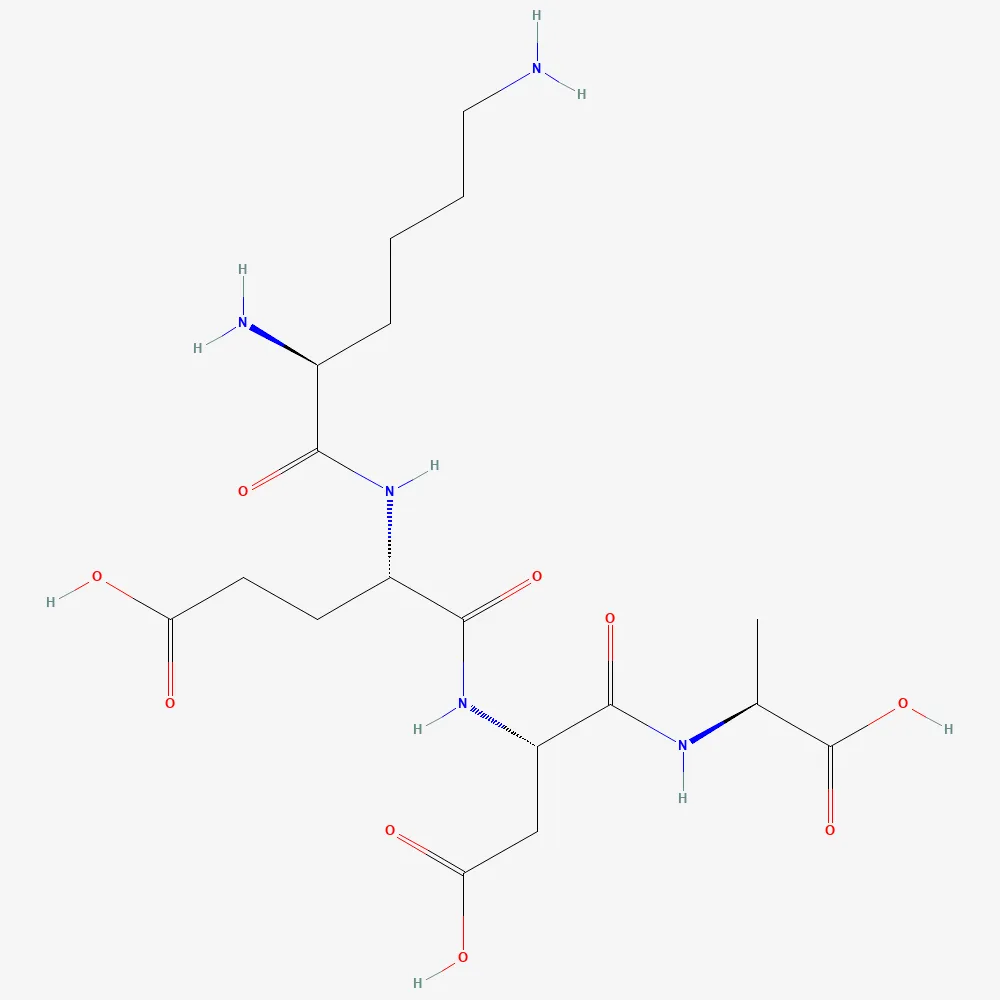
- Molecular formula
- C18H31N5O9
- Molecular weight
- 461.5 g/mol
- Length
- 4 amino acids
- Sequence
- KEDA
- PubChem CID
- 87919683
Identity checked against Georgian Medical News (Lezhava et al. 2023), via PubMed.
Livagen benefits: what the research shows
The published work is small but real:
- Rat liver disease. A review of animal models reports that Livagen, alongside a related liver peptide extract, protected the liver, supported immune function and acted as an antioxidant. The rats had chemically induced liver fibrosis or acute or chronic hepatitis, and the effect was largest in old animals Kuznik 2020 - Kuznik BI, Khasanova NB, Ryzhak GA et al. [The influence of polypeptide liver complex and tetrapeptide KEDA on organism physiological function in norm and age-related pathology.]. Adv Gerontol. 2020;33(1):159-164., in the references below.
- Aging human cells. In white blood cells (lymphocytes) donated by people aged 75-88, Livagen loosened DNA that becomes more tightly packed with age (heterochromatin) Lezhava 2006 - Lezhava T, Monaselidze J, Kadotani T et al. Anti-aging peptide bioregulators induce reactivation of chromatin. Georgian Med News. 2006., in the references below.
- Other lab work. Livagen increased protein production in rat liver cells grown in a dish. In donated human serum, it blocked an enzyme that breaks down enkephalins more efficiently than several standard enzyme blockers.
Livagen dosage
No published study, animal or human, states a dose meant for people. I also checked 4 clinic and vendor dosing pages. Unlike Bronchogen, where independent pages roughly agree, these don’t:
- Injected doses range from 150 mcg to 5-10 mg, about a 60-fold spread.
- They use three routes: under the skin, into the muscle, and by mouth or under the tongue.
- Courses run from 10 days to 12 weeks.
That is not a shared common practice. It looks like each page set its own numbers.
Common protocol
No consistent protocol in circulation. No two real sources converge on a usable protocol. Four dosing pages were fetched and read, and their injectable figures span nearly two orders of magnitude with no overlap: one states 150mcg SC once daily for a 20-day course; a second states 5-10mg intramuscularly once daily over 8-12 weeks (or a 10-day, 50-100mg-total course); a third gives a titration from 0.5mg up to 2.0mg SC daily/twice-daily over 8+ weeks; a fourth adds an oral protocol of 10-20mg daily plus a separate sublingual figure of 5-10mg twice daily. Route, magnitude and duration all disagree between sources, so there is no convergent common practice this page can responsibly state.
Livagen side effects
There are no human safety data. With no published trial, there is no adverse-reaction rate, no FDA label and no controlled tolerability study.
Reported in studies
The published record has no adverse-event data. It consists of animal disease models and donated human cells and serum, not a safety outcome in a dosed person Kuznik 2020 - Kuznik BI, Khasanova NB, Ryzhak GA et al. [The influence of polypeptide liver complex and tetrapeptide KEDA on organism physiological function in norm and age-related pathology.]. Adv Gerontol. 2020;33(1):159-164., in the references below.
Reported by users
Sellers’ pages most often mention injection-site irritation. That isn’t an independent survey or case report, so I note it without treating it as evidence.
Product quality is a separate risk. As a research chemical, no regulator checks that a vial matches its label or how pure it is. For injection-site problems, see injection-site reactions for what is ordinary and what needs attention.
Is Livagen legal?
US legal status - Research use only
Sold for laboratory research use only. Not approved by the FDA for human use, and cannot be lawfully marketed as a supplement or a medicine. Products sold this way are not made to pharmaceutical quality standards, and their contents are not verified by anyone.
Livagen is not approved for human use anywhere. It is sold as a research chemical, and no regulator checks that a vial matches its label.
Regulatory changes for this compound and others, as they happen: US peptide regulation tracker.
Related
How Livagen compares
Bioregulators. Doses for unapproved compounds are common practice, not trial-established. All bioregulators peptides →
| Compound | Main use | Evidence | Usual dose | US status |
|---|---|---|---|---|
| Livagen | Marketed for liver support and healthy aging within the Khavinson peptide-bioregulator line. | Animal / lab only | No consistent protocol | Research use only |
| Epitalon | Sold for longevity and anti-aging on the basis of telomere research. | Animal / lab only | 5-10 mg, once nightly, every night, for the length of the cycle | Research use only |
| Pinealon | Sold for cognition, focus and healthy aging. | Limited human data | 1-2 mg, once daily, morning preferred; some protocols run 5 days a week rather than every day | Research use only |
| Cartalax | Marketed for cartilage and joint support, sold as a "cartilage bioregulator" for age-related joint wear. | Animal / lab only | 200 mcg, once daily | Research use only |
| Testagen | Marketed for testosterone and reproductive-system support, sold as a "testes bioregulator." | Animal / lab only | 10-20 mg, once daily by mouth | Research use only |
| Vilon | Marketed as a thymus and immune-system bioregulator, sold for immune support and healthy ageing. | Animal / lab only | 10-20 mg, once daily by mouth | Research use only |
| Vesugen | Marketed as a vascular-tissue bioregulator for cardiovascular and blood-vessel aging; more recent papers from the same research group also study it as a candidate for age-related cognitive decline. | Limited human data | 500-5000 mcg, once daily, subcutaneous, commonly started low and titrated upward over the first 1-3 weeks | Research use only |
| Cardiogen | Marketed as a heart-tissue bioregulator for cardiovascular aging, from the Khavinson organ-specific peptide programme. | Animal / lab only | 200-2000 mcg, once daily, subcutaneous, most commonly cited around 1 mg/day | Research use only |
Where to buy Livagen for research
Each vendor is checked against my vendor checklist.
1.BioEdge Research Labs
20 mg vial
- No FDA warning letter found
- Names its testing lab
- Batch COAs published
Common questions
Is there any human evidence for Livagen?
Only lab work on donated human material. In white blood cells from people aged 75-88, Livagen changed how tightly DNA was packed, and in donated serum it blocked enzymes that break down enkephalins. That is real published work, but no living person has been dosed in a trial.
What is the usual Livagen dose?
No trial has set one. Online dosing pages disagree by about 60-fold and use different routes. The dosage section explains why I state no common protocol.
What are the side effects of Livagen?
There are no human safety data, because no human trial has been published. There is no adverse-reaction rate, no FDA label and no controlled tolerability study.
References (2 sources)
Bibliographic detail is fetched from PubMed, not written by me - so a citation here cannot drift from the paper it names. Study design comes from PubMed's own tags rather than my judgement.
- 1.Kuznik BI, Khasanova NB, Ryzhak GA et al. [The influence of polypeptide liver complex and tetrapeptide KEDA on organism physiological function in norm and age-related pathology.]. Adv Gerontol. 2020;33(1):159-164.StudyPMID 32362099
- 2.Lezhava T, Monaselidze J, Kadotani T et al. Anti-aging peptide bioregulators induce reactivation of chromatin. Georgian Med News. 2006.StudyPMID 16705247