Bronchogen: Benefits, Dosage and Side Effects
Bronchogen (AEDL): the Khavinson bronchial-tissue peptide, its rat COPD-model data, the dosage people commonly use, and why no human trial exists.

The short version
Bronchogen is a synthetic 4-amino-acid peptide from the Russian Khavinson bioregulator programme, marketed for lung and airway support. Its best evidence is a rat model of chronic obstructive pulmonary disease (COPD), where it reduced airway inflammation and restored the airway lining. No human trial of any kind has been published.
- Real rat data exists: Bronchogen reduced airway inflammation and restored the airway lining in a COPD model.
- No human trial has been published, at any dose, for any use.
- Not approved for human use anywhere; sold as a research chemical.
Bronchogen at a glance
- What it is
- Synthetic tetrapeptide (Ala-Glu-Asp-Leu)
- Main use
- Sold for bronchial and lung support, marketed within the Khavinson peptide-bioregulator line for respiratory and healthy-aging use.
- Also called
- AEDL peptide, Bronchogen tetrapeptide
- Molecular formula
- C18H30N4O9 (446.5 g/mol) Structure
- Evidence
- Animal / lab only
- US status
- Research use only
- Half-life
- Not established in humans
- How it is taken
- Subcutaneous injection
- Common protocol
- 1-2 mg, once daily, consistent time of day, for 1.4-4.3 weeks (common practice, not trial-established)
Dosing: the common protocol is below, with its sourcing.
What is Bronchogen?
Bronchogen is a synthetic peptide of 4 amino acids: alanine, glutamic acid, aspartic acid and leucine (Ala-Glu-Asp-Leu). It comes from the same Russian Khavinson bioregulator programme as Epitalon and Pinealon. It belongs to the programme’s tissue-specific “cytogen” line, made to match the amino-acid profile reported for natural peptide extracts from airway tissue. It is marketed for lung and airway support, alongside Chonluten, the programme’s other lung product.
The developers don’t print the sequence consistently:
- Two of their papers give Ala-Glu-Asp-Leu Fedoreyeva 2011 - Fedoreyeva LI, Kireev II, Khavinson VKh et al. Penetration of short fluorescence-labeled peptides into the nucleus in HeLa cells and in vitro specific interaction of the peptides with deoxyribooligonucleotides and DNA. Biochemistry (Mosc). 2011;76(11):1210-9., in the references below Khavinson 2012 - Khavinson VKh, Linkova NS, Polyakova VO et al. Peptides tissue-specifically stimulate cell differentiation during their aging. Bull Exp Biol Med. 2012;153(1):148-51., in the references below.
- A 2011 DNA-melting study names it Ala-Asp-Glu-Leu in its title Monaselidze 2011 - Monaselidze JR, Khavinson VKh, Gorgoshidze MZ et al. Effect of the peptide bronchogen (Ala-Asp-Glu-Leu) on DNA thermostability. Bull Exp Biol Med. 2011;150(3):375-7., in the references below.
- A 2014 paper on airway lining cells in Lung studies the Ala-Asp-Glu-Leu form Khavinson 2014 - Khavinson VKh, Tendler SM, Vanyushin BF et al. Peptide regulation of gene expression and protein synthesis in bronchial epithelium. Lung. 2014;192(5):781-91., in the references below.
This page uses Ala-Glu-Asp-Leu, but the published record doesn’t settle which order is correct.
Bronchogen structure
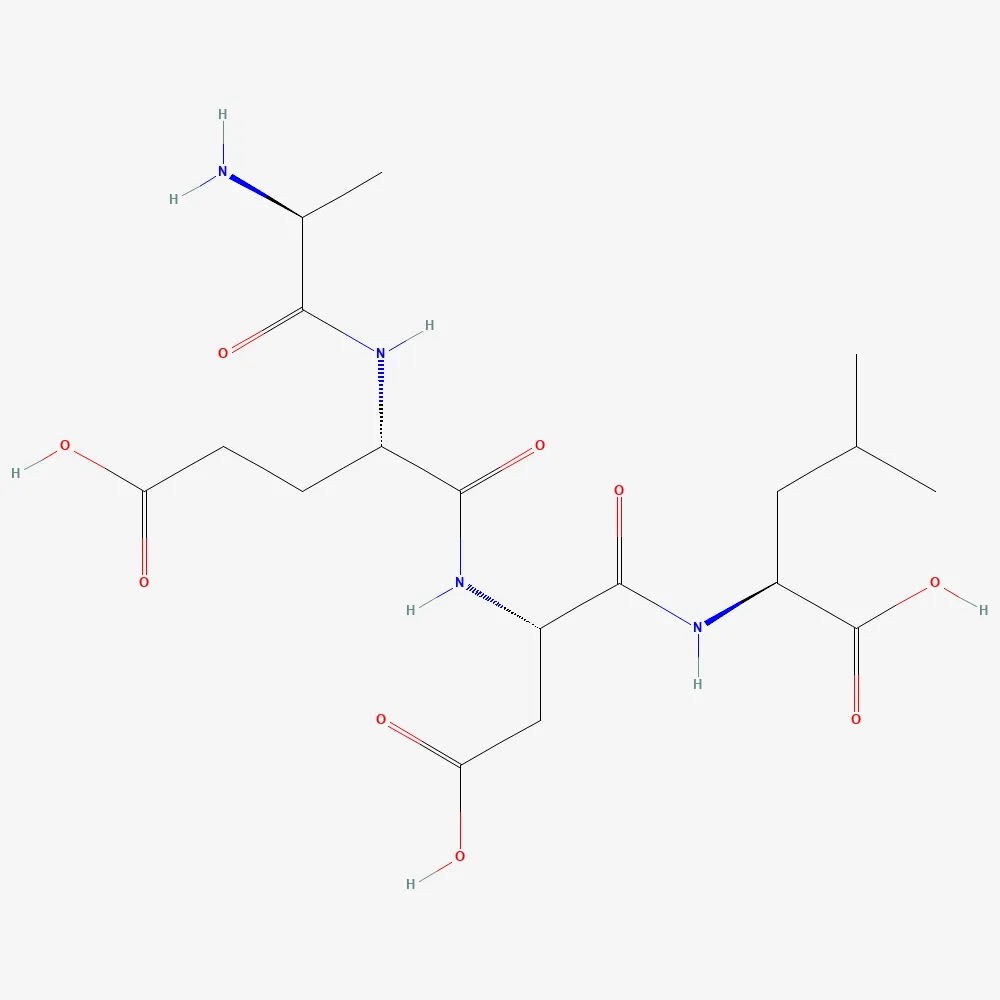
- Molecular formula
- C18H30N4O9
- Molecular weight
- 446.5 g/mol
- Length
- 4 amino acids
- Sequence
- AEDL
- Modifications
- Ala-Glu-Asp-Leu; free N- and C-termini; all L-amino acids.
- PubChem CID
- 11690869
The developers mostly print the sequence as Ala-Glu-Asp-Leu (shown here, and the PubChem record named Bronchogen), but at least one of their papers uses the order Ala-Asp-Glu-Leu, so the published order is not fully consistent.
Identity checked against Khavinson et al., Bull Exp Biol Med 2012.
Bronchogen benefits: what the research shows
The strongest result comes from rats. Rats were given chronic obstructive pulmonary disease (COPD) by 60 days of nitrogen dioxide exposure. A month of Bronchogen then reduced airway inflammation driven by neutrophils (a type of white blood cell) and restored the airway lining: its ciliated cells, secretory IgA and surfactant protein B Kuzubova 2015 - Kuzubova NA, Lebedeva ES, Dvorakovskaya IV et al. Modulating Effect of Peptide Therapy on the Morphofunctional State of Bronchial Epithelium in Rats with Obstructive Lung Pathology. Bull Exp Biol Med. 2015;159(5):685-8., in the references below.
Separately, lab work reports that Bronchogen switches on a marker of cell maturation more strongly in aged human airway cells grown in a dish than in young ones Khavinson 2012 - Khavinson VKh, Linkova NS, Polyakova VO et al. Peptides tissue-specifically stimulate cell differentiation during their aging. Bull Exp Biol Med. 2012;153(1):148-51., in the references below.
Bronchogen dosage
No human trial has set a dose. Clinic and vendor guides commonly describe 1-2 mg injected under the skin once a day, for a 10-30 day cycle with a break of several months. That is common practice, not a dose any trial or regulator has set.
Common protocol
What is commonly used, not a dose established in trials. No regulator has set a dose for Bronchogen. Sources differ, so the ranges below span them.
- Dose per administration
- 1-2 mg
- How often
- once daily, consistent time of day
- Route
- Subcutaneous injection
- Cycle length
- 1.4-4.3 weeks
- Break between cycles
- 13-26 weeks
- Common vial size
- 10 mg
- Timing
- Subcutaneous injection into the abdomen or thigh, same time each day.
- Commonly paired with
- Chonluten
Sources disagree on the exact per-injection amount (1.5mg standard vs a 1-2mg range vs a 1.0mg standard/2.0mg advanced split) and on cycle length (a fixed ~2-week course vs 10-20 days vs 10-30 days), so both are kept as ranges. Two of three sources state a break of several months; one gives 4-6 months explicitly.
Plan a cycle in the protocol builder or work out injection volume in the dosage calculator.
The common Bronchogen dose is 1-2 mg, once daily, consistent time of day. From a 10 mg vial mixed with 2 mL of bacteriostatic water, 1.5 mg is 30 units (0.3 mL) on a U-100 insulin syringe.
Bronchogen 10 mg vial: units per dose
Full 10 mg vial page: mixing, doses per vial, how long it lasts →
| Water added | Concentration | 1 unit = | 1 mg | 1.5 mg | 2 mg |
|---|---|---|---|---|---|
| 1 mL | 10 mg/mL | 100 mcg | 10 units | 15 units | 20 units |
| 2 mL | 5 mg/mL | 50 mcg | 20 units | 30 units | 40 units |
| 3 mL | 3.33 mg/mL | 33.33 mcg | 30 units | 45 units | 60 units |
Bronchogen 20 mg vial: units per dose
Full 20 mg vial page: mixing, doses per vial, how long it lasts →
| Water added | Concentration | 1 unit = | 1 mg | 1.5 mg | 2 mg |
|---|---|---|---|---|---|
| 1 mL | 20 mg/mL | 200 mcg | 5 units | 7.5 units | 10 units |
| 2 mL | 10 mg/mL | 100 mcg | 10 units | 15 units | 20 units |
| 3 mL | 6.67 mg/mL | 66.67 mcg | 15 units | 22.5 units | 30 units |
All Bronchogen vial sizes: 10 mg · 20 mg
Units are on a standard U-100 insulin syringe (100 units = 1 mL), rounded to the nearest half unit - half-unit marks are on 0.3 mL syringes. Water volumes are examples: more water means more units per dose, not more doses per vial. For any other vial or dose, use the dosage calculator.
How many 10 mg vials a cycle takes
| Scenario | Dose | Doses a week | Weeks | Total | 10 mg vials |
|---|---|---|---|---|---|
| Low end of the common protocol | 1 mg | 7 | 1.4 | 10 mg | 1 |
| High end of the common protocol | 2 mg | 7 | 4.3 | 60 mg | 6 |
Whole vials, rounded up. Plan a cycle with your own numbers in the protocol builder. Keep mixed vials cold and use them within the window in how long reconstituted peptides last; where to inject: subcutaneous injection sites.
Bronchogen side effects
There is no human safety data for Bronchogen. No clinical trial has been published, so there is no side-effect rate, FDA label or controlled tolerability study.
Reported in studies
The rat COPD study reported improvements in inflammation and tissue structure, not safety or tolerability Kuzubova 2015 - Kuzubova NA, Lebedeva ES, Dvorakovskaya IV et al. Modulating Effect of Peptide Therapy on the Morphofunctional State of Bronchial Epithelium in Rats with Obstructive Lung Pathology. Bull Exp Biol Med. 2015;159(5):685-8., in the references below.
Reported by users
Injection-site irritation is the effect most often described, but that comes from sellers’ own pages rather than an independent survey or case report, so I don’t treat it as evidence. Separately, no regulator checks that a research-chemical vial matches its label for purity or contents.
For the injection itself, see injection-site reactions for what is ordinary and what needs attention.
Is Bronchogen legal?
US legal status - Research use only
Sold for laboratory research use only. Not approved by the FDA for human use, and cannot be lawfully marketed as a supplement or a medicine. Products sold this way are not made to pharmaceutical quality standards, and their contents are not verified by anyone.
It is not approved for human use anywhere. It is sold as a research chemical, and no regulator checks that a vial matches its label.
Regulatory changes for this compound and others, as they happen: US peptide regulation tracker.
Related
How Bronchogen compares
Bioregulators. Doses for unapproved compounds are common practice, not trial-established. All bioregulators peptides →
| Compound | Main use | Evidence | Usual dose | US status |
|---|---|---|---|---|
| Bronchogen | Sold for bronchial and lung support, marketed within the Khavinson peptide-bioregulator line for respiratory and healthy-aging use. | Animal / lab only | 1-2 mg, once daily, consistent time of day | Research use only |
| Epitalon | Sold for longevity and anti-aging on the basis of telomere research. | Animal / lab only | 5-10 mg, once nightly, every night, for the length of the cycle | Research use only |
| Pinealon | Sold for cognition, focus and healthy aging. | Limited human data | 1-2 mg, once daily, morning preferred; some protocols run 5 days a week rather than every day | Research use only |
| Cartalax | Marketed for cartilage and joint support, sold as a "cartilage bioregulator" for age-related joint wear. | Animal / lab only | 200 mcg, once daily | Research use only |
| Testagen | Marketed for testosterone and reproductive-system support, sold as a "testes bioregulator." | Animal / lab only | 10-20 mg, once daily by mouth | Research use only |
| Vilon | Marketed as a thymus and immune-system bioregulator, sold for immune support and healthy ageing. | Animal / lab only | 10-20 mg, once daily by mouth | Research use only |
| Vesugen | Marketed as a vascular-tissue bioregulator for cardiovascular and blood-vessel aging; more recent papers from the same research group also study it as a candidate for age-related cognitive decline. | Limited human data | 500-5000 mcg, once daily, subcutaneous, commonly started low and titrated upward over the first 1-3 weeks | Research use only |
| Cardiogen | Marketed as a heart-tissue bioregulator for cardiovascular aging, from the Khavinson organ-specific peptide programme. | Animal / lab only | 200-2000 mcg, once daily, subcutaneous, most commonly cited around 1 mg/day | Research use only |
Where to buy Bronchogen for research
Each vendor is checked against my vendor checklist.
1.BioEdge Research Labs
20 mg vial
- No FDA warning letter found
- Names its testing lab
- Batch COAs published
Common questions
What is the usual Bronchogen dose?
No human trial has set one. Clinic and vendor guides commonly describe 1-2 mg injected under the skin once a day, for 10-30 days with a break of several months. That is common practice, not a tested dose; see the dosage section below.
What are the side effects of Bronchogen?
There is no human safety data, because no human trial has been published. There is no side-effect rate, no FDA label and no controlled tolerability study.
References (5 sources)
Bibliographic detail is fetched from PubMed, not written by me - so a citation here cannot drift from the paper it names. Study design comes from PubMed's own tags rather than my judgement.
- 1.Kuzubova NA, Lebedeva ES, Dvorakovskaya IV et al. Modulating Effect of Peptide Therapy on the Morphofunctional State of Bronchial Epithelium in Rats with Obstructive Lung Pathology. Bull Exp Biol Med. 2015;159(5):685-8.StudyPMID 26468022
- 2.Khavinson VKh, Linkova NS, Polyakova VO et al. Peptides tissue-specifically stimulate cell differentiation during their aging. Bull Exp Biol Med. 2012;153(1):148-51.StudyPMID 22808515
- 3.Fedoreyeva LI, Kireev II, Khavinson VKh et al. Penetration of short fluorescence-labeled peptides into the nucleus in HeLa cells and in vitro specific interaction of the peptides with deoxyribooligonucleotides and DNA. Biochemistry (Mosc). 2011;76(11):1210-9.StudyPMID 22117547
- 4.Monaselidze JR, Khavinson VKh, Gorgoshidze MZ et al. Effect of the peptide bronchogen (Ala-Asp-Glu-Leu) on DNA thermostability. Bull Exp Biol Med. 2011;150(3):375-7.StudyPMID 21240358
- 5.Khavinson VKh, Tendler SM, Vanyushin BF et al. Peptide regulation of gene expression and protein synthesis in bronchial epithelium. Lung. 2014;192(5):781-91.StudyPMID 25015171