Pancragen: Dosage, Evidence and Legal Status
Pancragen is a Khavinson pancreas tetrapeptide with real animal and small human diabetic-comparison data, but no randomised trial.

The short version
Pancragen is a four-amino-acid peptide from the Russian Khavinson bioregulator programme, marketed for pancreatic and metabolic support. Unusually for this family, it has human data: a small, non-randomised comparison in older people reports it lowered glucose and insulin resistance in those with type 2 diabetes. Rat and monkey studies report similar effects. None of it is a randomised controlled trial.
- A small, non-randomised human comparison reports Pancragen lowered glucose and insulin resistance in older people with type 2 diabetes.
- That is real human evidence, unusual for this family, but it is not a randomised, placebo-controlled trial.
- Separate rat and monkey studies report similar effects on blood glucose.
- Not approved for human use anywhere; sold as a research chemical or supplement.
Pancragen at a glance
- What it is
- Synthetic tetrapeptide (Lys-Glu-Asp-Trp-NH2)
- Main use
- Marketed for pancreatic and metabolic support and healthy aging, within the Khavinson peptide-bioregulator line.
- Also called
- Lys-Glu-Asp-Trp-NH2, KEDW peptide
- Molecular formula
- C26H37N7O8 (575.6 g/mol) Structure
- Evidence
- Limited human data
- US status
- Research use only
- Half-life
- Not established in humans
- How it is taken
- By mouth
- Common protocol
- 10-20 mg, 1-2 capsules (10 mg each), once or twice daily before meals, for 1.4-4.3 weeks (common practice, not trial-established)
Pancragen is sold as a Khavinson-line pancreas bioregulator, from the same Russian research tradition as Epitalon and Pinealon Khavinson 2002 - Khavinson VKh. Peptides and Ageing. Neuro Endocrinol Lett. 2002;23 Suppl 3:11-144., in the references below. Unusually for this family, it has human comparison data, though not a randomised trial.
What is Pancragen?
Pancragen is a synthetic four-amino-acid peptide (tetrapeptide), Lys-Glu-Asp-Trp-NH2, marketed for pancreatic function, blood-glucose support and healthy ageing. It is sold on the same premise as its sibling bioregulators: that a short peptide helps regulate gene activity in the organ it targets, here the pancreas.
Pancragen structure
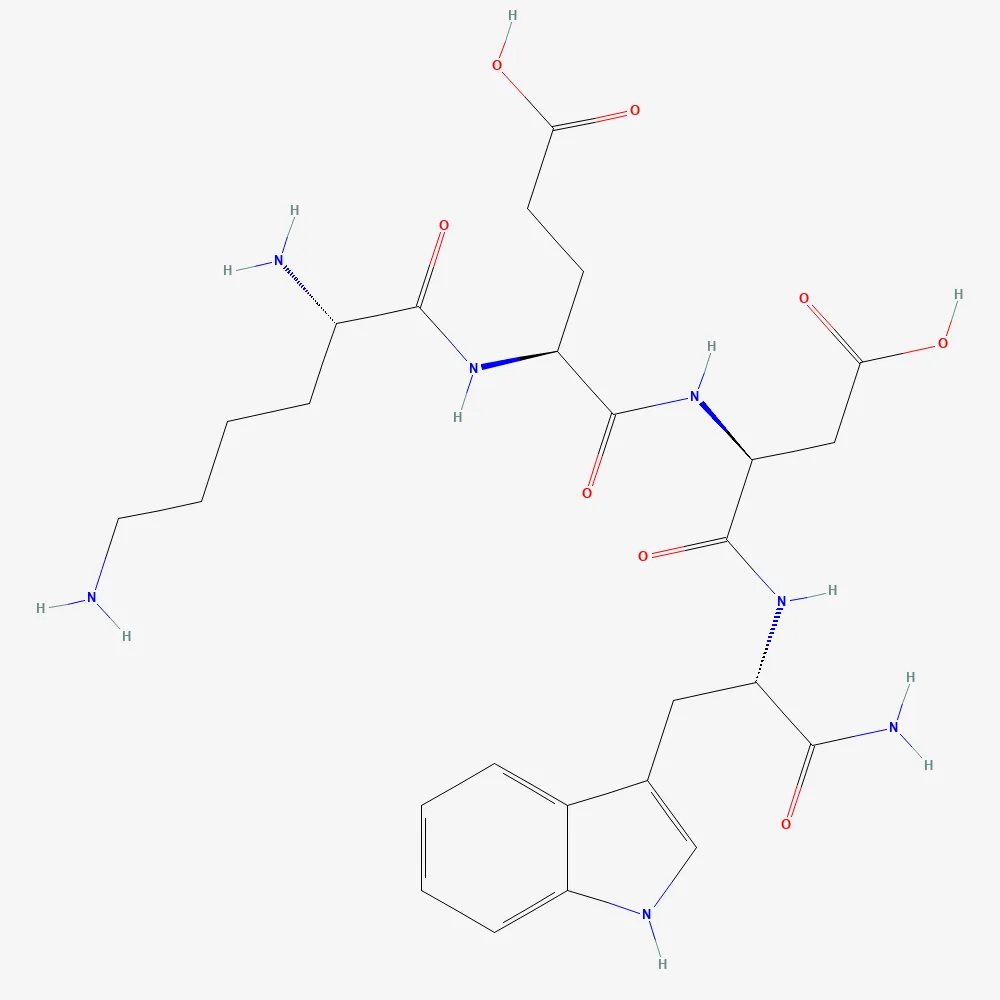
- Molecular formula
- C26H37N7O8
- Molecular weight
- 575.6 g/mol
- Length
- 4 amino acids
- Sequence
- KEDW
- Modifications
- Lys-Glu-Asp-Trp with a C-terminal amide; all L-amino acids.
- PubChem CID
- 68451868
Some papers print the sequence as Lys-Glu-Asp-Trp without noting the C-terminal amide; the developers' 2022 review lists the amide form shown here.
Identity checked against Khavinson et al., Int J Mol Sci 2022 (developers' review of their short peptides).
Pancragen benefits: what the research shows
The most substantial finding is a small, non-randomised human comparison of 30 healthy older adults and 33 with type 2 diabetes. In those given Pancragen, fasting glucose, insulin and an insulin-resistance index fell significantly. People not given it showed no change in these measures Korkushko 2011 - Korkushko OV, Khavinson VKh, Shatilo VB et al. Prospects of using pancragen for correction of metabolic disorders in elderly people. Bull Exp Biol Med. 2011;151(4):454-6., in the references below.
That puts Pancragen ahead of most Khavinson-line peptides on this site. But the study was not randomised or placebo-controlled, so it doesn’t carry the weight of a controlled trial.
Animal and lab studies point the same way:
- Monkeys. In old female rhesus monkeys, Pancragen lowered basal blood glucose and normalised insulin and C-peptide levels, improving their impaired glucose tolerance Goncharova 2015 - Goncharova ND, Ivanova LG, Oganyan TE et al. [Correction of impaired glucose tolerance using tetrapeptide (Pancragen) in old female rhesus monkeys]. Adv Gerontol. 2015;28(3):579-585., in the references below.
- Rats. In rats with chemically induced diabetes, Pancragen by mouth lowered blood sugar. Injected into muscle, it normalised the adhesion of the capillary lining in the mesentery (the tissue that holds the gut) without changing how leaky the capillaries were Khavinson 2007 - Khavinson VKh, Gavrisheva NA, Malinin VV et al. Effect of pancragen on blood glucose level, capillary permeability and adhesion in rats with experimental diabetes mellitus. Bull Exp Biol Med. 2007;144(4):559-62., in the references below.
- Cells. In cell culture, it is reported to switch on maturity (differentiation) markers in ageing pancreatic acinar and islet cells. That is a proposed mechanism for the effects seen in animals and people Khavinson 2013 - Khavinson VKh, Durnova AO, Polyakova VO et al. Effects of pancragen on the differentiation of pancreatic cells during their ageing. Bull Exp Biol Med. 2013;154(4):501-4., in the references below.
Pancragen dosage
No randomised trial has set a human dose for the oral form sold to consumers. Clinic and vendor pages most often describe 10-20 mg by mouth (1-2 capsules of 10 mg), once or twice a day before meals, for a 10-30 day course with a 3-6 month break before repeating. That is common practice, not a number any trial or regulator has set.
The human comparison study was run in a clinical research setting, and its abstract doesn’t state the dose or route. It isn’t interchangeable with the oral consumer protocol below.
Common protocol
What is commonly used, not a dose established in trials. No regulator has set a dose for Pancragen. Sources differ, so the ranges below span them.
- Dose
- 10-20 mg
- How often
- 1-2 capsules (10 mg each), once or twice daily before meals
- Route
- By mouth
- Cycle length
- 1.4-4.3 weeks
- Break between cycles
- 13-26 weeks
- Timing
- By mouth, before meals.
Two other figures circulate that this protocol does not fold in, because they contradict each other as much as they contradict the oral protocol above: one page describes 500 mcg intramuscularly multiple times a day over an 8-12 week course, another a 1-2 mg subcutaneous research-vial dose over a roughly 10-day course. Neither matches the other on route, dose scale or duration, so only the two oral sources that do converge are used here.
Other figures circulate too: an injection-into-muscle protocol of several hundred micrograms several times a day, and a research-vial protocol injected under the skin in the low milligrams. They disagree with each other on route, dose and duration as much as with the oral figures, so this page doesn’t merge them into one number.
Pancragen side effects
There is no controlled human safety study. The one human comparison measured glucose and insulin, not side effects, in a small, short, unblinded setting.
Reported by users
User reports about Pancragen are anecdotal, not clinical findings. It is sold as a research chemical or unregulated supplement, so no regulator checks that a product matches its label. That is a separate risk on top of the missing safety data.
Anyone with diabetes considering it should treat any glucose-lowering effect as a reason for closer medical monitoring, not less.
Is Pancragen legal?
US legal status - Research use only
Sold for laboratory research use only. Not approved by the FDA for human use, and cannot be lawfully marketed as a supplement or a medicine. Products sold this way are not made to pharmaceutical quality standards, and their contents are not verified by anyone.
Pancragen is not approved for human use anywhere. It is sold as a research chemical or unregulated supplement, and no regulator checks its contents.
Regulatory changes for this compound and others, as they happen: US peptide regulation tracker.
Related
How Pancragen compares
Bioregulators. Doses for unapproved compounds are common practice, not trial-established. All bioregulators peptides →
| Compound | Main use | Evidence | Usual dose | US status |
|---|---|---|---|---|
| Pancragen | Marketed for pancreatic and metabolic support and healthy aging, within the Khavinson peptide-bioregulator line. | Limited human data | 10-20 mg, 1-2 capsules (10 mg each), once or twice daily before meals | Research use only |
| Epitalon | Sold for longevity and anti-aging on the basis of telomere research. | Animal / lab only | 5-10 mg, once nightly, every night, for the length of the cycle | Research use only |
| Pinealon | Sold for cognition, focus and healthy aging. | Limited human data | 1-2 mg, once daily, morning preferred; some protocols run 5 days a week rather than every day | Research use only |
| Cartalax | Marketed for cartilage and joint support, sold as a "cartilage bioregulator" for age-related joint wear. | Animal / lab only | 200 mcg, once daily | Research use only |
| Testagen | Marketed for testosterone and reproductive-system support, sold as a "testes bioregulator." | Animal / lab only | 10-20 mg, once daily by mouth | Research use only |
| Vilon | Marketed as a thymus and immune-system bioregulator, sold for immune support and healthy ageing. | Animal / lab only | 10-20 mg, once daily by mouth | Research use only |
| Vesugen | Marketed as a vascular-tissue bioregulator for cardiovascular and blood-vessel aging; more recent papers from the same research group also study it as a candidate for age-related cognitive decline. | Limited human data | 500-5000 mcg, once daily, subcutaneous, commonly started low and titrated upward over the first 1-3 weeks | Research use only |
| Cardiogen | Marketed as a heart-tissue bioregulator for cardiovascular aging, from the Khavinson organ-specific peptide programme. | Animal / lab only | 200-2000 mcg, once daily, subcutaneous, most commonly cited around 1 mg/day | Research use only |
Where to buy Pancragen for research
Each vendor is checked against my vendor checklist.
1.BioEdge Research Labs
20 mg vial
- No FDA warning letter found
- Names its testing lab
- Batch COAs published
Common questions
Is there any human evidence for Pancragen?
Yes, more than for most compounds in this family. A published comparison of 30 healthy older adults and 33 with type 2 diabetes reports that Pancragen significantly lowered fasting glucose, insulin and an insulin-resistance index in the diabetic group, while people not given it showed no change. It was not randomised or placebo-controlled, so it is a real but limited signal.
What do the animal studies show?
In old female rhesus monkeys, Pancragen lowered basal blood glucose and normalised insulin and C-peptide, improving their impaired glucose tolerance. In rats with chemically induced diabetes, oral Pancragen lowered blood sugar, and injections into muscle normalised adhesion in capillary walls. Cell-culture work reports it switches on maturity markers in ageing pancreatic cells.
What is the usual Pancragen dose?
No randomised trial has set a human dose. Clinic and vendor pages most often describe 10-20 mg by mouth (1-2 capsules of 10 mg), once or twice a day before meals, for a 10-30 day course with a 3-6 month break. That is common practice, not a tested dose. The human comparison study's abstract doesn't state its dose or route, so it isn't interchangeable with this protocol; see the dosing section below.
What are the side effects of Pancragen?
No controlled human safety study exists. The one human comparison measured glucose and insulin, not side effects. Anything beyond that is an anecdotal user report.
References (5 sources)
Bibliographic detail is fetched from PubMed, not written by me - so a citation here cannot drift from the paper it names. Study design comes from PubMed's own tags rather than my judgement.
- 1.Korkushko OV, Khavinson VKh, Shatilo VB et al. Prospects of using pancragen for correction of metabolic disorders in elderly people. Bull Exp Biol Med. 2011;151(4):454-6.StudyPMID 22448364
- 2.Khavinson VKh, Durnova AO, Polyakova VO et al. Effects of pancragen on the differentiation of pancreatic cells during their ageing. Bull Exp Biol Med. 2013;154(4):501-4.StudyPMID 23486591
- 3.Khavinson VKh, Gavrisheva NA, Malinin VV et al. Effect of pancragen on blood glucose level, capillary permeability and adhesion in rats with experimental diabetes mellitus. Bull Exp Biol Med. 2007;144(4):559-62.StudyPMID 18642713
- 4.Goncharova ND, Ivanova LG, Oganyan TE et al. [Correction of impaired glucose tolerance using tetrapeptide (Pancragen) in old female rhesus monkeys]. Adv Gerontol. 2015;28(3):579-585.StudyPMID 28509500
- 5.Khavinson VKh. Peptides and Ageing. Neuro Endocrinol Lett. 2002;23 Suppl 3:11-144.ReviewPMID 12374906