Crystagen: Dosage, Evidence and Legal Status
Crystagen is a Khavinson immune-system tripeptide with exactly one published laboratory study behind it, and no human trial of any kind.

The short version
Crystagen is a short peptide from the Russian Khavinson bioregulator programme, marketed for immune support and healthy aging. PubMed lists exactly one paper that studies it by name: a Russian-language lab report on the ageing spleen whose abstract names no species. There is no clinical or randomised trial of any kind.
- Exactly one published paper studies Crystagen by name: a lab study whose abstract names no species and doesn't say whether it used live animals or tissue culture.
- No clinical trial and no randomised trial of any kind exists.
- That paper reports it activates B-cells in the ageing spleen but, unlike Timogen, does not renew spleen tissue.
- Not approved for human use anywhere; sold as a research chemical.
Crystagen at a glance
- What it is
- Short synthetic peptide sold as a Khavinson-line immune-system bioregulator
- Main use
- Marketed for immune-system support and healthy aging, within the Khavinson peptide-bioregulator line.
- Also called
- Immune bioregulator tripeptide
- Molecular formula
- C14H21N3O8 (359.33 g/mol) Structure
- Evidence
- Animal / lab only
- US status
- Research use only
- Half-life
- Not established in humans
- How it is taken
- Subcutaneous injection
- Common protocol
- 200-400 mcg, once daily during an initial course; some protocols move to every-other-day dosing for a longer maintenance phase, for 1.4-12 weeks (common practice, not trial-established)
Crystagen is sold as an immune-system peptide bioregulator from the Khavinson line, the same Russian research tradition as Epitalon and Pinealon Khavinson 2002 - Khavinson VKh. Peptides and Ageing. Neuro Endocrinol Lett. 2002;23 Suppl 3:11-144., in the references below. Exactly one published study tests it by name, and it is a lab report, not a clinical trial.
What is Crystagen?
Crystagen is marketed for immune support and healthy aging, along with the general anti-aging claims made for the whole Khavinson line. Like its siblings, it is sold on the idea that a short peptide from a particular tissue helps regulate gene activity in that organ system. For Crystagen that is the immune system, specifically lymphoid tissue such as the spleen.
Crystagen structure
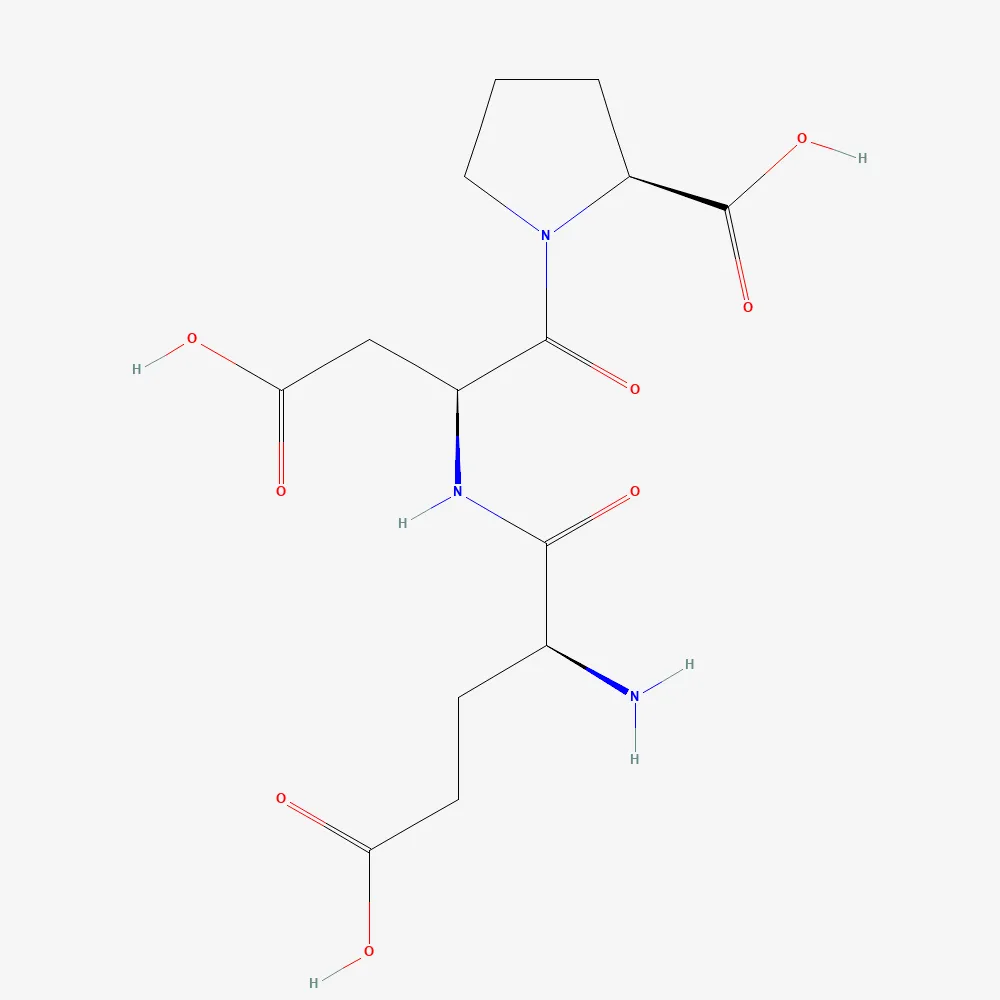
- Molecular formula
- C14H21N3O8
- Molecular weight
- 359.33 g/mol
- Length
- 3 amino acids
- Sequence
- EDP
- Modifications
- Glu-Asp-Pro; free N- and C-termini; all L-amino acids.
- PubChem CID
- 23624313
PubChem also holds a D-proline stereoisomer of this tripeptide (CID 145455337); that record is not this molecule.
Identity checked against Khavinson et al., Int J Mol Sci 2022 (developers' review of their short peptides).
Crystagen benefits: what the research shows
The one paper I could find and verify tested four short peptides side by side in the ageing spleen Сhervyakova 2014 - Сhervyakova NA, Linkova NS, Chalisova NI et al. [Molecular aspects of immunoprotective activity of peptides in spleen during the ageing process]. Adv Gerontol. 2014;27(1):224-228., in the references below. Its abstract names no species and doesn’t say whether the work was in live animals or tissue culture. It reports:
- Vilon activated T-helper cells, linked to less cell death.
- R-1 activated T-helper cells, linked to more cell renewal.
- Timogen activated B-cells by reducing cell death and increasing cell growth.
- Crystagen also activated B-cells, but unlike Timogen it did not renew spleen cells as the tissue aged.
That is the whole verifiable evidence for Crystagen: one comparison, in one lab model, in one paper that isn’t tagged as a clinical or randomised trial.
Crystagen dosage
No clinical trial has set a dose. Clinic and vendor pages commonly describe 200-400 mcg injected under the skin once a day for an initial course. Some protocols then move to every-other-day dosing for a longer maintenance phase, with a 4-6 month break before repeating. That is common practice, not a dose any trial or regulator has set.
Common protocol
What is commonly used, not a dose established in trials. No regulator has set a dose for Crystagen. Sources differ, so the ranges below span them.
- Dose per administration
- 200-400 mcg
- How often
- once daily during an initial course; some protocols move to every-other-day dosing for a longer maintenance phase
- Route
- Subcutaneous injection
- Cycle length
- 1.4-12 weeks
- Break between cycles
- 17-26 weeks
- Common vial size
- 20 mg
- Timing
- Subcutaneous injection, same time each day.
Sources agree on dose (200-400 mcg SC) and daily-to-every-other-day frequency, but describe cycle length very differently - a focused 10-day intensive course versus an 8-12 week course overall - so the range spans both readings rather than picking one.
Plan a cycle in the protocol builder or work out injection volume in the dosage calculator.
The common Crystagen dose is 200-400 mcg, once daily during an initial course; some protocols move to every-other-day dosing for a longer maintenance phase. From a 20 mg vial mixed with 2 mL of bacteriostatic water, 300 mcg is 3 units (0.03 mL) on a U-100 insulin syringe.
Crystagen 20 mg vial: units per dose
Full 20 mg vial page: mixing, doses per vial, how long it lasts →
| Water added | Concentration | 1 unit = | 200 mcg | 300 mcg | 400 mcg |
|---|---|---|---|---|---|
| 1 mL | 20 mg/mL | 200 mcg | 1 unit | 1.5 units | 2 units |
| 2 mL | 10 mg/mL | 100 mcg | 2 units | 3 units | 4 units |
| 3 mL | 6.67 mg/mL | 66.67 mcg | 3 units | 4.5 units | 6 units |
All Crystagen vial sizes: 20 mg
Units are on a standard U-100 insulin syringe (100 units = 1 mL), rounded to the nearest half unit - half-unit marks are on 0.3 mL syringes. Water volumes are examples: more water means more units per dose, not more doses per vial. For any other vial or dose, use the dosage calculator.
How many 20 mg vials a cycle takes
| Scenario | Dose | Doses a week | Weeks | Total | 20 mg vials |
|---|---|---|---|---|---|
| Low end of the common protocol | 200 mcg | 4 | 1.4 | 1.2 mg | 1 |
| High end of the common protocol | 400 mcg | 7 | 12 | 33.6 mg | 2 |
Whole vials, rounded up. Plan a cycle with your own numbers in the protocol builder. Keep mixed vials cold and use them within the window in how long reconstituted peptides last; where to inject: subcutaneous injection sites.
Crystagen side effects
There is no human safety data for Crystagen. The one published study measured immune-cell activity in spleen tissue, not safety in people.
Reported by users
Effects reported by people using Crystagen and similar Khavinson peptides are anecdotal, and there is no controlled tolerability study to check them against. Separately, no regulator checks that a research-chemical vial matches its label for purity or contents.
For the injection itself, see injection-site reactions for what is ordinary and what needs attention.
Is Crystagen legal?
US legal status - Research use only
Sold for laboratory research use only. Not approved by the FDA for human use, and cannot be lawfully marketed as a supplement or a medicine. Products sold this way are not made to pharmaceutical quality standards, and their contents are not verified by anyone.
It is not approved for human use anywhere. It is sold as a research chemical, and no regulator checks that a vial matches its label.
Regulatory changes for this compound and others, as they happen: US peptide regulation tracker.
Related
How Crystagen compares
Bioregulators. Doses for unapproved compounds are common practice, not trial-established. All bioregulators peptides →
| Compound | Main use | Evidence | Usual dose | US status |
|---|---|---|---|---|
| Crystagen | Marketed for immune-system support and healthy aging, within the Khavinson peptide-bioregulator line. | Animal / lab only | 200-400 mcg, once daily during an initial course; some protocols move to every-other-day dosing for a longer maintenance phase | Research use only |
| Epitalon | Sold for longevity and anti-aging on the basis of telomere research. | Animal / lab only | 5-10 mg, once nightly, every night, for the length of the cycle | Research use only |
| Pinealon | Sold for cognition, focus and healthy aging. | Limited human data | 1-2 mg, once daily, morning preferred; some protocols run 5 days a week rather than every day | Research use only |
| Cartalax | Marketed for cartilage and joint support, sold as a "cartilage bioregulator" for age-related joint wear. | Animal / lab only | 200 mcg, once daily | Research use only |
| Testagen | Marketed for testosterone and reproductive-system support, sold as a "testes bioregulator." | Animal / lab only | 10-20 mg, once daily by mouth | Research use only |
| Vilon | Marketed as a thymus and immune-system bioregulator, sold for immune support and healthy ageing. | Animal / lab only | 10-20 mg, once daily by mouth | Research use only |
| Vesugen | Marketed as a vascular-tissue bioregulator for cardiovascular and blood-vessel aging; more recent papers from the same research group also study it as a candidate for age-related cognitive decline. | Limited human data | 500-5000 mcg, once daily, subcutaneous, commonly started low and titrated upward over the first 1-3 weeks | Research use only |
| Cardiogen | Marketed as a heart-tissue bioregulator for cardiovascular aging, from the Khavinson organ-specific peptide programme. | Animal / lab only | 200-2000 mcg, once daily, subcutaneous, most commonly cited around 1 mg/day | Research use only |
Where to buy Crystagen for research
Each vendor is checked against my vendor checklist.
1.Next Level PharmFeatured
20 mg vial
- No FDA warning letter found
- Names its testing lab
- Batch COAs published
- Takes card payment
2.BioEdge Research Labs
20 mg vial
- No FDA warning letter found
- Names its testing lab
- Batch COAs published
Common questions
Is there any human evidence for Crystagen?
No. PubMed lists exactly one paper that studies Crystagen by name, a Russian-language lab study of the ageing spleen. It is not a clinical trial or a study in people.
What does the one existing study actually show?
It tested four short Khavinson peptides (Vilon, Timogen, Crystagen and one labelled R-1) side by side in the ageing spleen; the abstract names no species and doesn't say whether it used live animals or tissue culture. Vilon and R-1 activated T-helper cells. Timogen and Crystagen both activated B-cells, but only Timogen renewed spleen cells as the tissue aged. That is one narrow lab finding, not evidence of general immune support.
What is the usual Crystagen dose?
No clinical trial has set one. Clinic and vendor pages commonly describe 200-400 mcg injected under the skin once a day, for a 10-day to 12-week course with a 4-6 month break. That is common practice, not a tested dose; see the dosing section below.
What are the side effects of Crystagen?
There is no human safety data of any kind. The one published study looked at spleen cells, not safety in people. Effects reported by users are anecdotal.
References (2 sources)
Bibliographic detail is fetched from PubMed, not written by me - so a citation here cannot drift from the paper it names. Study design comes from PubMed's own tags rather than my judgement.
- 1.Сhervyakova NA, Linkova NS, Chalisova NI et al. [Molecular aspects of immunoprotective activity of peptides in spleen during the ageing process]. Adv Gerontol. 2014;27(1):224-228.StudyPMID 28976144
- 2.Khavinson VKh. Peptides and Ageing. Neuro Endocrinol Lett. 2002;23 Suppl 3:11-144.ReviewPMID 12374906